APAO 2014, Теория, Група β — Задача 2. LSVT and babr
X Asian-Pacific Astronomy Olympiad — Theoretical round · Group β · 24 ноември 2014 г.
Бележка
Maybe not all problems have correct questions. Some questions (maybe the main question of the problem, maybe one of the subquestions) may make no real sense. In this case you have to write in your answer (in English or Russian): «impossible situation – ситуация невозможна». Of course, this answer has to be explained numerically or logically.
Data from the tables (Planetary data, stars, constants, etc.) may be used for solving every problem.
The answers «Да-Yes» or «Нет-No» have to be written in English or Russian.
Parameters of orbits and physical characteristics
Parameters of orbits and physical characteristics of planets, Sun and Moon.
| Body | Average distance to central body (astr. units) | Average distance (million km) | Sidereal (or analogous) period (tropical years) | Period (days) | Eccentricity |
|---|---|---|---|---|---|
| Sun | |||||
| Mercury | 0.387 | 57.9 | 0.241 | 87.969 | 0.206 |
| Venus | 0.723 | 108.2 | 0.615 | 224.701 | 0.007 |
| Earth | 1.000 | 149.6 | 1.000 | 365.256 | 0.017 |
| Moon | 0.00257 | 0.38440 | 0.0748 | 27.3217 | 0.055 |
| Mars | 1.524 | 227.9 | 1.880 | 686.980 | 0.093 |
| Jupiter | 5.204 | 778.6 | 11.862 | 4332.59 | 0.048 |
| Saturn | 9.584 | 1433.7 | 29.458 | 10759.20 | 0.054 |
| Uranus | 19.191 | 2871.0 | 84.015 | 30685.93 | 0.046 |
| Neptune | 30.071 | 4498.6 | 164.778 | 60187.64 | 0.008 |
| Body | Equatorial diameter (km) | Mass ( kg) | Average density (g/cm³) | Gravity at surface (m/s²) | Maximum magnitude from Earth** | Albedo |
|---|---|---|---|---|---|---|
| Sun | 1392000 | 1989000 | 1.409 | −26.8 | ||
| Mercury | 4879 | 0.3302 | 5.43 | 3.70 | −2.2 | 0.06 |
| Venus | 12104 | 4.8690 | 5.24 | 8.87 | −4.7 | 0.78 |
| Earth | 12756 | 5.9742 | 5.515 | 9.81 | 0.36 | |
| Moon | 3475 | 0.0735 | 3.34 | 1.62 | −12.7 | 0.07 |
| Mars | 6794 | 0.6419 | 3.94 | 3.71 | −2.0 | 0.15 |
| Jupiter | 142984 | 1899.8 | 1.33 | 24.86 | −2.7 | 0.66 |
| Saturn | 120536 | 568.50 | 0.70 | 10.41 | 0.7 | 0.68 |
| Uranus | 51118 | 86.625 | 1.30 | 8.44 | 5.5 | 0.74 |
| Neptune | 49532 | 102.78 | 1.76 | 11.20 | 7.8 | 0.58 |
**) For outer planets and Moon — in mean opposition.
| Coordinates | Irkutsk | Listvyanka |
|---|---|---|
| Longitude (E) | ||
| Latitude (N) | ||
| Distance to the center of the Earth | km | km |
| Timezone | UT+8 | UT+8 |
Some constants and formulae
| Constant or formula | Value |
|---|---|
| Speed of light in vacuum, (m/s) | 299792458 |
| Constant of gravitation, (N·m²/kg²) | |
| Solar constant, (W/m²) | 1367 |
| Hubble parameter, (km/s/Mpc), mean value | 68 |
| Hubble parameter, diapason of values | 50–100 |
| Planck constant, (J·s) | |
| Charge of electron, (C) | |
| Mass of electron, (kg) | |
| Proton-to-electron ratio | 1836.15 |
| Faraday constant, (C/mol) | 96485 |
| Magnetic constant, (H/m) | |
| Universal gas constant, (J/mol/K) | 8.314 |
| Boltzmann constant, (J/K) | |
| Stefan-Boltzmann constant, (W/m²/K⁴) | |
| Wien's displacement constant, (m·K) | 0.002897 |
| Laboratory wavelength of Hα (Å) | 6562.81 |
| Tropical year length, (days) | 365.242199 |
| Standard atmosphere (Pa) | 101325 |
| Visible light extinction by the terrestrial atmosphere in zenith (minimum) | 19%, 0.23 mag |
| Height of homogeneous atmosphere (m) | 7991 |
| Refractive index of water for 20°C, | 1.334 |
| Moment of inertia of a solid ball | |
| Volume of a ball | |
| Area of a sphere | |
| 3.14159265 | |
| e | 2.71828183 |
| Golden ratio, | 1.61803399 |
Условие
The Large Solar Vacuum Telescope (LSVT) of the Institute of Solar-Terrestrial Physics, located in Listvyanka, has the main mirror 760 mm in diameter and focal length 40 m. One of the main activities of the scientists observing with the LSVT is the research of active features in solar atmosphere. Scientists regularly observe sunspots.
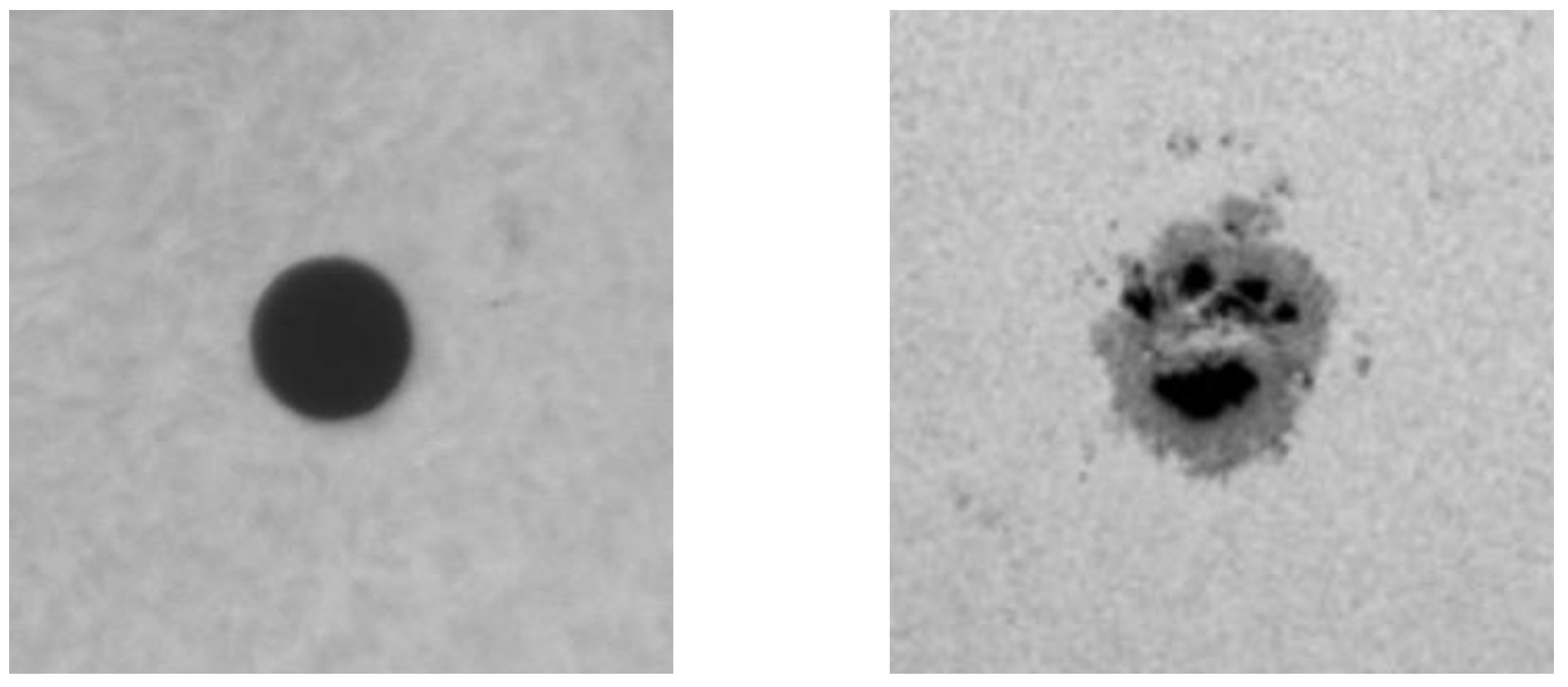
2.1 Draw in real scale a picture of image of the sunspot “footstep of babr” (see picture and condition of the previous problem) obtained in the focal plane of the LSVT.
2.2 When observing the Sun during sunset scientists have seen a running animal on the hill on the opposite side of the Angara river (approximately 5 km away). Scientists have suggested it is a babr, cat’s like animal (felidae) about the size of a tiger. Estimate how far you need to move the screen on which the Sun was recorded to clearly see on it the silhouette image of the animal.
2.3 Draw in actual scale in your notebook something (a point, spot, silhouette, image or something else) that will be visible on the screen.
2.4 Will the resolving power of LSVT be enough to understand what kind of animal is observed? («да-yes» or «нет-no»).
Решение
Внимание: Непълно решение
В архива няма официално решение на тази задача.
Оригинал в Архива: betatheo.pdf · допълнителни данни: data1.pdf · допълнителни данни: data2.pdf