APhO 2000, Теория — Задача 2. Detection of Alpha Particles
1st ASIAN PHYSICS OLYMPIAD — THEORETICAL COMPETITION · 25 април 2000 г.
READ THIS FIRST
- Use only the pen provided.
- Use only the marked side of the paper
- Each problem should be answered on separate sheets
- In your answers please user primarily symbols, equations, numbers, graphs, tables and as little text as possible.
- Write at the top of every sheet in your report:
- Your candidate number (APhO identification number).
- The problem number and section identification, e.g.2/a.
- Number each sheet consecutively.
- Write on the front page the total number of sheets in your report
Условие
We are constantly being exposed to radiation, either natural or artificial. With the advance of nuclear power reactors and utilization of radioisotopes in agriculture, industry, biology and medicine, the number of man made prepared (artificial) radioactive sources is also increasing every year. One type of the radiation emitted by radioactive materials is alpha () particles (doubly ionized helium atom having two units of positive charge and four units of nuclear mass).
The detection of particles by electrical means is based on their ability to produce ionization when passing through gas and other substance. For particle in air at normal (atmospheric) pressure, there is an empirical relation between the mean range and its energy E
Where is measured in cm and E in MeV.
For monitoring radiation, one can use an ionization chamber, which is a gas-filled detector that operates on the principle of separation of positive and negative charges created during the ionization of gas atoms by the particle. The collection of charges yields a pulse that can be detected, amplified and then recorded. The voltage difference between anode and cathode is kept sufficiently high so that there is a negligible amount of recombination of charges during their passage to the anodes.
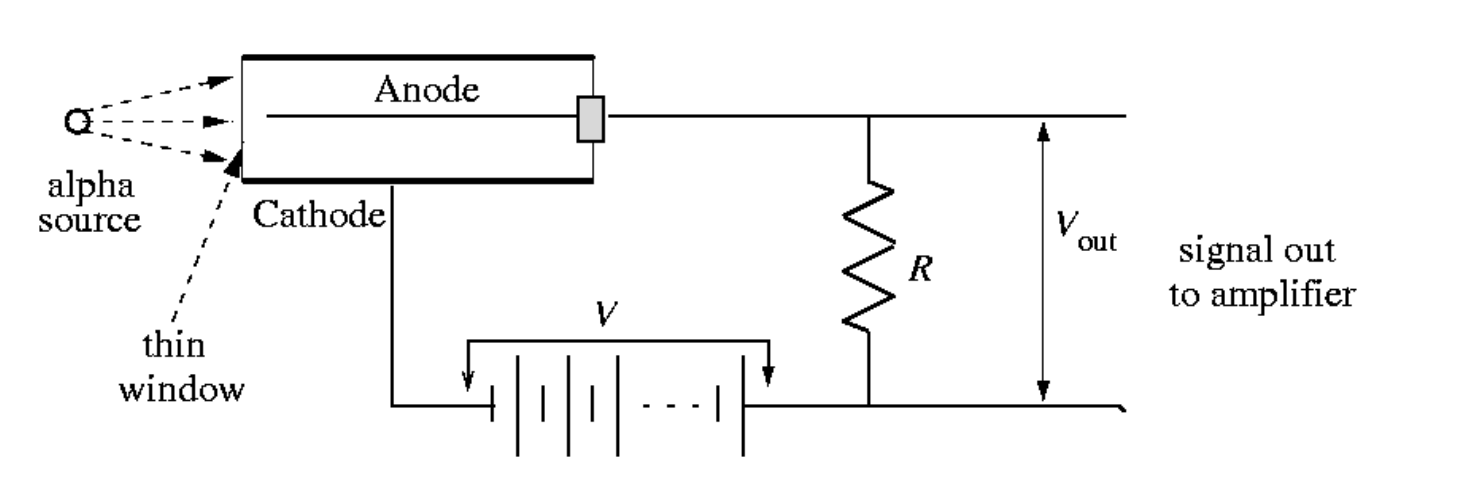
a. An ionization chamber electrometer system with a capacitance of 45 picofarad is used to detect particles having a range of 5.50 cm. Assume the energy required to produce an ion-pair (consisting of a light negative electron and a heavier positive ion, each carrying one electronic charges of magnitude e = 1.60 x Coulomb) in air is 35 eV. What will be the magnitude of the voltage produced by each particle?
b. The voltage pulses due to the particle of the above problem occur across a resistance R. The smallest detectable saturation current (a condition where the current is more or less constant, indicating that the charge is collected at the same rate at which it is being produced by the incident particle) with this instrument is ampere. Calculate the lowest activity A (disintegration rate of the emitter radioisotope) of the source that could be detected by this instrument if the range is 5.50 cm assuming a 10 % efficiency for the detector geometry.
c. The above ionization chamber is to be used for pulse counting with a time constant seconds. Calculate the resistance and also the necessary voltage pulse amplification required to produce 0.25 V signal.
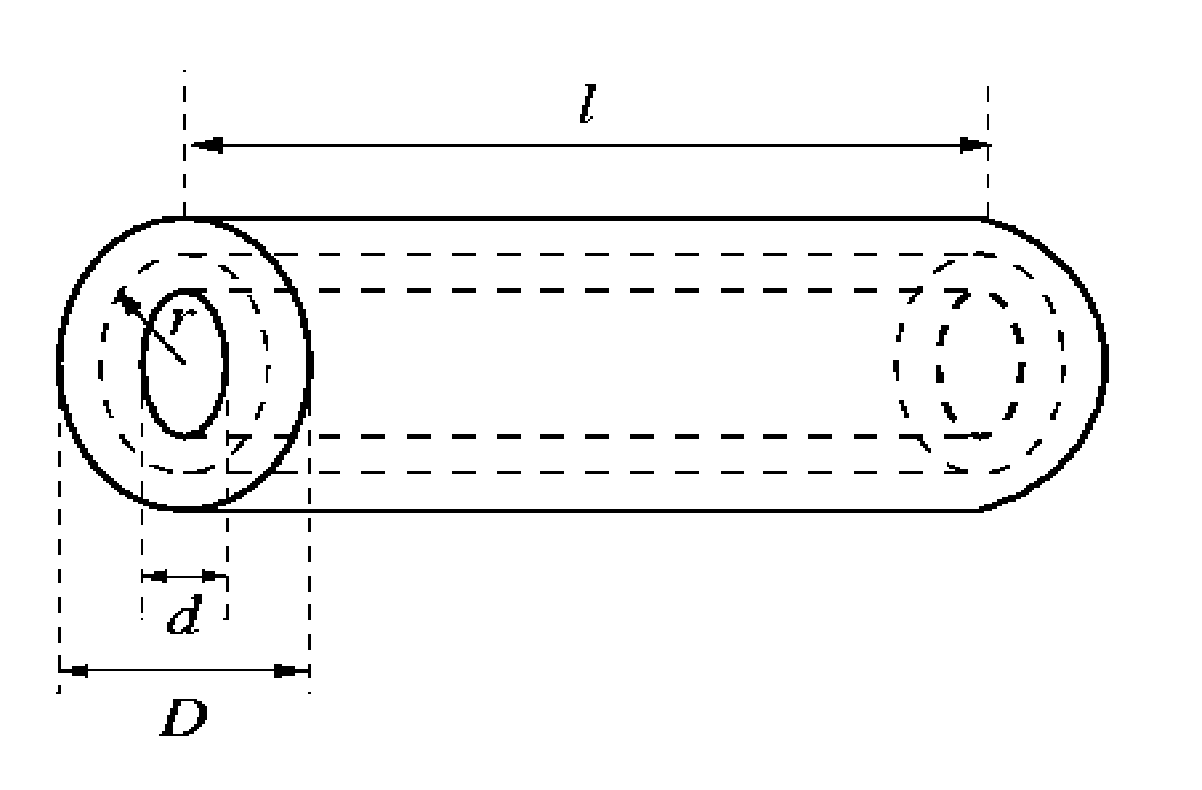
d. Ionization chamber has geometry such as cylindrical counter, the central metal wire (anode) and outer thin metal sheath (cathode) have diameter d and D, respectively. Derive the expression for the electric field E( ) and potential V ( ) at a radial distance from the central axis when the wire carries a charge per unit length . Then deduce the capacitance per unit length of the tube. The breakdown field strength of air is 3 MV (breakdown field strengths greater than , maximum electric field in the substance ). If d=1 mm and D = 1 cm , calculate the potential difference between wire and sheath at which breakdown occurs.
Data : 1 MeV = eV ; 1 picoFarad = F ; 1 Ci = 3.7 x disintegration/second = Ci ( Curie, the fundamental SI unit of activity A );
Отговори
a. 0.68 mV
b. 330 dis/s
Equivalently Ci (official solution).
c. R = 22.22 MΩ; G = 368
d. 3.45 kV
The official solution prints “V = 3.453.45 kV” (the value is duplicated in the source); .
Решение
a. From the given range-energy relation and the data supplied we get
(0.5 point)
since = 35 eV, then
(0.5 point)
Size of voltage pulse:
(0.5 point)
Hence
(0.5 point)
b. Electrons from the ions-pairs produced by particles from a radioactive sources of activity A (=number of particles emitted by the sources per second) which enter the detector with detection efficiency 0.1, will produce a collected current.
(1.0 point)
With = A, the
(1.0 point)
Since 1 Ci = 3.7 x dis then
(1.0 point)
c. With time constant
(0.5 point)
For the voltage signal with height V = 0.68 mV generated at the anode of the ionization chamber by 6.69 MeV particles in problem (a), to achieve q 0.25 V= 250mV voltage signal, the necessary gain of the voltage pulse amplifier should be
(0.5 point)
d. By symmetry , the electric field is directed radially and depends only on distance the axis and can be deducted by using Gauss’ theorem.
If we construct a Gaussian surface which is a cylinder of radius and length l , the charge contained within it is .
The surface integral
(1.0 point)
Since the field E is everywhere constant and normal to the curved surface. By Gauss’s theorem :
so
Since E is radial and varies only with , then and the potential V can be found by integrating E( ) with respect to , if we call the potential of inner wire , we have
Thus
(1.0 point)
We can use this expression to evaluate the voltage between the capacitor’s conductors by setting , giving a potential difference of
since the charge Q in the capacitor is l, and the capacitance C is defined by Q=CV, the capacitance per unit length is
(1.0 point)
The maximum electric field occurs where r minimum, i.e. at . if we set the field at equal to the breakdown field , our expression for E® shows that the charges per unit length in the capacitor must be . Substituting for the potential difference V across the capacitor gives
Taking = 3 x V , d= 1mm, and D= 1 cm , gives V = 3.453.45 kV.
(1.0 point).
Оригинал в Архива: th_problems.pdf · официални решения: th_solutions.pdf