APhO 2001, Експеримент — Задача 3. Question (3)
2nd Asian Physics Olympiad — TAIPEI, TAIWAN — Experimental Competition — Thursday, April 26, 2001 · 26 април 2001 г. · 3 т.
Read This First
Time Available : 5 hours
Read This First:
- Use only the pen provided.
- Use only the front side of the answer sheets and paper.
- In your answers please use as little text as possible ; express yourself primarily in equations, numbers and figures. If the required result is a numerical number, underline your final result with a wavy line.
- Write on the blank sheets of paper the results of all your measurements and whatever else you consider is required for the solution of the question and that you wish to be marked.
- It is absolutely essential that you enter in the boxes at the top of each sheet of paper used your Country and your student number (Student No.). In addition, on the blank sheets of paper used for each question, you should enter the number of the question (Question No.), the Section label, the progressive number of each sheet (Page No.) and the total number of blank sheets that you have used and wish to be marked for each question (Total No. of pages). If you use some blank sheets of paper for notes that you do not wish to be marked, put a large cross through the whole sheet and do not include them in your numbering.
- At the end of the exam please put your answer sheets and graphs in order.
Условие
Assume that the solar cell can be modeled as a device consisting of an ideal current source (light-generated current source), an ideal diode, a shunt resistance , and a series resistance ,
a. Draw an equivalent circuit diagram for the solar cell under light illumination.
b. Derive the I-V relationship for the equivalent circuit. Express the result in terms of , , (light-generated current), and (the current passing through the diode).
c. Assuming that = infinity and = 0 and can be neglected, find the I-V relationship and prove that it can be written in the form as given below:
where is the open-circuit voltage, is the short-circuit current, and , are constants.
Отговори
- b.
- c. Official solution: ; gives ; gives .
Решение
(3) (Question (3) : 3.0 points)
Assume that the solar cell can be modeled as a device consisting of an ideal current source (light-generated current source), an ideal diode, a shunt resistance , and a series resistance ,
a. Draw a correct equivalent circuit diagram for the solar cell under light illumination.
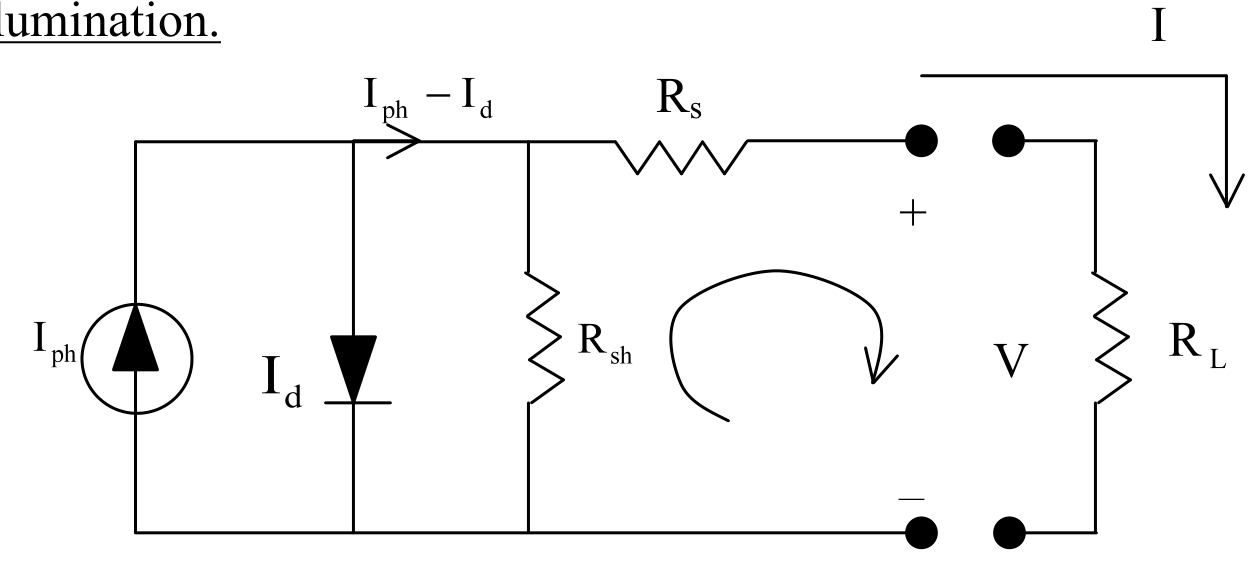
⊙Correct circuit diagram (1.5 points)
b. Derive I-V relationship for the equivalent circuit. Express the result in terms of , , light generated current ,and current passing through the diode .
Applying Kirchhoff’s loop rule, one obtain
⊙Correct equation (0.5 points)
c. Assuming that = infinity and = 0 and can be neglected, find the I-V relationship and prove that it can be written in the form as given below:
where is the open-circuit voltage, is the short-circuit current, and , are constants.
proof: with , = infinity, the equivalent circuit becomes
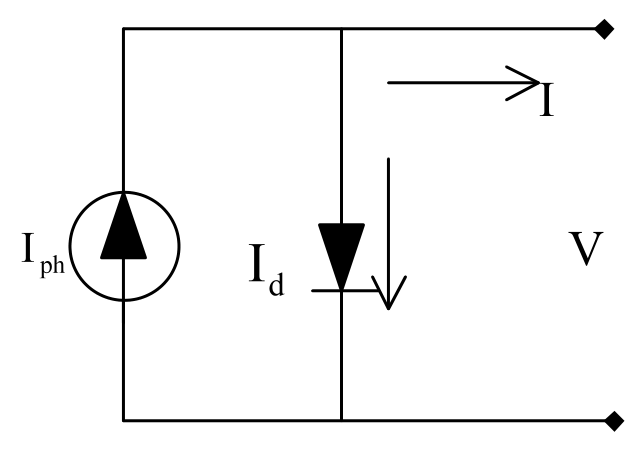
Hence
for close circuit
for open circuit
⊙Correct proof of vs relation (1 point)
Partial credit may be given for appropriate intermediate results.
Оригинал в Архива: exp.pdf · официални решения: exp_sol.pdf