APhO 2001, Теория — Задача 1. When will the Moon become a Synchronous Satellite?
APhO 2001 — Theoretical Question 1 · 10 т.
Условие
The period of rotation of the Moon about its axis is currently the same as its period of revolution about the Earth so that the same side of the Moon always faces the Earth. The equality of these two periods presumably came about because of actions of tidal forces over the long history of the Earth-Moon system.
However, the period of rotation of the Earth about its axis is currently shorter than the period of revolution of the Moon. As a result, lunar tidal forces continue to act in a way that tends to slow down the rotational speed of the Earth and drive the Moon itself further away from the Earth.
In this question, we are interested in obtaining an estimate of how much more time it will take for the rotational period of the Earth to become equal to the period of revolution of the Moon. The Moon will then become a synchronous satellite, appearing as a fixed object in the sky and visible only to those observers on the side of the Earth facing the Moon. We also want to find out how long it will take for the Earth to complete one rotation when the said two periods are equal.
Two right-handed rectangular coordinate systems are adopted as reference frames. The third coordinate axes of these two systems are parallel to each other and normal to the orbital plane of the Moon.
(I) The first frame, called the CM frame, is an inertial frame with its origin located at the center of mass of the Earth-Moon system.
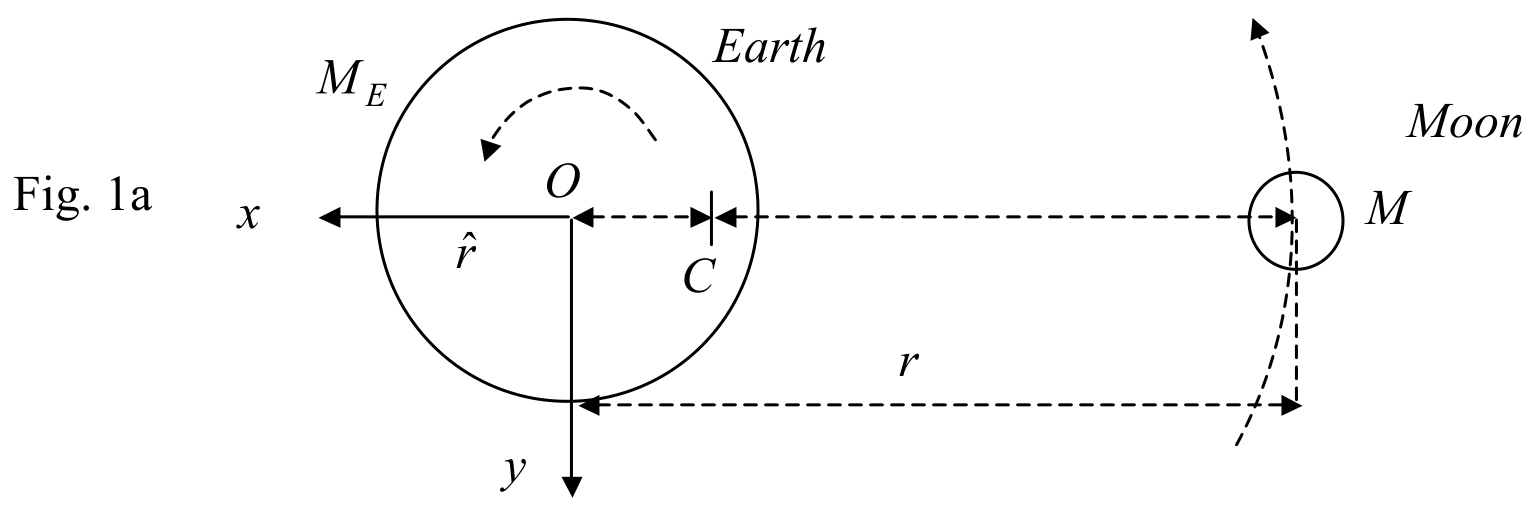
(II) The second frame, called the xyz frame, has its origin fixed at the center of the Earth. Its -axis coincides with the axis of rotation of the Earth. Its -axis is along the line connecting the centers of the Moon and the Earth, and points in the direction of the unit vector as shown in Fig.1a. The Moon remains always on the negative -axis in this frame.
Note that distances in Fig.1a are not drawn to scale. The curved arrows show the directions of the Earth's rotation and the Moon's revolution. The Earth-Moon distance is denoted by .
The following data are given:
(a) At present, the distance between the Moon and the Earth is and increases at a rate of 0.038 m per year.
(b) The period of revolution of the Moon is currently days.
(c) The mass of the Moon is .
(d) The radius of the Moon is .
(e) The period of rotation of the Earth is currently hours.
(f) The mass of the Earth is .
(g) The radius of the Earth is .
(h) The universal gravitational constant is .
The following assumptions may be made when answering questions:
(i) The Earth-Moon system is isolated from the rest of the universe.
(ii) The orbit of the Moon about the Earth is circular.
(iii) The axis of rotation of the Earth is perpendicular to the orbital plane of the Moon.
(iv) If the Moon is absent and the Earth does not rotate, then the mass distribution of the Earth is spherically symmetric and the radius of the Earth is .
(v) For the Earth or the Moon, the moment of inertia about any axis passing through its center is that of a uniform sphere of mass and radius , i.e. .
(vi) The water around the Earth is stationary in the xyz frame.
Answer the following questions:
1 With respect to the center of mass , what is the current value of the total angular momentum of the Earth-Moon system? [3 т.]
2 When the period of rotation of the Earth and the period of revolution of the Moon become equal, what is the duration of one rotation of the Earth? Denote the answer as and express it in units of the present day. Only an approximate solution is required so that iterative methods may be used. [3 т.]
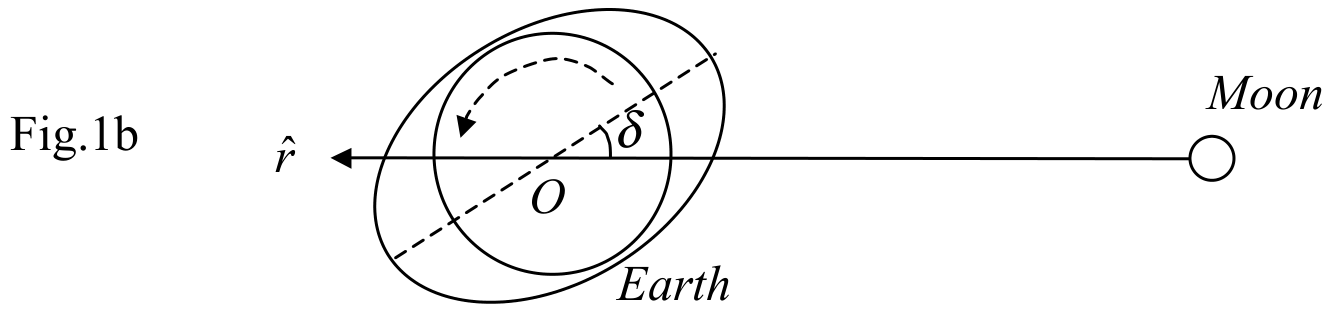
3 Consider the Earth to be a rotating solid sphere covered with a surface layer of water and assume that, as the Moon moves around the Earth, the water layer is stationary in the xyz-frame. In one model, frictional forces between the rotating solid sphere and the water layer are taken into account. The faster spinning solid Earth is assumed to drag lunar tides along so that the line connecting the tidal bulges is at an angle with the -axis, as shown in Fig.1b. Consequently, lunar tidal forces acting on the Earth will exert a torque about to slow down the rotation of the Earth.
The angle is assumed to be constant and independent of the Earth-Moon distance until it vanishes when the Moon's revolution is synchronous with the Earth's rotation so that frictional forces no longer exist. The torque therefore scales with the Earth-Moon distance and is proportional to .
According to this model, when will the rotation of the Earth and the revolution of the Moon have the same period? Denote the answer as and express it in units of the present year.
[4 т.]
Mathematical formulae
The following mathematical formulae may be useful when answering questions:
(M1) For and :
(M2) If and , then .
Answer Sheet
(1) The current value of the total angular momentum of the Earth-Moon system is
__________
(2) When the periods of rotation of the Earth and the revolution of the Moon become equal, the duration of one rotation of the Earth is (in units of the present day)
__________
(3) The amount of time required for the rotation of the Earth and the revolution of the Moon to have the same period is (in units of the present year)
__________
Решение
(1)
The total orbital angular momentum of the Earth-Moon system with respect to can be calculated as follows.
Since all angular momenta are along the -direction, only the -component of each angular momentum will be calculated. The distance between the center of mass and the center of the Earth is
The angular speed of the Moon's revolution is
The orbital angular momentum of the Moon about is
The angular speed of the Moon's spinning or rotational motion is
The spin angular momentum of the Moon is
This is much smaller than the Moon's orbital angular momentum and can therefore be neglected.
The orbital angular momentum of the Earth about is
The angular speed of the Earth's spinning motion is
The moment of inertia of the Earth about its axis of rotation is
The spin angular momentum of the Earth is
Thus, the total angular momentum of the Earth-Moon system is given by
Note that .
(2)
According to Newton's form for Kepler's third law of planetary motions, the angular speed of the revolution of the Moon about the Earth is related to the Earth-Moon distance by
Therefore, the orbital angular momentum of the Earth-Moon system with respect to is
(Note: , so that .)
When the angular speed of the Earth's rotation is equal to the angular speed of the orbiting Moon, the total angular momentum of the Earth-Moon system is, with the spin angular momentum of the Moon neglected, given by
The last equality follows from conservation of total angular momentum and Eq.(2).
For an initial estimate of , the spin angular momentum of the Earth may be neglected in Eq.(5a) to give
An improved estimate may be obtained by using the above estimated value to compute the spin angular momentum of the Earth and use Eq.(5a) again to solve for . The result is
Further iterations of the same procedure lead to the same value just given. Thus, the period of rotation of the Earth will be
(3)
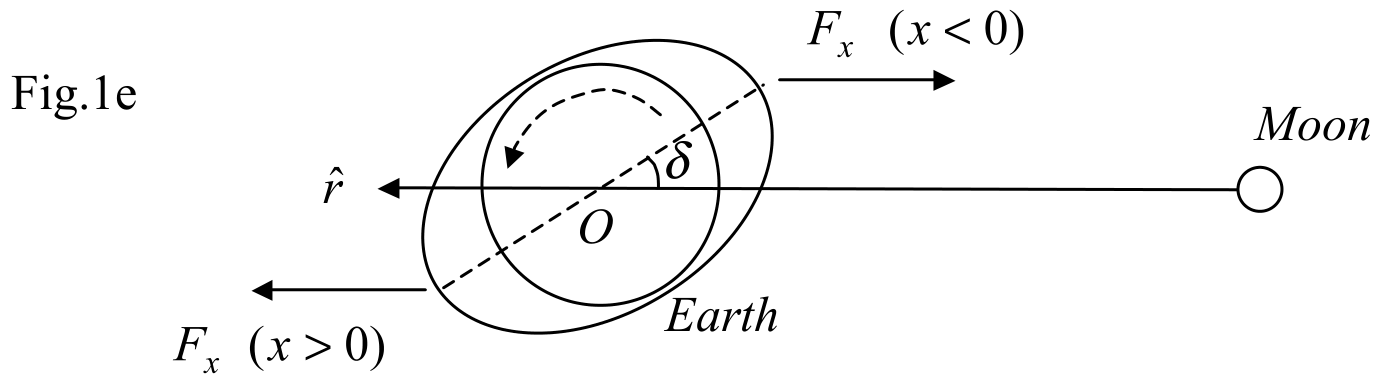
Since the total torque is proportional to , we conclude
Let the current values of and be, respectively, and . From Eq.(6), we then have
The torque is equal to the rate of change of spin angular momentum of the Earth so that
By Newton's law of action and reaction or by the law of conservation of the total angular momentum, is equal to the rate of change of the total orbital angular momentum of the Earth-Moon system so that
But according to Eq.(3), we have
and Eq.(4) may be written as
This implies
The value of can be determined from Eq. (11a) as follows:
Starting with Eq.(11a) in the following form
we may use Eq.(3) to express in terms of and obtain the following equations:
where the constant stands for the expression in the square brackets. The last equation leads to the solution
where is the length of time needed for the angular speed of the rotation of the Earth to be equal to that of the Moon's revolution about the Earth.
Using the values of and obtained in Eqs.(1a) and (5b) and the value of in Eq.(13), we have
Marking Scheme
| Question | Marks | Criterion |
|---|---|---|
| (1), 3.0 | 0.4 | location of center of mass : 0.2 for distance to Earth; 0.2 for distance to Moon |
| 0.4 | Orbital angular momentum of the Moon : 0.2 for formula; 0.2 for numerical value | |
| 0.4 | spin angular momentum of the Moon : 0.2 for formula; 0.2 for numerical value | |
| 0.4 | Orbital angular momentum of the Earth : 0.2 for formula; 0.2 for numerical value | |
| 0.4 | spin angular momentum of the Earth : 0.2 for formula; 0.2 for numerical value | |
| 0.2 | knowing total angular momentum of a system is the sum of orbital and spin angular momenta | |
| 0.8 | total angular momentum of the Earth-Moon system : 0.2 for order of magnitude; 0.4 for value to two significant digits; 0.2 for unit | |
| (2), 3.0 | 0.8 | Newton's form of Kepler's third law : 0.6 for ; 0.2 for expression of constant |
| 0.4 | realizing total orbital angular momentum is a function of or [blank in source] alone | |
| 0.2 | realizing spin angular momentum of the Moon is negligible | |
| 0.4 | resorting to the law of conservation of total angular momentum | |
| 1.2 | period of rotation of the Earth : 0.3 for order of magnitude in units of second; 0.4 for value to two significant digits; 0.5 for providing an equation for finding | |
| (3), 4.0 | 0.2 | 0.2 for knowing |
| 0.4 | realizing relation between torque and rate of slowdown of Earth's rotation: | |
| 0.4 | concluding is equal to rate of increase of total orbital angular momentum of the Earth-Moon system: | |
| 1.0 | current value of the torque : 0.2 for realizing is related to ; 0.3 for converting the derivative to ; 0.4 for value of ; 0.1 for unit of torque | |
| 0.6 | converting the derivative to : 0.1 for realizing is related to ; 0.1 for realizing is related to ; 0.4 for converting into a differential equation for | |
| 0.6 | providing an equation for the solution of | |
| 0.8 | estimate of time : 0.3 for order of magnitude in units of second; 0.4 for value to two significant digits; 0.1 for value in years |
Оригинал в Архива: 1.pdf · официални решения: 1_sol.pdf · допълнителни данни: 1_anssheet.pdf · допълнителни данни: 1_marking.pdf