4th Asian Physics Olympiad — Theoretical Competition — 23 April 2003
Условие
In the near future we ourselves may take part in launching of a satellite which, in point of view of physics, requires only the use of simple mechanics.
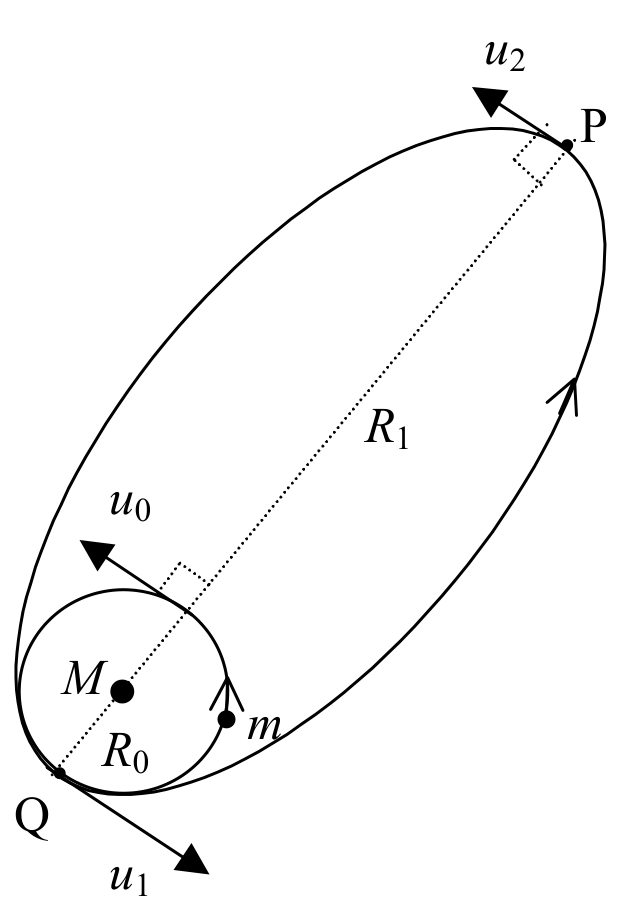
a) A satellite of mass m is presently circling the Earth of mass M in a circular orbit of radius R0. What is the speed (u0) of mass m in terms of M,R0 and the universal gravitation constant G? [1 т.]
b) We are to put this satellite into a trajectory that will take it to point P at distance R1 from the centre of the Earth by increasing (almost instantaneously) its velocity at point Q from u0 to u1. What is the value of u1 in terms of u0,R0,R1? [2 т.]
c) Deduce the minimum value of u1 in term of u0 that will allow the satellite to leave the Earth’s influence completely. [1 т.]
d) (Referring to part b.) What is the velocity (u2) of the satellite at point P in terms of u0,R0,R1? [1 т.]
e) Now, we want to change the orbit of the satellite at point P into a circular orbit of radius R1 by raising the value of u2 (almost instantaneously) to u3.
What is the magnitude of u3 in terms of u2,R0,R1? [1 т.]
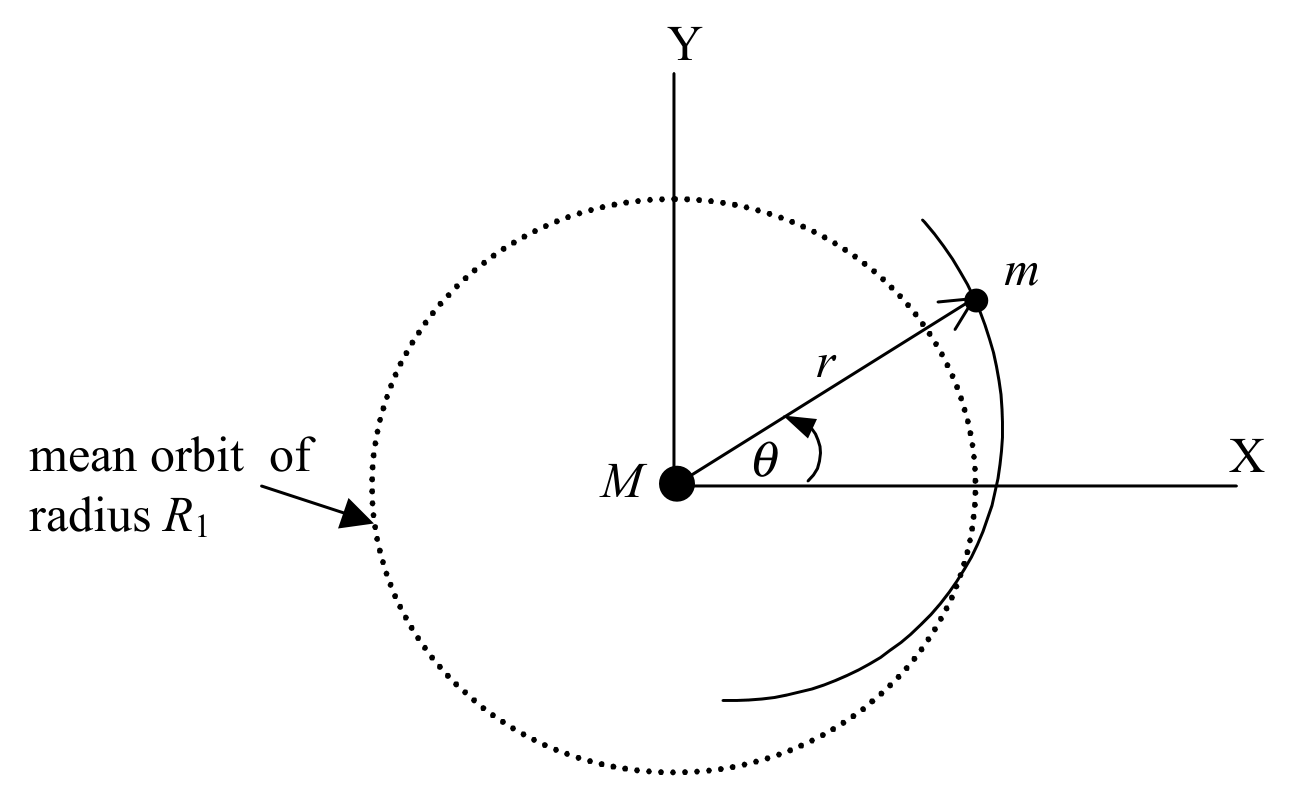
f) If the satellite is slightly and instantaneously perturbed in the radial direction so that it deviates from its previously perfectly circular orbit of radius R1, derive the period of its oscillation T of r about the mean distance R1.
Hint: Students may make use (if necessary) of the equation of motion of a satellite in orbit:
m[dt2d2r−(dtdθ)2r]=−Gr2Mm……………(1)
and the conservation of angular momentum:
mr2dtdθ=constant……………(2)
[3 т.]
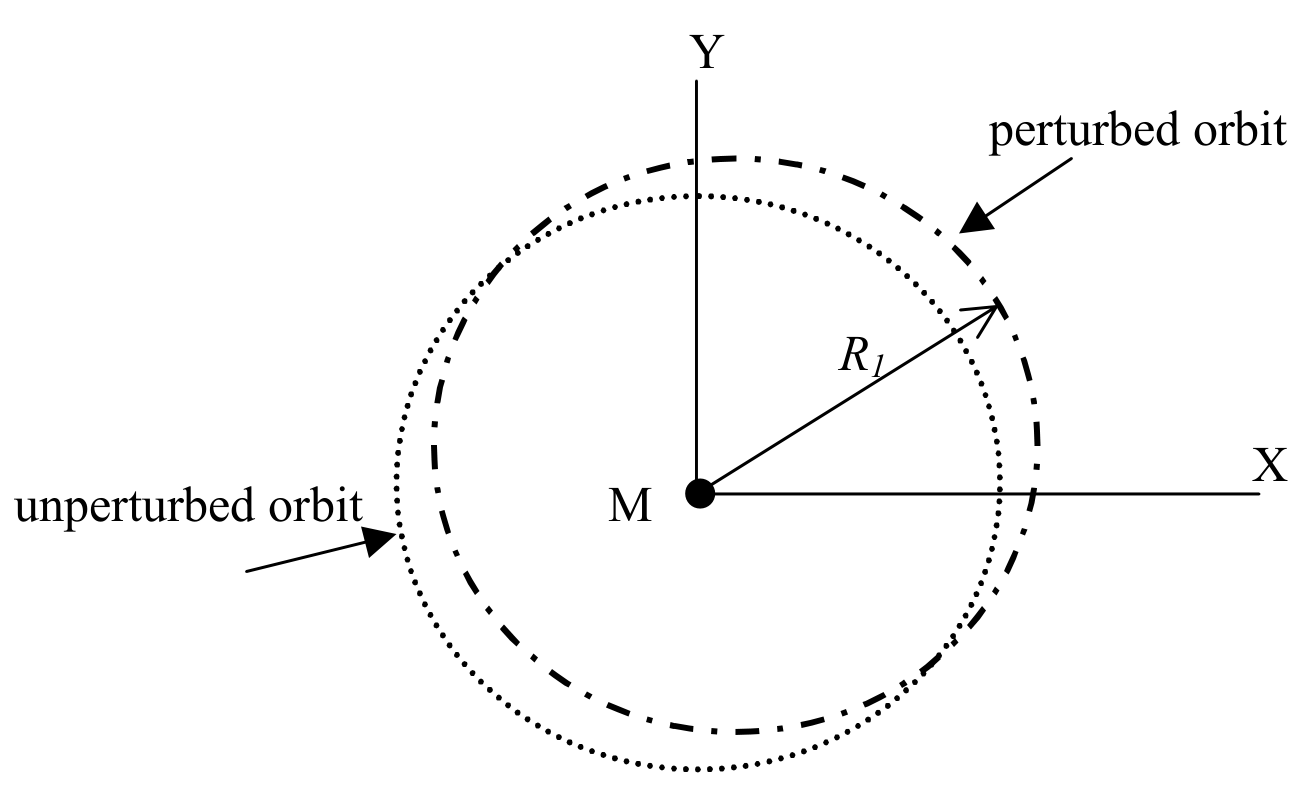
g) Give a rough sketch of the whole perturbed orbit together with the unperturbed one. [1 т.]
Отговори
a)u0=R0GM
b)u1=u0R1+R02R1
c)u1=2u0
d)u2=u0R1(R1+R0)2R0
e)u3=u22R0R1+R0
f)T=2πGMR13
Решение
a)
R0mu02=R02GMm,u0=R0GM
(1 point)
b) conservation of angular momentum: mu1R0=mu2R1
conservation of energy: 21mu22−R1GMm=21mu12−R0GMm
[(R1R0)2−1]u12=2GM[R11−R01]
R12(R0−R1)(R0+R1)u12=(2GM)R0R1(R0−R1)
u1=R0GMR1+R02R1=u0R1+R02R1
(2 points)
c)
R1→∞limu1=2u0
(1 point)
d)
u2=u1R1R0=u0R1(R1+R0)2R0
(1 point)
e)
u3=R1GM=R0GMR1R0=u0R1R0
=R1R02R0R1(R1+R0)u2
u3=u22R0R1+R0
(1 point)
f) (3 points) combining equations (1) and (2) :
dt2d2r−r3C/m=−r2GM
and for the circular orbit of radius R1 we have mC=GMR1
hence
dt2d2r−r3GMR1=−r2GM
putting r=R1+η, where η≪R1
∴dt2d2η−R13(1+R1η)3GMR1=−R12(1+R1η)2GM
dt2d2η−R12GM(1−3R1η)≈−R12GM(1−2R1η)
dt2d2η≈−R13GMη
the frequency of oscillation about mean distance is f=2π1R13GM
the period T=f1=2πGMR13
Note that this period is the same as the orbital period