APhO 2003, Теория — Задача 2. II. Optical Gyroscope
4th Asian Physics Olympiad — Theoretical Competition — 23 April 2003 · 23 април 2003 г.
Условие
In 1913 Georges Sagnac (1869-1926) considered the use of a ring resonator to search for the aether drift relative to a rotating frame. However, as often happen, his results turned out to be useful ways that Sagnac himself never dreamt of. One of those applications is the Fibre-Optic Gyroscope (FOG) which is based upon a simple phenomena, first observed by Sagnac. The essential physics associated with the Sagnac effect is due to the phase shift caused by two coherent beams of light being sent around a rotating ring of optical fibre in the opposite directions. This phase shift is also used to determine the angular speed of the ring.
As shown in a schematic diagram in Fig. 1, a light wave enters a circular optical fibre light path of radius at point P on the rotating platform with a uniform angular speed , in the clockwise direction. Here the light wave is split into two waves which travels in the opposite directions, clockwise (CW) and counter clockwise (CCW), through the ring. The refractive index of optical fibre material is . Assuming the light traveling inside the fibre-optic cable is a smooth circular path of radius .
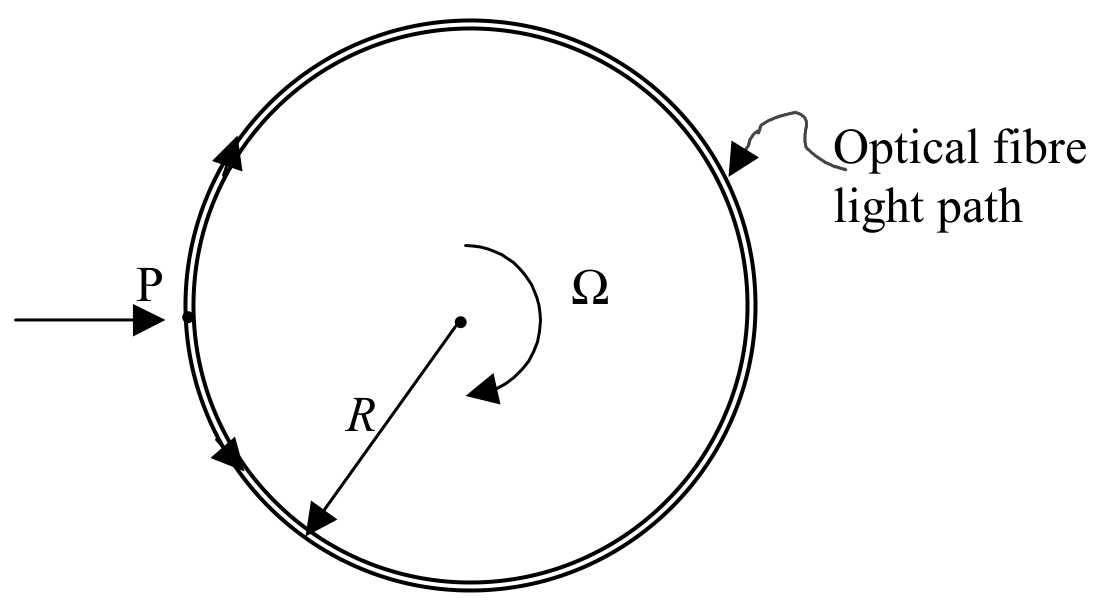
a) Practically, the orbital speed of the ring is much less than the speed of light such that , find the time difference where and denote the round-trip transit time of the CW and CCW beam respectively. Give your answer in term of area enclosed by the ring. [2 т.]
b) Find the optical path difference, , for the CW and CCW beams to complete one round-trip of the light within the rotating ring. [2 т.]
c) For a circular fibre-optic of radius, , what is the maximum value of for the rotation of the earth? Given . [1 т.]
d) In part b), the measurement could be amplified by increasing number of turns in fibre-optic coil, , find the phase difference, , for lights to complete the turns. [1 т.]
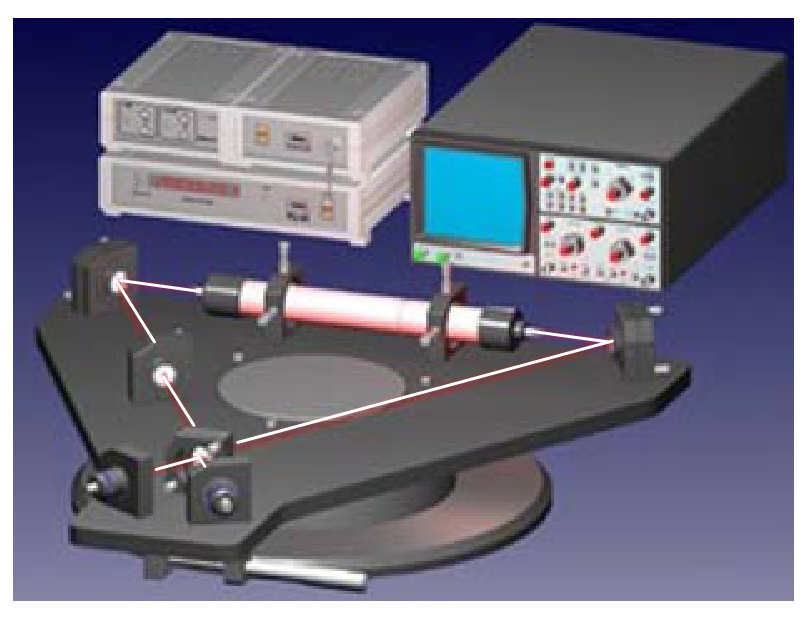
e) The second scheme of the Optical Gyroscope is Ring Laser Gyroscope (RLG). This could be accomplished by the inclusion of active laser cavity into an equilateral triangular ring, of total length , as illustrated in Fig.2. The laser source here will generate two amplified coherent light sources propagating in the opposite directions. In order to sustain the laser oscillation in this triangular ring resonator, the perimeter of the ring must be equal to the integer multiple of wavelength . Etalon, additional component inserted into the ring, is possible to cause frequency selective losses in the ring resonator, so that the undesired modes can be damped and suppressed.
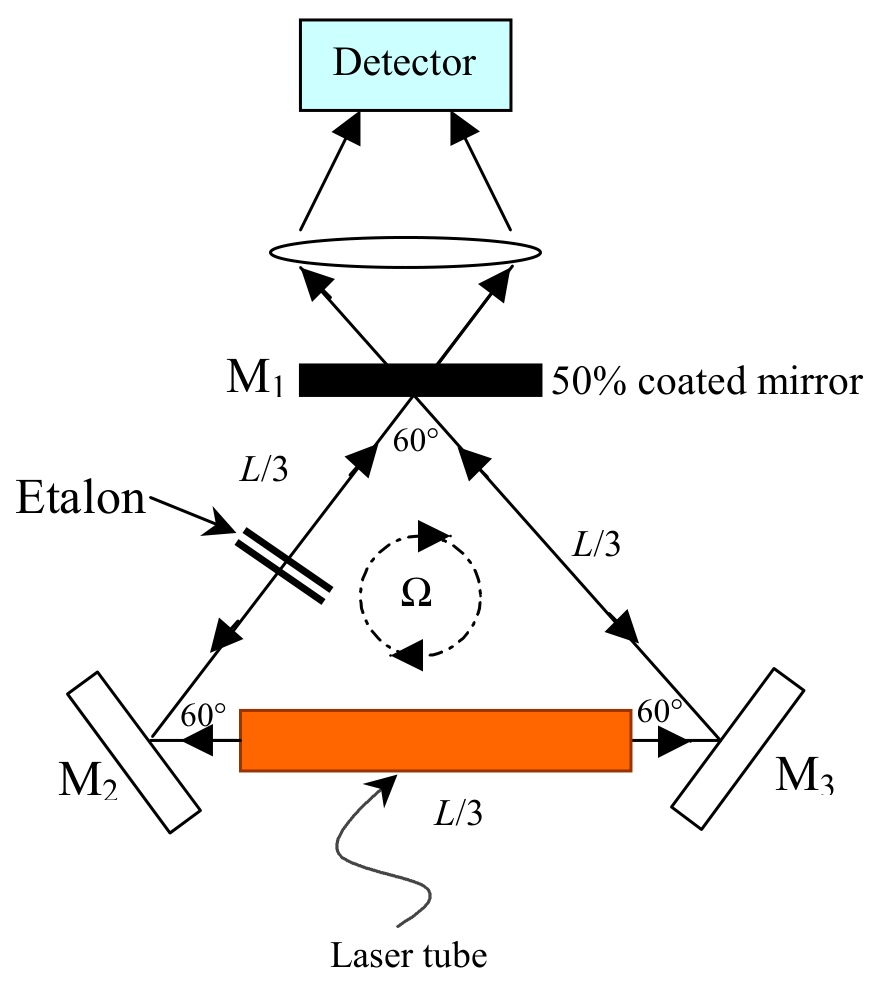
Find the time difference of the transit in clockwise and counterclockwise, , for the case of the triangular ring as shown in the figure 2. Give the answer in terms of and the area enclosed by the ring. Show that this result is the same as that of the circular ring. [2 т.]
f) If the ring is rotating with an angular frequency as shown in Fig. 2, there will be frequency difference between CW and CCW measurements. What is the observed beat frequency, , between the CW and CCW beams in terms of . [2 т.]
Отговори
- a)
- b)
- c) m
- d)
- e)
- f)
Решение
Solution and Marking Scheme
Theory
II. Optical Gyroscope
The light wave moves with speed in the medium having refractive index . Wavelength of light in medium , where is the wavelength of light in vacuum.
a) (2 points)
transit time for the CW beam:
transit time for the CCW beam:
the time difference between and :
since
b) (2 points) the round-trip optical path difference, , is given by
c) (1 point)
d) (1 point) the corresponding optical phase difference is,
for turns of fiber optic ring,
e) (2 points)
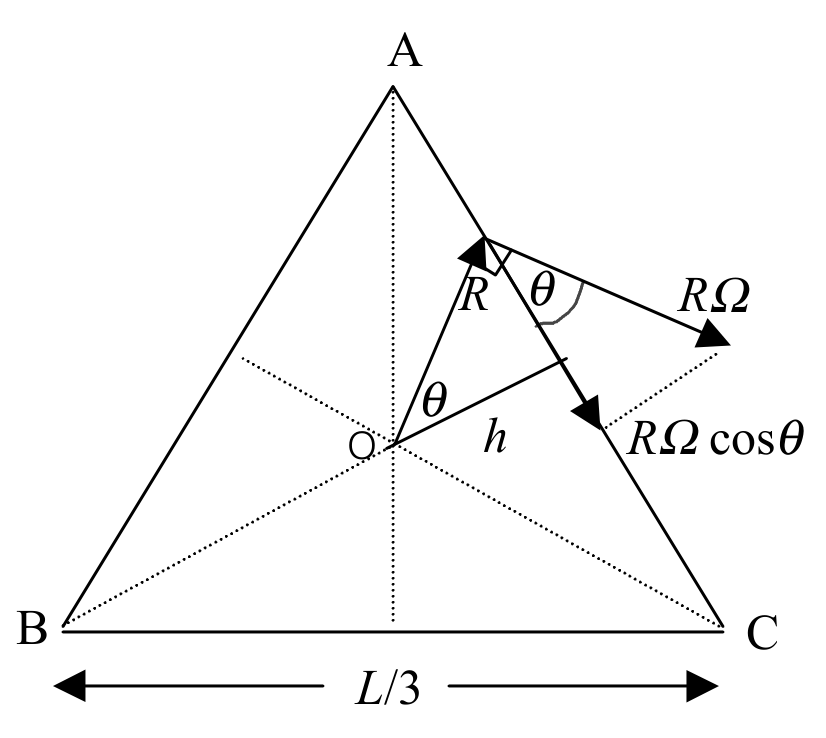
The figure shows the triangular ring rotating about the centre o with the angular speed in the clockwise direction. Without loosing generality, let‘s first consider the velocity of light along AC in the CW and CCW direction,
, where h is constant.
where is the time taken for light travelling along AC in the CW and CCW.
, where L is the perimeter of the triangular ring.
Therefore, the time difference of light travelling in one complete cycle.
, where is the area of the triangular ring.
f) The resonance frequencies associated with corresponding to the effective cavity lengths seen by CW and CCW propagating beams respectively is,
where is the perimeter of the equilateral triangle in the CW (+) and CCW (-) and we also use the fact that . Therefore,
The condition to sustain the laser oscillation (given in the problem),
, m = 1, 2, 3, … integers (1 point)
(1 point)
the approximation arises from
where L is the perimeter of the triangular ring. Hence,
(1 point)