APhO 2004, Теория — Задача 2. Optical fiber
Theoretical Competition-Problem No. 2. Optical fiber
Условие
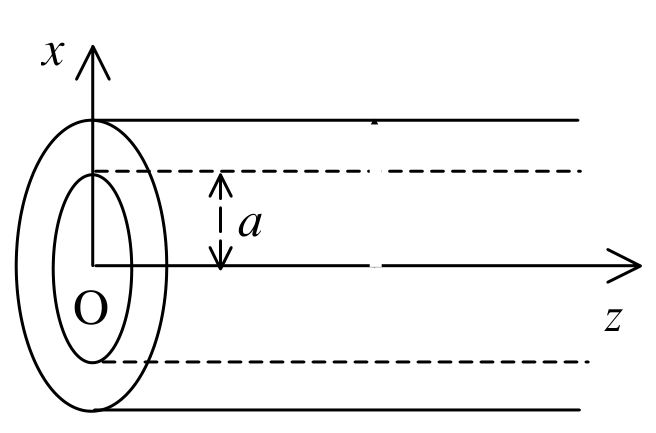
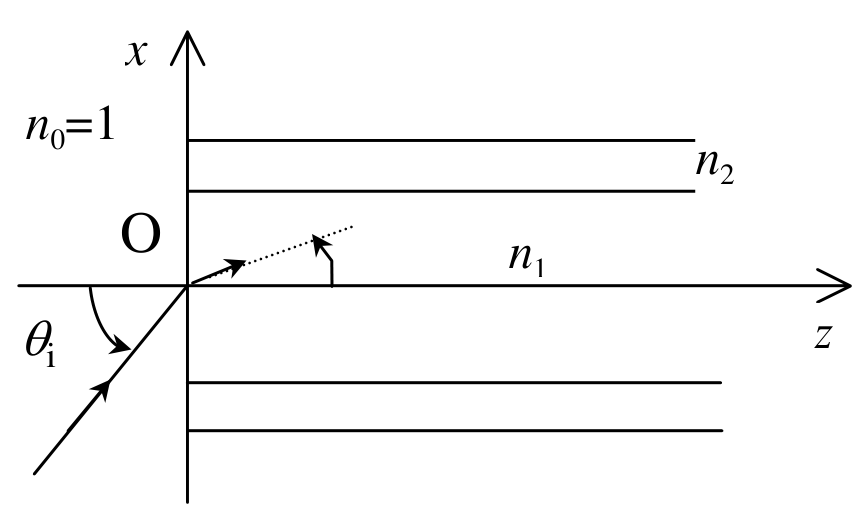
An optical fiber consists of a cylindrical core of radius , made of a transparent material with refraction index varying gradually from the value on the axis to (with ) at a distance from the axis, according to the formula
where is the distance from the core axis and is a constant. The core is surrounded by a cladding made of a material with constant refraction index . Outside the fiber is air, of refractive index .
Let O be the axis of the fiber, with O - the center of the fiber end.
Given ; ; , .
- A monochromatic light ray enters the fiber at point O under an incident angle , the incident plane being the plane O.
1.a. Show that at each point on the trajectory of the light in the fiber, the refractive index and the angle between the light ray and the O axis satisfy the relationship where is a constant. Find the expression for in terms of and . [1.0 points]
1.b. Use the result found in 1.a. and the trigonometric relation , where is the slope of the tangent to the trajectory at point (, ), derive an equation for . Find the full expression for in terms of , and . By differentiating the two sides of this equation versus , find the equation for the second derivative . [1.0 points]
1.c. Find the expression of as a function of , that is , which satisfies the above equation. This is the equation of the trajectory of light in the fiber. [1.0 points]
1.d. Sketch one full period of the trajectories of the light rays entering the fiber under two different incident angles . [1.0 points]
- Light propagates in the optical fiber.
2.a. Find the maximum incident angle , under which the light ray still can propagate inside the core of the fiber. [1.5 points]
2.b. Determine the expression for coordinate of the crossing points of a light ray with O axis for . [1.5 points]
- The light is used to transmit signals in the form of very short light pulses (of negligible pulse width).
3.a. Determine the time it takes the light to travel from point O to the first crossing point with O for incident angle and .
The ratio of the coordinate of the first crossing point and is called the propagation speed of the light signal along the fiber. Assume that this speed varies monotonously with .
Find this speed (called ) for .
Find also the propagation speed (called ) of the light along the axis Oz.
Compare the two speeds. [3.25 points]
3.b. The light beam bearing the signals is a converging beam entering the fiber at O under different incident angles with . Calculate the highest repetition frequency of the signal pulses, so that at a distance two consecutive pulses are still separated (that is, the pulses do not overlap). [1.75 points]
Attention
- The wave properties of the light are not considered in this problem.
- Neglect any chromatic dispersion in the fiber.
- The speed of light in vacuum is c =
- You may use the following formulae:
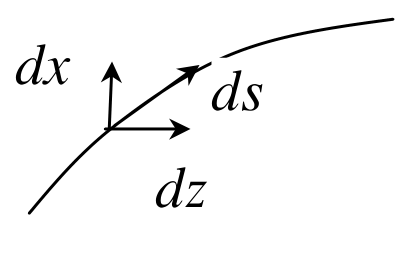
- The length of a small arc element in the O plane is
- is the inverse function of the sine function. Its value equals the less angle the sine of which is . In other words, if then .
Отговори
1.a.
1.b.
1.c.
2.a. 20.13 °
sin θiM = √(n1² − n2²) = 0.344; θiM = 0.351 rad = 20.13°.
2.b.
3.a.
3.b. 547.1 MHz
fM = 2cn2 / (z(n1 − n2)²).
Решение
Solutions of Problem No. 1
Optical fiber
1.a. At both sides of the point O (outside and inside the fiber), according to Snell law, we have:
where is the value of angle at point O inside the fiber.
The light trajectory lays in the plane. Because the refraction index varies along direction, we divide axis into small elements , so that in each of these elements can be considered as constant. We have, then:
where is the angle between the light trajectory and direction. Because , then
Thus, at each point of coordinate on the light trajectory, we have:
Because
we have
Then
1.2. Because , from (6) we have:
Squaring the two sides, we obtain:
and
After derivating the two sides of (8) versus , we get:
Because and
- at =0
- at =
we get
Finally, we get the equation for
1.c. The equation for the light trajectory is obtained by solving (10). This is an equation similar to that for an harmonic oscillation, which solution can be written right away
with
The parameters and are determined from the boundary conditions:
- at =0, =0, hence =0
- at =0 inside the fiber, , then
The equation for the trajectory of the light inside the fiber is:
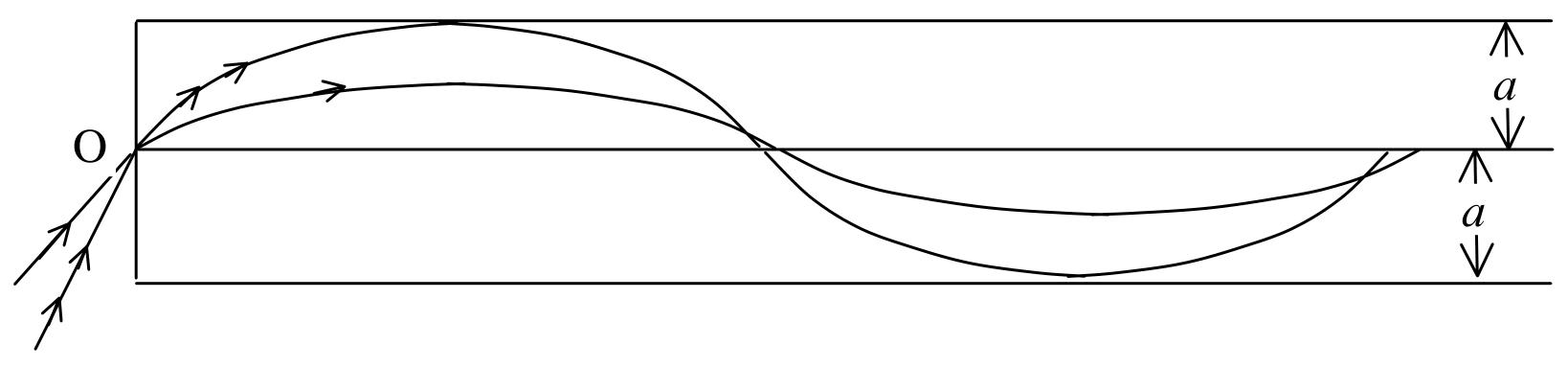
1.d. Here is a sketch of the trajectories of two rays entering the fiber at O, under different incident angles.
2.a. The condition for the light to propagate along the fiber is that . This means that:
or:
Thus the incident angle must not exceed , with
or:
2.b. The crossing points of the light beam with O axis must satisfy the condition , with - an integer. The coordinates of these points are:
except for =0.
3.a. The rays entering the fiber at different incident angles have different trajectories. As a consequence, the propagation speeds of the rays along the fiber should be different.
The light trajectories are sinusoidal as given in (13). Let us calculate the time it takes the light to propagate from point O to its first crossing point with O axis. This is twice the time it takes the light to propagate from point O to its position most distant from O axis.
The time required for the light to travel a small segment along its trajectory is
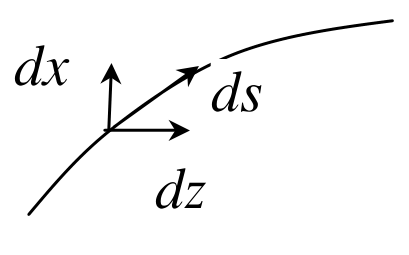
From (6), we have
and
where
Using (16), (17), (18), we obtain
The propagation speed along the fiber is , where is the coordinate of the first crossing point, which is determined by (15) for . Because and depend on the incident angle , also depends on .
For , from (14a), we get
and
The propagation speed of the light along the O axis is
because the refraction index is n on the axis of the fiber.
The numerical value is
3.b. If the beam of the light pulses is formed by rays converging at O, then the rays with different incident angles has different propagation speeds. The two rays of incident angles and arrive to the plane with a time delay
This means that a very short light pulse becomes a pulse of finite width given by (22) at the plane . If two consecutive pulses enter the fiber with a delay greater than , then at the plane , they are separated. Hence the repetition frequency of the pulses must not exceed the maximal value:
If , then