APhO 2004, Теория — Задача 3. Compression and expansion of a two gases system
Theoretical Competition-Problem No. 3. Compression and expansion of a two gases system
Условие
A cylinder is divided in two compartments with a mobile partition NM. The compartment in the left is limited by the fond of the cylinder and the partition NM (Figure 1). This compartment contains one mole of water vapor. The compartment in the right is limited by the partition NM and a mobile piston AB. This compartment contains one mole of nitrogen gas (N).
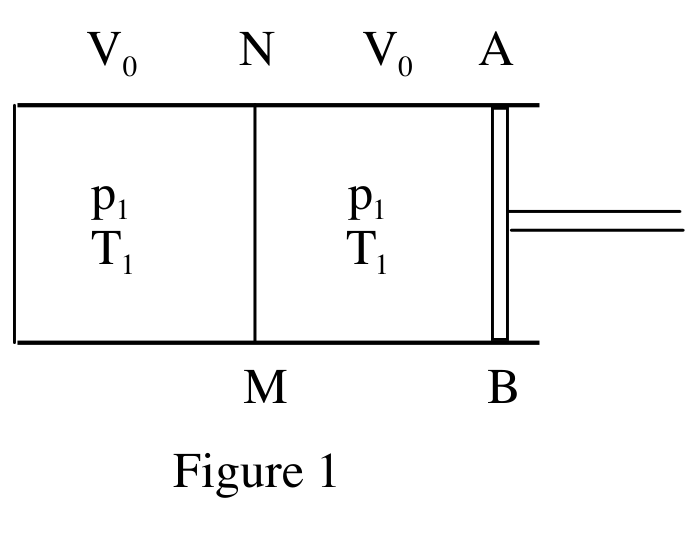
At first, the volumes and temperatures of the gases in two compartments are equal. The partition NM is well heat conductive. His heat capacity is very small and can be neglected.
The specific volume of liquid water is negligible in comparison with the specific volume of water vapor at the same temperature.
The specific latent heat of vaporization is defined as the amount of heat that must be delivered to one unit of mass of substance to convert it from liquid state to vapor at the same temperature. For water at , .
1.a Suppose that the piston and the wall of the cylinder are heat conductive, the partition NM can slide freely without friction. The initial state of the gases in the cylinder is defined as follows:
Pressure atm.; total volume ; temperature K.
The piston AB slowly compresses the gases in a quasi-static (quasi-equilibrium) and isothermal process to the final volume
a. Draw the curve, that is the curve representing the dependence of pressure on the total volume of both gases in the cylinder at temperature . Calculate the coordinates of important points of the curve. [1.5 pts]
Gas constant: J/mol.K or L.atm./mol.K
1 atm. =101.3 kPa;
Under the pressure =1 atm., water boils at the temperature K. [1,5 т.]
1.b Calculate the work done by the piston in the process of gases compressing. [1.0 pts]
[1 т.]
1.c Calculate the heat delivered to outside in the process. [1.5 pts]
2.a All conditions as in 1. except that there is friction between partition NM and the wall of the cylinder so that NM displaces only when the difference of the pressures acting on its two opposed faces attains 0.5 atm. and over (assuming that the coefficients of static and kinetic friction are equal).
a. Draw the p(V) curve representing the pressure in the right compartment as a function of the total volume of both gases in the cylinder at a constant temperature T. [1.5 pts]
2.b Calculate the work done by the piston in compressing the gases. [0.5 pts]
2.c After the volume of gases reaches the value , piston AB displaces slowly to the right and makes a quasi-static and isothermal process of expansion of both substances (water and nitrogen) to the initial total volume . Continue to draw in the diagram in question 2.a. the curve representing this process [2.0 pts]
Hint for 2.
Create a table like the one shown here and use it to draw the curves as required in 2.a. and 2.c.
| State | Left compartment Volume | Pressure | Right compartment Volume | Pressure | Total volume | Pressure on piston AB |
|---|---|---|---|---|
| initial | | 0.5 atm. | | 0.5 atm. | 0.5 atm. | |
| 2 | | | | | ||
| 3 | | | | | ||
| . | | | | | ||
| . | | | | | ||
| . | | | | | ||
| . | | | | | ||
| . | | | | | ||
| final | | | | |
[2 т.]
3.a Suppose that the wall and the fond of the cylinder and the piston are heat insulator, the partition NM is fixed and heat conductive, the initial state of gases is as in 1. Piston AB moves slowly toward the right side and increases the volume of the right compartment until the water vapor begins to condense in the left compartment.
a. Calculate the final volume of the right compartment. [3 pts]
3.b Calculate the work done by the gas in this expansion. [1 pts]
The ratio of isobaric heat capacity to isochoric one for nitrogen is and for water vapor .
In the interval of temperature from 353 K to 393 K one can use the following approximate formula:
where is boiling temperature of water under pressure , - its molar mass. , and are given above. [1 т.]
Отговори
1.a Isotherm through (2V0, 0.5 atm), (V0, 1 atm), (V0/2, 1 atm), (V0/4, 2 atm); V0 = RT1/p1 = 0.0612 m³ = 61.2 dm³.
1.b 9.55 kJ
1.c 47 kJ
The official solution prints “46.946 J ≅ 47 kJ”; the unit J in the intermediate value is a misprint in the source (the value is 46 946 J).
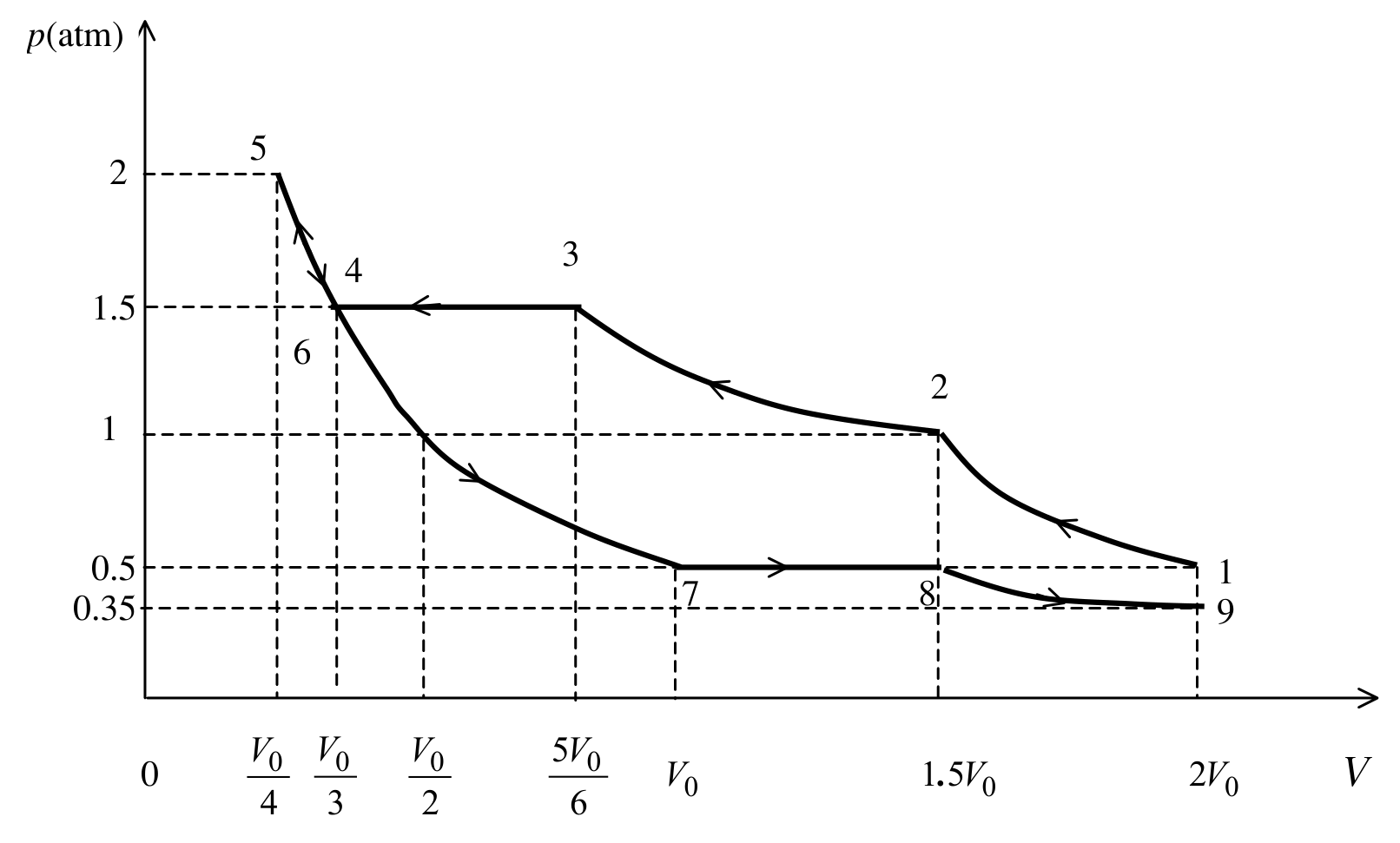
2.a See the table of states 1–9 and Figure 2 of the official solution.
2.b 12.65 kJ
2.c Expansion path 5 → 6 → 7 → 8 → 9 of Figure 2; final state: right compartment √2·V0 at √2/4 ≈ 0.35 atm, left compartment (2 − √2)V0 at 0.85 atm.
3.a 0.08 m³
V' ≈ 1.33 V0 (T' = 354 K) or 1.35 V0 (T' = 353 K), i.e. 0.0816 m³ or 0.082 m³ ≅ 0.08 m³.
3.b 900 J
868 J (T' = 354 K) or 914 J (T' = 353 K) ≅ 9×10² J.
Решение
1.
a. The isotherm curve is shown in Figure 1.
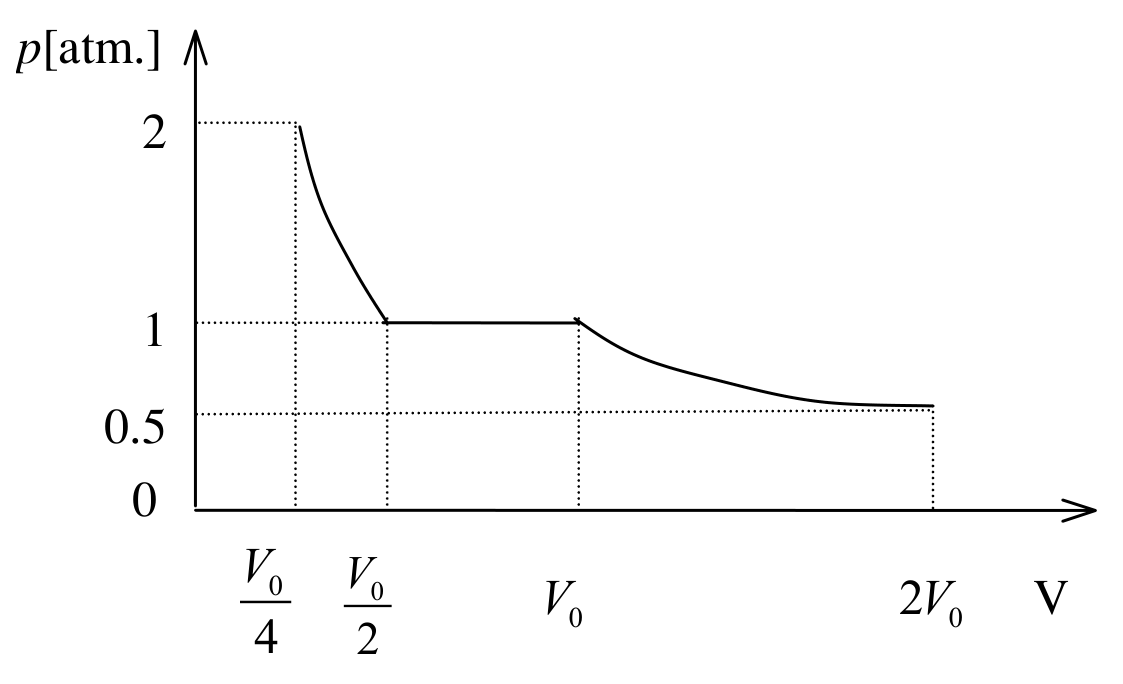
b. The process of compressing can be divided into 3 stages:
The work in each stage can be calculated as follows:
The total work of gases compressing is:
c. In the second stage 23, all the water vapor (one mole) condenses. The heat delivered in the process equals the sum of the work and the decrease of internal energy of one mole of water vapor in the condensing process.
One can remark that is the heat delivered when one mole of water vapor condenses, and equals . Thus
2. The process of compression (2. a.) and expansion (2.c.) of gases can be divided into several stages. The stages are limited by the following states:
| State | Left compartment Volume | Pressure (atm.) | Right compartment Volume | Pressure (atm.) | Total volume | Pressure on piston (atm.) |
|---|---|---|---|---|
| 1 | | 0.5 | | 0.5 | 0.5 | |
| 2 | | 0.5 | | 1 | 1 | |
| 3 | | 1 | | 1.5 | 1.5 | |
| 4 | 0 | 1 | | 1.5 | 1.5 | |
| 5 | 0 | 1.5 | | 2 | 2 | |
| 6 | 0 | 1.5 | | 1.5 | 1.5 | |
| 7 | 0 | 1 | | 0.5 | 0.5 | |
| 8 | | 1 | | 0.5 | 0.5 | |
| 9 | | | | | = 0.35 |
a. See figure 2 below.
b. The work done by the piston in the process of compressing the gases equals the sum of the work calculated in 1. and the work done by the force of friction. The latter equals 0.5 atm. (the force of kinetic friction appears in the process 234 during which the displacement of the partition NM corresponding to a variation of volume of the left compartment). Then, we have:
c. In process 89 the pressure in the left compartment is always larger than the pressure in the right one (with a difference of 0.5 atm.). If denotes the pressure in the right compartment, the pressure in the left one will be + 0.5 atm.
Let be the total volume in process 89, we have
with , can be defined by
This is equivalent to:
The pressure in the right compartment is = 0.35 atm.
The volume of the right compartment is
The pressure in the left compartment is atm.
The volume of the left compartment is
3.
a. Apply the first law of thermodynamic for the system of two gases in the cylinder:
In an element of process in which the variations of temperature and volume are respectively d and d:
On the other hand: (4)
One can deduce the differential equation for the process:
or
By putting
after integrating (5), we have:
The condensing temperature of water vapor under the pressure 0.5 atm. is also the boiling temperature of water under the same pressure. By using the given approximate formula, we obtain
- If we consider approximatively constant (with relative deviation about ) can be easily found, and
The volume of the right compartment at temperature can be calculated as follows:
b.The work done by the gas in the expansion is:
- If we consider the dependence of water vapor pressure on temperature , we must resolve the transcendental equation
This equation can be reduced to a numerical one:
By giving different values 354, 353, 352 and choosing the one which satisfies this equation, we find the approximate solution :
With this value of temperature, the volume of the right compartment is :
b. The work done by the gas in the expansion is: