APhO 2005, Теория — Задача 1. Question 1
6th Asian Physics Olympiad — theoretical competition · 10 т.
Внимание: Бележка към темата
Complete3native whole questions/9requests,14Q+30final-key pages, full derivations, both original swing alternatives, all native rubrics and four blank forms. Printed reversed subpart labels, conflicting swing counts, mirror allocations, field rounding, unnamed-point text and aberrant/overlaid native graphics remain source-attributed and literal.
Native cover and instructions — Wednesday, April 27th, 2005
Please read this first: 1. The time available is 5 hours for the theoretical competition. 2. Use only the pen provided. 3. Use only the front side of the paper. 4. Begin each part of the problem on a separate sheet. 5. For each question, in addition to the blank sheets where you may write, there is an answer form where you must summarize the results you have obtained. Numerical results should be written with as many digits as are appropriate to the given data. 6. Write on the blank sheets of paper whatever you consider is required for the solution of the question. Please use as little text as possible; express yourself primarily in equations, numbers, figures, and plots. 7. Fill in the boxes at the top of each sheet of paper used by writing your Country No and Country Code, your student number (Student No), the number of the question (Question No), the progressive number of each sheet (Page No), and the total number of blank sheets used for each question (Total No of pages). Write the question number and the section letter of the part you are answering at the top of each sheet. If you use some blank sheets of paper for notes that you do not wish to be marked, put a large X across the entire sheet and do not include it in your numbering. 8. At the end of the exam, arrange all sheets for each problem in the following order; ; answer form ; used sheets in order ; the sheets you do not wish to be marked ; unused sheets and the printed question Place the papers inside the envelope and leave everything on your desk. You are not allowed to take any sheets of paper out of the room.
Условие
Question 1
1A. SPRING CYLINDER WITH MASSIVE PISTON
Consider moles of ideal Helium gas at a pressure , volume and temperature placed in a vertical cylindrical container (see Figure 1.1). A moveable frictionless horizontal piston of mass (assume ) and cross section compresses the gas leaving the upper section of the container void. There is a vertical spring attached to the piston and the upper wall of the container. Disregard any gas leakage through their surface contact, and neglect the specific thermal capacities of the container, piston and spring. Initially the system is in equilibrium and the spring is unstretched. Neglect the spring’s mass.
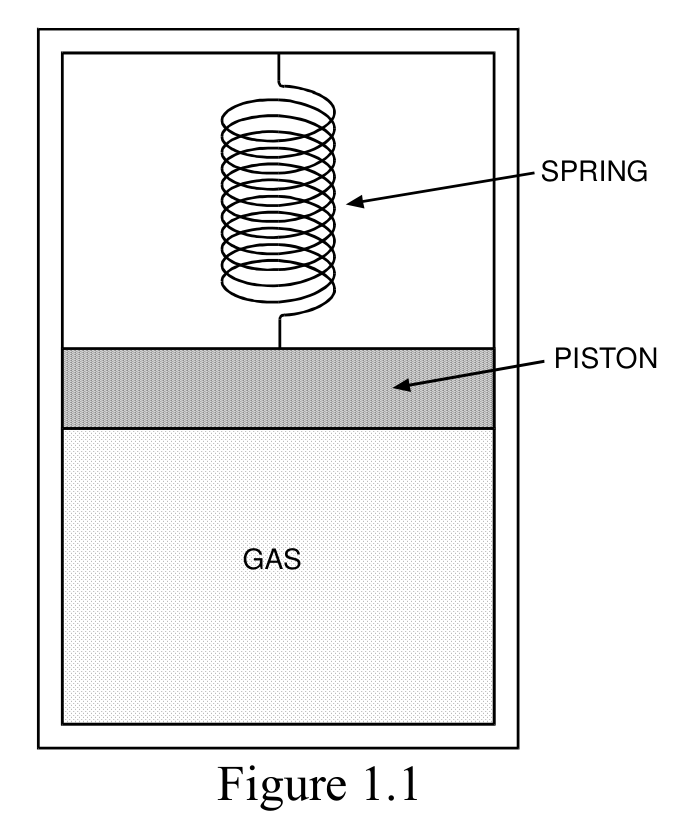
Let the spring constant . All the processes in gas are adiabatic. Gas constant . For mono-atomic gas (Helium) use Laplace constant .
a Calculate the frequency of small oscillation of the piston, when it is slightly displaced from equilibrium position. [2 т.]
b Then the piston is pushed down until the gas volume is halved, and released with zero velocity. calculate the value(s) of the gas volume when the piston speed is . [3 т.]
1B. THE PARAMETRIC SWING (5 points)
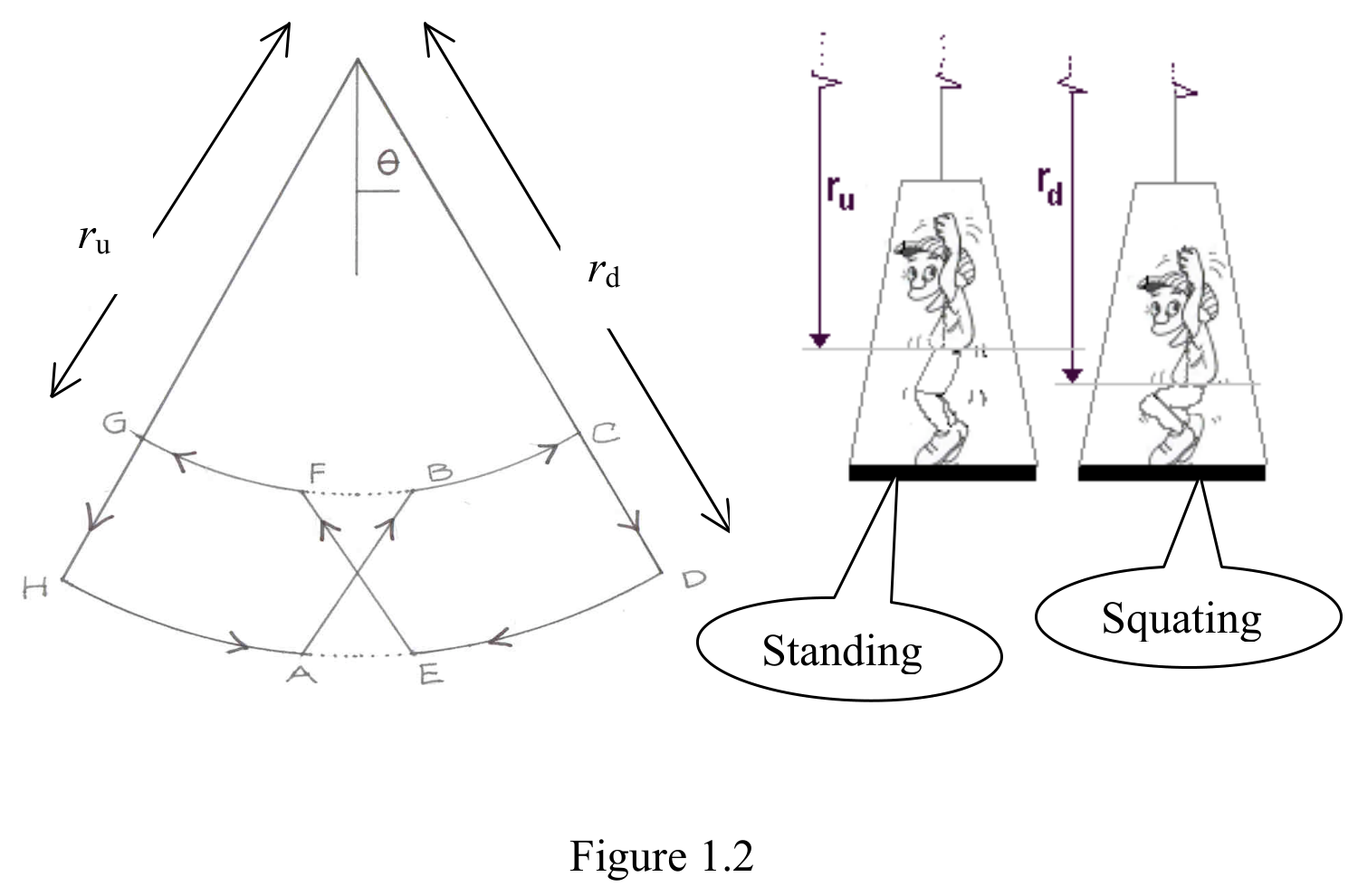
A child builds up the motion of a swing by standing and squatting. The trajectory followed by the center of mass of the child is illustrated in Fig. 1.2. Let be the radial distance from the swing pivot to the child’s center of mass when the child is standing, while is the radial distance from the swing pivot to the child’s center of mass when the child is squatting. Let the ratio of to be , that is the child moves its center of mass by roughly 7% compared to its average radial distance from the swing pivot.
To keep the analysis simple it is assumed that the swing be mass-less, the swing amplitude is sufficiently small and that the mass of the child resides at its center of mass. It is also assumed that the transitions from squatting to standing (the A to B and the E to F transitions) are fast compared to the swing cycle and can be taken to be instantaneous. It is similarly assumed that the squatting transitions (the C to D and the G to H transitions) can also be regarded as occurring instantaneously.
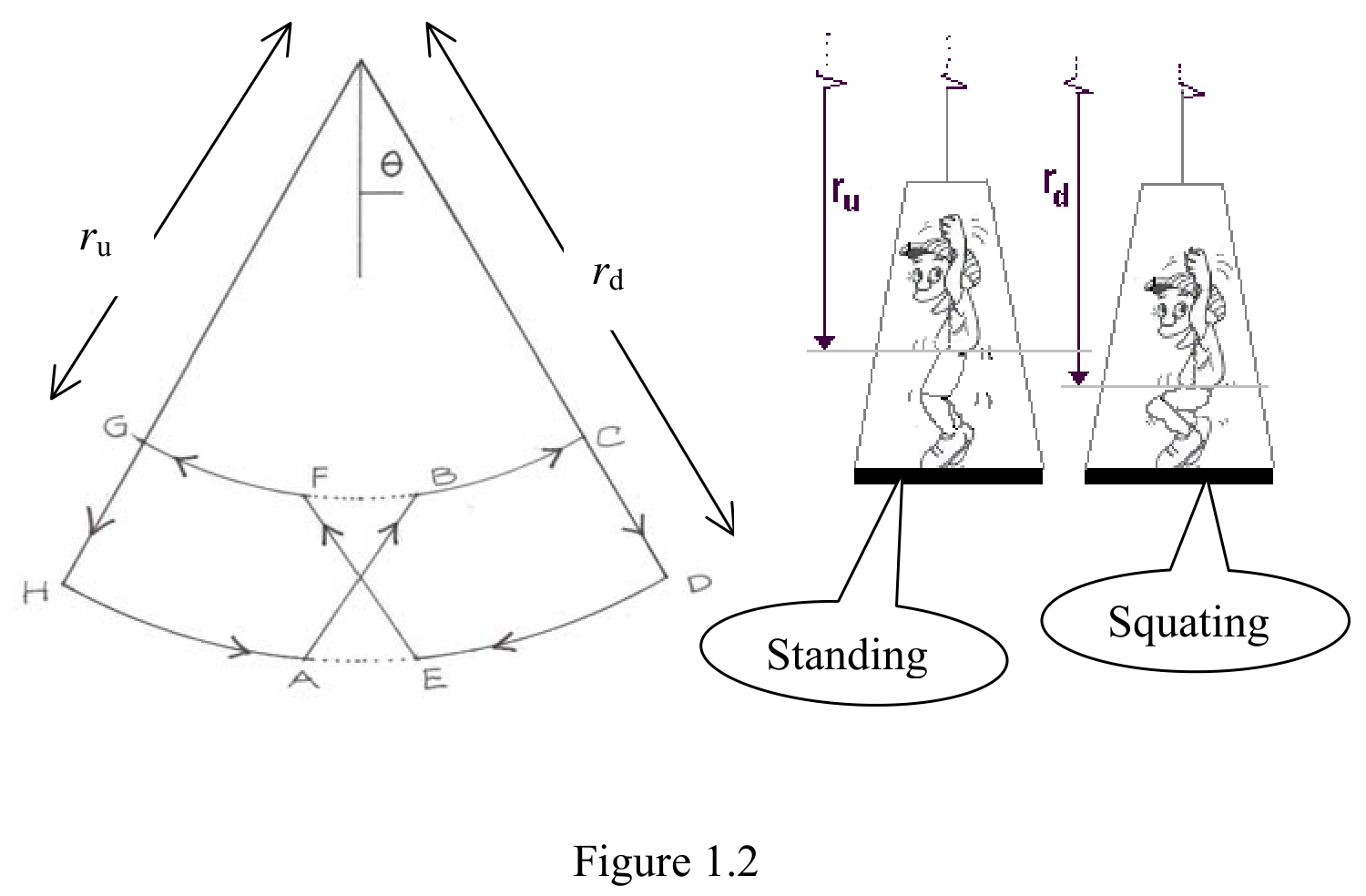
1B How many cycles of this maneuver does it take for the child to build up the amplitude (or the maximum angular velocity) of the swing by a factor of two? [5 т.]
ANSWER FORM
ANSWER FORM
Header fields: Country no; Country code; Student No.; Question No.; Page No.; Total No. of pages.
1A a): (formula) = ___; = ___ Hz.
1A b): (formula) = ___; Value(s) of gas volume = ___.
1B: (number of cycles) = ___.
Решение
1A. SPRING CYLINDER WITH MASSIVE PISTON
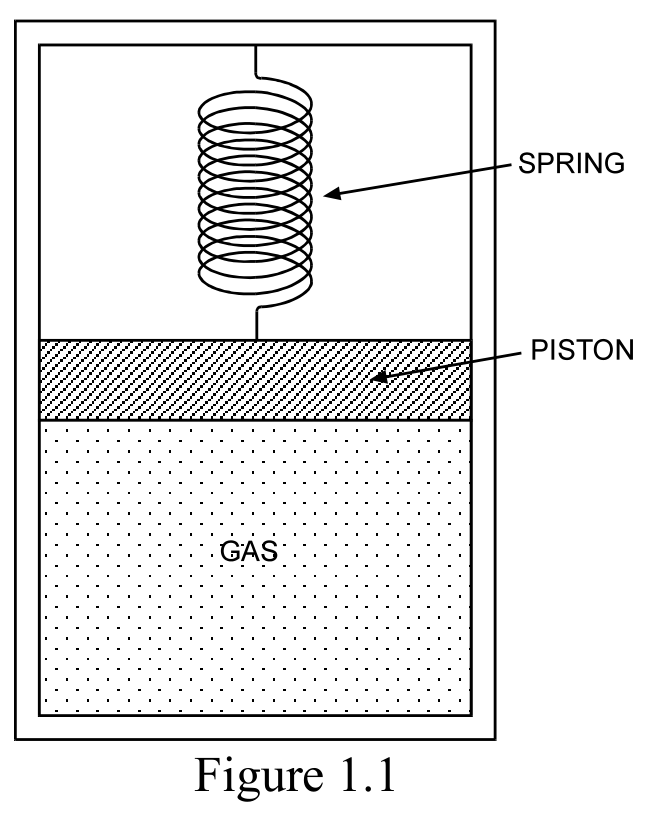
The Questions and Solutions packet repeats the question on native page 1 with the following printed diagram variant.
a) Gas Volume
At the initial condition, the system is in equilibrium and the spring is unstreched; therefore
The initial volume of gas
The work done by the gas from to
Equation (3) can also be obtained by calculating the internal energy change (without integration)
where is the temperature when the gas volume is .
The change of the gravitational potential energy
The change of the potential energy of the spring
The kinetic energy
By conservation of energy, we have
Let , so the above equation becomes
With we get
Solving equation (12) numerically, we get and .
Therefore or .
b) Small Oscillation (2 points)
The equation of motion when the piston is displaced by from the equilibrium position is
is the gas pressure
Since then we have , therefore
The frequency of the small oscillation is
Numerically .
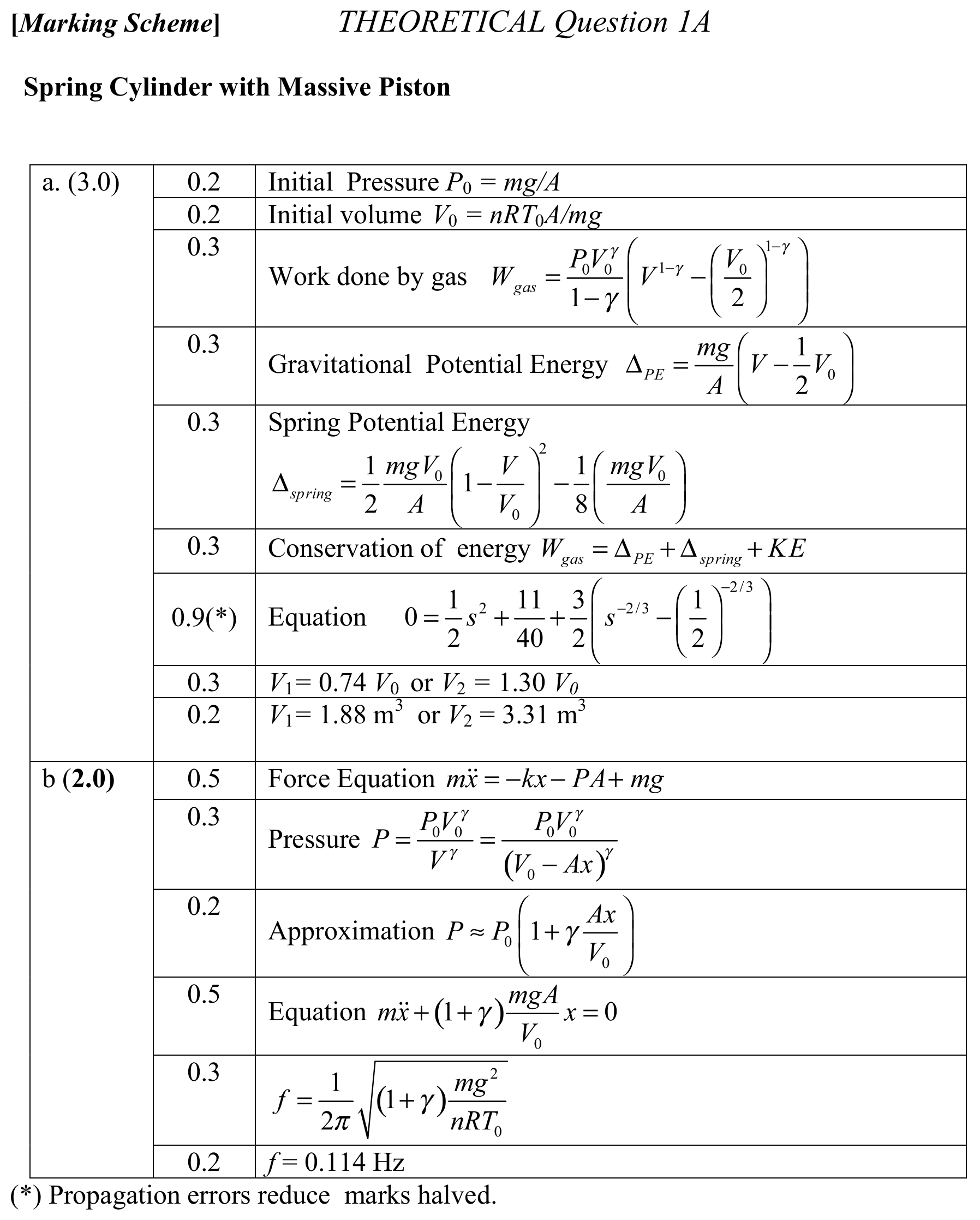
[Marking Scheme] THEORETICAL Question 1A — Spring Cylinder with Massive Piston
The following letters are the key’s printed letters.
| Key part | Marks | Printed item |
|---|---|---|
| a. (3.0) | 0.2 | Initial Pressure |
| a. | 0.2 | Initial volume |
| a. | 0.3 | Work done by gas: |
| a. | 0.3 | Gravitational Potential Energy |
| a. | 0.3 | Spring Potential Energy |
| a. | 0.3 | Conservation of energy |
| a. | 0.9(*) | Equation |
| a. | 0.3 | or |
| a. | 0.2 | or |
| b (2.0) | 0.5 | Force Equation |
| b | 0.3 | Pressure |
| b | 0.2 | Approximation |
| b | 0.5 | Equation |
| b | 0.3 | |
| b | 0.2 |
(*) Propagation errors reduce marks halved.
1B. THE PARAMETRIC SWING (5 points)
The key repeats the question with this native diagram variant.
Solution 1 (5 points)
(1) The conservation of angular momentum (CAM) from A to B, C to D, E to F and G to H.
= mass of the child; = distance of the child’s center of mass to the swing’s pivot P; = the swing’s angular velocity with respect to P.
A to B: Let and are the angular velocity at point A and B respectively, then according to CAM,
so that,
hence each time the swing repeat moving upward (A to B or E to F) its angular speed increases by factor of .
(2) The Conservation of Mechanical Energy (from B to C)
The change of the potential energy (from B to C) is the same as the rotation energy at point B,
Using the similar method, we could get the following equation for the transition from D to E,
From equations (3), (5) and (6) we have,
For half a cycle we have
For complete cycles, the growth of angular velocity amplitude as well as the angular amplitude increases by a factor of .
For then with one gets .
ALTERNATE SOLUTION
The moment of inertia with respect to the swing pivot
Since the A to B transition is fast one has by conservation of angular momentum,
The energy at point A is
The energy at point B is
where is the vertical distance the child’s center of mass moves.
The energy at point C (conservation of energy)
As the child squats at the C to D transition, the swing losses energy of the amount so
Energy at point E is equal to energy at point D (conservation energy)
But we have also
From equation (7) and (8) we have,
Using equation (2) this equation yields,
Where we have used . Using equation (1) one obtains from equation (10)
From this one obtains,
This ratio gives the fractional increase in the amplitude for one half cycle of the swing motion. The fractional increase in the amplitude after cycles is thus,
Where is the initial amplitude and is the amplitude after cycles. Substitute the values,
or,
Thus it takes only 5 swing cycles for the amplitude to build up by a factor of two.
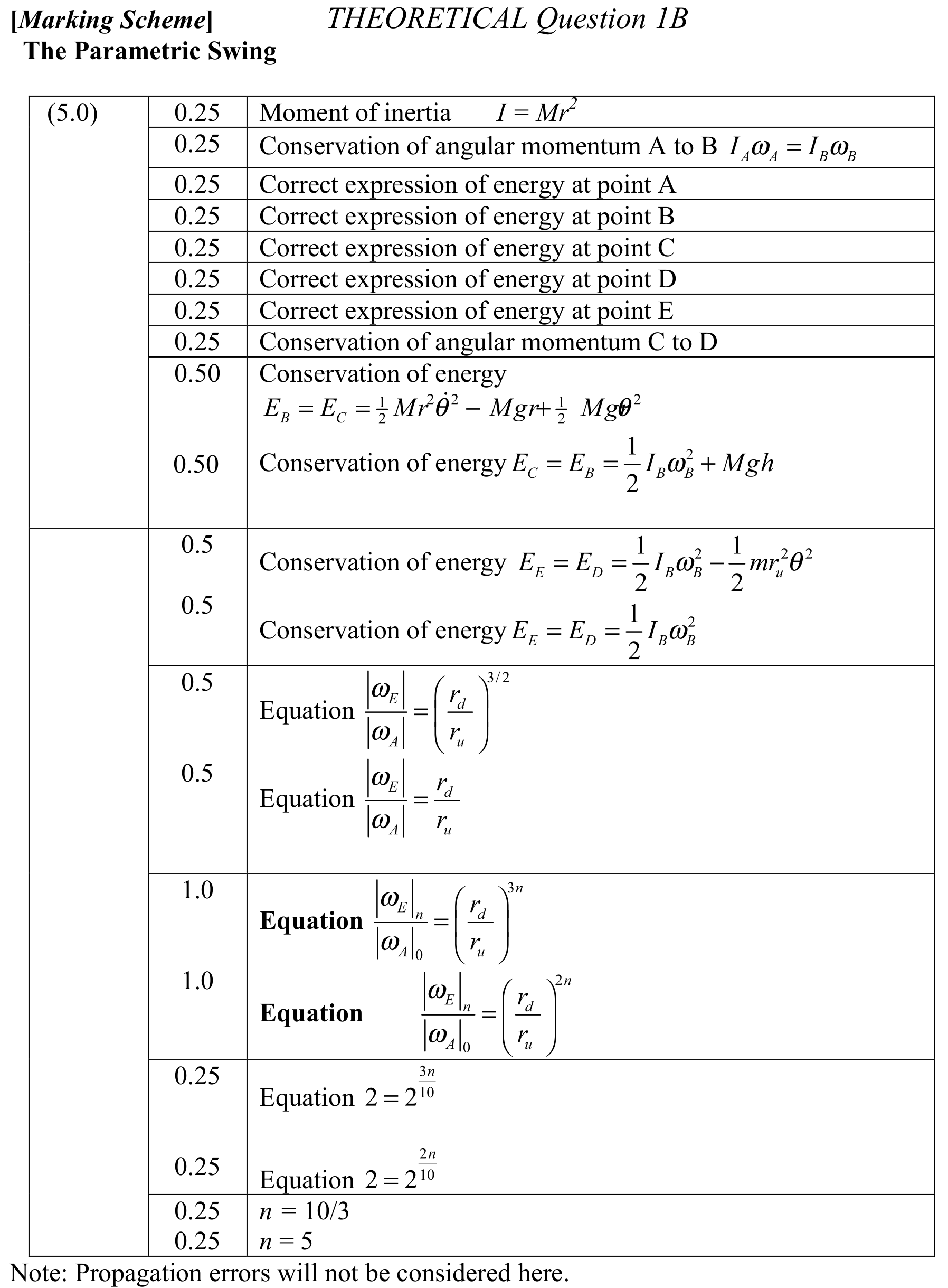
[Marking Scheme] THEORETICAL Question 1B — The Parametric Swing (5.0)
The original prints paired alternatives in shared cells. Their literal formulas and marks follow; alternatives do not create extra question parts.
| Marks | Printed item |
|---|---|
| 0.25 | Moment of inertia |
| 0.25 | Conservation of angular momentum A to B |
| 0.25 | Correct expression of energy at point A |
| 0.25 | Correct expression of energy at point B |
| 0.25 | Correct expression of energy at point C |
| 0.25 | Correct expression of energy at point D |
| 0.25 | Correct expression of energy at point E |
| 0.25 | Conservation of angular momentum C to D |
| 0.50 / 0.50 | Conservation of energy / |
| 0.5 / 0.5 | Conservation of energy / |
| 0.5 / 0.5 | Equation / |
| 1.0 / 1.0 | Equation / |
| 0.25 / 0.25 | Equation / |
| 0.25 / 0.25 | / |
Note: Propagation errors will not be considered here.
Reader note: original key authority and question/key order
The retained th_solutions.pdf is headed 6th Asian Physics Olympiad, Pekanbaru–Indonesia2005, THEORETICAL COMPETITION, Questions and Solutions, FINAL VERSION and contains matching full worked solutions and marking schemes. The question cover carries an APhO.ORG digital-signature attestation. This transcription uses the retained event-branded final key, preserving the original bytes and printed defects. Native key pages2–6 label Gas Volume as a(3.0) and Small Oscillation as b(2.0); the question and the repeated stem label frequency a(2), volume b(3). The key’s letters/order and the question’s letters/order are both retained.
Reader note: two printed swing alternatives and literal formulas
The key prints Solution1 ending n=10/3 and ALTERNATE SOLUTION ending n=5. Its marking table prints both as paired alternatives. Both complete derivations survive without choosing or silently reconciling the two outcomes. Solution1 Eq2 lacks an equals sign between L_B and the following mr_u² angular-velocity term; Eq4 has a minus potential-energy term. The rubric also prints its own literal energy expressions. These are retained rather than substituted with an inferred correction.
Reader note: literal magnetic-field result and reference
The solenoid calculation prints B=4.24mT while its rubric prints4.23mT. Both values survive. The fringe-field derivation literally refers to figure4; the diagram captions remain2.4 and2.5, and its Eq9 uses ΔP_z while the rubric prints a total subscript. These source forms remain literal.
Reader note: vector glyph correspondence and malformed native graphics
Native question pages10–11 show aberrant vector accents, and Figure2.4 contains an aberrant field icon. Personally viewed MuPDF and retained Poppler previews agree on those forms, so they are not represented as a detected loss peculiar to one renderer. The matching repeated prose on native key pages21–22 prints actual vector arrows; typed vector notation follows that retained source correspondence. All question diagrams and distinct key diagram versions preserve actual original pixels, including the malformed field icon and overlaid key Figures3.1,3.2,3.4. No graphic is redrawn or repaired.
Reader note: literal mirror allocations and unnamed-point gap
The question and repeated stem give3A2.5points,3B2points,3C5.5points; the original marking tables giveA3.0,B2.0,C5.0. Native point allocations remain unchanged. Question3C and its key literally say atoms at point without naming the point; this original gap remains in both transcribed passages. The printed frequency equality0.5 and50% conclusion remain literal rather than replaced by a recomputed value. no further companion is listed in the exact retained Theory archive folder.
Оригинал в Архива: th_problems.pdf · официални решения: th_solutions.pdf