APhO 2005, Теория — Задача 3. Question 3 LIGHT DEFLECTION BY A MOVING MIRROR
6th Asian Physics Olympiad — theoretical competition · 10 т.
Внимание: Бележка към темата
Complete3native whole questions/9requests,14Q+30final-key pages, full derivations, both original swing alternatives, all native rubrics and four blank forms. Printed reversed subpart labels, conflicting swing counts, mirror allocations, field rounding, unnamed-point text and aberrant/overlaid native graphics remain source-attributed and literal.
Native cover and instructions — Wednesday, April 27th, 2005
Please read this first: 1. The time available is 5 hours for the theoretical competition. 2. Use only the pen provided. 3. Use only the front side of the paper. 4. Begin each part of the problem on a separate sheet. 5. For each question, in addition to the blank sheets where you may write, there is an answer form where you must summarize the results you have obtained. Numerical results should be written with as many digits as are appropriate to the given data. 6. Write on the blank sheets of paper whatever you consider is required for the solution of the question. Please use as little text as possible; express yourself primarily in equations, numbers, figures, and plots. 7. Fill in the boxes at the top of each sheet of paper used by writing your Country No and Country Code, your student number (Student No), the number of the question (Question No), the progressive number of each sheet (Page No), and the total number of blank sheets used for each question (Total No of pages). Write the question number and the section letter of the part you are answering at the top of each sheet. If you use some blank sheets of paper for notes that you do not wish to be marked, put a large X across the entire sheet and do not include it in your numbering. 8. At the end of the exam, arrange all sheets for each problem in the following order; ; answer form ; used sheets in order ; the sheets you do not wish to be marked ; unused sheets and the printed question Place the papers inside the envelope and leave everything on your desk. You are not allowed to take any sheets of paper out of the room.
Условие
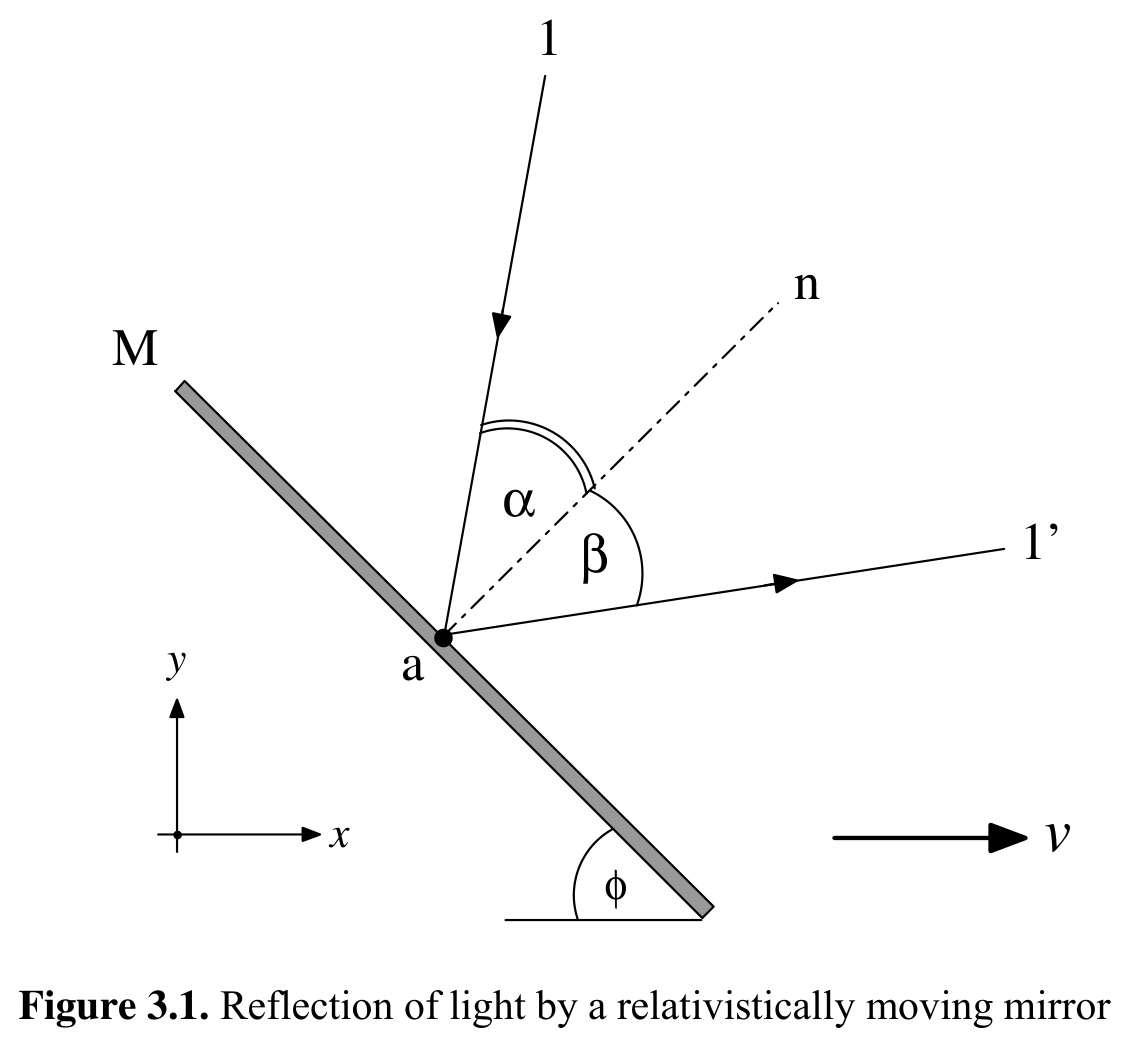
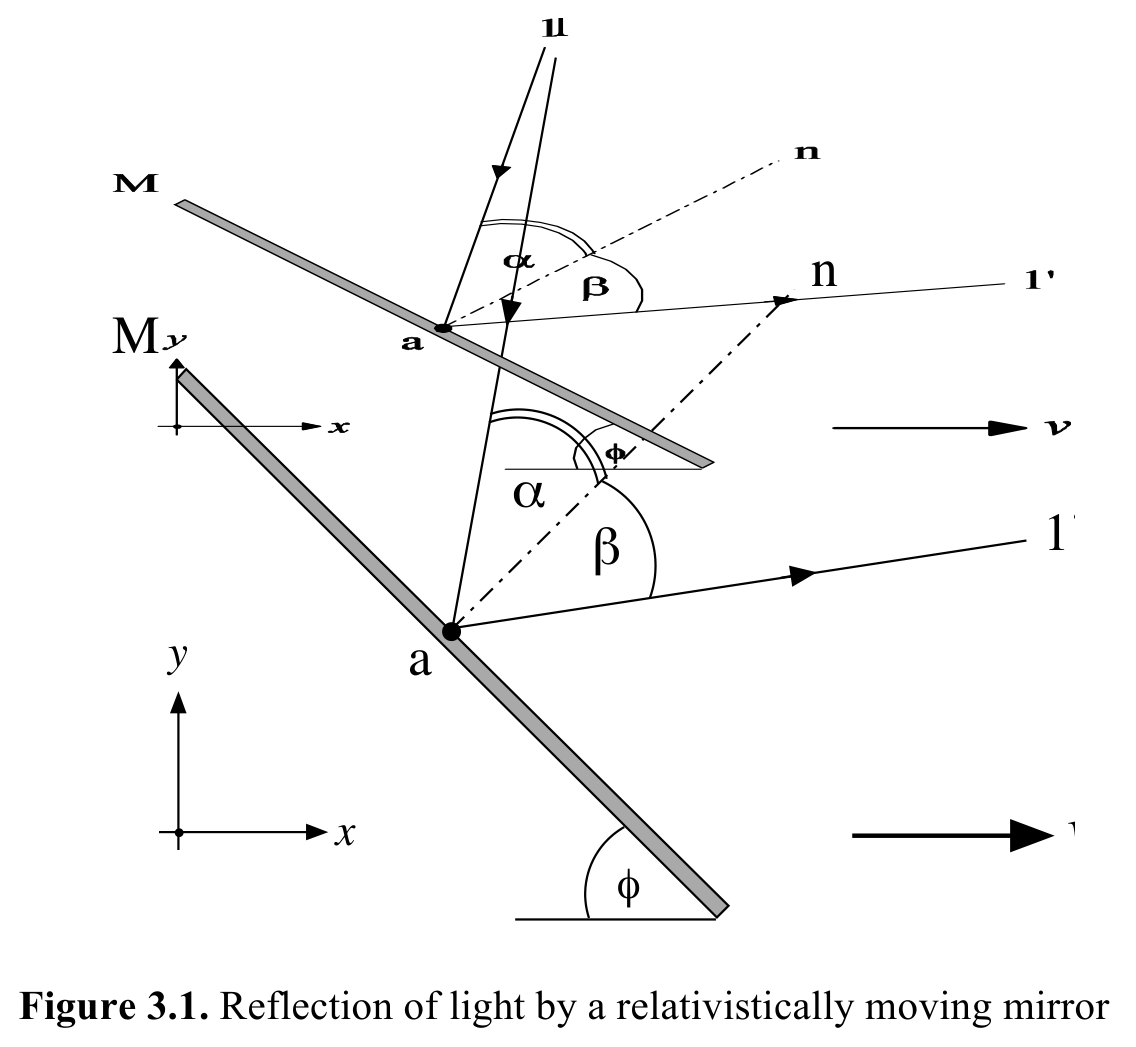
Reflection of light by a relativistically moving mirror is not theoretically new. Einstein discussed the possibility or worked out the process using the Lorentz transformation to get the reflection formula due to a mirror moving with a velocity . This formula, however, could also be derived by using a relatively simpler method. Consider the reflection process as shown in Fig. 3.1, where a plane mirror M moves with a velocity (where is a unit vector in the x-direction) observed from the lab frame F. The mirror forms an angle with respect to the velocity (note that , see figure 3.1). The plane of the mirror has as its normal. The light beam has an incident angle and reflection angle which are the angles between and the incident beam 1 and reflection beam , respectively in the laboratory frame F. It can be shown that,
3A. Einstein’s Mirror (2.5 points)
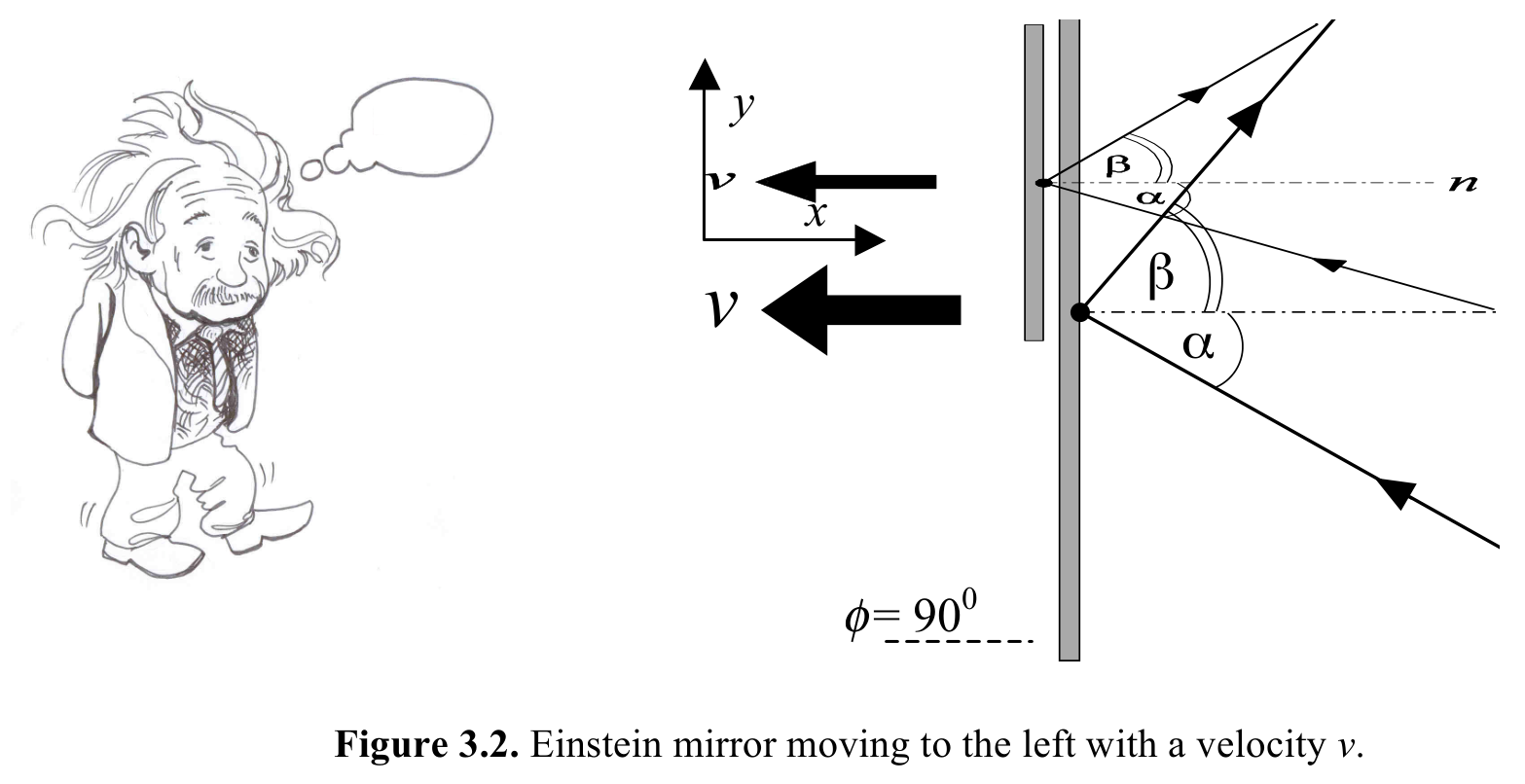
About a century ago Einstein derived the law of reflection of an electromagnetic wave by a mirror moving with a constant velocity (see Fig. 3.2). By applying the Lorentz transformation to the result obtained in the rest frame of the mirror, Einstein found that:
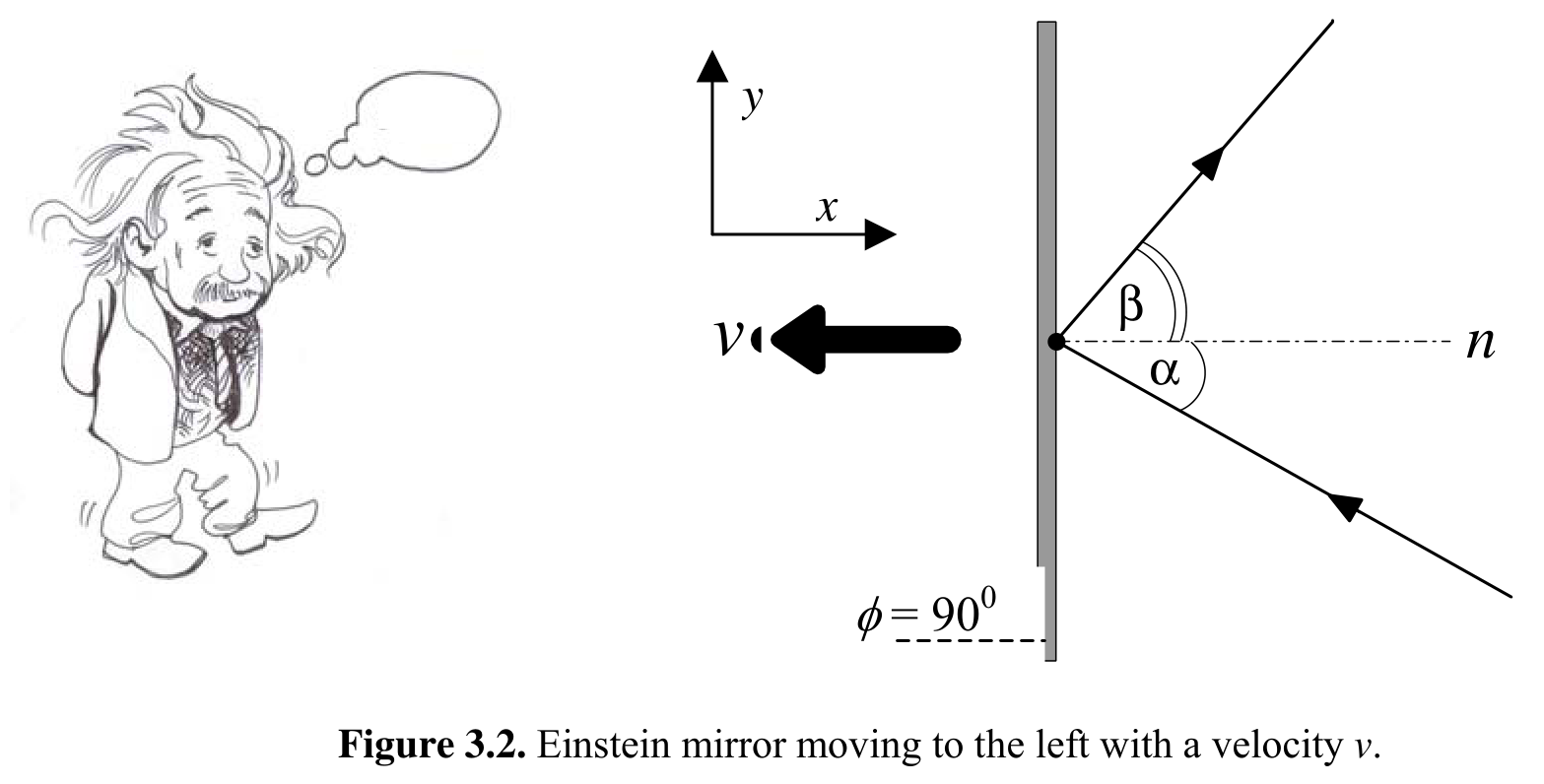
3A Derive this formula using Equation (1) without Lorentz transformation! [2,5 т.]
3B. Frequency Shift (2 points)
3B In the same situation as in 3A, if the incident light is a monochromatic beam hitting M with a frequency , find the new frequency after it is reflected from the surface of the moving mirror. If and in figure 3.2, find frequency shift in percentage of . [2 т.]
3C. Moving Mirror Equation (5.5 Points)
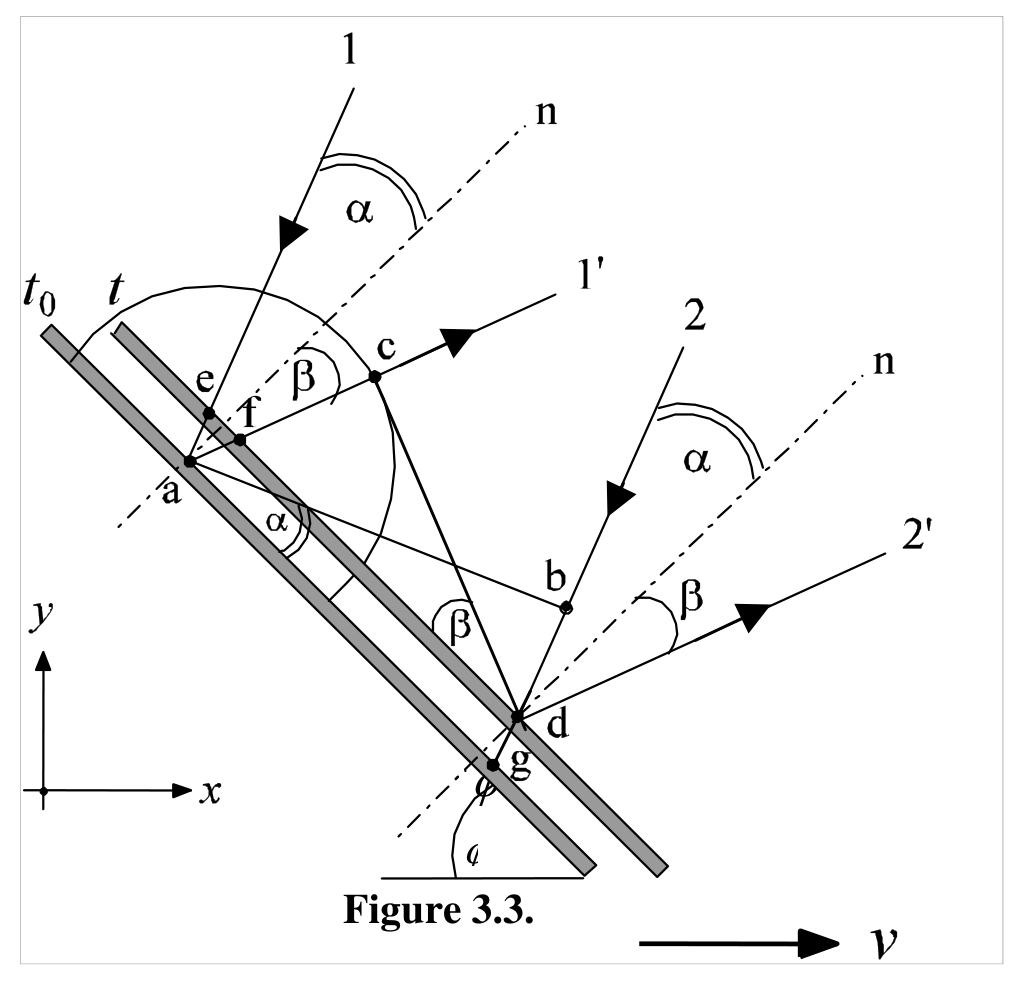
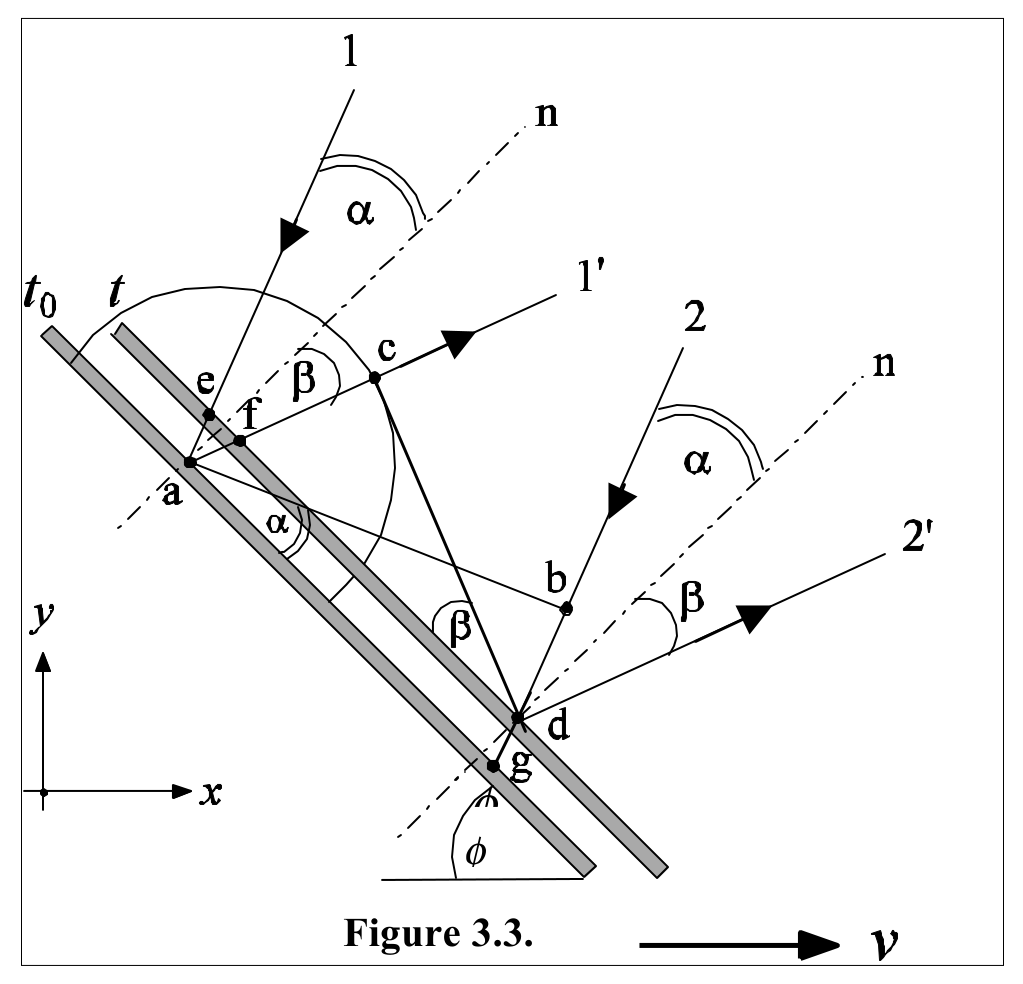
Figure 3.3 shows the positions of the mirror at time and . Since the observer is moving to the left, the mirror moves relatively to the right. Light beam 1 falls on point at and is reflected as beam . Light beam 2 falls on point at and is reflected as beam . Therefore, is the wave front of the incoming light at time . The atoms at point are disturbed by the incident wave front and begin to radiate a wavelet. The disturbance due to the wave front stops at time when the wavefront strikes point . The semicircle in the figure represents wave-front of the wavelet at time .
3C By referring to figure 3.3 for light wave propagation or using other methods, derive equation (1). [5,5 т.]
ANSWER FORM
ANSWER FORM — 3
Header fields: Country no; Country code; Student No.; Question No.; Page No.; Total No. of pages.
3A) Einstein’s Mirror — Proof: blank box.
3B. Shift Frequency — Frequency Shift = blank box.
3C. Moving Mirror Equation — Proof: blank box.
Решение
The original Questions and Solutions packet repeats the complete question on pages 21–23 with clear printed vector arrows in its prose and these native diagram variants. The source overlays multiple versions in Figures 3.1 and 3.2; the printed pixels are retained.
a) EINSTEIN’S MIRROR
By taking and replacing with in Equation (1) we obtain
This equation can also be written in the form of
The square of this equation can be written in terms of a squared equation of , as follows,
which has two solutions,
and
However, if the mirror is at rest () then ; therefore the proper solution is
b) FREQUENCY SHIFT
The reflection phenomenon can be considered as a collision of the mirror with a beam of photons each carrying an incident and reflected momentum of magnitude
The conservation of linear momentum during its reflection from the mirror for the component parallel to the mirror appears as
Thus
For and ,
so that
Thus, there is a decrease of frequency by 50% due to reflection by the moving mirror.
c) RELATIVISTICALLY MOVING MIRROR EQUATION
Figure 3.3 shows the positions of the mirror at time and . Since the observer is moving to the left, system is moving relatively to the right. Light beam 1 falls on point at and is reflected as beam . Light beam 2 falls on point at and is reflected as beam . Therefore, is the wave front of the incoming light at time . The atoms at point are disturbed by the incident wave front and begin to radiate a wavelet. The disturbance due to the wave front stops at time when the wavefront strikes point . As a consequence
From this figure we also have , and
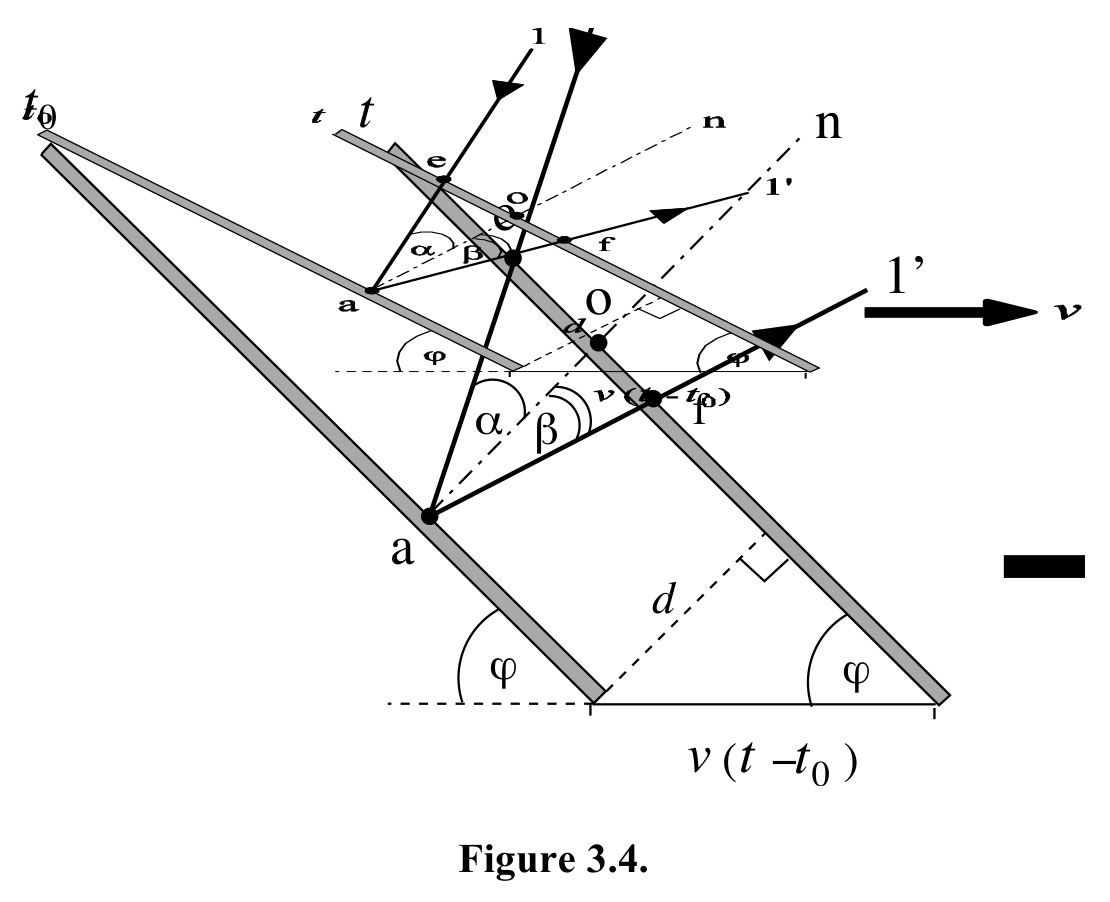
Figure 3.4 displays the beam path 1 in more detail. From this figure it is easy to show that
and
From the triangles and we have and . Since , then
By substituting Equations (14), (16), (17), and (18) into Equation (15) we obtain
and
Eliminating from the two Equations above leads to
By collecting the terms containing we obtain
or
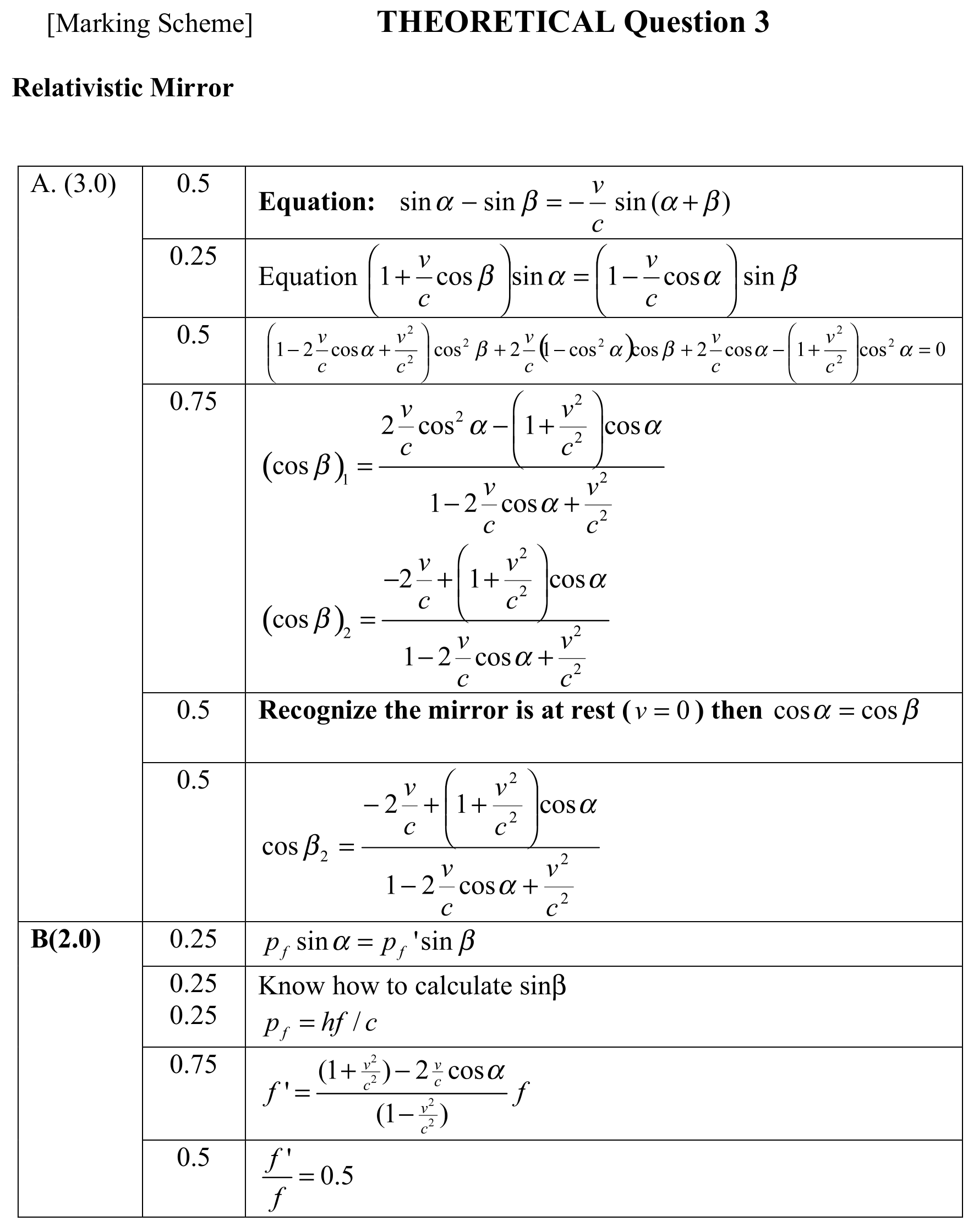
[Marking Scheme] THEORETICAL Question 3 — Relativistic Mirror
The printed key totals are A. (3.0), B(2.0), and (5.0) for C. The question paper instead assigns 2.5, 2, and 5.5 points. All literal allocations remain below.
| Part | Marks | Printed item |
|---|---|---|
| A. (3.0) | 0.5 | Equation |
| A. | 0.25 | Equation |
| A. | 0.5 | |
| A. | 0.75 | and |
| A. | 0.5 | Recognize the mirror is at rest () then |
| A. | 0.5 | |
| B(2.0) | 0.25 | |
| B | 0.25 | Know how to calculate sinβ |
| B | 0.25 | |
| B | 0.75 | |
| B | 0.5 |
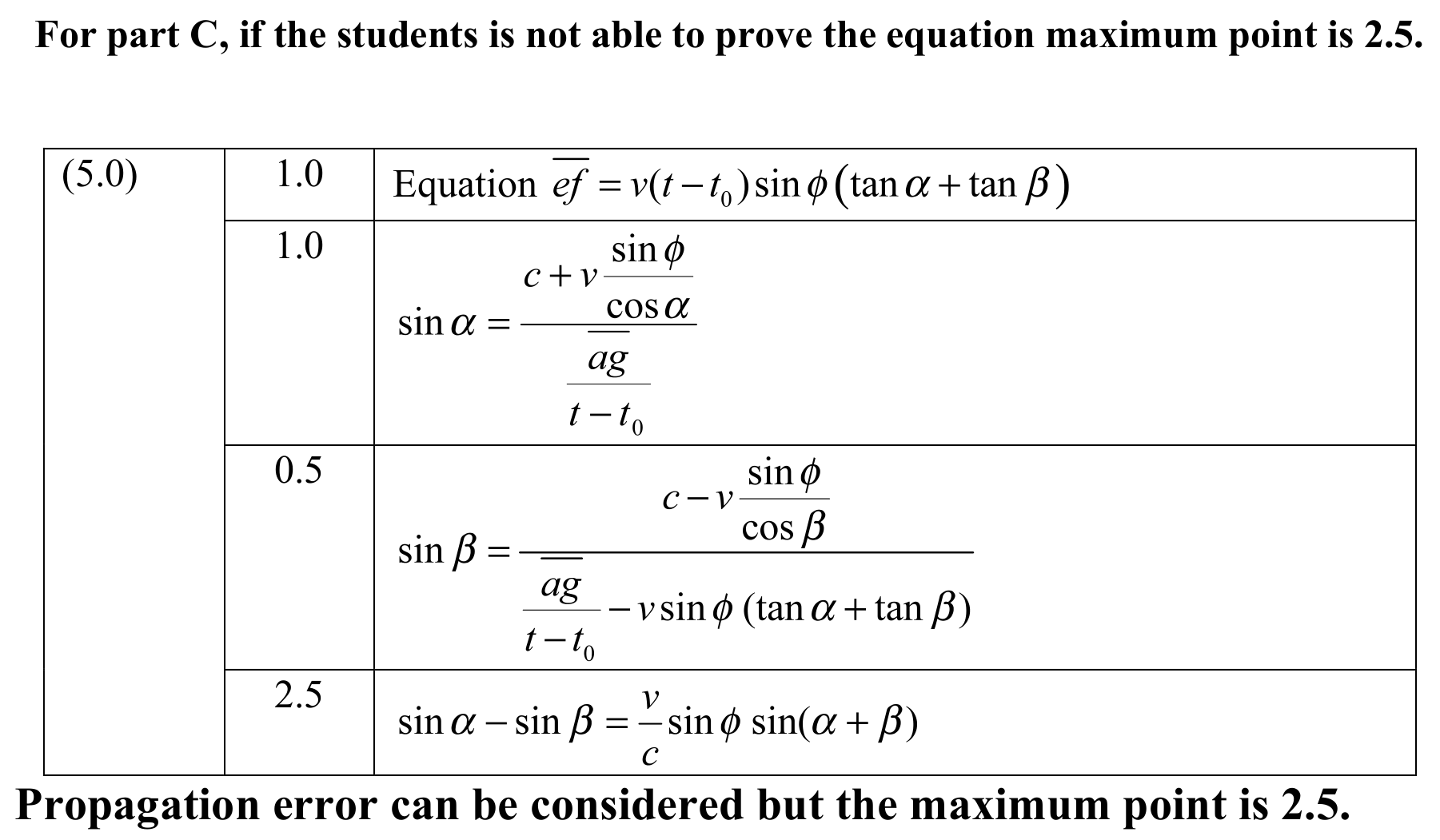
For part C, if the students is not able to prove the equation maximum point is 2.5.
| Part | Marks | Printed item |
|---|---|---|
| (5.0) | 1.0 | Equation |
| C | 1.0 | |
| C | 0.5 | |
| C | 2.5 |
Propagation error can be considered but the maximum point is 2.5.
Reader note: original key authority and question/key order
The retained th_solutions.pdf is headed 6th Asian Physics Olympiad, Pekanbaru–Indonesia2005, THEORETICAL COMPETITION, Questions and Solutions, FINAL VERSION and contains matching full worked solutions and marking schemes. The question cover carries an APhO.ORG digital-signature attestation. This transcription uses the retained event-branded final key, preserving the original bytes and printed defects. Native key pages2–6 label Gas Volume as a(3.0) and Small Oscillation as b(2.0); the question and the repeated stem label frequency a(2), volume b(3). The key’s letters/order and the question’s letters/order are both retained.
Reader note: two printed swing alternatives and literal formulas
The key prints Solution1 ending n=10/3 and ALTERNATE SOLUTION ending n=5. Its marking table prints both as paired alternatives. Both complete derivations survive without choosing or silently reconciling the two outcomes. Solution1 Eq2 lacks an equals sign between L_B and the following mr_u² angular-velocity term; Eq4 has a minus potential-energy term. The rubric also prints its own literal energy expressions. These are retained rather than substituted with an inferred correction.
Reader note: literal magnetic-field result and reference
The solenoid calculation prints B=4.24mT while its rubric prints4.23mT. Both values survive. The fringe-field derivation literally refers to figure4; the diagram captions remain2.4 and2.5, and its Eq9 uses ΔP_z while the rubric prints a total subscript. These source forms remain literal.
Reader note: vector glyph correspondence and malformed native graphics
Native question pages10–11 show aberrant vector accents, and Figure2.4 contains an aberrant field icon. Personally viewed MuPDF and retained Poppler previews agree on those forms, so they are not represented as a detected loss peculiar to one renderer. The matching repeated prose on native key pages21–22 prints actual vector arrows; typed vector notation follows that retained source correspondence. All question diagrams and distinct key diagram versions preserve actual original pixels, including the malformed field icon and overlaid key Figures3.1,3.2,3.4. No graphic is redrawn or repaired.
Reader note: literal mirror allocations and unnamed-point gap
The question and repeated stem give3A2.5points,3B2points,3C5.5points; the original marking tables giveA3.0,B2.0,C5.0. Native point allocations remain unchanged. Question3C and its key literally say atoms at point without naming the point; this original gap remains in both transcribed passages. The printed frequency equality0.5 and50% conclusion remain literal rather than replaced by a recomputed value. no further companion is listed in the exact retained Theory archive folder.
Оригинал в Архива: th_problems.pdf · официални решения: th_solutions.pdf