APhO 2006, Теория — Задача 1. Laser cooling of atoms
Theoretical Question 1: Laser cooling of atoms · 10 т.
Внимание: Бележка към темата
The original text uses η for the constant whose listed value is that of ℏ; Figure 1 uses ℏ. The printed opening energy difference E_g − E_e = ηω₀ and the solution’s small-velocity condition υ_x/c ≪ δ/ω₀ are retained as printed.
Условие
In this problem you are asked to consider the mechanism of atom cooling with the help of laser radiation. Investigations in this field led to considerable progress in the understanding of the properties of quantum gases of cold atoms, and were awarded Nobel prizes in 1997 and 2001.
Theoretical Introduction
Consider a simple two-level model of the atom, with ground state energy and excited state energy . Energy difference is , the angular frequency of used laser is , and the laser detuning is . Assume that all atom velocities satisfy , where is the light speed. You can always restrict yourself to first nontrivial orders in small parameters and . Natural width of the excited state due to spontaneous decay is : for an atom in an excited state, the probability to return to a ground state per unit time equals . When an atom returns to a ground state, it emits a photon of a frequency close to in a random direction.
It can be shown in quantum mechanics, that when an atom is subject to low-intensity laser radiation, the probability to excite the atom per unit time depends on the frequency of radiation in the reference frame of the atom, , according to
where is a parameter, which depends on the properties of atoms and laser intensity.
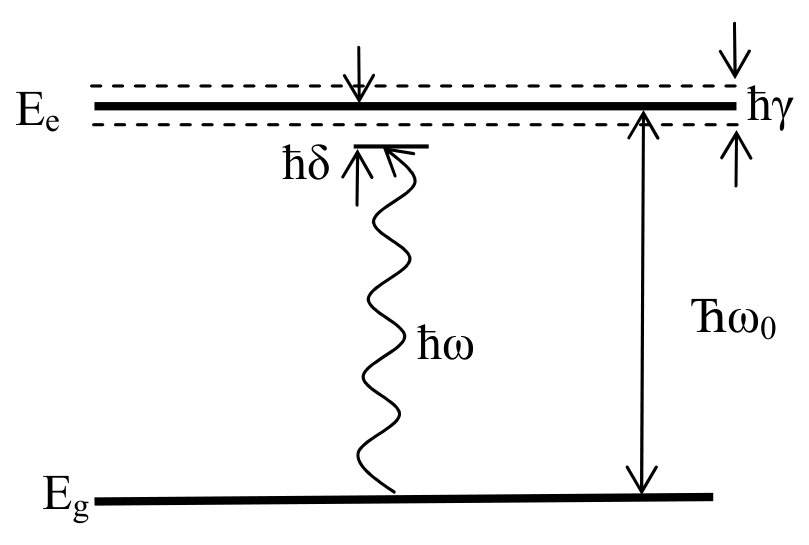
In this problem properties of the gas of sodium atoms are investigated neglecting the interactions between the atoms. The laser intensity is small enough, so that the number of atoms in the excited state is always much smaller than number of atoms in the ground state. You can also neglect the effects of the gravitation, which are compensated in real experiments by an additional magnetic field.
Numerical values:
| Planck constant | |
|---|---|
| Boltzmann constant | |
| Mass of sodium atom | |
| Frequency of used transition | |
| Excited state linewidth | |
| Concentration of the atoms |
Questions
a) Suppose the atom is moving in the positive direction with the velocity , and the laser radiation with frequency is propagating in the negative direction. What is the frequency of radiation in the reference frame of the atom? [1 т.]
b) Suppose the atom is moving in the positive direction with the velocity , and two identical laser beams shine along direction from different sides. Laser frequencies are , and intensity parameters are . Find the expression for the average force acting on an atom. For small this force can be written as . Find the expression for . What is the sign of , if the absolute value of the velocity of the atom decreases? Assume that momentum of an atom is much larger than the momentum of a photon. [2,5 т.]
In what follows we will assume that the atom velocity is small enough so that one can use the linear expression for the average force.
c) If one uses 6 lasers along , and axes in positive and negative directions, then for the dissipative force acts on the atoms, and their average energy decreases. This means that the temperature of the gas, which is defined through the average energy, decreases. Using the concentration of the atoms given above, estimate numerically the temperature , for which one cannot consider atoms as point-like objects because of quantum effects. [2 т.]
In what follows we will assume that the temperature is much larger than and six lasers along , and directions are used, as was explained in part c).
In part b) you calculated the average force acting on the atom. However, because of the quantum nature of photons, in each absorption or emission process the momentum of the atom changes by some discrete value and in random direction, due to the recoil processes.
d) Determine numerically the square value of the change of the momentum of the atom, , as the result of one absorption or emission event. [0,5 т.]
e) Because of the recoil effect, average temperature of the gas after long time doesn’t become an absolute zero, but reaches some finite value. The evolution of the momentum of the atom can be represented as a random walk in the momentum space with an average step , and a cooling due to the dissipative force. The steady-state temperature is determined by the combined effect of these two different processes. Show that the steady state temperature is of the form:
Determine . Assume that is much larger than . [3,5 т.]
Note: If vectors are mutually statistically uncorrelated, mean square value of their sum is
f) Find numerically the minimal possible value of the temperature due to recoil effect. For what ratio is it achieved? [0,5 т.]
Решение
a)
, this is classic Doppler effect.
b)
Absolute value of the momentum, transferred during each absorption, equals
The momentum of the emitted photon is uniformly distributed over different directions, and after averaging gives a contribution which is much smaller than . The average force is nonzero, since for atoms moving towards right frequency of right laser gets larger (due to Doppler effect discussed in part A), while frequency of left laser goes down. Since number of scattered photons depends on the frequency in the reference frame of the atom, there is a net nonzero force. It equals
For ,
For , one needs .
c)
Characteristic de-Broglie wavelength at temperature equals . To consider the atoms as point-like objects one needs this distance to be much smaller than characteristic inter particle separation . From the condition that these two lengths are of the same order of magnitude we get
d)
— this is the mean square recoil momentum of a photon.
e)
Assume that the steady state value of the average square of the momentum of atom equals . In steady state regime this quantity doesn’t change with time, and temperature is obtained according to . Let the momentum at some point of time in steady state regime be . Let’s consider the value of the momentum after some time . During this time the atom will participate in absorption-emission processes (6 comes from the number of lasers). For each absorption-emission event the atom gets two recoil kicks, each with a mean square value calculated in part d) (one kick is during absorption and one is during emission). The directions of these kicks are uncorrelated for different events, so this leads to an increase of the mean square of the momentum by .
On the other hand, atoms are cooled because of the dissipative force, and the change of the mean square of the momentum because of this process is .
For steady state solution these two processes compensate each other, so we obtain:
Thus the temperature
f)
The minimum is achieved for , and equals
Mark Distribution
| No. | Total Pt | Partial Pt | Contents |
|---|---|---|---|
| a) | 1 | Expression for Doppler shifted frequency | |
| b) | 2.5 | 0.3 | Expression for photon momentum (1) |
| 0.5 | Correct or with the Doppler shifted frequency | ||
| 1.0 | Expression for | ||
| 0.5 | Expression for | ||
| 0.2 | The correct sign of | ||
| c) | 2.0 | 0.5 | Expression for characteristic de Broglie wavelength or an estimate from uncertainty principle |
| 0.5 | Expression for characteristic inter particle separation | ||
| 0.5 | The equality between De Broglie wavelength and inter-particle separation | ||
| 0.5 | Numerical value of temperature | ||
| d) | 0.5 | Numerical answer | |
| e) | 3.5 | 0.5 | Calculation of the number of absorption-emission processes during time |
| 1.5 | Expression for the change of the mean square momentum (or energy) for time due to random kicks (heating rate) | ||
| 0.5 | Expression for the cooling rate | ||
| 1.0 | Final expression | ||
| f) | 0.5 | 0.3 | Expression for minimal temperature and numerical value |
| 0.2 |