APhO 2007, Теория — Задача 1. Back-and-Forth Rolling of a Liquid-Filled Sphere
Physics Competition — Theoretical Competition — 8th APhO, Shanghai·China 2007 · 10 т.
Please read this first
Please read this first:
The time available is 5 hours for the theoretical competition.
- Use only the pen provided.
- Use only the one side of the paper.
- Begin each part of the problem on a separate sheet.
- For each question, in addition to the blank sheets where you may write, there is an answer sheet where you must summarize the results you have obtained. Numerical results should be written with as many digits as are appropriate to the given data.
- Write on the blank sheets of paper whatever you consider is required for the solution of the question. Please use as little text as possible; express your answers primarily in equations, numbers, figures, and plots.
- Fill in the boxes at the top of each answer sheet of paper used by writing your student code as shown on your identification tag, and additionally on the “blank” sheets: your student code, the problem number, the progressive number of each sheet (Page n. from 1 to N) and the total number (N) of “blank” sheets that you use and wish to be evaluated (Page total) for each problem; If you use some blank sheets of paper for notes that you do not wish to be marked, put a large X across the entire sheet and do not include it in your numbering.
- At the end of the competition, arrange all sheets for each problem in the following order:
(a) answer sheet (b) used sheets in order (c) the sheets you do not wish to be marked (d) unused sheets and the printed questions
Place the papers inside the envelope provided and leave everything on your desk. You are not allowed to take any sheets of paper out of the room.
Условие
Consider a sphere filled with liquid inside rolling back and forth at the bottom of a spherical bowl. That is, the sphere is periodically changing its translational and rotational direction. Due to the viscosity of the liquid inside, the movement of the sphere would be very complicated and hard to deal with. However, a simplified model presented here would be beneficial to the solution of such a problem.
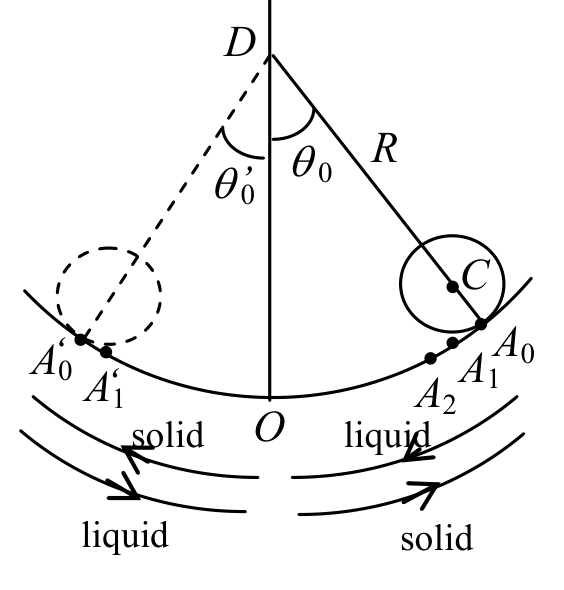
Assume that a rigid thin spherical shell of radius and mass is fully filled with some liquid substance of mass , denoted as W. W has such a unique property that usually it behaves like an ideal liquid (i.e. without any viscosity), while in response to some special external influence (such as electric field) it transits to solid state immediately with the same volume; and once the applied influence removed, the liquid state recovers immediately. Besides, this influence does not give rise to any force or torque exerting on the sphere. This liquid-filled spherical shell (for convenience, called ‘the sphere’ hereafter) is supposed to roll back and forth at the bottom of a spherical bowl of radius ( ) without any relative slipping, as shown in the figure. Assume the sphere moves only in the vertical plane (namely, the plane of the figure), please study the movement of the sphere for the following three cases:
- W behaves as in ideal solid state, meanwhile W contacts the inner wall of the spherical shell so closely that they can be taken as solid sphere as a whole of radius with an abrupt density change across the interface between the inside wall of the shell and W.
1.(1) Calculate the rotational inertia of the sphere with respect to the axis passing through its center . (You are asked to show detailed steps.) [1 т.]
1.(2) Calculate the period of the sphere rolling back and forth with a small amplitude without slipping at the bottom of the spherical bowl. [2,5 т.]
2. W behaves as an ideal liquid with no friction between W and the spherical shell. Calculate the period of the sphere rolling back and forth with a small amplitude without slipping at the bottom of the spherical bowl. [2,5 т.]
3. W transits between ideal solid state and ideal liquid state.
Assume at time , the sphere is kept at rest, the line makes an angle ()with the plumb line , where is the center of the spherical bowl. The sphere contacts the inner wall of the bowl at point , as shown in the figure. Release the sphere, it starts to roll left from rest. During the motion of the sphere from to its equilibrium position , W behaves as ideal liquid. At the moment that the sphere passes through point , W changes suddenly into solid state and sticks itself firmly on the inside wall of the sphere shell until the sphere reaches the left highest position . Once the sphere reaches , W changes suddenly back into the liquid state. Then, the sphere rolls right; and W changes suddenly into solid state and sticks itself firmly on the inside wall of the spherical shell again when the sphere passes through the equilibrium position . When the sphere reaches the right highest position , W changes into liquid state once again. Then the whole circle repeats time after time. The sphere rolls right and left periodically but with the angular amplitude decreased time after time. The motion direction of the sphere is shown by curved arrows in the figure, together with the words “solid” and “liquid” showing corresponding state of W. It is assumed that during such process of rolling back and forth, no any relative slide happens between the sphere and the inside wall of the bowl (or, alternatively, the bottom of the bowl can supply as enough friction as needed). Calculate the period of the sphere rolling right and left, and the angular amplitude of the center of the sphere, namely, the angle that the line makes with the vertical line when the sphere reaches the right highest position for the n-th time (only is shown in the figure). [4 т.]
Отговори
- 1.(1)
- 1.(2)
- 2.
- 3.
Решение
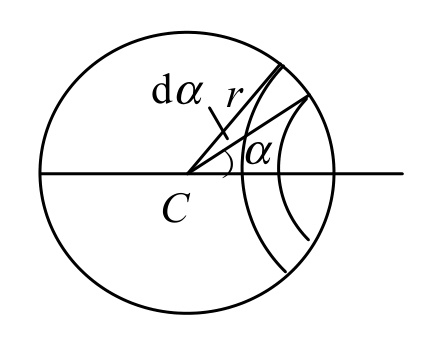
1.(1) Let and denote the rotational inertia of the spherical shell and W in solid state respectively, while be the sum of and . The surface mass density of the spherical shell is . Cut a narrow zone from the spherical shell perpendicular to its diameter, which spans a small angle with respect to the center of the sphere , while the spherical zone makes an angle with the diameter of the spherical shell, which is called axes hereafter, as shown in Fig. 1. The rotational inertia of the narrow zone about the axis is , therefore integral over the whole spherical shell gives
The volume density of W is . By using above result for the spherical zone it can be seen that the rotational inertia of the solid W about the axis is
Then,
(2)According to the Newton’s second law we can derive the translational motion equation of the center of mass for the sphere along the tangent of the bowl,
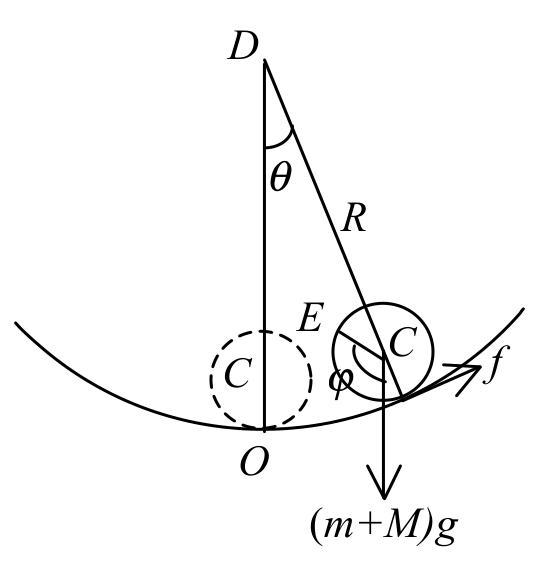
where denotes the angular position of the center of mass of the sphere as shown in Fig.2, and is the frictional force acting on the sphere by the inside wall of the bowl. From the rotational dynamics, we have,
where is the angular position of the reference radius with respect to the starting position. Assumed constraint of pure rolling on the motion of the sphere reads,
Equations (1A.4)-(1A.6) lead to
This is a motion equation of the type of simple harmonic oscillator. Therefore, we obtain the angular frequency and period of the sphere rolling right and left:
- This case can be treated similarly, except taking that the ideal liquid does not rotate into consideration. Therefore Eqs. (1A.4) and (1A.6) are still applicable, while Eq. (1A.5) needs to be modified as
Equations (1A.4), (1A.6), and (1A.9) result in
Then, the angular frequency and period of the sphere rolling back-and-forth are obtained respectively.
- The time taken by the sphere from position to equilibrium position is , from to , and from to , from to . Although the angular amplitude decreases step by step (see below) during the rolling process of the sphere right and left, the period keeps unchanged. This means
Next, we calculate the change of the angular amplitude. When the sphere passes through the equilibrium position after it rolled down from the initial position , the velocity of its center is
Now the angular velocity of the spherical shell rotating about the axis is
where axis is the axis of rotation through the center of the sphere and perpendicular to the paper plane of Fig.2. When W behaves as liquid (before it changes into solid state), the angular momentum of the sphere relative to point is
When W changes suddenly into solid state, due to the fact that both gravitational and frictional force pass through point , the angular momentum of the sphere relative to is conserved, we have
where and represent the angular velocity of the sphere immediately before and after passing through point . Therefore
while after passing through point the velocity of the center of the sphere becomes
Once the sphere reaches the left highest position corresponding to the left angular amplitude we have
However,
From above two expressions we obtain
Similarly we can treat the process that the sphere rolls from position back to , the second highest position on the right, corresponding to the second right angular amplitude , and obtain
Then,
Following the similar procedure repeatedly we finally obtain: