APhO 2007, Теория — Задача 2B. Dielectric spheres inside an external electric field
Theoretical problem 2 · 3 т.
Условие
By immersing a number of small dielectric particles inside a fluid of low-viscosity, you can get the resulting system as a suspension. When an external electric field is applied on the system, the suspending dielectric particles will be polarized with electric dipole moments induced. Within a very short period of time, these polarized particles aggregate together through dipolar interactions so that the effective viscosity of the whole system enhances significantly (the resulting system can be approximately viewed as a solid). This type of phase transition is called “electrorheological effect”, and such a system is called “electrorheological fluid” correspondingly. Such an effect can be applied to fabricate braking devices in practice, since the response time of such a phase transition is shorter than conventional mechanism by several orders of magnitude. Through solving several problems in the following, you are given a simplified picture to understand the inherent mechanism of the electrorheological transition.
1.(1) When there are many identical dielectric spheres of radius immersed inside the fluid, we assume that the dipole moment of each sphere , is induced solely by the external field , independent of any of the other spheres (Note: ).
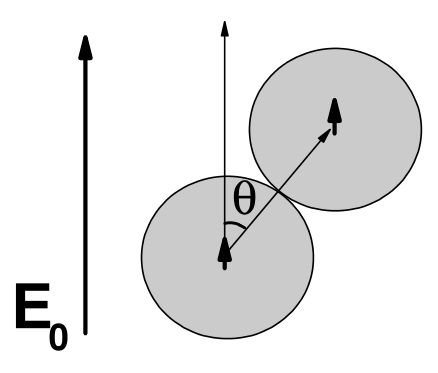
When two identical small dielectric spheres exist inside the fluid and contact with each other, while the line connecting their centers makes an angle with the external field direction (see Fig. 2-6), write the expression of the energy of dipole-dipole interaction between the two small contacting dielectric spheres, in terms of , and . (Note: In your calculations each polarized dielectric sphere can be viewed as an electric dipole located at the center of the sphere) [0,5 т.]
1.(2) Calculate the dipole-dipole interaction energies for the three configurations shown in Fig. 2-7. [0,75 т.]
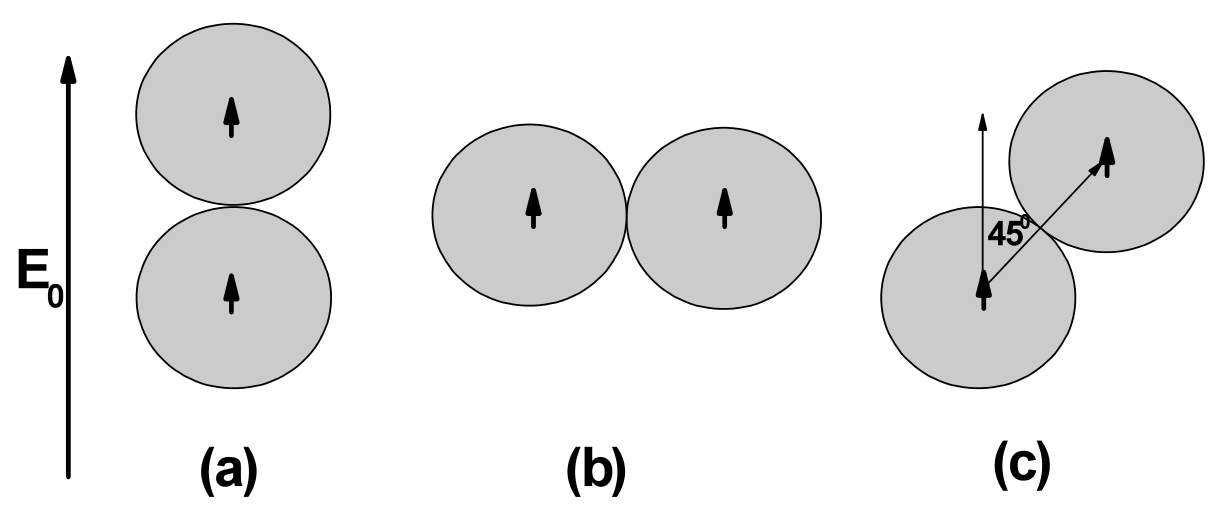
1.(3) Identify which configuration of the system is the most stable one. [0,25 т.]
(Note: In your calculations each polarized dielectric sphere can be viewed as an electric dipole located at the center of the sphere, and the energy of dipole-dipole interaction can be expressed in terms of and .)
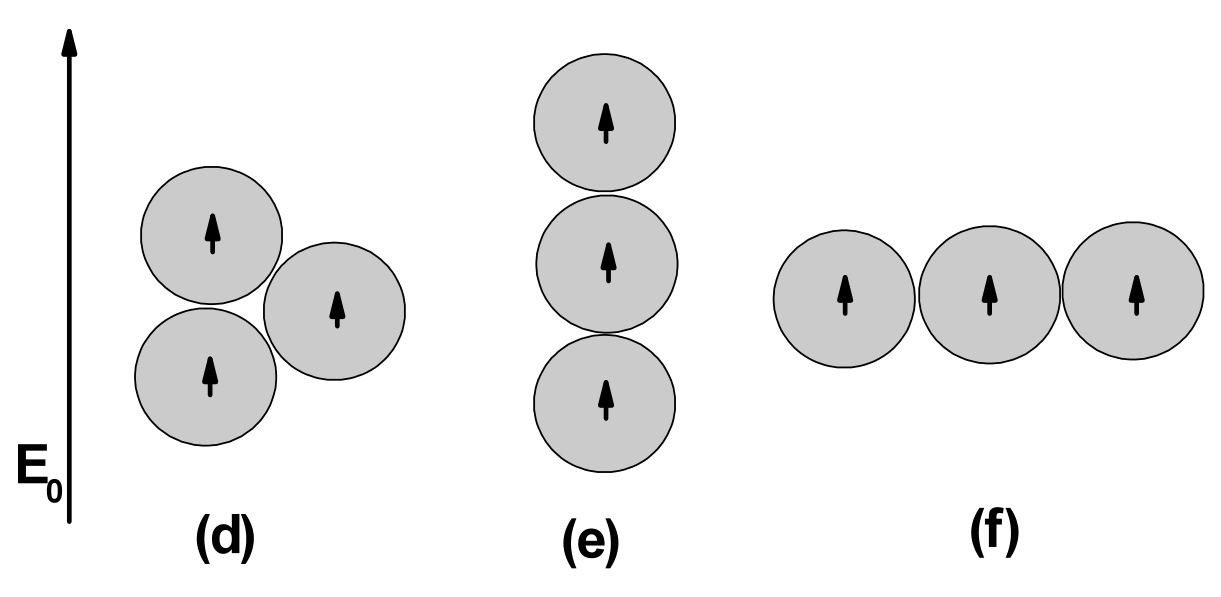
2.(1) In the case that three identical spheres exist inside the fluid, based on the same assumption as in question 1,
calculate the dipole-dipole interaction energies for the three configurations shown in Fig. 2-8; [0,9 т.]
2.(2) identify which configuration of the system is the most stable one; [0,3 т.]
2.(3) identify which configuration of the system is the most unstable one. [0,3 т.]
(Note: In your calculations each polarized dielectric sphere can be viewed as an electric dipole located at the center of the sphere, and the energy of dipole-dipole interaction can be expressed in terms of and .)
Отговори
- 1.(1)
- 1.(2)
- 1.(3) Configuration (a)
- 2.(1)
- 2.(2) Configuration (e)
- 2.(3) Configuration (f)
Решение
1. (1) Adopting the polar coordinates, the z component of the electric field produced by a dipole located at the origin with its axis parallel to the z axis is:
where is the length of the relative position vector of the two dipoles. In the external electric field , the energy of a dipole with its axis parallel to the z axis is:
Therefore we obtain that the interaction energy between two contacting small dielectric spheres is
(2) Based on Eq. (2B.2) for the configuration (a) we obtain:
For configuration (b)
For configuration (c),
(3) Comparison between (2B.3),(2B.4) and (2B.5) shows that configuration (a) has the lowest energy, corresponding to the ground state of the system.
2. With the similar approach to question 1 the interaction energies for the three different configurations can also be calculated.
For configuration (d),
For configuration (e),
For configuration (f),
Comparison shows that configuration (e) of the lowest energy is most stable, while configuration (f) of the highest energy is most unstable.