By collision with relativistic high energy electron, a photon can get energy from the high energy electron, i.e. the energy and frequency of the photon increases because of the collision. This is so-called inverse Compton scattering. Such kind of phenomenon is of great importance in astrophysics, for example, it provides an important mechanism for producing X rays and γ rays in space.
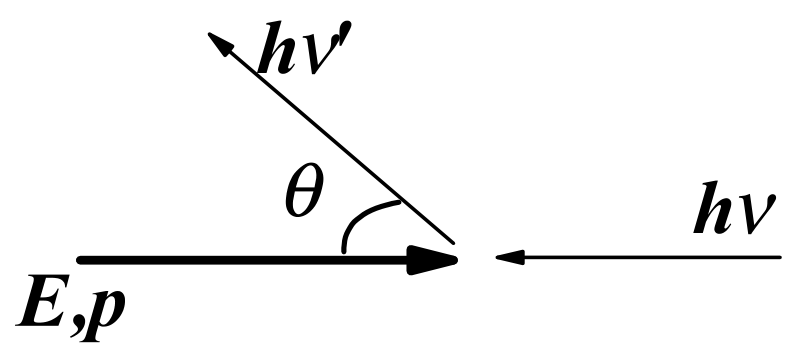
1. A high energy electron of total energy E (its kinetic energy is higher than static energy) and a low energy photon (its energy is less than the static energy of an electron) of frequency ν move in opposite directions, and collide with each other. As shown in the figure below, the collision scatters the photon, making the scattered photon move along the direction which makes an angle θ with its original incident direction (the scattered electron is not shown in the figure). Calculate the energy of the scattered photon, expressed in terms of E,ν,θ and static energy E0 of the electron. Show the value of θ, at which the scattered photon has the maximum energy, and the value of this maximum energy. [2,4 т.]
2. Assume that the energy E of the incident electron is much higher than its static energy E0, which can be shown as E=γE0,γ≫1, and that the energy of the incident photon is much less than E0/γ, show the approximate expression of the maximum energy of the scattered photon. Taking γ=200 and the wavelength of the incident visible light photon λ=500nm, calculate the approximate maximum energy and the corresponding wavelength of the scattered photon.
Parameters: Static energy of the electron E0=0.511MeV, Planck constant h=6.63×10⁻³⁴J⋅s, and hc=1.24×10³eV⋅nm, where c is the light speed in the vacuum. [1,2 т.]
3. (1) A relativistic high energy electron of total energy E and a photon move in opposite directions and collide with each other. Show the energy of the incident photon, of which the photon can gain the maximum energy from the incident electron. Calculate the energy of the scattered photon in this case. [0,7 т.]
3. (2) A relativistic high energy electron of total energy E and a photon, moving in perpendicular directions respectively, collide with each other. Show the energy of the incident photon, of which the photon can gain the maximum energy from the incident electron. Calculate the energy of the scattered photon in this case. [0,7 т.]
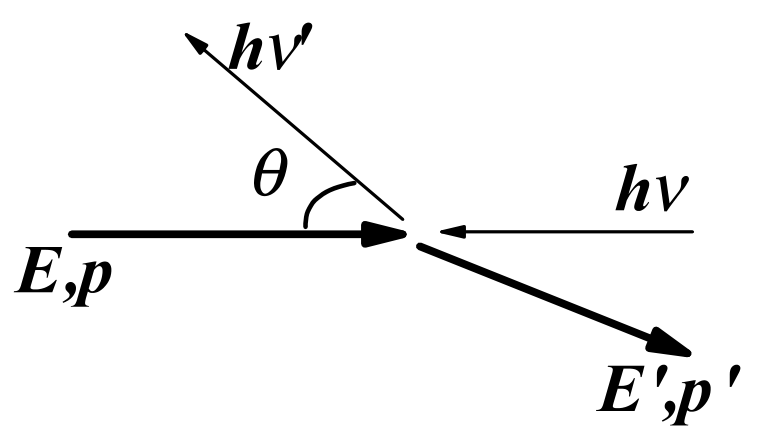
Let p and E denote the momentum and energy of the incident electron, p′ and E′ the momentum and energy of the scattered electron, and hν and hν′ the energies of the incident and scattered photon respectively. For this scattering process (see Fig. 1) energy conservation reads
hν+E=hν′+E′(1B.1)
Figure 1
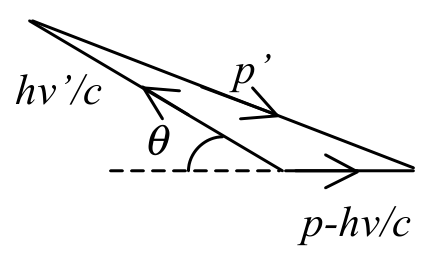
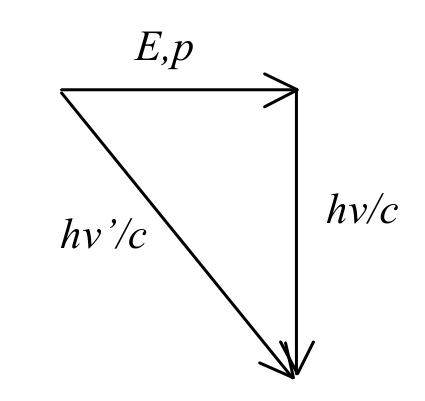
while the momentum conservation can be shown as (see Fig.2)
Figure 2
(p′c)2=(hν′)2+(pc−hν)2+2hν′(pc−hν)cosθ(1B.2)
Equations (1B.1) and (1B.2), combined with the energy-momentum relations
We have assumed that the kinetic energy of the incident electron is higher than its static energy, and the energy of the incident photon hν is less than E0, so that E2−E02>hν. Therefore from Eq. (1B.5), it can be easily seen that θ=π results in the maximum of hν′, and the maximum hν′ is
corresponding to a wavelength λ′=hν′hc=4.0×1051.24×103=3.1×10⁻³nm.
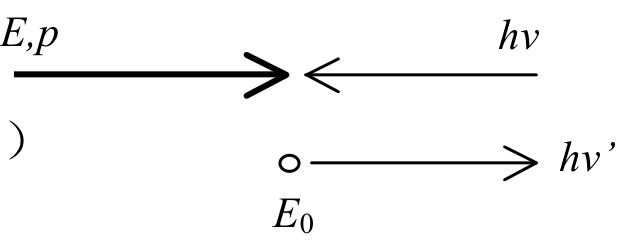
(1) It is obvious that if the incident electron gives its total kinetic energy to the photon, the photon gains the maximum energy from the incident electron through the scattering process, namely the electron should become at rest after the collision. In this case, we have (see Fig. 3)
Figure 3
hν+E=hν′+E0(Conservation of energy)(1B.9)
p−hν/c=hν′/c(Conservation of momentum)
or
pc−hν=hν′(1B.10)
Subtracting (1B.10) from (1B.9) leads to the energy of the incident photon
hν=21(E0−E+pc)=21(E0−E+E2−E02).(1B.11)
In above equation the energy- momentum relation
(pc)2=E2−E02(1B.12)
has been taken into account. Therefore from Eq. (1B.9) we obtain the energy of the scattered photon
Figure 4
hν′=hν+E−E0=21(E−E0+E2−E02).(1B.13)
(2) Similar to question 3. (1), now we have (see Fig. 4)
hν+E=hν′+E0(Conservation of energy)(1B.9)
p2+(hν/c)2=(hν′/c)2(Conservation of momentum)
That is,
(pc)2+(hν)2=(hν′)2.(1B.14)
Substitution of Eq. (1B.12) into Eq. (1B.14) yields
E2−E02+(hν)2=(hν′)2.
On the other hand, square of Eq. (1B.9) results in
(hν′)2=E2+E02+(hν)2+2Ehν−2EE0−2E0hν
Combination of the above two equations leads to
E2+E02+(hν)2+2Ehν−2EE0−2E0hν=E2−E02+(hν)2
That is,
2(E−E0)hν=2E0(E−E0).
Then, we obtain the energy of the incident photon
hν=E0.(1B.15)
Substitution of (1B.15) into Eq. (1B.9) gives the energy of the scattered photon
hν′=hν+E−E0=E(1B.16)
Explanatory notes about the solution of Question 3:
Question 3. (1) can also be solved as follows. According to Eq. (1B.6), the maximum energy Δ that the photon of energy hν gains from the electron is
Δ=hνmax′−hν=2E+2hν−pcpchν−h2ν2,
where pc=E2−E02. To obtain the maximum Δ, we use the extreme condition
Let the numerator equal to zero, a quadratic equation results:
2(hν)2+2(E−pc)hν−(Epc−p2c2)=0.
Its two roots can be shown as
hν=21[−(E−pc)±E2−p2c2]=21(−E+pc±E0).
Since the negative sign leads to a meaningless negative hν, we have
hν=21(E2−E02−E+E0).
where pc=E2−E02 has been taken into account. This result is just the same as Eq. (1B.11). The expression for hν′ is then the same as Eq. (1B.13).
Question 3. (2) can also be solved as follows
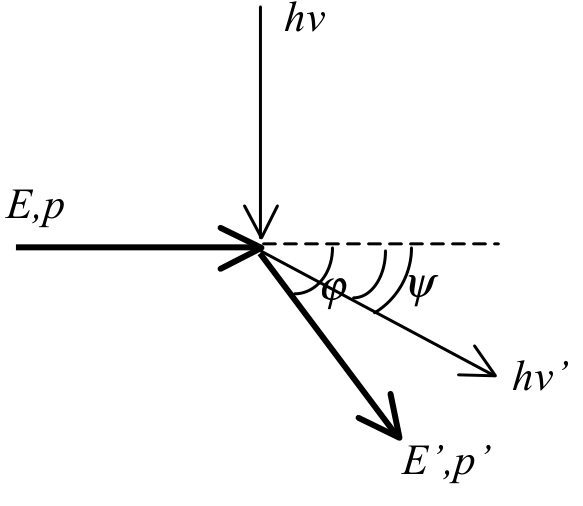
For the sake of simplification, it is assumed that the scattered photon and electron move in the same plane which the incident photon and electron moved in. Meanwhile the angles which the directions of the scattered photon and electron make with the direction of the incident electron are denoted by ψ and φ respectively (see the figure). Then, we have
E+hν=E′+hν′,(Conservation of energy)(1B.1’)
p=chν′cosψ+p′cosφ,
or
pc−hν′cosψ=p′ccosφ,(Conservation of horizontal momentum)(1B.2’)
and
chν=chν′sinψ+p′sinφ,
or
hν−hν′sinψ=p′csinφ.(Conservation of vertical momentum)(1B.3’)