APhO 2008, Теория — Задача 1. Tea Ceremony and Physics of Bubbles
THEORETICAL COMPETITION. 9th Asian Physics Olympiad, Ulaanbaatar, Mongolia (April 22, 2008 ) · 20 април 2008 г. · 10 т.
Условие
The tea ceremony is traditional in Asia. One of the important steps in preparation of tea is the boiling of fresh water when bubbles appear inside. Bubbles are familiar from daily life and occupy an important role in physics, chemistry, medicine and technology. Nevertheless, their behavior is often surprising and unexpected - and, in many cases, still not understood.
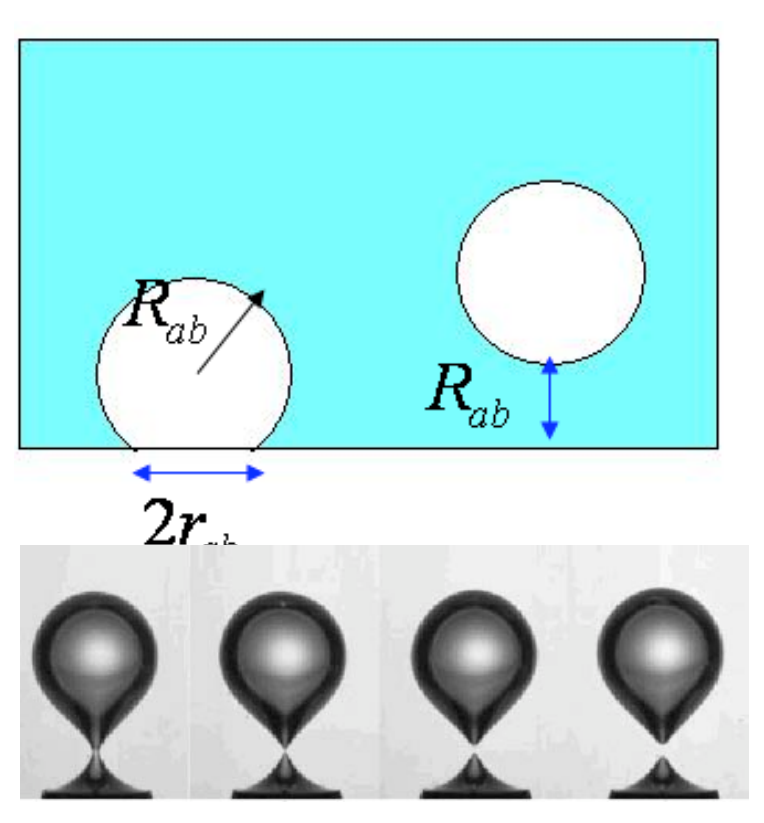
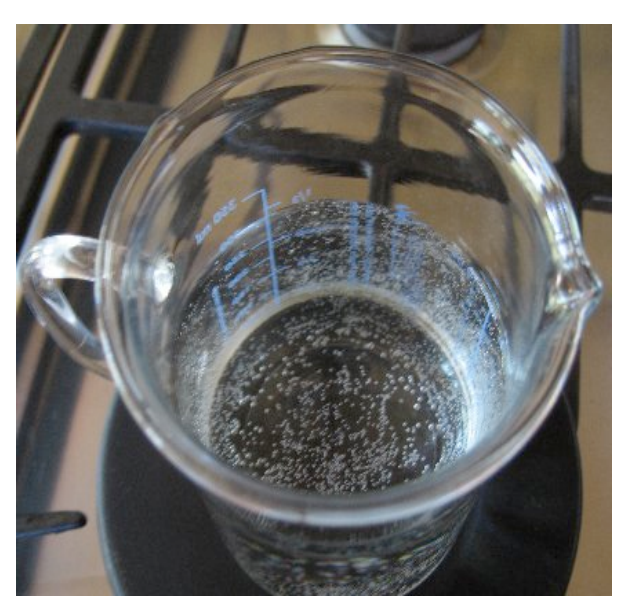
At room temperature the pure water is saturated with gas. With increasing temperature the excess pressure of dissolved gas increases, the dissolved air is liberated and air bubbles (ABs) appear at the bottom and walls of teakettle (Fig.2). For pure water the wettability is sufficient and an AB represents a truncated sphere with radius and with unwetted foundation with radius . At more heating ABs expand and by reaching certain sizes can detach from the bottom (Fig.3), flow up to the water surface and burst there. The vapor bubbles (VBs) appear when the water temperature at the bottom reaches the critical value at which the pressure of the saturated vapor exceeds the external pressure. The vapor production increases tens times, VBs expand and detach from the bottom. VB may be considered consisting only of vapor. If the water is heated sufficiently, the uprising VB continue to swell, reach the surface and burst. Else, water is not heated enough in the higher layers and there exits a vertical strong temperature gradient. By reaching relatively cold layers of water VB collapse in the volume of water (Fig.4). This causes the induced degassing - strong oscillations and a considerable amount of dissolved air is released in the form of microscopic air bubbles (MAB). This can generate ultrasonic vibrations.
The main stages of the bubble evolution during the boiling process are:
- the appearance and growth of AB at the bottom and walls, their transmutation into VB;
- the detachment and uprising of VB, their disappearance in the water volume or at the surface;
- the appearance of MAB in the water volume and their uprising to the surface.
This theoretical description is in good agreement with modern experiments. Particularly, an interesting noise analysis experiment (NAE, Ural State University, Ekaterinburg) for the boiling water was performed. Highly sensitive microphones attached to wide-band amplifiers and brought to an electric teakettle have detected three main origins of noises:
- AB's detachments from the bottom before boiling (generate oscillations with Hz, );
- VB's collapses in the volume of water (generate oscillations with kHz );
- MAB's appearances under the water surface (generate oscillations with ~35kHz to 60kHz).
Hints:
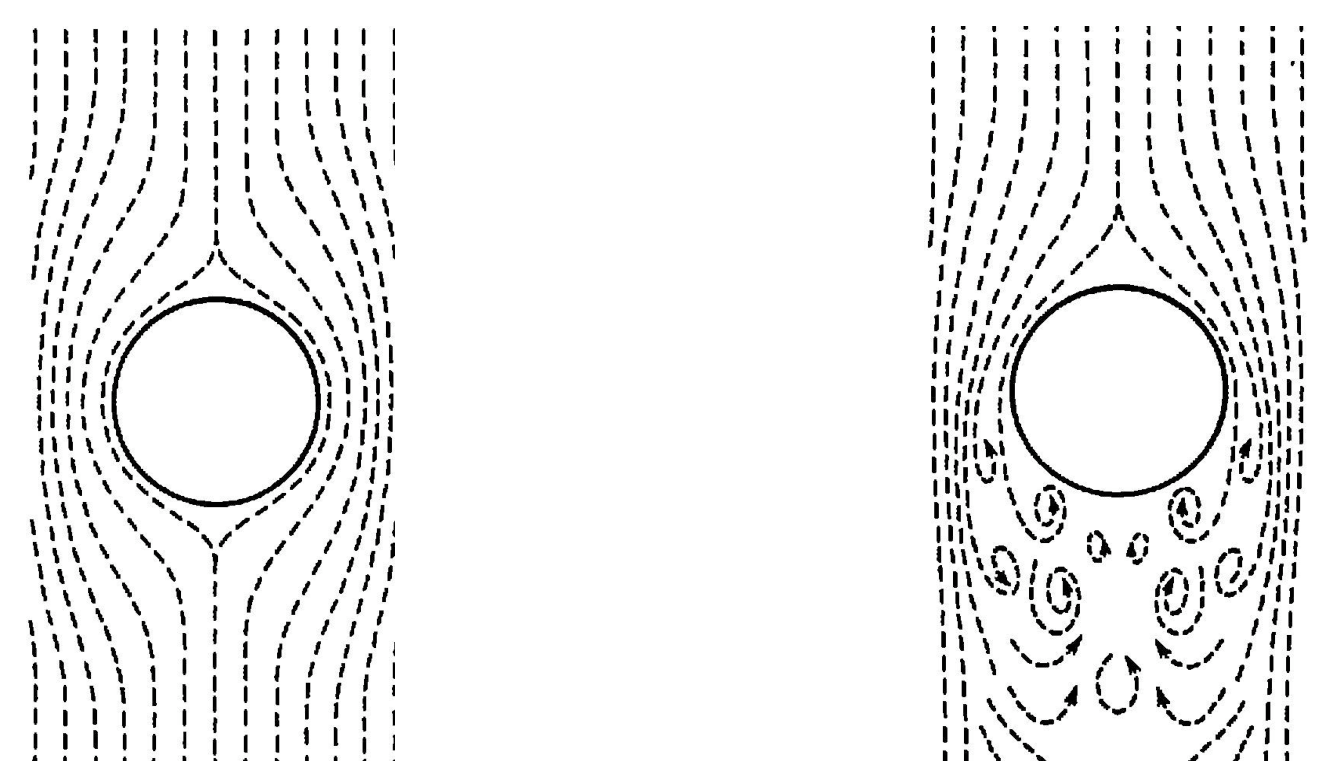
1) It is well known that a small bubble rises along a rectilinear path and a laminar flow is observed - water flows easy and layer-wise (see Fig.1). Then, the Stokes formula describes the dissipative force for a particle moving with slow velocity :
In contrast to this picture, when relatively large bubbles lift to the surface, it disturbs the surrounding water, cavitation hollows appear behind and the turbulent flow is observed (see Fig.1). In this case a part of the kinetic energy of an uprising bubble transfers into the dissipative work.
2) When the surface of liquid has a convex (concave) form there appears a surface tension force due to molecular interaction near the edge. This pressure can be given by formula
where - is the surface tension coefficient (unit=N/m), the force coming to unit length of surface, R – is the radius of surface curvity.
3) When dealing with a short process with characteristic duration time "t", its inverse value may be considered as a characteristic frequency . Use this definition for calculating the noise frequencies.
Useful data:
- atmospheric pressure,
- water density,
- vapor density at T=293K; ( at T=373K)
- vapor pressure at T=293K; ( at T=373K)

- acceleration of gravity,
- molecular weight of air
- the gas universal constant
- surface tension coefficient of water,
- coefficient of viscosity of water
H=10cm – Water attitude in teakettle
Questions (total 10 points):
Consider water boiling in a flat-bottomed cylinder glass teakettle at normal atmospheric pressure. The bottom of the kettle heats up uniformly and a vertical temperature gradient exists, bubbles appear and evolute (Fig.2).
Q1 Write the pressure condition of the growth of an AB in the water volume at height , where H is the water surface level in the teakettle. Take into account the inequality . [in terms of ] [1 т.]
Q2 Write for an AB the condition of the detachment from the bottom of the teakettle (Fig.3). Take into account the relation . [in terms of ] [1,5 т.]
Q3 Consider an AB with radius at the bottom of the teakettle. As water is boiled, the bubble is saturated with vapor and enlarges its radius. Write the ratio of the masses of the air and saturated vapor inside the bubble at given temperature T. Calculate the ratio at room temperature T=20C () and at boiling point at T=100C (). [in terms of ] [1,5 т.]
Q4 By using the NAE data and Newton's Law estimate the radius of the AB detached from the bottom and uprised in distance (Fig.3). Assume, that the added-mass (taking into account surrounding water layer) of AB is a half of the analogous water bubble. [1 т.]
Q5 Write the radius of the foundation of an AB just before the uprising, when the connecting "neck" is very narrow (see Fig.3). [in terms of ]. Calculate it by using the radius found in Q4. [1,5 т.]
Q6 By using the NAE data estimate the radius of collapsing VB (Fig.4) by assuming that the radial pressure is about 3kPa during this process. [1,2 т.]
Q7 By using previous results for VB calculate the radius of the MAB produced during induced degassing. [0,5 т.]
Q8 Write the uprising velocity for typical AB by using the Stokes law of a laminar flow. [in terms of ]. Estimate the uprising time for H=10cm. [0,6 т.]
Q9 Write the average velocity of the elevation of VB with turbulent type of flow [in terms of ]. Estimate the uprising time for H=10cm. [1,2 т.]
Отговори
Q1
Q2
The marking scheme prints the fuller form g(4πRab³/3)(ρw − ρab) > σ·2πrab + (P0 + gρwH)·πrab².
Q3 ξ = μair/(RTρv)·(P0 + gρwH + 2σ/Rb − Pvapor); ξ ≈ 69.2 at T = 20 °C (Rb = 0.5 mm), ξ ≈ 0.017 at T = 100 °C (Rb = 1 mm)
Q4 0.001 m
ν1 = 1/t1 = √(g/Rab), Rab ≈ 1·10⁻³ m
Q5 0.0000902 m
rab ≈ 2gρwRab³/(3σ)
Q6 3 mm
Rcb = (1/ν2)√(3ΔP/(2ρw)) ≈ 3 mm
Q7 Rmab ≈ 0.05 ÷ 0.086 mm
Q8 2.2 m/s
vlam ≈ 2.2 m/s; the official solution concludes that the Stokes formula is not applicable (0.045 s rise time).
Q9 vturb ≈ √(8gRvb/3) ≈ (0.16 ÷ 0.28) m/s; tturb > H/vturb ≈ (0.35 ÷ 0.62) s
Решение
Solutions:
S1. The condition of the survival and growth for AB appeared in the water volume at height is the competitiveness of the pressures acting inside and outside (atmospheric, hydrostatic and surface tension) on the bubble surface:
S2. The Archimedes lifting force is
where - the air density in bubble.
For the Laplace surface tension force plays main role in holding down the bubble:
The stability of the AB at the bottom means:
At more heating the lifting force overbalances the holding force:
and AB is detached from the bottom and floats (Fig.3).
S3. The air and vapor pressures inside compensate the outer pressure for a stable bubble.
The mass of air inside AB may be found from the Clayperon-Mendeleev equation
The vapor mass is
Then the ratio is
For and :
This bubble consists mostly of air.
For and :
This bubble consists mostly of saturated vapor.
S4. Consider AB detached from the bottom and uprising in distance (see Fig.3). During the rise, bubbles induce a displacement of the surrounding fluid in their vicinity, which leads to an added-mass force. The added-mass of a bubble is
The acceleration at the detachment moment is
The characteristic "detachment time"
defines the duration of the impact to the liquid during the detachment. The liquid begins to vibrate with characteristic frequency
Substituting the date from NAE we estimate the characteristic radius of detaching AB
S5. The balance of the lifting and confining forces reads
Find the typical foundation radius:
For AB with radius ~1mm we calculate
S6. Consider collapsing VB during time piece (Fig.4). Let's estimate the characteristic frequency of the ultrasonic shock waves. The surrounding water flood the collapsed VB with acceleration a and the Newton equation reads
where the acceleration of the water front converging in the center of VB is
The radial pressure on the VB surface is given
Particularly, for the obtained data of the NAE experiment we obtain
Particularly,
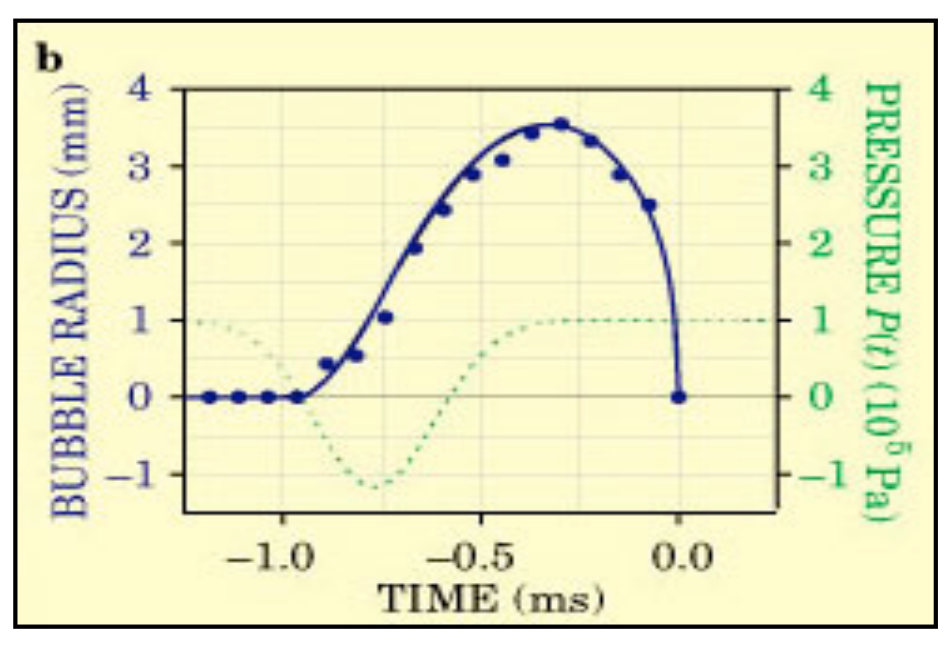
This result is in good agreement with another experiment (see Fig.5) where the radius is found about 3.5mm and the collapsing time is about 1ms (i.e., ~1kHz noise).
S7. Obviously, the physical nature of MAB is the same as for VB. Then,
S8. A bubble detached from the bottom is hoisted under the influence of Archimedes force. The water resistant force depends on the nature of the streamline flow (Figs.1,6,7).
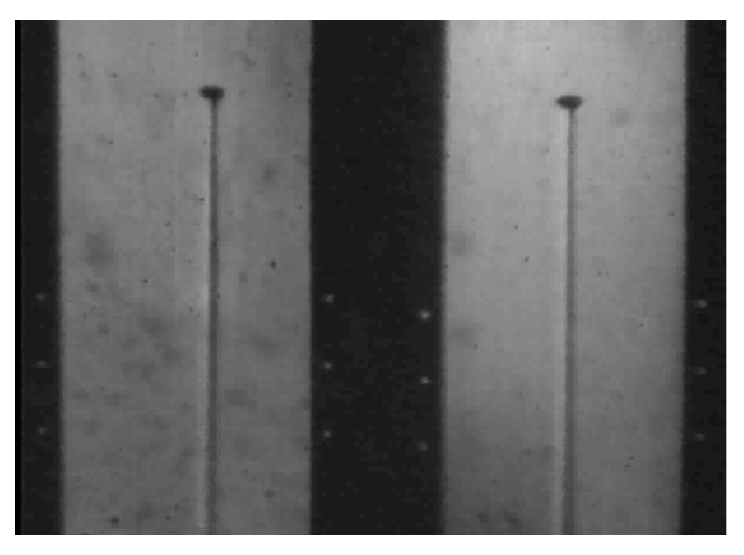
But for a bubble with radius about 1mm the emersion laminar velocity becomes too fast
and the bubble passes the 10cm distance to the surface for 0.045 second !!!. It is obviously wrong. Therefore, the Stokes formula is not applicable for AB and VB rising from the bottom.
S9. As a path instability sets in, a bubble can uprise by either zigzag or spiral (Fig.8).
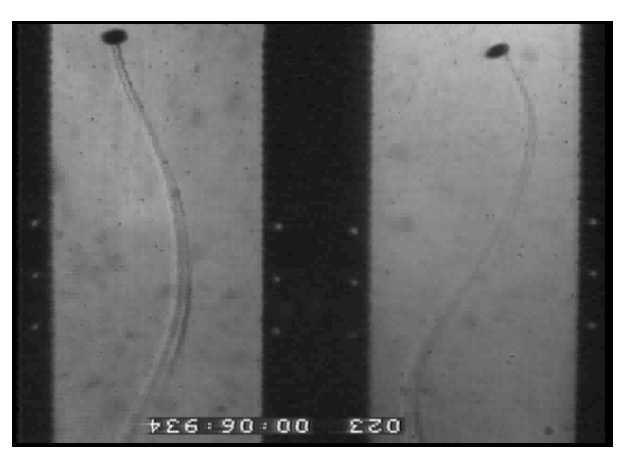
Obviously, the lifting force is
During its uprising in distance 'h' the bubble removes a water portion with mass:
and performs a work (transfers kinetic energy)
Then, we estimate the dissipative force
Since VB flows steady without any acceleration, the dissipative (braking) force balances the Archimedes force:
Then, the average (for spiral motion) turbulent velocity is
For a typical radius of uprising AB (~1mm) or collapsing VB (~3mm) we calculate the velocity
The time required to pass a distance H ~10cm:
This is a quite reasonable result and the bubbles mostly elevate under the turbulence flow law.
[Marking Scheme] Tea Ceremony and Physics of Bubbles
| Q | Item | Answer | Points |
|---|---|---|---|
| 1 | condition of growth | 1.0 | |
| 2 | condition of detachment | 1.5 | |
| 3 | the ratio | 1.1 | |
| the ratio at T=20C | 0.2 | ||
| the ratio at T=100C | 0.2 | ||
| 4 | characteristic frequency | 0.8 | |
| radius of detaching | 0.2 | ||
| 5 | foundation radius: | 1.2 | |
| For radius 1mm | 0.3 | ||
| 6 | Radius of collapsing bubble | 1.0 | |
| Numerical value | 0.2 | ||
| 7 | radius | 0.5 | |
| 8 | laminar velocity | 0.6 | |
| 9 | turbulent velocity | 1.0 | |
| Numerical speed | 0.1 | ||
| Ascending time | 0.1 | ||
| TOTAL | 10.0 |