APhO 2008, Теория — Задача 2. Ionic Crystal, Yukawa-type Potential and Pauli Principle
APhO 2008 — Theoretical Problem 2 · 10 т.
Competition header
THEORETICAL COMPETITION
9th Asian Physics Olympiad
Ulaanbaatar, Mongolia (April 22, 2008)
Условие
Atoms of many chemical elements possess very low ionization energy and easily loose the outer electrons. Vice versa, atoms of other elements accept easily the electrons. Taken into one volume, these positive and negative ions can combine into stable ionic structures. Many solids exhibit a crystal structure, in which the atoms are arranged in extremely regular, periodic patterns. In an ideal crystal the same basic structural unit is repeated through the space.
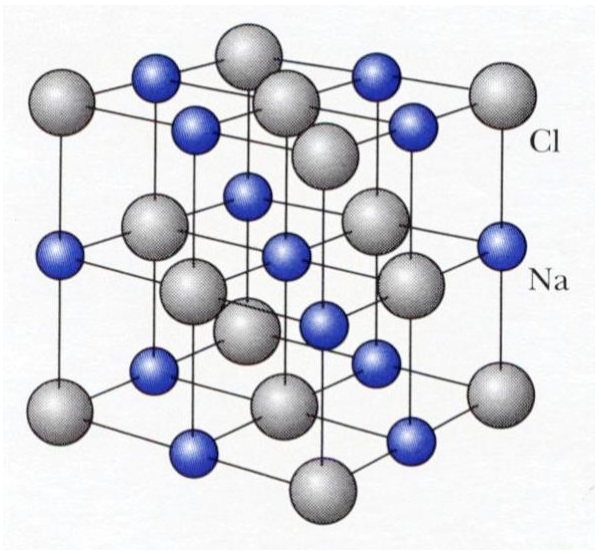
Fig.1
The face-centered cubic lattice of the sodium chloride (NaCl). The lattice spacing between the atomar centres is constant and is given by parameter .
The main contribution to the binding energy of an ionic crystal is given by the electrostatic potential energy of ions.
The electric interaction acting between two point charges and standing in distance is well defined by Coulomb's potential:
where is the Coulomb constant. A negative force implies an attractive force. The force is directed along the line joining the two charges. For the case of NaCl crystals both types of ions has the unit charge and one should also take into account many other neighbors acting on the chosen ion. Taking into account all positive and negative ions in a crystal of the infinite sizes results in the attractive potential energy , where is the distance between nearest neighbors and is the Madelung constant [E.Madelung, Phys. Zs, 19 (1918) p542] and used in determining the energy of a single ion in a crystal.
Along the attractive potential energy there should to be a repulsive potential energy due to the Pauli Exclusion Principle and the overlap of electron shells in a crystal lattice. In contrast to the Coulomb-type attractive part, the repulsive potential energy is very short range.
There are two different models to describe the repulsive potential.
Model #1. A reasonable approximation to the repulsive potential is an exponential function:
which describes the repulsion interaction of selected ion with the entire crystal lattice. Here is coupling strength and stands for the range parameter.
Model #2. Another good approximation to the repulsive potential is an inverse power
where is coupling strength and is integer greater than 2 (the Born exponent). These parameters take into account the repulsion with entire crystals.
Obviously, the physical parameters and model potentials depend on the type of crystal lattice.
Experimental data for the lattice constant and the dissociation energy (needed to break the lattice into separate ions) are given in Table 1 for some ionic crystals at normal temperature and pressure.
| Crystal | [nm] | [kJ/mole] |
|---|---|---|
| NaCl | 0.282 | +764.4 |
| LiF | 0.214 | +1014.0 |
| RbBr | 0.345 | +638.8 |
Table 1. Properties of Salt Crystals with the NaCl Structure [C.Kittel, "Introduction to Solid State Physics", N.Y., Wiley (1976) p.92] (in one mole there are the Avogadro’s number of pairs of ions or atoms).
Questions (total 10 points):
Q1 Write down the Coulomb potential for an ion located at the centre of cubic lattice in Fig 1. Let it interact only with the nearest neighbors (in distance up to and including ) of a crystal lattice. Find the Madelung constant corresponding to this approximation. [1,5 т.]
Q2 By using Model #1 write down the net potential energy per ion . Determine its equilibrium equation for and write down the net potential energy [in terms of ]. Use exact Madelung constant . [1,5 т.]
Q3 By using experimental data estimate the range parameter . Use . [2 т.]
Q4 By using Model #2 write down the net potential energy per ion. Determine its equilibrium position and write down the net potential energy . Use exact Madelung constant . [in terms of ] [2 т.]
Q5 By using experimental data (from Table 1) estimate the Born exponent for NaCl. Estimate the proportions of the Coulomb interaction and the Pauli exclusion (repulsive part) in the entire net potential energy in the equilibrium state? [1,5 т.]
Q6 The ionization energy (required to extract an electron from an atom) of the Na atom is +5.14 eV, the electron affinity (required to receive an electron to an atom) of the Cl atom is -3.61 eV. Estimate the total binding energy (holds an atom inside lattice) per atom in the NaCl crystal. The experimental result is . [in terms of eV]
Use the conversion of units: . [1,5 т.]
Решение
Solutions:
S1
Consider a positive ion in the NaCl is surrounded by 26 neighbors (see Fig.1). The first group of 6 nearest "central" neighbors have negative charges. They are located in distance from the considered ion and their contribution is attractive:
The next group of "central" neighbors are 12 ions standing in distance . All they have positive charge and act repulsively
Easily to guess that the "vertex" 8 negative ions standing in distance produce an attractive potential:
Having done summation of these contributions, we obtain the zero-order Coulomb potential
where the approximate Madelung constant reads
S2
The net potential energy is the sum of attractive and repulsive exponential parts and reads
The condition for the equilibrium position is
Then, may be defined from
The equilibrium potential is:
S3
The dissociation energy corresponding to an ion (pair of atoms) is
This energy will be spent to overcome the potential energy
Then,
Subsequently,
This result is in good agreement with experimental data (see Table 2).
| Crystal | r [nm] | [nm] | [kJ/mole] |
|---|---|---|---|
| NaCl | 0.282 | 0.032 | -764.4 |
| LiF | 0.214 | 0.029 | -1014.0 |
| RbBr | 0.345 | 0.034 | -638.8 |
Table 2. Properties of Salt Crystals with the NaCl Structure [C.Kittel, "Introduction to Solid State Physics", N.Y., Wiley (1976) p.92]
S4
The repulsive inverse-power part leads to the following net potential
The equilibrium position is defined from the zero-force condition
The equation for reads
Then,
Here, the first term corresponds to the Coulomb potential and the second – to the Pauli's.
S5
Comparing with previous result (see 3. and 4.) we express the Born exponent
With one finds that
The Coulomb and the Pauli potentials contribute to the net potential with a proportion 9:1. This result agrees well with experimental data (see, Table 3).
| Ion type | n |
|---|---|
| 7 | |
| 9 | |
| 12 |
Table 3. The experimental fit for the Born exponent. [CRC Handbook of Physics, 2004]
S6
The ionization energy of the Na atom is +5.14 eV while the electron affinity of the Cl atom is -3.61 eV. Subsequently, the electron transfer energy per atom is the half difference
The total binding energy per atom in the NaCl crystal is:
This estimate is in satisfactory agreement with the experimental result
Marking Scheme
[Marking Scheme] Ionic Crystal, Yukawa-type Potential and Pauli Principle
| Q | Item | Answer | Points |
|---|---|---|---|
| 1. | Attractive Coulomb potential | 0.5 | |
| Madelung constant | 1.0 | ||
| 2. | Equilibrium position | 0.5 | |
| Net potential | 1.0 | ||
| 3. | Pair energy | 0.2 | |
| Equation for potential | 0.9 | ||
| Equation for range parameter | 0.8 | ||
| Range parameter | 0.1 | ||
| 4. | Equilibrium position | 0.5 | |
| Equation for | 0.5 | ||
| Net potential | 1.0 | ||
| 5. | Born exponent | 1.2 | |
| Proportions | 0.3 | ||
| 6. | Electron transfer energy | 0.5 | |
| the total binding energy | 1.0 | ||
| total | 10.0 |
Source note: the final marking-scheme formula is clipped after “−3.19[e” at the right cell boundary in the archived PDF. The complete result −3.19 eV appears in S6 above.