APhO 2008, Теория — Задача 3. How does a superluminal object look like?
THEORETICAL COMPETITION. 9th Asian Physics Olympiad. Ulaanbaatar, Mongolia (April 22, 2008 ) · 22 април 2008 г.
Условие
Can a body move faster than the speed of light? The answer is “No” if the object is moving in the vacuum. But the answer can be “Yes”, if we deal with the phase speed of light in an optically dense medium with refractive index of (, where is the speed of light in the medium, and is the speed of light in the vacuum).
We say a body is superluminal, if , where is the velocity of the body. One of the well known examples of the superluminal body is a charged particle generating Cherenkov radiation.
Throughout the problem we will deal with a superluminal body of constant velocity in an optical medium without dispersion. is the velocity of light in the medium.
For the simplicity, we introduce a notation and an angle given by
and .
1. Radiating superluminal particle
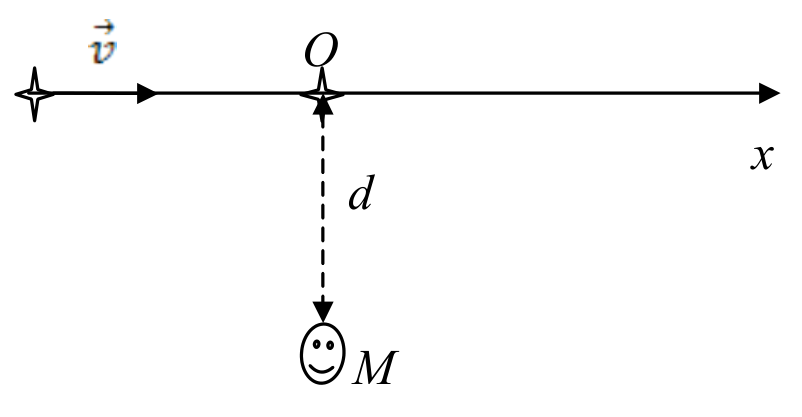
As shown in Fig.1, a radiating particle is moving along the -axis with a constant velocity ().
An observer is located at the distance from -axis.
We choose the point nearest to the observer as the point , the origin on the -axis. The time when the particle actually passes over the point is taken to be .
(1) Suppose the light radiated at the given time is observed at time . Express in terms of and . [1 т.]
(2) At time , the observer first sees the particle at position . Find the apparent position and the observed time for this first appearance in terms of and . [2 т.]
(3) Find the apparent position(s) of the particle for any given time . Write your answer in terms of and . [2 т.]
(4) Find the apparent velocity(s) (t) of the particle for any given time . Write your answer in terms of , and . [1 т.]
(5) Find the apparent velocity(s) of the first appearance of the particle. [0,2 т.]
(6) Find the apparent velocity(s) of the particle at infinite distances from the origin, . Write your answer in terms of and . [0,2 т.]
(7) Sketch the graph of the apparent velocity versus time , indicating clearly asymptotic values of the apparent velocity. [1 т.]
(8) Can an apparent velocity exceed the light speed in the vacuum, i.e. ? [0,2 т.]
2.Radiating linear object
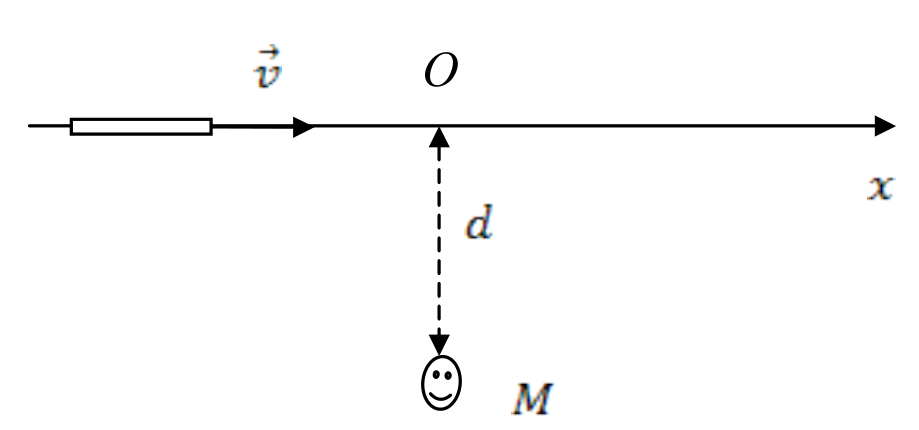
Consider a linear object, radiating light and moving along the -axis. The length of the linear object is in the rest frame of the object.
A. Parallel movement
In this section, we assume that the radiating linear object moves longitudinally along -axis as shown in Fig.2.
(9) Determine the time interval of complete appearance of the whole linear object from the first appearance of its front point. Write your answer in terms of and . [0,3 т.]
(10) Determine the apparent length(s) of the object at the moment of its complete appearance. Write your answer in terms of and . [0,4 т.]
B. Perpendicular movement
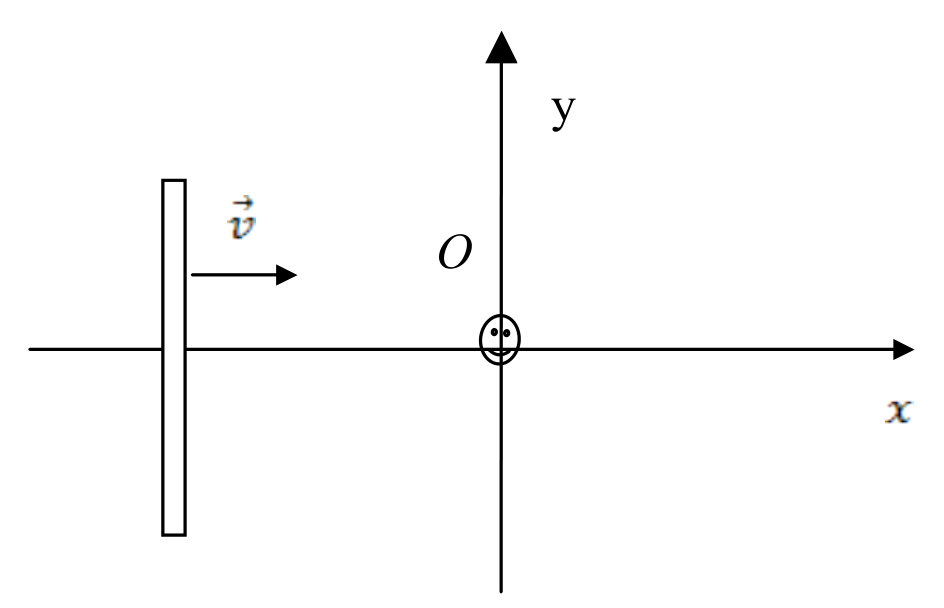
In this section, we assume that the radiating linear object moves perpendicularly along -axis as shown in Fig.3. Let the observer be located at the origin of -axis . The object is symmetrical with respect to -axis.
(11) Show that for a given time , the apparent form of this object is an ellipse or part(s) of an ellipse. [0,7 т.]
Find the following quantities and express them in terms of , and .
(12) Find the position of the centre of symmetry of the ellipse for a given time in terms of and . [0,5 т.]
(13) Determine the lengths of the semi-major and semi-minor axes of the ellipse for a given time in terms of and . [0,5 т.]
Отговори
(1)
(2)
(3)
(4)
(5)
(6)
(8) Can
In the marking scheme the 0.2 points are printed on the row „Can“; nothing is circled.
(9)
(10)
(11)
(12)
(13)
Решение
Внимание: Непълно решение
The official marking scheme gives only final answers; its answer box for part (7) (graph of v' versus t) is printed empty.
Marking Scheme
1. Radiating superluminal dot
(1) Expression of in terms of and .
[1.0]
(2) The apparent position in terms of and .
[1.0]
The observed time of the first appearance in terms of and .
[1.0]
(3) The apparent position(s) (t) in terms of and .
[2.0]
(4) The apparent velocity(s) (t) in terms of and .
[1.0]
(5) The apparent velocity(s) of the first appearance of the particle
[0.2]
(6) The apparent velocity(s) of the particle at infinite distances in terms of and
[0.2]
(7) The graph of the apparent velocity versus time . (Remember to write down the asymptotic values of the apparent velocity).
[1.0]
(8) An apparent velocity CAN / CANNOT exceed the light speed in the vacuum. Circle the correct answer.
| Can | 0.2 |
|---|---|
| Can not |
1.1. Radiating linear object
A. Parallel movement
(9) The time interval of complete appearance of the whole linear object from the first appearance of its front point. (in terms of and )
[0.3]
(10) The apparent length(s) of the object at the moment of its complete appearance. (in terms of and )
[0.4]
B. Perpendicular movement
(11) Show that the x and y coordinates of any given point of the object satisfy an elliptic equation
[0.7]
(12) The position of the centre of symmetry of the ellipse in terms of and .
[0.5]
(13) The lengths of the semi-major and semi-minor axes of the ellipse in terms of and .
[0.5]