APhO 2010, Теория — Задача 1. Particles and Waves
Theoretical Question 1 — Particles and Waves · 25 април 2010 г. · 10 т.
Условие
This question includes the following three parts dealing with motions of particles and waves:
Part A. Inelastic scattering of particles
Part B. Waves on a string
Part C. Waves in an expanding universe
Part A. Inelastic Scattering and Compositeness of Particles
A particle is considered elementary if it has no excitable internal degrees of freedom such as, for example, rotations and vibrations about its center of mass. Otherwise, it is composite.
To determine if a particle is composite, one may set up a scattering experiment with the particle being the target and allow an elementary particle to scatter off it. In case that the target particle is composite, the scattering experiment may reveal important features such as scaling, i.e. as the forward momentum of the scattered particle increases, the scattering cross section becomes independent of the momentum.
For a scattering system consisting of an elementary particle incident on a target particle, we shall denote by the total translational kinetic energy loss of the system. Here the translational kinetic energy of a particle, whether elementary or composite, is defined as the kinetic energy associated with the translational motion of its center of mass. Thus we may write
where and are the total translational kinetic energies of the scattering pair before and after scattering, respectively.
In Part A, use non-relativistic classical mechanics to solve all problems. All effects due to gravity are to be neglected.
(a) As shown in Fig. 1, an elementary particle of mass moves along the axis with -component of momentum . After being scattered by a stationary target of mass , its momentum becomes .
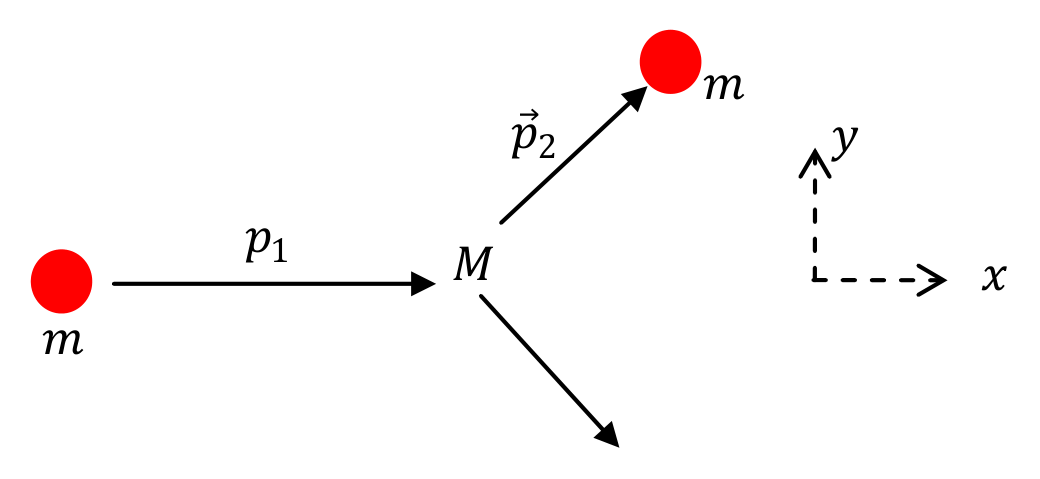
From data on , one can determine if the target particle is elementary or composite. We shall assume that lies in the - plane and that the - and -components of are given, respectively, by and .
(i) Find an expression for in terms of , and . [0.2 point]
(ii) If the target particle is elementary, the momenta , and are related in a particular way by a condition.
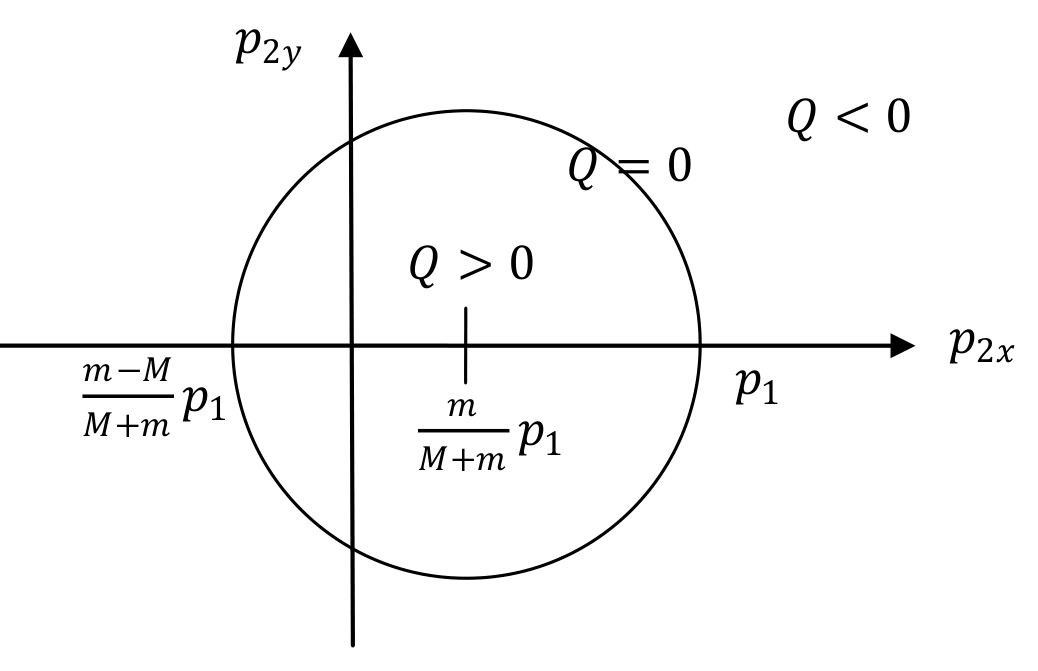
For given , plot the condition as a curve in the - plane. Specify the value of for each intercept of the curve with the -axis. In the same plot, locate regions of points of corresponding to , , , and label each of them as such. [0.7 point]
For a stationary composite target in its ground state before scattering, which region(s) of contains those points of allowed? [0.2 point] [1,1 т.]
(b) Now, consider a composite target consisting of two elementary particles each with mass . They are connected by a spring of negligible mass. See Fig. 2. The spring has a force constant and does not bend sideways. Initially, the target is stationary with its center of mass at the origin O, and the spring, inclined at an angle to the -axis, is at its natural length . For simplicity, we assume that only vibrational and rotational motions can be excited in the target as a result of scattering.
The incident elementary particle of mass moves in the -direction both before and after scattering with its momenta given, respectively, by and . Note that is negative if the particle recoils and moves backward. A scattering occurs only if the incident particle hits one of the target particles and . We assume all three particles move in the same plane before and after scattering.
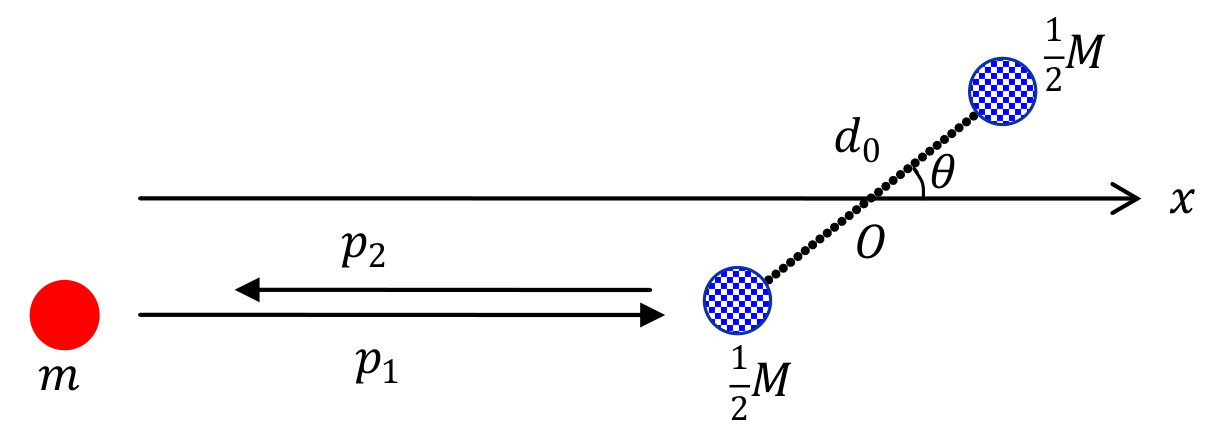
(i) If the maximum length of the spring after scattering is , find an equation which relates the ratio to the quantities and . [0.7 point]
(ii) Let . When the angle of orientation of the target is allowed to vary, the scattering cross section gives the effective target area, in a plane normal to the direction of incidence, which allows certain outcomes to occur as a result of scattering. It is known that for all outcomes which lead to the same value of , the value of must span an interval and we may choose the unit of cross section so that is simply given by the numerical range of the interval. Note that , , and, consequently, are dependent on . Let be the threshold value of at which starts to become independent of .
In the limit of large , give an estimate of . Express your answer in terms of , and . [1.1 points]
Assume and in the limit of large , plot as a function of for a given . In the plot, specify the range of and . [1.1 points] [2,9 т.]
Part B. Waves on a String
Consider an elastic string stretched between two fixed ends A and B, as shown in Fig. 3. The linear mass density of the string is . The speed of propagation for transverse waves in the string is . Let the length be . The string is plucked sideways and held in a triangular form with a maximum height at its middle point. At time , the plucked string is released from rest. All effects due to gravity may be neglected.
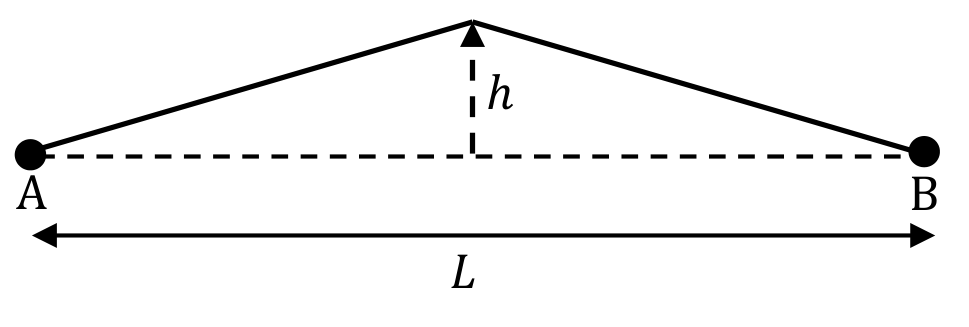
(c) Find the period of vibration for the string. [0.5 point]
Plot the shape of the string at . In the plot, specify lengths and angles which serve to define the shape of the string. [1.7 points] [2,2 т.]
(d) Find the total mechanical energy of the vibrating string in terms of , , , and . [0.8 point]
Part C. An Expanding Universe
Photons in the universe play an important role in delivering information across the cosmos. However, the fact that the universe is expanding must be taken into account when one tries to extract information from these photons. To this end, we normally express length and distance using a universal scale factor which depends on time . Thus the distance between two stars stationary in their respective local frames is proportional to :
where is a constant and accounts for the expansion of the universe. We use a dot above a symbol of a variable to denote its time derivative, i.e. , and let . Taking time derivatives of both sides of Eq. (1), one obtains the Hubble law:
where is the Hubble parameter at time . At the current time , we have
where light-year.
Assume the universe to be infinitely large and expanding in such a way that
where is a constant. In such a universe, the Hubble parameter is a constant equal to . Moreover, it can be shown that the wavelength of photons travelling in the universe will be stretched in proportion to the expansion of the universe, i.e.
Now suppose that photons making up a Lyman-alpha emission line were emitted at by a star that was stationary in its local frame and that we as observers are stationary in our local frame. When these photons were emitted, their wavelength was . But when they reach us now at , their wavelength is red-shifted to .
(e) As these photons traveled, the universe kept expanding so that the star kept receding from us. Given that the speed of light in vacuum has never changed, what was the distance of the star from us when these photons were emitted at ? Express the answer in units of Mpc. [2.2 points]
(f) What is the receding velocity of the star with respect to us now at ? Express the answer in units of the speed of light in vacuum . [0.8 point]
Appendix
The following formula may be used when needed:
Отговори
(a)
(ii): the condition is a circle centered at with radius , intercepts and ; inside, outside. A composite target in its ground state allows the circle and its interior ().
(b)
(i): . For : rises from 0 at to 1 at and stays 1 up to .
(c)
At the string is a trapezoid: rising over the first at angle with , flat at height over the middle , and falling over the last .
(d)
(e) 690 Mpc
(f) 0.2 c
Решение
Part A. Inelastic scattering and compositeness of particles
(a) Let the momentum of the target particle after scattering be . The law of conservation of linear momentum implies . The total translational kinetic energies of the scattering system before and after scattering are, respectively,
(i) By definition, we have , or equivalently,
(ii) If the incident and target particles are both elementary, their internal energies remain the same before and after the scattering. By the law of conservation of energy, we must have , or . Thus, we obtain from Eq. (a-2) the following equality
In the - plane, this represents a circle centered at with radius . The case is shown in Fig. A1. The values of at the intercepts of the circle with the -axis are
For a composite target in its ground state before scattering, the law of conservation of energy implies
where is the change in internal energy (or excitation energy) of the target as a result of scattering and and are given by Eq. (a-1). Thus, in this case, the total translational kinetic energy loss is given by . For points on the circumference of the circle in Fig. A1, we have , i.e. elastic scattering. For the interior of the circle, we have , corresponding to inelastic scattering with the target in an excited state after scattering.
The circle and its interior () are thus allowed by a composite target in its ground state before scattering.
(b) Let be the angular momentum of the target about an axis through its center of mass and normal to the plane of particle motions after scattering. By the law of conservation of angular momentum,
where the + (or –) sign is implied if the target particle on the left (or right) in Fig. 2 is hit by the incident particle.
(i) After scattering, the target may undergo vibrational and rotational motions. When the spring reaches its maximum extension, the length of the spring is and the moment of inertia of the target rotating about an axis through its center of mass and perpendicular to the spring is . The law of conservation of energy implies
where the last term represents the rotational kinetic energy of the target at the maximum extension of the spring. According to Eq. (a-4), we have
and therefore
Note that, since and , we have from Eq. (a-2)
A scattering can occur only if and , so from Eq. (a-8), we obtain
where the equalities hold only if .
*An equation marked with an asterisk gives key answers to the problem.
(ii) The scattering cross section is given by the numerical range of . For given and , is a constant by Eq. (a-8), and the value of can be found from Eq. (a-7) to be
In the limit of large , the last inequality can hold only if is very small. Thus may be neglected in the factor and we obtain
where
is nonnegative and the last equality follows from Eq.(a-8).
From Eq. (a-10), the minimum value of is found to be zero for all , and this occurs when
Moreover, the maximum value of is seen to be given by
Note that, from Eq. (a-11), it follows
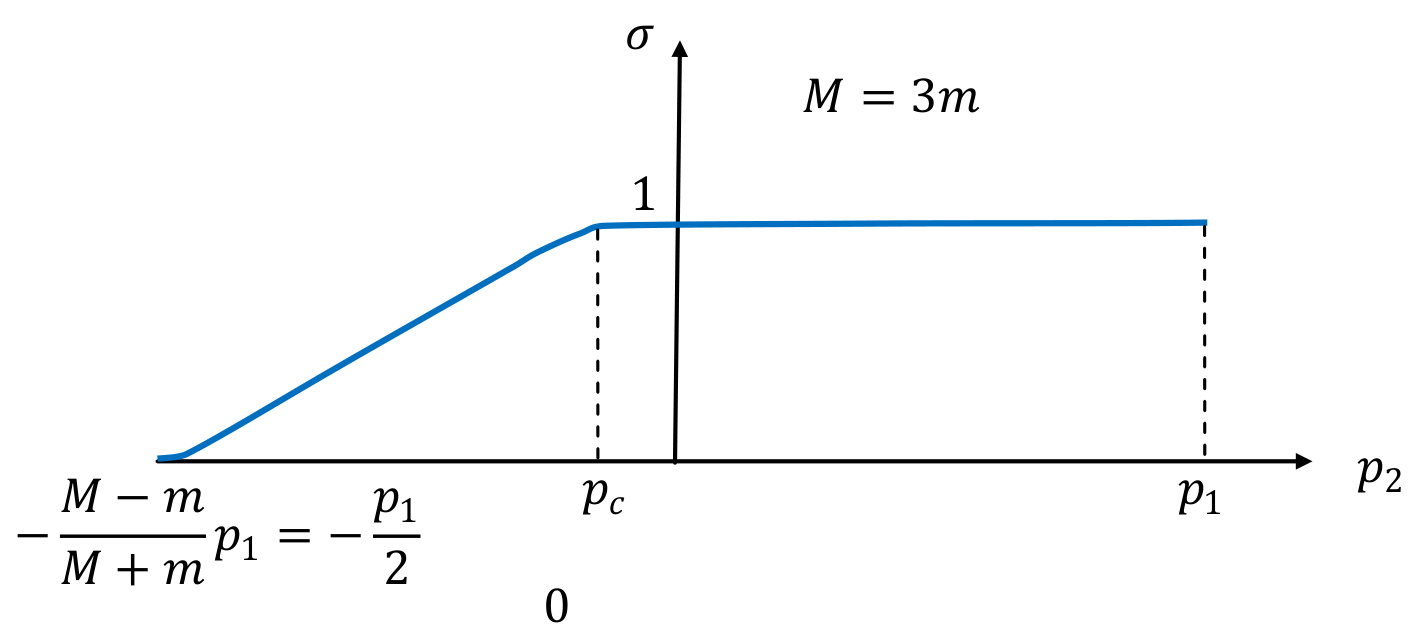
Since , the cross section is given by and, from Eq. (a-12), we see that it becomes 1 and is independent of when . Thus the threshold value at which scaling of cross section starts is given by
For below the threshold value, the cross section is equal to according to Eq. (a-12) and, from Eq. (a-11), we have the following result
Note that, from Eq. (a-9), we have for as expected. The cross section as a function of is shown in Fig. A2 which evidently shows scaling behavior.
Part B. Waves on a string
(c) The initial disturbance will propagate toward the fixed ends. It can be considered as the superposition of two waves with wave forms and , travelling toward the right and the left, respectively. They will both be reflected out of phase at the fixed ends. At , the sum of their displacements must be equal to the initial wave form . Therefore
Let . At , the string is at rest and the sum of velocities and of the two waves at must be zero. Thus we have
Integrating Eq. (b-2) with respect to and combining with Eq. (b-1), we obtain
where is a constant. (Note that this result may also be obtained by graphical construction which takes initial conditions into account by superposing two pulses of identical wave form but travelling in opposite directions.)
Since both waves, after being reflected once at each end and having travelled a distance , return to its original position and state, the period is thus
[Another way to get the period ]:
Because the first harmonics (with the longest period) has , we have
At , 1/8 of each wave will have been reflected out of phase as shown below, where the result for the wave traveling to the right is shown as dashed lines,
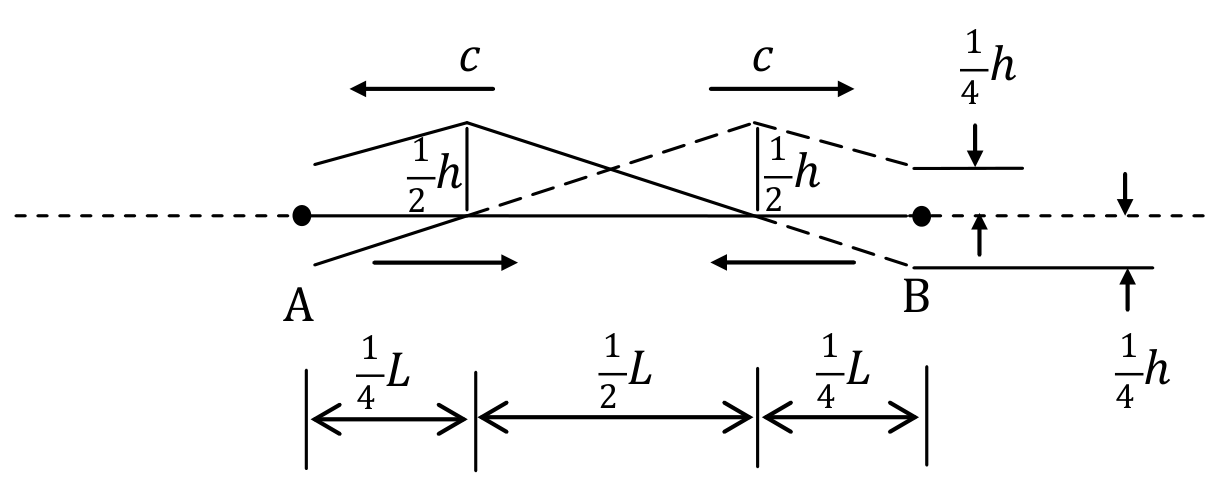
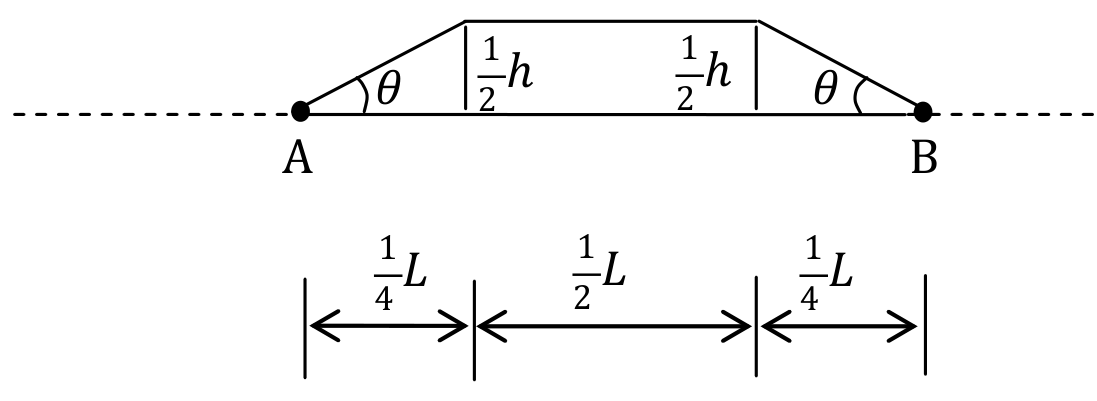
The displacements of all wave components may be added to give the resultant wave form at , as shown below.
[Another solution of (c)]:
Since the evolution of the string is periodic, waves that can simulate it must be periodic in space. Furthermore, since the string is released from rest, we can consider the initial configuration of the string as a superposition of two saw-tooth waves travelling in opposite directions as shown below:
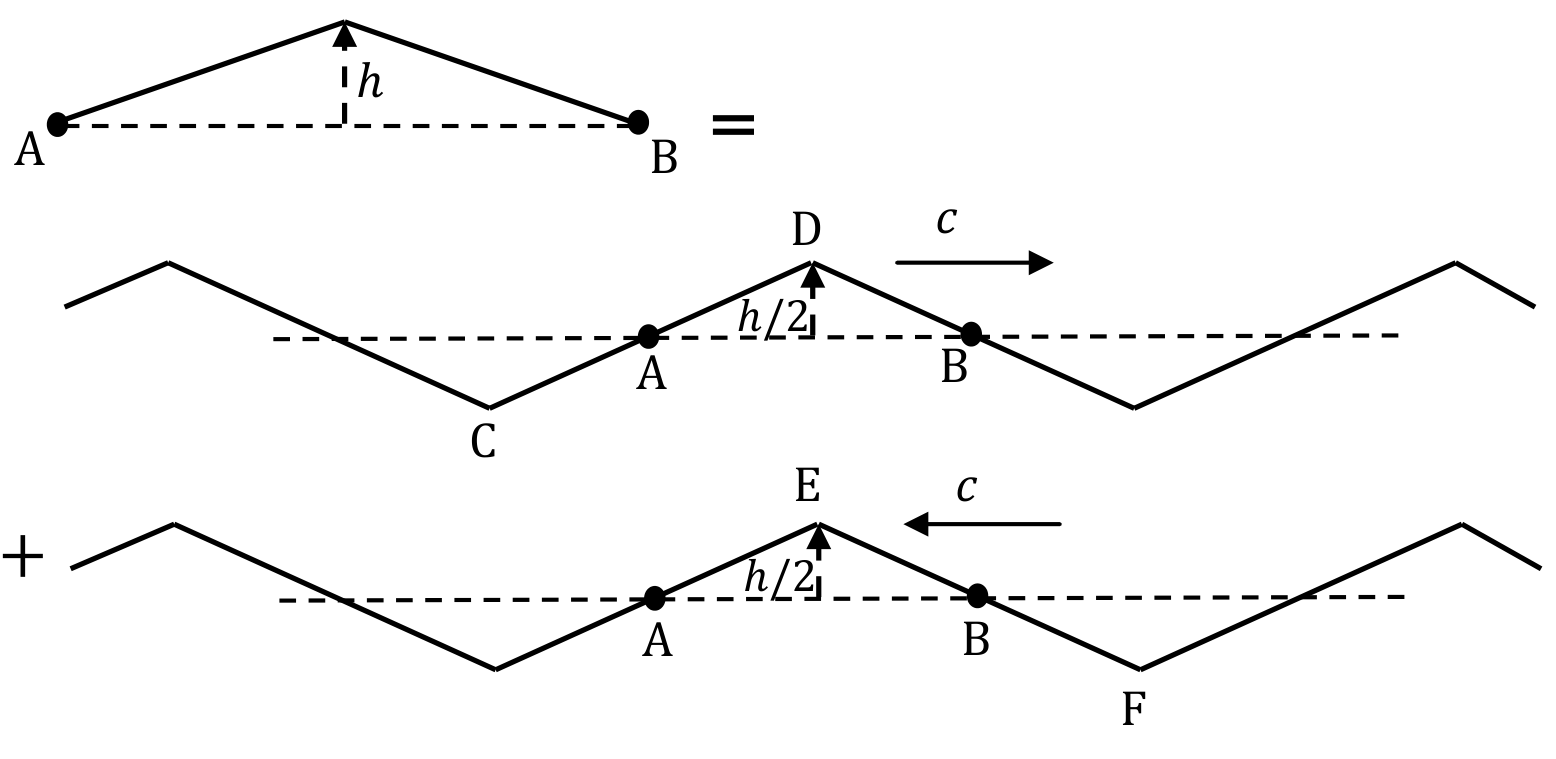
Both A and B will be fixed because two saw-tooth waves tend to move A or B in opposite directions. Clearly, the period of motion is the time for the saw-tooth wave to travel the distance . Hence we obtain
At any time , the shape of the string is determined by adding up the two waves as shown below:
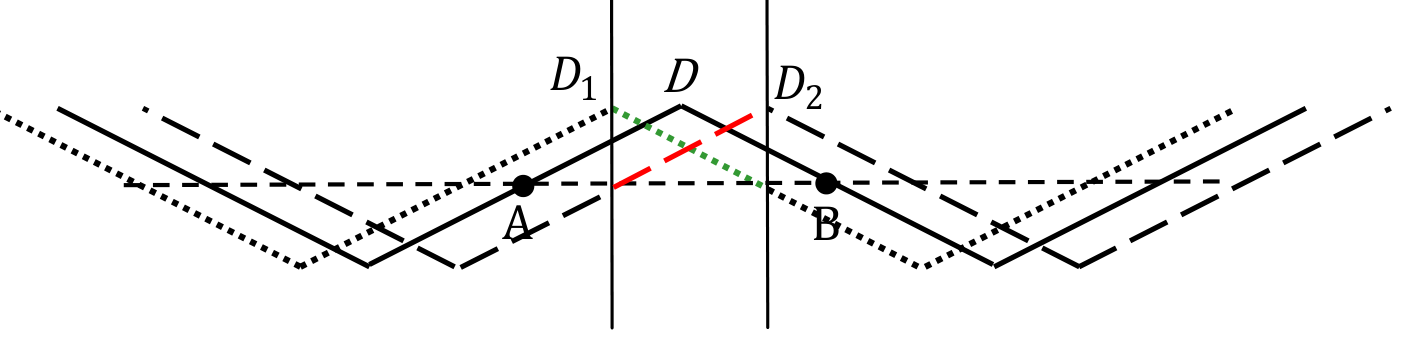
From the figure above, one sees that between and , two saw-tooth waves (line marked by green and red line) have opposite slopes and hence their sum between and is constant with the height being given by (the height of or ). Between and or and , two saw-tooth waves have the same slope but move in opposite direction, hence their sum simply reproduces the original saw-tooth shape. Thus, the shape of string at time is
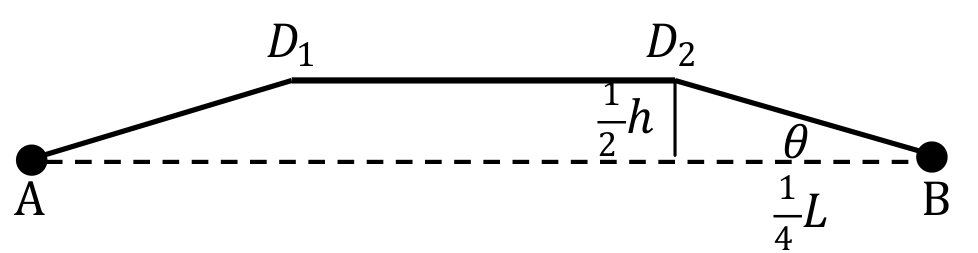
with . For , and
(d) To find the total energy, we note that the normal force which pulls the string sideways at the midpoint is
where is the constant tension () on the string and is the transverse displacement at the midpoint. The work done by is the total mechanical energy given to the string or
where use has been made of .
[Another solution of (d)]:
Because with being the tension on the string, we have . The total mechanical energy at is the potential energy
Here is the displacement of the elastic string.
[Yet another solution of (d)]:
We consider a special moment when and move into region completely. At this moment, the string is flat so that total mechanical energy is equal to the total kinetic energy. Since the velocity for each point on the string is (downward) with , we obtain
Part C. The expanding universe
(e) The photons were emitted at , and are received now at , so
On the other hand, the Hubble parameter can be derived as
which is independent of time.
Within at some moment in the past, the photons traveled , which was
at time due to the cosmic expansion. The photons were emitted at so the distance of the star from us at that time is
We already know from Eq. (c-2) that
thus
(f) Due to the cosmic expansion, the above distance is actually longer now:
Thus according to the Hubble Law, we can compute the receding velocity of the star now: