APhO 2010, Теория — Задача 2. Strong Resistive Electromagnets
Theoretical Competition — 25 April 2010 — Question Number 2 — Theoretical Question 2: Strong Resistive Electromagnets · 25 април 2010 г.
Условие
Resistive electromagnets are magnets with coils made of a normal metal such as copper or aluminum. Modern strong resistive electromagnets can provide steady magnetic fields higher than 30 tesla. Their coils are typically built by stacking hundreds of thin circular plates made of copper sheet metal with lots of cooling holes stamped in them; there are also insulators with the same pattern. When voltage is applied across the coil, current flows through the plates along a helical path to generate high magnetic fields in the center of the magnet.
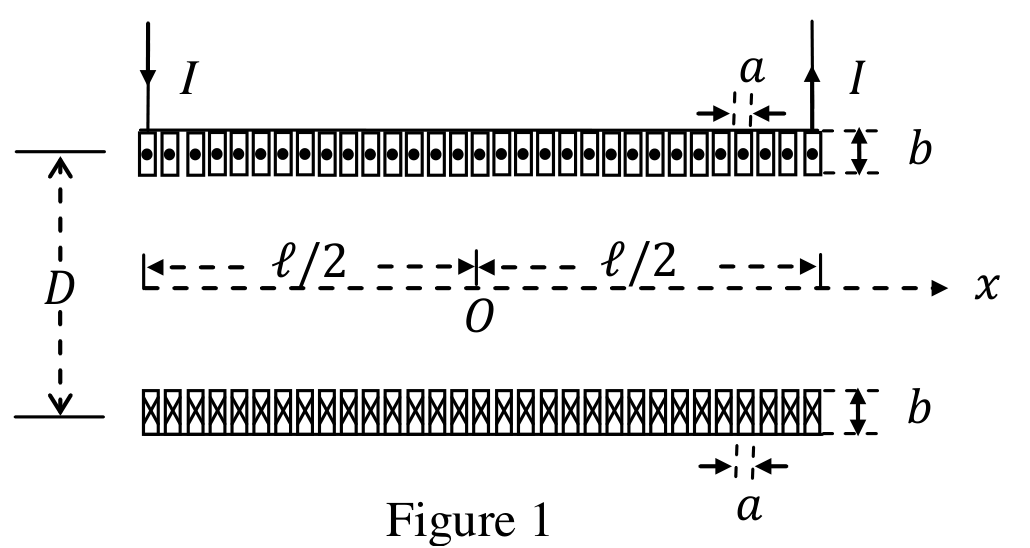
In this question we aim to assess if a cylindrical coil (or solenoid) of many turns can serve as a magnet for generating high magnetic fields. As shown in Fig. 1, the center of the magnet is at O. Its cylindrical coil consists of turns of copper wire carrying a current uniformly distributed over the cross section of the wire. The coil’s mean diameter is and its length along the axial direction is . The wire’s cross section is rectangular with width and height . The turns of the coil are so tightly wound that the plane of each turn may be taken as perpendicular to the axis and . In Table 1, data specifying physical dimensions of the coil are listed.
| Table 1 |
|---|
In assessing if such a magnet can serve to provide high magnetic fields, two limiting factors must not be overlooked. One is the mechanical rigidity of the coil to withstand large Lorentz force on the field-producing current. The other is that the enormous amount of Joule heat generated in the wire must not cause excessive temperature rise. We shall examine these two factors using simplified models.
The Appendix at the end of the question lists some mathematical formulae and physical data which may be used if necessary.
(a) Part A. Magnetic Fields on the Axis of the Coil
Assume so that one may regard the wire as a thin strip of width . Let O be the origin of coordinates. The direction of the current flow is as shown in Fig. 1.
(a) Find the -component of the magnetic field on the axis of the coil as a function of when the steady current passing through the coil is . [1.0 point]
(b) Find the steady current passing through the coil if is . Use data given in Table 1 when computing numerical values. [0.4 point]
(c) Part B. The Upper Limit of Current
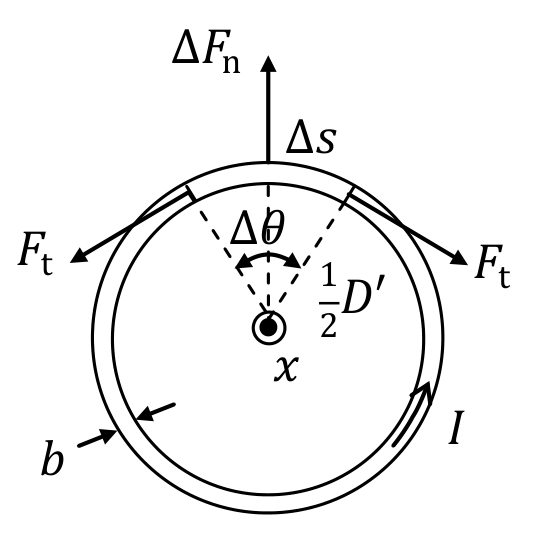
In Part B, we assume the length of the coil is infinite and . Consider the turn of the coil located at . The magnetic field exerts Lorentz force on the current passing through the turn. Thus, as Fig. 2 shows, a wire segment of length is subject to a normal force which tends to make the turn expand.
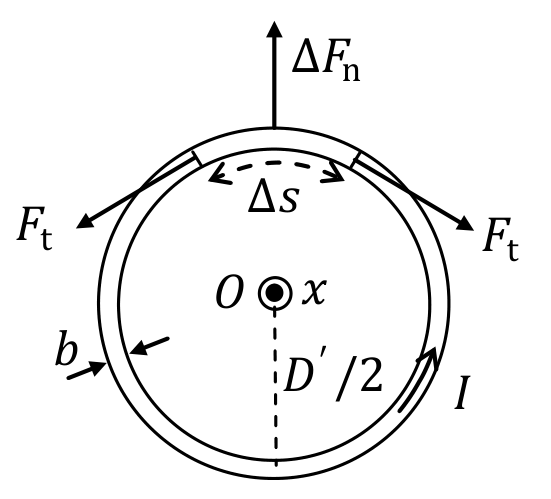
(c) Suppose that, when the current is , the mean diameter of the expanded coil remains at a constant value larger than , as shown in Fig. 2.
Find the outward normal force per unit length . [1.2 point]
Find the tension acting along the wire. [0.6 point] [1,8 т.]
(d) Neglect the coil’s acceleration during the expansion. Assume the turn will break when the wire’s unit elongation (i.e. tensile strain or fractional change of the length) is 60 % and tensile stress (i.e. tension per unit cross sectional area of the unstrained wire) is . Let be the current at which the turn will break and the corresponding magnetic field at the center O.
Find an expression for and then calculate its value. [0.8 point]
Find an expression for and then calculate its value. [0.4 point] [1,2 т.]
(e) Part C. The Rate of Temperature Rise
When the current is and the temperature of the coil is , assume that the resistivity, the specific heat capacity at constant pressure, and the mass density of the wire of the coil are, respectively, given by , and .
(e) Find an expression for the power density (i.e. power per unit volume) of heat generation in the coil and then calculate its value. Use data in Table 1. [0.5 point]
(f) Let be the time rate of change of temperature in the coil. Find an expression for and then calculate its value. [0.5 point]
(g) Part D. A Pulsed-Field Magnet
If the large current needed for a strong magnet lasts only for a short time, the temperature rise caused by excessive Joule heating may be greatly reduced. This idea is employed in a pulsed-field magnet.
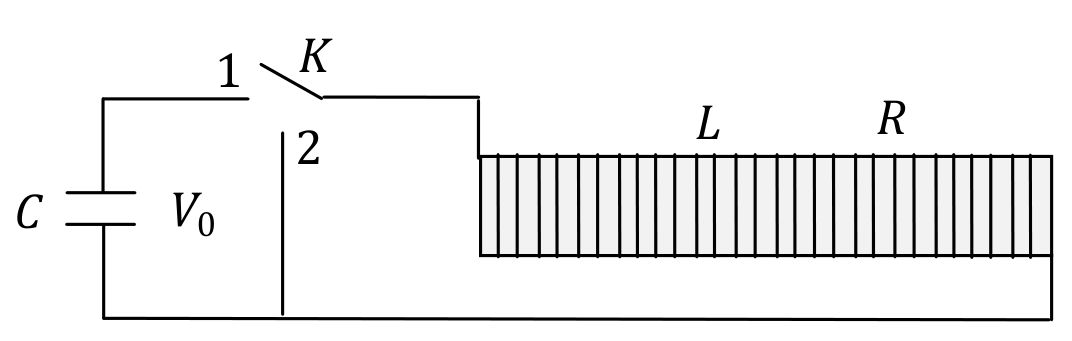
Thus, as shown in Fig. 3, a capacitor bank of capacitance charged initially to a potential is used to drive the current through the coil. The circuit is equipped with a switch . The inductance and resistance of the circuit are assumed to be entirely due to the coil. The construct and dimensions of the coil are the same as given in Fig. 1 and Table 1. Assume , , and to be independent of temperature and the magnetic field is the same as that of an infinite solenoid with .
(g) Find expressions for the inductance and resistance . [0.6 point]
Calculate the values of and . Use data given in Table 1. [0.4 point] [1 т.]
(h) At time , the switch is thrown to position 1 and the current starts flowing. For , the charge on the positive plate of the capacitor and the current entering the positive plate are given by
in which and are positive constants and is given by
Note that, if is expressed as a function of a new variable , then and its time derivative are identical in form except for an overall constant factor. The time derivative of may therefore be obtained similarly without further differentiations.
Find and in terms of , , and . [0.8 point]
Calculate the values of and when is . [0.4 point] [1,2 т.]
(i) Let be the maximum value of for . Find an expression for . [0.6 point]
If , what is the maximum value of the initial voltage of the capacitor bank for which will not exceed found in Problem (d)? [0.4 point] [1 т.]
(j) Suppose the switch is moved instantly from position 1 to 2 when the absolute value of the current reaches . Let be the total amount of heat dissipated in the coil from to and the corresponding temperature increase of the coil. Assume the initial voltage takes on the maximum value obtained in Problem (i) and the electromagnetic energy loss is only in the form of heat dissipated in the coil.
Find an expression for and then calculate its value. [1.0 point]
Find an expression for and then calculate its value. Note that the value for must be compatible with the assumption of constant and . [0.4 point] [1,4 т.]
Appendix
permeability of free space
Отговори
(a)
(b) 18000 A
Official: I0 = 1.7794 × 10⁴ A ≅ 1.8 × 10⁴ A.
(c)
(d)
(e) W/m³
Official: ρe J² = ρe (I/(ab))² = 1.720 × 10¹⁰ W/m³ ≅ 1.7 × 10¹⁰ W/m³.
(f) 5000 K/s
Official: Ṫ = (ρe/(ρm cp))(I/(ab))² = 4.975 × 10³ K/s ≅ 5.0 × 10³ K/s.
(g)
(h)
(i)
(j)
Решение
Part A. Magnetic Fields on the Axis of the Coil
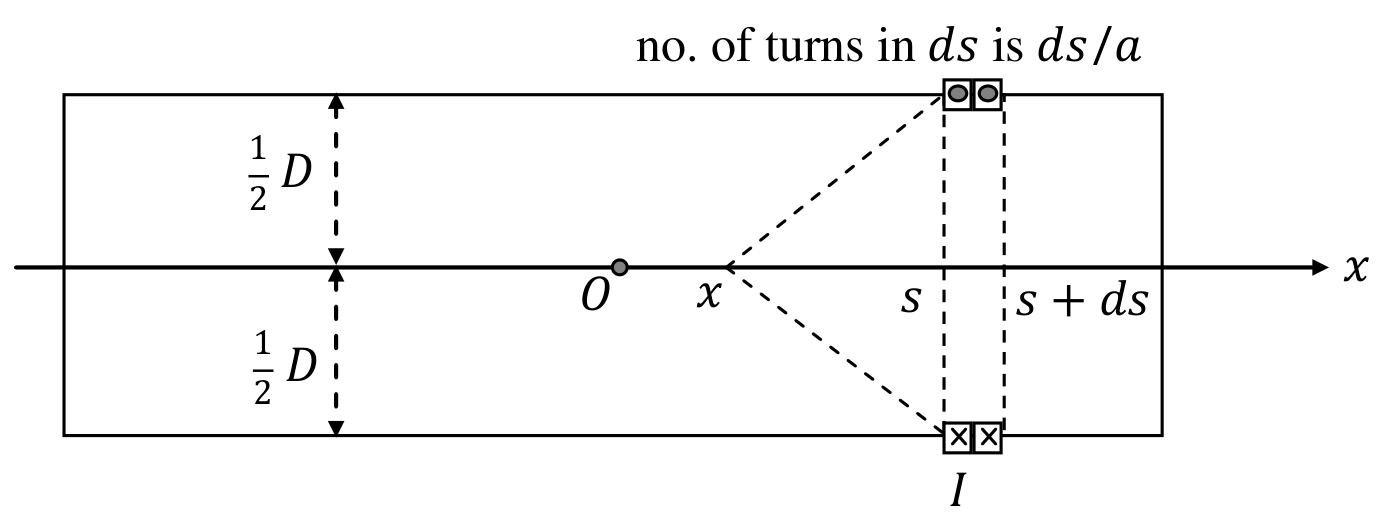
(a) At the point on the axis, the magnetic field due to the current passing through the turns located in the interval is (see Fig. A1)
which, when summed over all turns of the coil, leads to the total magnetic field with
(b) From Eq. (a-2), the magnetic field at O with is
If is , then the current must be equal to
*An equation marked with an asterisk gives key answers to the problem.
Part B. The Upper Limit of Current
(c) For an infinitely long coil with and , the magnetic field acting on the current is the average of the fields inside and outside of the coil. The field outside is zero and the field inside is the same as that at O, i.e. in Eq. (b-1) with . Thus we have
and the outward normal force on the wire segment of length is
As can be seen from Fig. A2, the resultant of the pair of tension forces at the ends of the segment is given by
This must be in equilibrium with the normal force so that, by using Eq. (c-2), we have
(d) At breaking, the tensile stress of the wire is, from Eq. (c-4),
and the tensile strain of the wire is
From the last two equations, the current at which the turn will break is
and the magnitude of the magnetic field at the center O, i.e. Eq. (b-1) with , is
Part C. Rate of Temperature Rise
(e) When the current is , the current density is given by
The power density is given by
(ALTERNATIVE)
The volume and resistance (appearing also in Problem (h)) of the current-carrying wire for a coil of length are given by
The total power of Joule heat generated in the coil is
Thus the power density is
Note that, by Eqs. (e-3) to (e-5), the expression for power density may also be written as
This is identical to that obtained in Eq. (e-2).
(f) The time rate of temperature increase of the coil is
At and , we have
(ALTERNATIVE)
The heat capacity of the coil is
From Eqs. (e-5) and (f-3), the time rate of temperature increase is
Part D. A Pulsed-Field Magnet
(g) The magnetic flux through each turn is, in the limit , given by
The inductance of the coil is
The resistance of the coil is the same as given in Eq. (e-4). Thus
(h) According to Kirchhoff’s circuit law, the change of electric potential around a closed circuit must be zero and we have
In this question, we are given
Comparing the right sides of Eqs. (1) and (2), one sees that the current is obtained from by changing the latter’s time variable to or, equivalently, changing to , and then multiplying its amplitude constant by a factor
Since in Eq. (2) has the same form as in Eq. (1), we may apply the same rule again to obtain its derivative as
Making use of Formula 2 given in Appendix, we may express the left side of Eq. (h-1) as a linear combination of and so that
which can be satisfied if and only if
Note that Eqs. (h-4) and (h-5) may be obtained more simply by considering Eq. (h-1) at the moments when and 0, respectively. Subtracting Eq. (h-5) from Eq. (h-4), we obtain
If we use the expressions given in Eqs. (g-2) and (g-3), we obtain
Adding up Eqs. (h-4) and (h-5), we have, by Eq. (h-6) and Eq. (3),
This may be rewritten as
and we obtain
(i) From Eq. (h-2), the maximum value of appears at when the time is
From Eq. (2), the maximum value of is then given by
From Eqs. (3), (h-7) and (h-10), we have
If does not exceed found in Problem (d), we must have
which implies that the maximum value of occurs when the equality holds and is given by
[j] When reaches its maximum at , the voltage of the capacitor has dropped from the initial voltage to
From to , the energy supplied by the capacitor bank to the circuit, in the form of Joule heat and magnetic energy in the field of the coil, is
By the law of conservation of energy, this entire amount of energy is eventually turned into heat in the coil and we have
If the heat capacity (as computed in Eq. (f-3) remains about the same as that at , then the temperature increase is
With such a temperature increase, the thermal and electrical properties of a metal such as copper do not change substantially.