Theoretical Competition, 25 April 2010 — Theoretical Question 3: Electron and Gas Bubbles in Liquids · 25 април 2010 г. · 10 т.
Условие
This question deals with physics of two bubble-in-liquid systems. It has two parts:
Part A. An electron bubble in liquid helium
Part B. Single gas bubble in liquid
Part A. An Electron Bubble in Liquid Helium
When an electron is planted inside liquid helium, it can repel atoms of liquid helium and form what is called an electron bubble. The bubble contains nothing but the electron itself. We shall be interested mainly in its size and stability.
We use Δf to denote the uncertainty of a quantity f. The components of an electron’s position vector q=(x,y,z) and momentum vector p=(px,py,pz) must obey Heisenberg’s uncertainty relations ΔqαΔpα≥ℏ/2, where ℏ is the Planck constant divided by 2π and α=x,y,z.
We shall assume the electron bubble to be isotropic and its interface with liquid helium is a sharp spherical surface. The liquid is kept at a constant temperature very close to 0K with its surface tension σ given by 3.75×10⁻⁴N⋅m−1 and its electrostatic responses to the electron bubble may be neglected.
Consider an electron bubble in liquid helium with an equilibrium radius R. The electron, of mass m, moves freely inside the bubble with kinetic energy Ek and exerts pressure Pe on the inner side of the bubble-liquid interface. The pressure exerted by liquid helium on the outer side of the interface is PHe.
(a) Find a relation between PHe, Pe, and σ. [0.4 point]
Find a relation between Ek and Pe. [1.0 point] [1,4 т.]
(b) Denote by E0 the smallest possible value of Ek consistent with Heisenberg’s uncertainty relations when the electron is inside the bubble of radius R. Estimate E0 as a function of R. [0,8 т.]
(c) Let Re be the equilibrium radius of the bubble when Ek=E0 and PHe=0.
Obtain an expression for Re and calculate its value. [0,6 т.]
(d) Find a condition that R and PHe must satisfy if the equilibrium at radius R is to be locally stable under constant PHe. Note that PHe can be negative. [0,6 т.]
(e) There exists a threshold pressure Pth such that equilibrium is not possible for the electron bubble when PHe is less than Pth. Find an expression for Pth. [0,6 т.]
Part B. Single Gas Bubble in Liquid — Collapsing and Radiation
In this part of the problem, we consider a normal liquid, such as water.
When a gas bubble in a liquid is driven by an oscillating pressure, it can show dramatic responses. For example, following a large expansion, it can collapse rapidly to a small radius and, near the end of the collapse, emit light almost instantly. In this phenomenon, called single-bubble sonoluminescence, the gas bubble undergoes cyclic motions which typically consist of three stages: expansion, collapse, and multiple after-bounces. In the following we shall focus mainly on the collapsing stage.
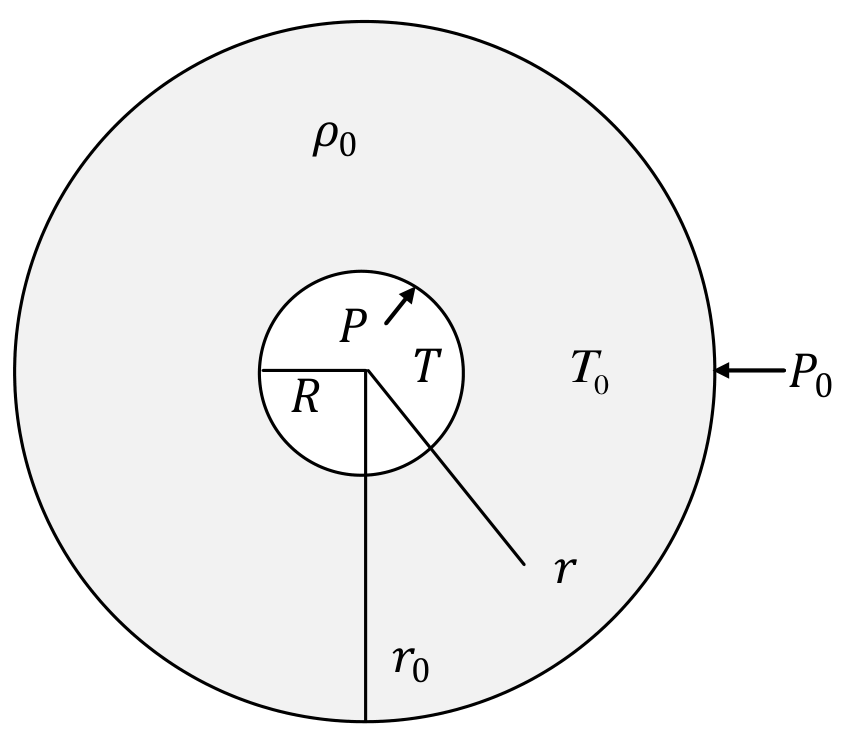
We assume that, at all times, the bubble considered is spherical and its center remains stationary in the liquid. See Fig 1. The pressure, temperature, and density are always uniform inside the bubble as its size diminishes. The liquid containing the bubble is assumed to be isotropic, nonviscous, incompressible, and very much larger in extent than the bubble. All effects due to gravity and surface tension are neglected so that pressures on both sides of the bubble-liquid interface are always equal.
● Radial motion of the bubble-liquid interface
As the bubble’s radius R=R(t) changes with time t, the bubble-liquid interface will move with radial velocity R˙≡dR/dt. It follows from the equation of continuity of incompressible fluids that the liquid’s radial velocity r˙≡dr/dt at distance r from the center of the bubble is related to the rate of change of the bubble’s volume V by
dtdV=4πR2R˙=4πr2r˙.(1)
This implies that the total kinetic energy Ek of the liquid with mass density ρ0 is
where r0 is the radius of the outer surface of the liquid.
Fig. 1
(f) Assume the ambient pressure P0 acting on the outer surface r=r0 of the liquid is constant.
Let P=P(R) be the gas pressure when the radius of the bubble is R.
Find the amount of work dW done on the liquid when the radius of the bubble changes from R to R+dR. Use P0 and P to express dW. [0.4 point]
The work dW must be equal to the corresponding change in the total kinetic energy of the liquid. In the limit r0→∞, it follows that we have Bernoulli’s equation in the form
21ρ0d(RmR˙2)=(P−P0)RndR.(3)
Find the exponents m and n in Eq. (3). Use dimensional arguments if necessary. [0.4 point] [0,8 т.]
● Collapsing of the gas bubble
From here on, we consider only the collapsing stage of the bubble. The mass density of the liquid is ρ0=1.0×10³kg⋅m−3, the temperature T0 of the liquid is 300K and the ambient pressure P0 is 1.01×10⁵Pa. We assume that ρ0, T0, and P0 remain constant at all times and the bubble collapses adiabatically without any exchange of mass across the bubble-liquid interface.
The bubble considered is filled with an ideal gas. The ratio of specific heat at constant pressure to that at constant volume for the gas is γ=5/3. When under temperature T0 and pressure P0, the equilibrium radius of the bubble is R0=5.00μm.
Now, this bubble begins its collapsing stage at time t=0 with R(0)=Ri=7R0, R˙(0)=0, and the gas temperature Ti=T0. Note that, because of the bubble’s expansion in the preceding stage, Ri is considerably larger than R0 and this is necessary if sonoluminescence is to occur.
(g) Express the pressure P≡P(R) and temperature T≡T(R) of the ideal gas in the bubble as a function of R during the collapsing stage, assuming quasi-equilibrium conditions hold. [0,6 т.]
(h) Let β≡R/Ri and β˙=dβ/dt. Eq. (3) implies a conservation law which takes the following form
21ρ0β˙2+U(β)=0.(4)
Let Pi≡P(Ri) be the gas pressure of the bubble when R=Ri. If we introduce the ratio Q≡Pi/[(γ−1)P0], the function U(β) may be expressed as
U(β)=μβ−5[Q(1−β2)−β2(1−β3)].(5)
Find the coefficient μ in terms of Ri and P0. [0,6 т.]
(i) Let Rm be the minimum radius of the bubble during the collapsing stage and define βm≡Rm/Ri. For Q≪1, we have βm≈CmQ.
Find the constant Cm. [0.4 point]
Evaluate Rm for Ri=7R0. [0.3 point]
Evaluate the temperature Tm of the gas at β=βm. [0.3 point] [1 т.]
(j) Assume Ri=7R0. Let βu be the value of β at which the dimensionless radial speed u≡∣β˙∣ reaches its maximum value. The gas temperature rises rapidly for values of β near βu.
Give an expression and then estimate the value of βu. [0.6 point]
Let uˉ be the value of u at β=βˉ≡(βm+βu)/2. Evaluate uˉ. [0.4 point]
Give an expression and then estimate the duration Δtm of time needed for β to diminish from βu to the minimum value βm. [0.6 point] [1,6 т.]
● Sonoluminescence of the collapsing bubble
Consider the bubble to be a surface black-body radiator of constant emissivity a so that the effective Stefan-Boltzmann’s constant σeff=aσSB. If the collapsing stage is to be approximated as adiabatic, the emissivity must be small enough so that the power radiated by the bubble at β=βˉ is no more than a fraction, say 20 %, of the power E˙ supplied to it by the driving liquid pressure.
(k) Find the power E˙ supplied to the bubble as a function of β. [0.6 point]
Give an expression and then estimate the value for an upper bound of a. [0.8 point] [1,4 т.]
The official solution prints ū = 5.52 × 10⁶ without a unit (it is a rate, s⁻¹).
(k)E˙=−4πRi3Piβ3β˙,a≤0.0107
Решение
Part A. An Electron Bubble in Liquid Helium
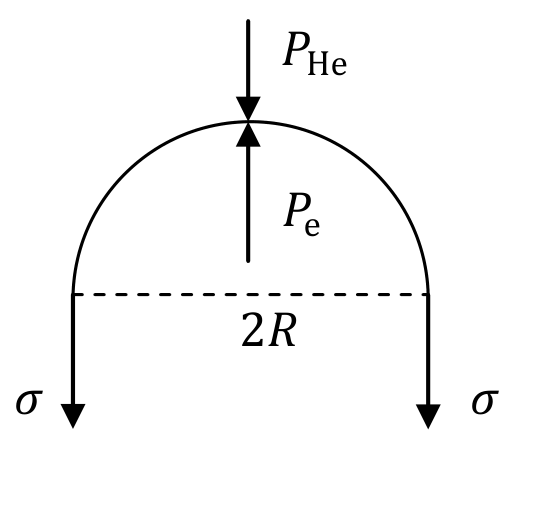
(a) Consider a half of the spherical interface (see Fig. A1 below). The condition for its static equilibrium implies that the total force acting on it must be zero. This implies
πR2(Pe−PHe)=2πRσ(a−1)
which leads to
Fig. A1
Pe=PHe+R2σ((a−2)∗)
An equation marked with an asterisk gives key answers to the problem.
According to the de Broglie relation p=h/λ∝1/R, the non-relativistic kinetic energy Ek is inversely proportional to R2, i.e.
Ek=2mp2=R2const..(a−3)
By the work- energy theorem, we have
−PedV=dEk=(−2)R3const.dR=−R2EkdR(a−4)
Thus,
−Pe(4πR2dR)=−R2EkdR(a−5)
or
Pe=2πR31Ek((a−6)∗)
[Alternative]
The state of an electron confined in the bubble corresponds to standing waves which vanish on the interface. According to Part B of Question 1, these are equivalent to the superposition of two travelling waves moving in opposite directions and continually being reflected at the interface. They give rise to pressure on the interface and the relation between the non-relativistic kinetic energy Ek and the pressure Pe for an electron inside a bubble is similar to that obtained from the kinetic theory of gases. Thus we have
Pe=32VEk=4πR32Ek=2πR31Ek((a−7)∗)
(b) Let ℏ=h/(2π). From the uncertainty relations, we have
ΔxΔpx≥21ℏ,ΔyΔpy≥21ℏ,ΔzΔpz≥21ℏ.(b−1)
From symmetry considerations implied by isotropy, we have
and the kinetic energy must satisfy the following inequality:
Ek=2mp2≥2m1(49ℏ2)r21(b−7)
The smallest possible kinetic energy E0 of the electron consistent with the uncertainty relations is thus obtained if the mean-squared-radius r2 is set equal to its largest possible value of R2. This gives
Ek≥E0=8mR29ℏ2((b−8)∗)
(c) If Ek=E0, it follows from Eqs. (a-2), (a-3), and (b-7) that we have
Pe=2πR31E0=16mπR59ℏ2=R2σ+PHe(c−1)
For PHe=0, this gives the following equilibrium radius of the electron bubble:
It might be of some interest to note that, from Eq. (c-1), the corresponding minimum kinetic energy is
E0=4πR02σ=3h(2πmσ)1/2=0.100eV(c−3)
(d) The condition for stable local equilibrium of the electron bubble at radius R is that when R is increased by a small amount dR>0, the inward force pushing on the interface must be greater than the outward force so as to decrease the radius. Thus, from Eq. (c-1), we obtain
(R+dR)2σ+PHe>16mπ(R+dR)59ℏ2(d−1)
By keeping only terms linear in dR after both sides of the inequality are expanded as a power series and making use of Eq. (c-1) to eliminate PHe, we obtain
(−1)R22σ>(−5)16mπR69ℏ2(d−2)
Note that the same inequality is obtained if we consider a small change dR<0. Using Eq. (c-1), we may express Eq. (d-2) in terms of PHe as
R2σ<5(PHe+R2σ)(d−3)
or equivalently,
PHe>−(5R8σ)((d−4)∗)
(e) From Eqs. (a-2), (a-6), and (b-8), we have
R2σ+PHe=Pe=2πR3Ek≥2πR3E0=16mπR59ℏ2(e−1)
or equivalently,
PHe≥16mπR59ℏ2−R2σ(e−2)
The minimum of the right-hand side of the inequality occurs when its derivative vanishes, i.e.
16mπR6−45ℏ2+R22σ=0(e−3)
or
R=Rth=(32mπσ45ℏ2)1/4(e−4)
Substituting the last result back into Eq. (e-2), we obtain
For PHe<Pth, no equilibrium is possible for the electron bubble.
Part B. Single Gas Bubble in Liquid — Collapsing and Radiation
(f) When the bubble’s radius R changes by dR, the volume of the liquid displaced by the interface is dV=4πR2dR. But the total volume of the incompressible liquid cannot change, so the change of the volume at the outer surface of the liquid must also be dV. Thus the amount of work done on the liquid is
dW=PdV−P0dV=(P−P0)4πR2dR((f−1)∗)
From Eq.(2), the change in total kinetic energy of the liquid is, in the limit r0→∞,
dEk=d[2πρ0R4R˙2(R1−r01)]=2πρ0d(R3R˙2).(f−2)
Since dEk=dW, we obtain
21ρ0d(RmR˙2)=(P−P0)RndR.(f−3)
with
m=3,n=2.((f−4)∗)
(g) The initial gas temperature is T0. According to the ideal gas law, the initial gas pressure Pi=P(Ri) is thus given by
PiRi3=P0R03.((g−1)∗)
Since the process is adiabatic, the radial dependence of the gas pressure P is
(j) From Eq. (h-4), the maximum value of the radial speed u≡∣β˙∣ occurs at β=βu where −U(β) is also at its maximum, i.e. the derivative of U(β) with respect to β must vanish at β=βu. Since
(k) Suppose the bubble is a surface radiator with emissivity a. By making use of Eq. (g-3), the radiant power Wr of the bubble at temperature T can be written as a function of β, i.e.
Wr=a(σSBT4)4πR2=4πRi2aσSBT04β61,(k−1)
where σSB is the Stefan-Boltzmann constant. The power supplied to the bubble is
The assumption of an adiabatic collapsing of the bubble is deemed reasonable when the radiant power is less than 20 % of the power supplied to the bubble at β=βˉ. Thus we have