APhO 2011, Теория — Задача 1. The Shockley-James Paradox
Theoretical Question 1: The Shockley-James Paradox · 10 т.
Внимание: Бележка към темата
The official marking scheme for (c) prints a lowercase r in ε₂ = 2πrE, whereas the solution uses R. The answer form labels (a) M₁₂ whereas the question asks M₂₁. These printed distinctions are retained.
Theoretical Competition
3 May 2011 — 12th APhO, Israel. Question Number 1.
Условие
In the year 1905, Albert Einstein proposed the special theory of relativity to resolve the inconsistency between Newton’s mechanics and Maxwell’s electromagnetism. Proper understanding of the theory led to the resolution of many apparent paradoxes. At the time, the discussion focused mostly on the propagation of electromagnetic waves.
In this question, we solve a paradox of a different type. For a fairly simple system of charges proposed by W. Shockley and R. P. James in 1967, understanding the conservation of linear momentum requires careful relativistic analysis. If a point charge is located near a magnet of changing magnetization, there's an induced electric force on the charge, but no apparent reaction on the magnet. The process may be slow enough that any electromagnetic radiation (and any momentum carried away by it) is negligible. Thus, apparently we get a cannon without recoil.
In our analysis of this system, we will demonstrate that in relativistic mechanics, a composite body may hold a non-zero mechanical momentum while remaining stationary.
Part I: Understanding the impulse on the point charge (3,3 т.)
Consider a circular current loop of radius carrying a current , and a second, larger current loop of radius , concentric with the first and lying in the same plane.
a. A current passing through loop 2 (the larger loop) generates a magnetic flux through loop 1. Find the ratio . It is called the mutual inductance coefficient. [1 т.]
b. Given that , obtain the total induced EMF in the larger loop as a result of a variation of the current in the smaller loop. Neglect the current in the larger loop. Hint: the induced EMF is equal to the rate of change of the magnetic flux through the loop. [0,8 т.]
c. The EMF you found in part (b) is due to the tangential component of an induced electric field. Obtain an expression for the tangential electric field at radius as a function of the rate of change of the current. [0,5 т.]
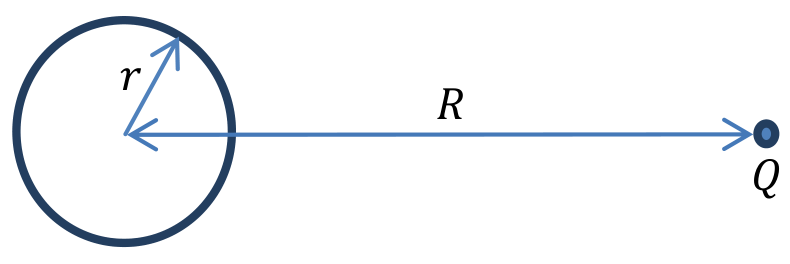
We now remove the larger current loop, and instead put a massive point charge at radius , as shown in Figure 1. It may be assumed that the charge moves very little during the relevant time periods.
d. Find the total tangential impulse received by the point charge as the current in the small loop changes from an initial value to the final value . [1 т.]
Part II: Understanding the recoil of the current loop (4,4 т.)
We will now understand the origin of the recoil of the loop, using a loop of different geometry.
e. Consider a hollow tube with walls made of a neutral insulating material of length and cross section carrying an electric current . The current is due to charged particles of rest mass and charge distributed homogenously inside the tube with number density . Assume that the charged particles are all moving along the tube with the same velocity. Find the total momentum of the charged particles in the tube, taking Special Relativity effects into account. [1,1 т.]
f. Consider a square current loop with side . At a distance from the loop, there is a point charge ; see Figure 2. The loop carries current . We will model the current loop as a neutral tube, as in part (e). The charge carriers can move freely along the loop, colliding elastically with the walls and making elastic right turns at the corners. Neglect all interactions among the charge carriers. Assume also that all the charge carriers at a given section along the tube always move with the same velocity. Assume that the loop is heavy and that its motion can be neglected. Calculate the total linear momentum of the charge carriers in the loop. It is called "hidden momentum". [3,3 т.]
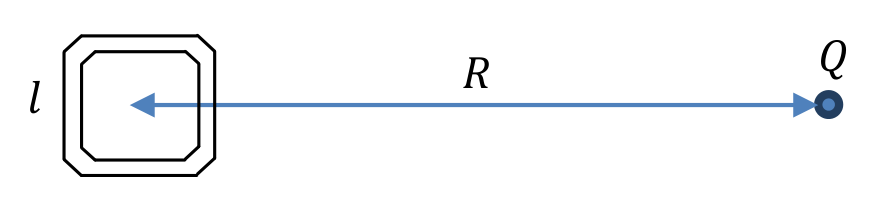
When the current stops, this linear momentum is transferred to the loop, and it gets an impulse equal to minus the impulse received by the point charge . This is the missing recoil that we were looking for (note that in the initial state there is also momentum in the electromagnetic field; this is important for conservation of the total momentum of the entire system).
Part III: Summarizing the results (2,3 т.)
g. Current loops are often characterized by their magnetic moment , where is the current and is the loop’s area. Express the answer to part (d) in terms of , , and . Likewise, express the answer to part (f) in terms of , , and . Note that the electric and magnetic constants are related by:
where is the speed of light. [0,8 т.]
h. In a more realistic model, the current loop is a conducting wire, and the field of the point charge does not penetrate into the conductor. We assume that the current is still conducted by charge carriers inside the wire. Decide whether each of the following statements is true or false, and circle the correct option in the Answer Form.
Note: You may leave a statement undecided, but if you decide incorrectly, you will not get credit at all for part (h).
- A. (0.5 pts.) The linear momentum of the current loop is zero.
- B. (0.5 pts.) As the total current in the loop changes from to zero, the charge carriers decelerate, causing induced currents in the wire’s conducting material. Because of these induced currents, the point charge will not get a net impulse.
- C. (0.5 pts.) The surface charges on the wire, induced by the presence of the external charge, will experience an electric force as the current changes from to zero. This way, the loop will get the same impulse as found in part (f). [1,5 т.]
Решение
a.
The magnetic field created by the large loop at its center is:
Since , this is the field throughout the area of the small loop. Therefore, the flux through the small loop is given by:
The mutual inductance is then given by:
b.
Since , we have:
Taking the derivative with respect to time, this becomes:
c.
The EMF is work per unit charge, while the electric field is force per unit charge. Therefore:
d.
The electric field from part (c) leads to a force:
Integrating over (and disregarding the sign), we get the impulse:
e.
The current can be written as:
where is the charge carriers’ velocity. We therefore have:
The momentum is then given by:
where is the Lorentz factor associated with .
f.
The hidden momentum is due to the charge carriers in the two vertical sides of the loop. Let be the mass of the charge carriers, let be their charge, and let be the potential energy difference for a charge carrier between the two sides. Denote the longitudinal densities and velocities of the charges in the two sides by , , and . Let and be the appropriate Lorentz factors. From the constant value of the current, we have:
Energy conservation for the charge carriers passing from one side to the other reads:
The total momentum now reads:
Note that all the microscopic quantities , , and have dropped out.
g)
In part (d), the magnetic moment is , and we get:
In part (f), the magnetic moment is , and we get:
We see that the results are identical.
h)
The answer is (A)+(C). (A) is true because between the near side and the far side of the loop vanishes. (B) cannot be true, because the back-reaction of the induced charges on the external charge is a higher-order effect; for instance, it involves higher powers of . Then the conservation of center-of-mass velocity requires that (C) is true.
Marking Scheme
| Part | Criterion | Points | Notes |
|---|---|---|---|
| a) 1.0 | Finding at the center | 0.3 | |
| Writing | 0.3 | ||
| Final answer | 0.4 | No credit for internal propagating error | |
| b) 0.8 | Understanding that | 0.2 | |
| Understanding that | 0.2 | Disregard sign | |
| Final answer | 0.4 | No credit for internal propagating error | |
| c) 0.5 | Writing | 0.3 | Partial credit for - 0.1 |
| Final answer | 0.2 | No credit for internal propagating error | |
| d) 1.0 | Writing | 0.2 | |
| Writing as a function of | 0.2 | ||
| Writing | 0.2 | ||
| Final answer | 0.4 | ||
| e) 1.1 | Understanding that | 0.2 | |
| Understanding that | 0.3 | ||
| Understanding that (or ) | 0.3 | ||
| Final answer | 0.3 | No credit for internal propagating error | |
| f) 3.3 | Understanding that or | 0.3 | |
| Understanding that there are separate and (or ) | 0.4 | ||
| Expressing in terms of the charge densities and velocities | 0.4 | E.g. | |
| Cancelling out the charge densities | 0.7 | E.g. | |
| Understanding that | 0.5 | ||
| Finding | 0.4 | ||
| Final answer | 0.6 | If the result was reverse-engineered from part (g), this will be the only credit given. No credit for internal propagating error. | |
| g) 0.8 | Writing for part (d) | 0.1 | |
| Re-expressing the result of part (d) | 0.3 | ||
| Writing for part (f) | 0.1 | ||
| Re-expressing the result of part (f) | 0.3 | No credit here if the answer to (f) was reverse-engineered. | |
| h) 1.5 | Correct answer (yes/no) for each statement | No credit at all if a statement was decided incorrectly. |
Answer Form
Student Code: ___– · Page No.: ____ · Total No.: ____
| Part | Answer |
|---|---|
| a. | ______ |
| b. | ______ |
| c. | ______ |
| d. | ______ |
| e. | ______ |
| f. | ______ |
| g. Re-expressed results | ______; ______ |
| h. | A: True / False; B: True / False; C: True / False |
Оригинал в Архива: 1.pdf · официални решения: 1_sol.pdf · допълнителни данни: 1_anssheet.pdf · допълнителни данни: 1_marking.pdf