Problem Physics of Spin — Theory Question 3 · 10 т.
Условие
All matters in the universe have fundamental properties called spin, besides their mass and charge. Spin is an intrinsic form of angular momentum carried by particles. Despite the fact that quantum mechanics is needed for a full treatment of spin, we can still study the physics of spin using the usual classical formalism. In this problem, we are investigating the influence of magnetic field on spin using its classical analogue.
The classical torque equation of spin is given by
τ=dtdL=μ×B.
In this case, the angular momentum L represents the “intrinsic” spin of the particles, μ is the magnetic moment of the particles, and B is magnetic field. The spin of a particle is associated with a magnetic moment via the equation
μ=−γL
where γ is the gyromagnetic ratio.
In this problem, the term “frequency” means angular frequency (rad/s), which is a scalar quantity. All bold letters represent vectors; otherwise they represent scalars.
Part A. Larmor precession (1,6 т.)
1. Prove that the magnitude of magnetic moment μ is always constant under the influence of a magnetic field B. For a special case of stationary (constant) magnetic field, also show that the angle between μ and B is constant.
(Hint: You can use properties of vector products.) [0,8 т.]
2. A uniform magnetic field B exists and it makes an angle ϕ with a particle's magnetic moment μ. Due to the torque by the magnetic field, the magnetic moment μ rotates around the field B, which is also known as Larmor precession. Determine the Larmor precession frequency ω0 of the magnetic moment with respect to B=B0k. [0,8 т.]
Part B. Rotating frame (3,4 т.)
In this section, we choose a rotating frame S′ as our frame of reference. The rotating frame S′=(x′,y′,z′) rotates with an angular velocity ωk as seen by an observer in the laboratory frame S=(x,y,z), where the axes x′,y′,z′ intersect with x,y,z at time t=0. Any vector A=Axi+Ayj+Azk in a lab frame can be written as A=Ax′i′+Ay′j′+Az′k′ in the rotating frame S′. The time derivative of the vector becomes
where (dtdA)lab is the time derivative of vector A seen by an observer in the lab frame, and (dtdA)rot is the time derivative seen by an observer in the rotating frame. For all the following problems in this part, the answers are referred to the rotating frame S′.
1. Show that the time evolution of the magnetic moment follows the equation
(dtdμ)rot=−γμ×Beff,
where Beff=B−γωk′ is the effective magnetic field. [0,8 т.]
2. For B=B0k, what is the new precession frequency Δ in terms of ω0 and ω? [0,4 т.]
3. Now, let us consider the case of a time-varying magnetic field. Besides a constant magnetic field, we also apply a rotating magnetic field b(t)=b(cosωti+sinωtj), so B=B0k+b(t). Show that the new Larmor precession frequency of the magnetic moment is
Ω=γ(B0−γω)2+b2.
[1,2 т.]
4. Instead of applying the field b(t)=b(cosωti+sinωtj), now we apply b(t)=b(cosωti−sinωtj), which rotates in the opposite direction and hence B=B0k+b(cosωti−sinωtj). What is the effective magnetic field Beff for this case (in terms of the unit vectors i′,j′,k′)? What is its time average, Beff (recall that cos2πt/T=sin2πt/T=0)? [1 т.]
Part C. Rabi oscillation (3 т.)
For an ensemble of N particles under the influence of a large magnetic field, the spin can have two quantum states: “up” and “down”. Consequently, the total population of spin up N↑ and down N↓ obeys the equation
N↑+N↓=N.
The difference of spin up population and spin down population yields the macroscopic magnetization along the z axis:
M=(N↑−N↓)μ=Nμz.
In a real experiment, two magnetic fields are usually applied, a large bias field B0k and an oscillating field with amplitude 2b perpendicular to the bias field (b≪B0). Initially, only the large bias is applied, causing all the particles lie in the spin up states (μ is oriented in the z-direction at t=0). Then, the oscillating field is turned on, where its frequency ω is chosen to be in resonance with the Larmor precession frequency ω0, i.e. ω=ω0. In other words, the total field after time t=0 is given by
B(t)=B0k+2bcosω0ti.
1. In the rotating frame S′, show that the effective field can be approximated by
Beff≈bi′,
which is commonly known as rotating wave approximation. What is the precession frequency Ω in frame S′? [1,2 т.]
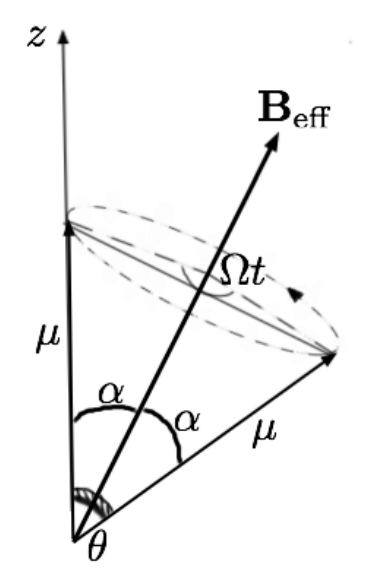
2. Determine the angle α that μ makes with Beff. Also, prove that the magnetization varies with time as
M(t)=Nμ(cosΩt).
[0,6 т.]
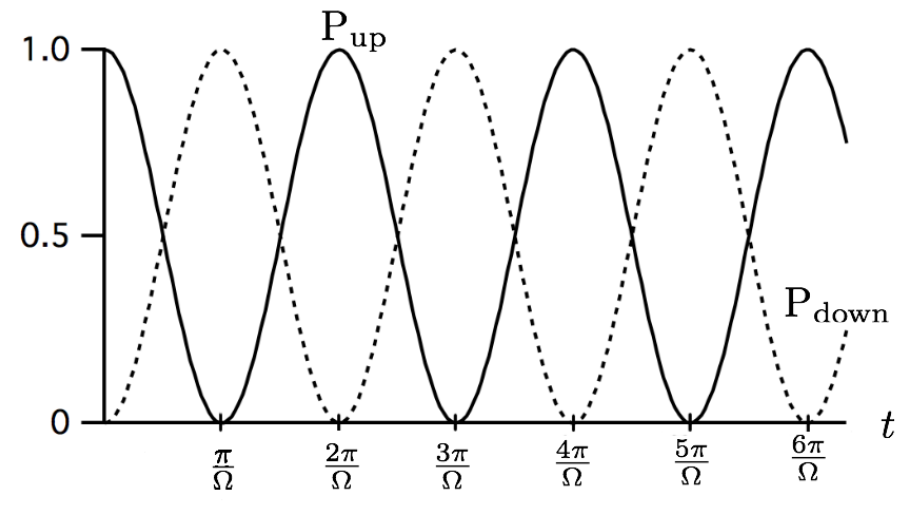
3. Under the application of magnetic field described above, determine the fractional population of each spin up P↑=N↑/N and spin down P↓=N↓/N as a function of time. Plot P↑(t) and P↓(t) on the same graph vs. time t. The alternating spin up and spin down population as a function of time is called Rabi oscillation. [1,2 т.]
Part D. Measurement incompatibility (2 т.)
Spin is in fact a vector quantity; but due to its quantum properties, we cannot measure each of its components simultaneously (i.e. we can know both ∣μ∣ and μz as in above problems; but not all ∣μ∣,μx,μy, and μz simultaneously). In this problem, we will do a calculation based on the Heisenberg uncertainty principle (using the relation ΔpqΔq≥ℏ) to show how these measurements are incompatible with each other.
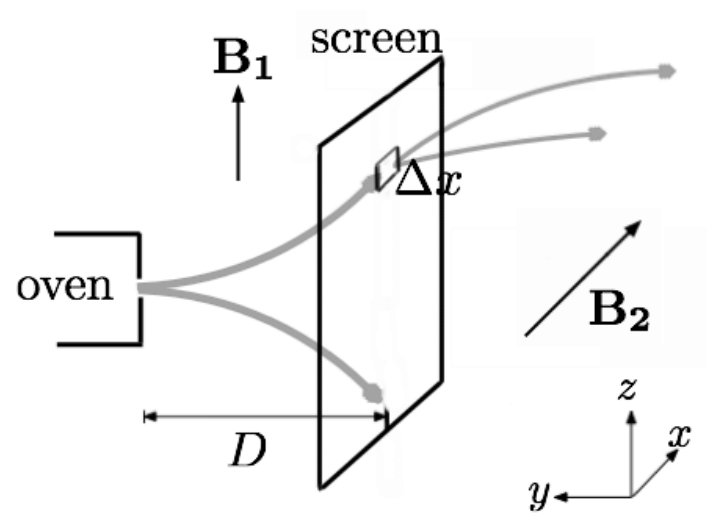
1. Let us consider an oven source of silver atoms, which has a small opening. The atoms stream out of the opening along −y direction (see Figure below) and experience a spatial varying field B1. The field B1 has strong bias field component in the z direction, where the atoms with different magnetic moment μz=±γℏ are split in the z direction. At a distance D from the oven source, a screen SC1 is put to allow only spin up atoms to pass (blocking spin down atoms). Thus, at the instant after passing the screen, the atoms are prepared in spin up states. After the screen, the atoms enter a region of non-homogenous field B2 where the atoms feel a force
Fx=μxC.
The field B2 has strong bias field component in the x direction, where the atoms have magnetic moment μx=±γℏ.
In order to determine μx by observing the splitting in x direction, show that the following condition must be fulfilled:
ℏ1∣μx∣ΔxCt≫1,
where t is the duration after leaving the screen SC1 and Δx is the opening width on SC1. [1 т.]
2. The atoms are initially prepared in the spin up states right after leaving the screen, where μz=γℏ=∣μx∣. This means the atoms will precess at rates covering a range of values Δω with respect to the x component of B2, specifically B2x=B0+Cx. Prove that the spread in the precession angle Δωt is so large and hence we cannot measure both μx and μz simultaneously. In other words, the measurement of μx destroys the information on μz. [1 т.]
Summary Answer Sheet
Student Code: □ □ □ □ □
Physics of Spin (10 points)
Part A. Larmor Precession (1.6 points)
Question
Answer
Marks
1. 0.8 pts
__________
2. 0.8 pts
ω0= __________
Part B. Rotating Frame (3.4 points)
Question
Answer
Marks
1. 0.8 pts
__________
2. 0.4 pts
Δ= __________
3. 1.2 pts
__________
4. 1.0 pts
Beff= __________; Beff= __________
Part C. Rabi Oscillation (3.0 points)
Question
Answer
Marks
1. 1.2 pts
__________; Ω= __________
2. 0.6 pts
α= __________; __________
3. 1.2 pts
P↑=NN↑= __________; P↓=NN↓= __________
Part D. Measurement incompatibility (2.0 points)
Question
Answer
Marks
1. 1.0 pts
__________
2. 1.0 pts
__________
Решение
Part A. Larmor Precession
From the two equations given in the text, we obtain the relation
dtdμ=−γμ×B.(1)
Taking the dot product of eq (1). with μ, we can prove that
μ⋅dtdμdtd∣μ∣2μ=∣μ∣=−γμ⋅(μ×B),=0,=const.(2)
Taking the dot product of eq. (1) with B, we also prove that
B⋅dtdμB⋅dtdμB⋅μ=−γB⋅(μ×B),=0,=const.(3)
An acute reader will notice that our master equation in (1) is identical to the equation of motion for a charged particle in a magnetic field
dtdv=mqv×B.(4)
Hence, the same argument for a charged particle in magnetic field can be applied in this case.
For a magnetic moment making an angle of ϕ with B,
which gives an effective field of (with ω=ω0=γB0):
Beff=(B0−γω)k′+bi′+b(cos2ω0ti′−sin2ω0tj′).
Since ω0≫γb, the rotation of the term b(cos2ω0ti′−sin2ω0tj′) is so fast compared to the frequency γb. This means that we can take the approximation
Beff≈(B0−γω)k′+bi′=bi′,(10)
where the magnetic moment precesses with frequency Ω=γb.
As Ω=γb≪ω0, the magnetic moment does not “feel” the rotating term b(cos2ω0ti′−sin2ω0tj′) which averaged to zero.
Since the angle α that μ makes with Beff stays constant and μ is initially oriented along the z axis, α is also the angle between Beff and the z axis which is
tanα=B0−γωb.(11)
From the geometry of the system, we can show that (cosθ=μz/μ):
In the x direction, the uncertainty in position due to the screen opening is Δx. According to the uncertainty principle, the atom momentum uncertainty Δpx is given by
Δpx≈Δxℏ,
which translates into an uncertainty in the x velocity of the atom,
vx≈mΔxℏ.
Consequently, during the time of flight t of the atoms through the device, the uncertainty in the width of the beam will grow by an amount δx given by
δx=Δvxt≈mΔxℏt.
So, the width of the beams is growing linearly in time. Meanwhile, the two beams are separating at a rate determined by the force Fx and the separation between the beams after a time t becomes
dx=2×21mFxt2=m1∣μx∣Ct2.
In order to be able to distinguish which beam a particle belongs to, the separation of the two beams must be greater than the widths of the beams; otherwise the two beams will overlap and it will be impossible to know what the x component of the atom spin is. Thus, the condition must be satisfied is
dxm1∣μx∣Ct2ℏ1∣μx∣ΔxCt≫δx,≫mΔxℏt,≫1.(15)
As the atoms pass through the screen, the variation of magnetic field strength across the beam width experienced by the atoms is
ΔB=ΔxdxdB=CΔx.
This means the atoms will precess at rates covering a range of values Δω given by
Δω=γΔB=ℏμzΔB=ℏ∣μx∣CΔx,
and, if previous condition in measuring μx is satisfied,
Δωt≫1.(16)
In other words, the spread in the angle Δωt through which the magnetic moments precess is so large that the z component of the spin is completely randomized or the measurement uncertainty is very large.