APhO 2014, Теория — Задача 1. Question 1
15TH ASIAN PHYSICS OLYMPIAD, 11 - 18 MAY 2014, SINGAPORE — Question 1 · 11 май 2014 г.
Условие
The schematic below shows the Hadley circulation in the Earth’s tropical atmosphere around the spring equinox. Air rises from the equator and moves poleward in both hemispheres before descending in the subtropics at latitudes (where positive and negative latitudes refer to the northern and southern hemisphere respectively). The angular momentum about the Earth’s spin axis is conserved for the upper branches of the circulation (enclosed by the dashed oval). Note that the schematic is not drawn to scale.
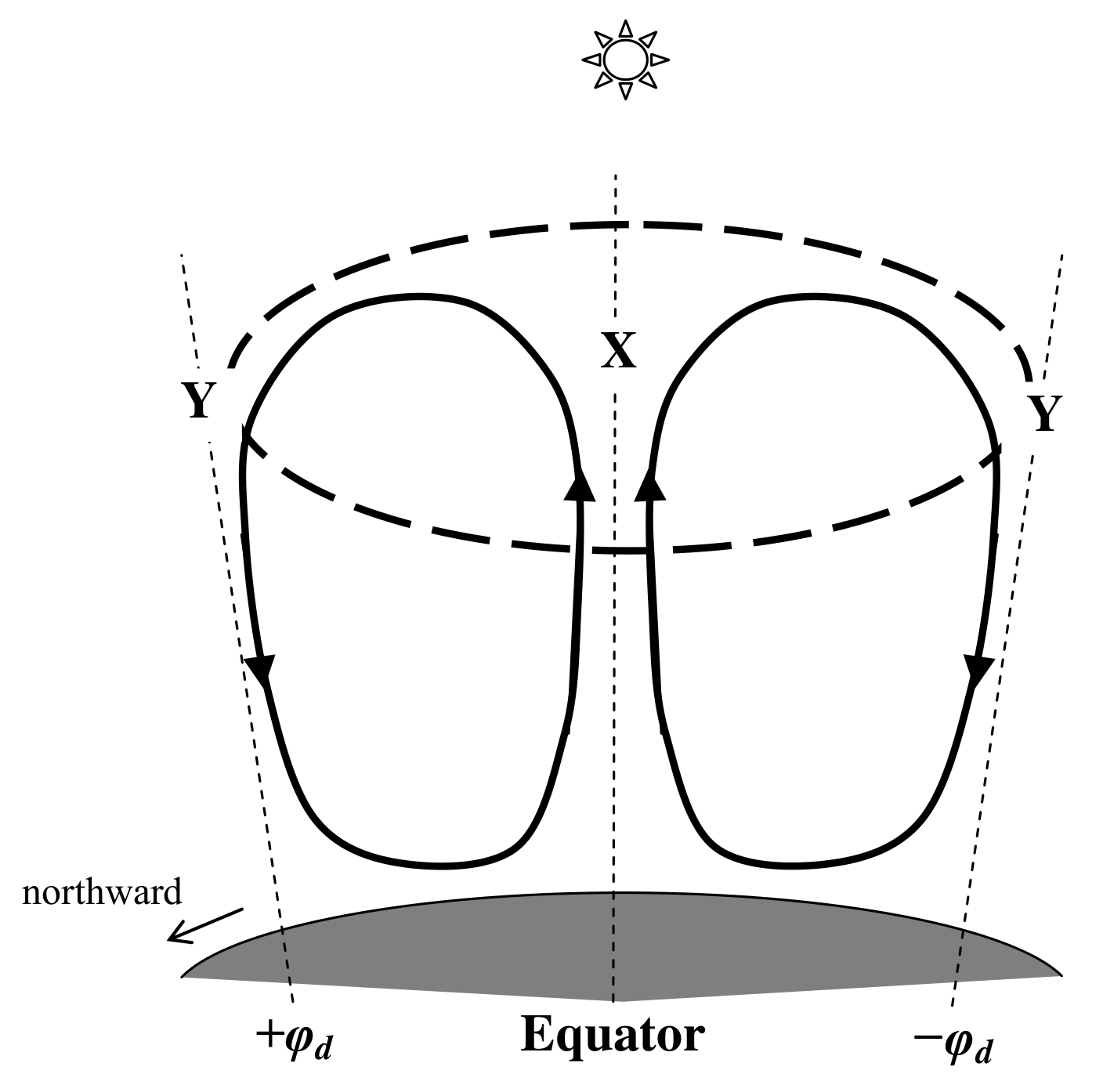
(a) (2 points) Assume that there is no wind velocity in the east-west direction around the point X. What is the expression for the east-west wind velocity at the points Y? Convention: positive velocities point from west to east.
(The angular velocity of the Earth about its spin axis is , the radius of the Earth is , and the thickness of the atmosphere is much smaller than .)
(b) (1 point) Which of the following explains ultimately why angular momentum is not conserved along the lower branches of the Hadley circulation?
Tick the correct answer(s). There can be more than one correct answer.
(I) There is friction from the Earth's surface.
(II) There is turbulence in the lower atmosphere, where different layers of air are mixed
(III) The air is denser lower down and so inertia slows down the motion around the spin axis of the Earth.
(IV) The air is moist at the lower levels causing retardation to the wind velocity.
Around the northern winter solstice, the rising branch of the Hadley circulation is located at the latitude and the descending branches are located at and as shown in the schematic below. Refer to this diagram for parts (c), (d) and (e).
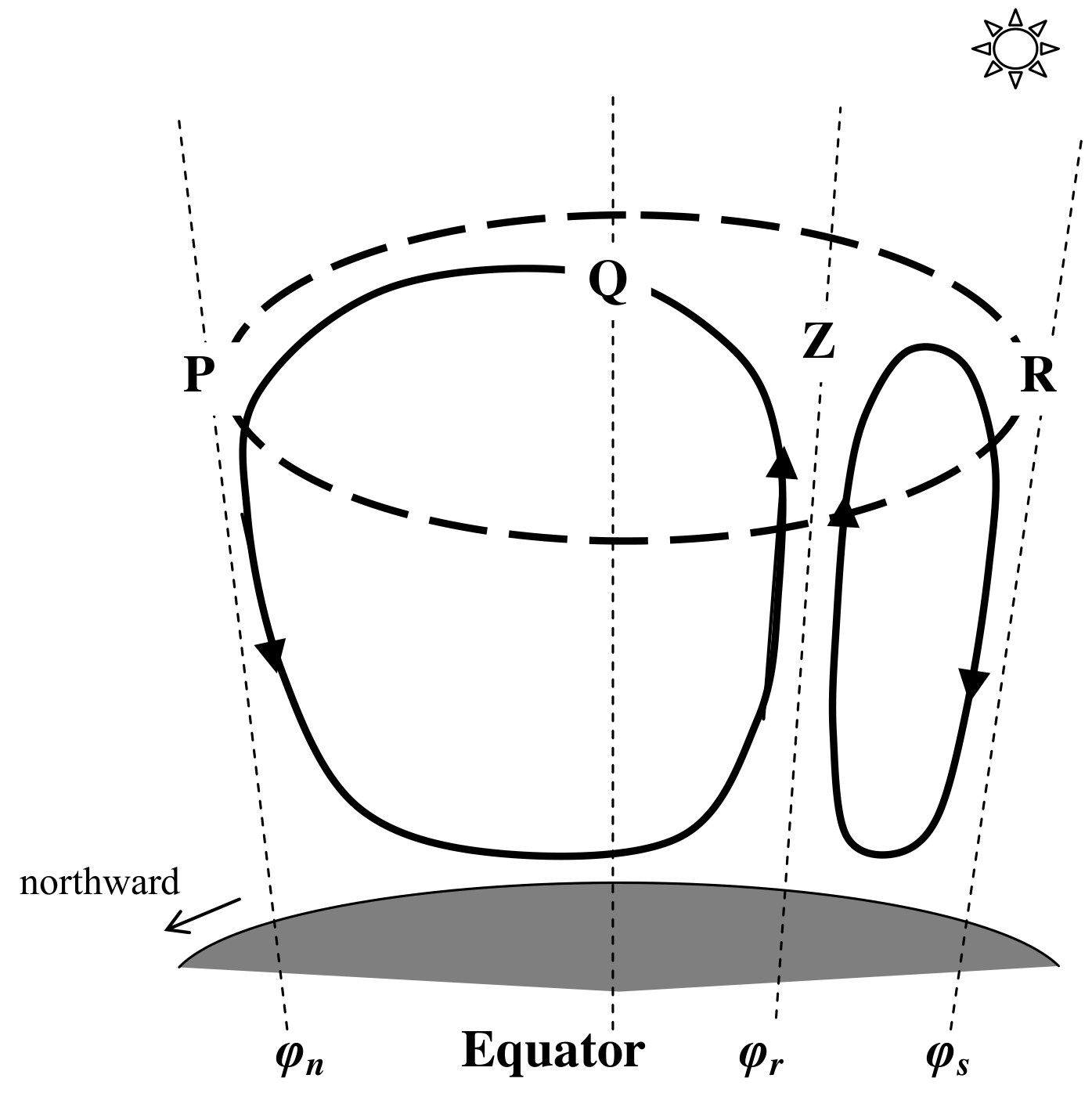
(c) (2 points) Assume that there is no east-west wind velocity around the point Z. Given that , and , what are the east-west wind velocities , and respectively at the points P, Q and R?
(The radius of the Earth is .)
Hence, which hemisphere below has a stronger atmospheric jet stream?
(I) Winter Hemisphere
(II) Summer Hemisphere
(III) Both hemispheres have equally strong jet streams.
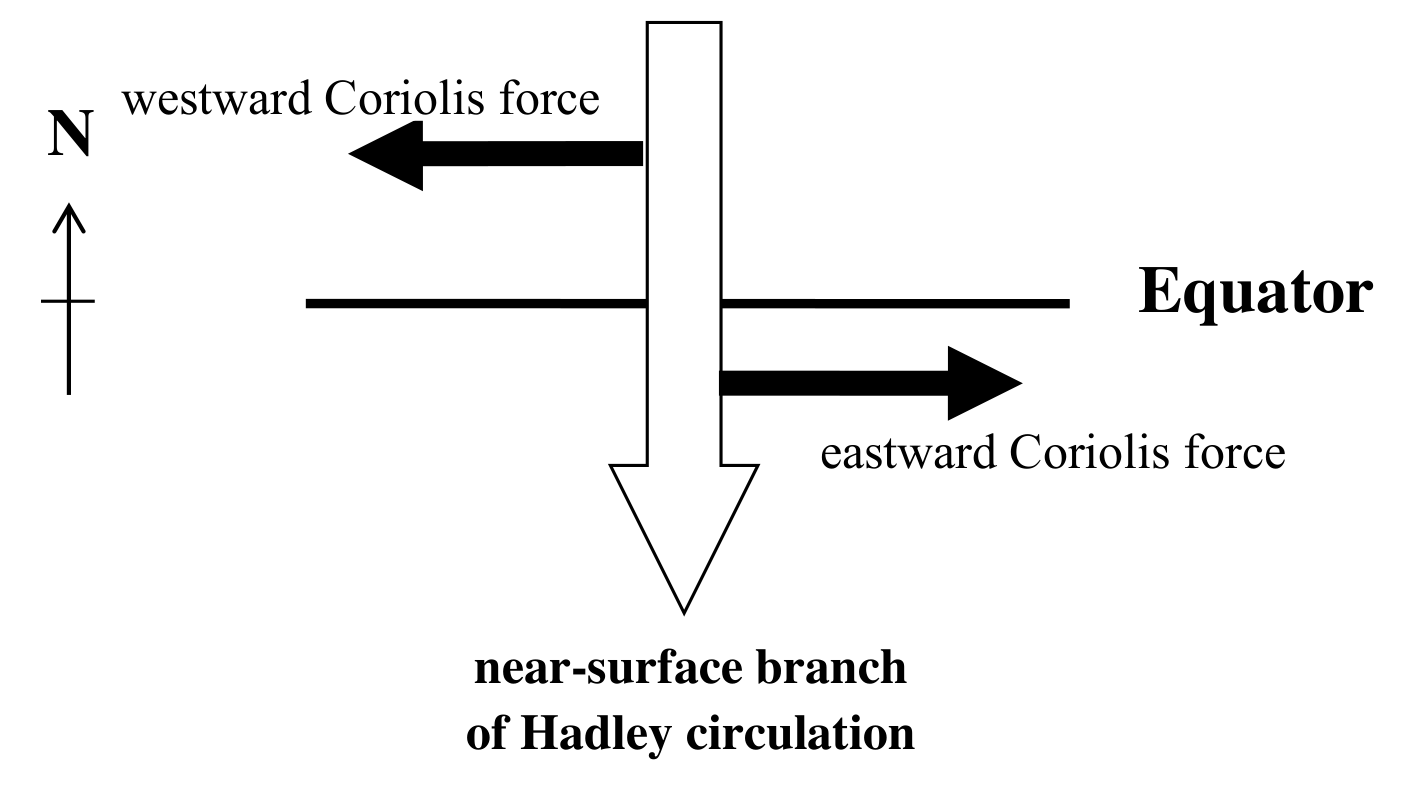
(d) (1 point) The near-surface branch of the Hadley circulation blows southward across the equator. Mark by arrows on the figure below the direction of the east-west component of the Coriolis force acting on the tropical air mass
(A) north of the equator;
(B) south of the equator.
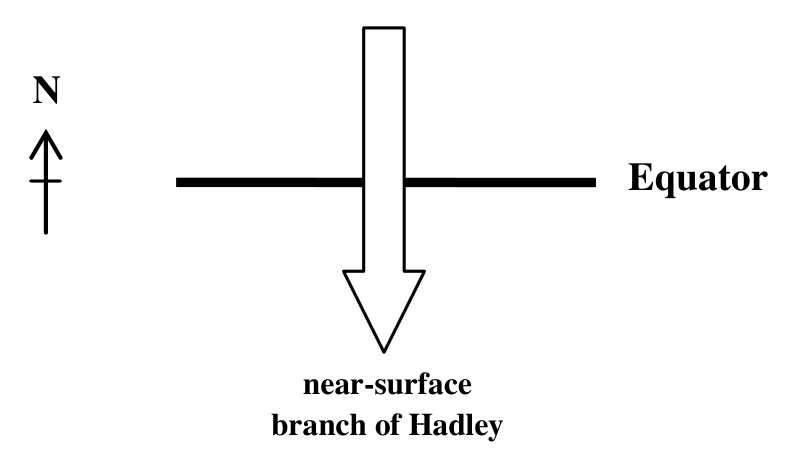
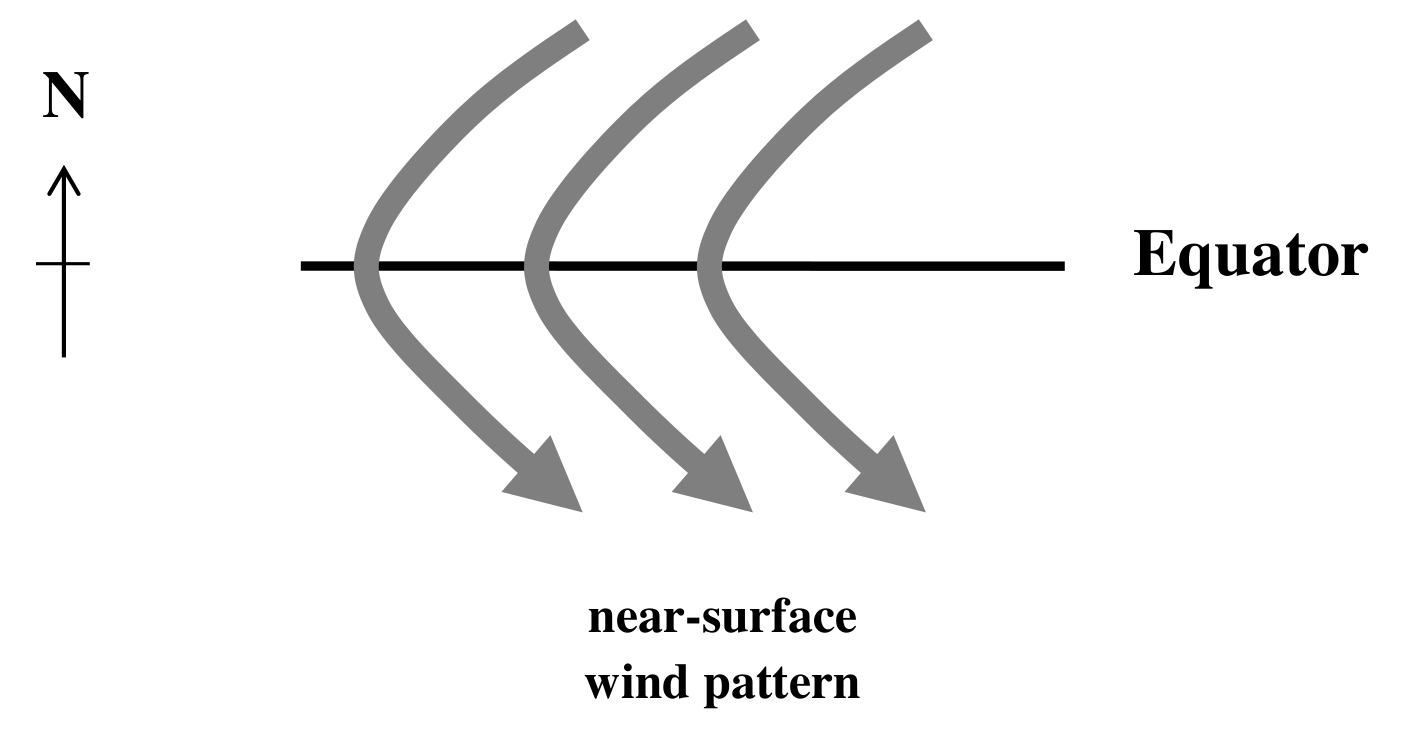
(e) (1 point) From your answer to part (d) and the fact that surface friction nearly balances the Coriolis forces in the east-west direction, sketch the near-surface wind pattern in the tropics near the equator during northern winter solstice.
Suppose the Hadley circulation can be simplified as a heat engine shown in the schematic below. Focusing on the Hadley circulation reaching into the winter hemisphere as shown below, the physical transformation of the air mass from A to B and from D to E are adiabatic, while that from B to C, C to D and from E to A are isothermal. Air gains heat by contact with the Earth's surface and by condensation of water from the atmosphere, while air loses heat by radiation into space.
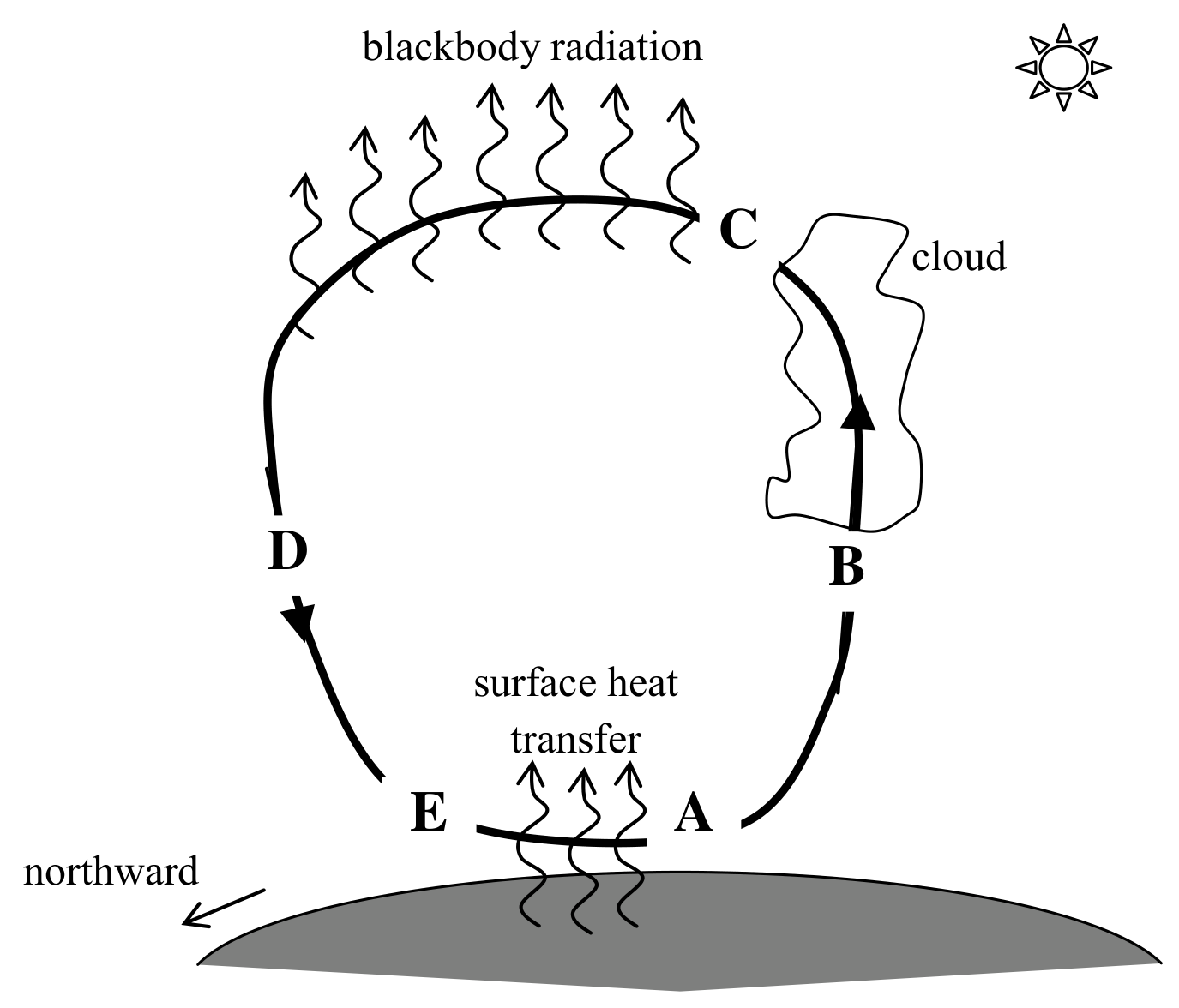
(f) (2 points) Given that atmospheric pressure at a vertical level owes its origin to the weight of the air above that level, order the pressures , , , , , respectively at the points A, B, C, D, E by a series of inequalities.
(Given that and . Note that 1 hPa is 100 Pa.)
(g) (2 points) Let the temperature next to the surface and at the top of the atmosphere be and respectively. Given that the pressure difference between points A and E is 20 hPa, calculate for .
Note that the ratio of molar gas constant () to molar heat capacity at constant pressure () for air, , is 2/7.
(h) (2 points) Calculate the pressure .
(i) For an air mass moving once around the winter Hadley circulation, using the molar gas constant, , and the quantities defined above, obtain expressions for
(A) (2 points) the net work done per unit mole ignoring surface friction;
(B) (1 point) the heat loss per unit mole at the top of the atmosphere. [3 т.]
(j) (1 point) What is the value of the ideal thermodynamic efficiency for the winter Hadley circulation?
(k) (2 points) Prove that the actual thermodynamic efficiency for the winter Hadley circulation is always smaller than , showing all mathematical steps.
(l) (1 point) Which of the following statements best explains why is less than the ideal value? Tick the correct answer(s). There can be more than one correct answer.
(I) We have ignored work done against surface friction.
(II) Condensation occurs at a temperature lower than the temperature of the heat source.
(III) There is irreversible evaporation of water at the surface.
(IV) The ideal efficiency is applicable only when there is no phase change of water.
Отговори
- (a)
- (b) (I) & (II)
- (c) uP = 105 m/s, uQ = −8.97 m/s, uR = 48.1 m/s; (I) the winter hemisphere has a stronger jet stream.
- (d) (A) north of the equator: westward; (B) south of the equator: eastward.
- (e) Near-surface winds cross the equator southward, blowing westward north of the equator and eastward south of it (winds from the north-east turning towards the south-east after crossing the equator).
- (f)
- (g) 195 K
- (h) 220 hPa
- (i)
- (j) 0.35
- (l) (II) & (III)
Решение
(a) Solution:
As the problem is symmetric about the equator, we need only consider the northern hemisphere as shown below.
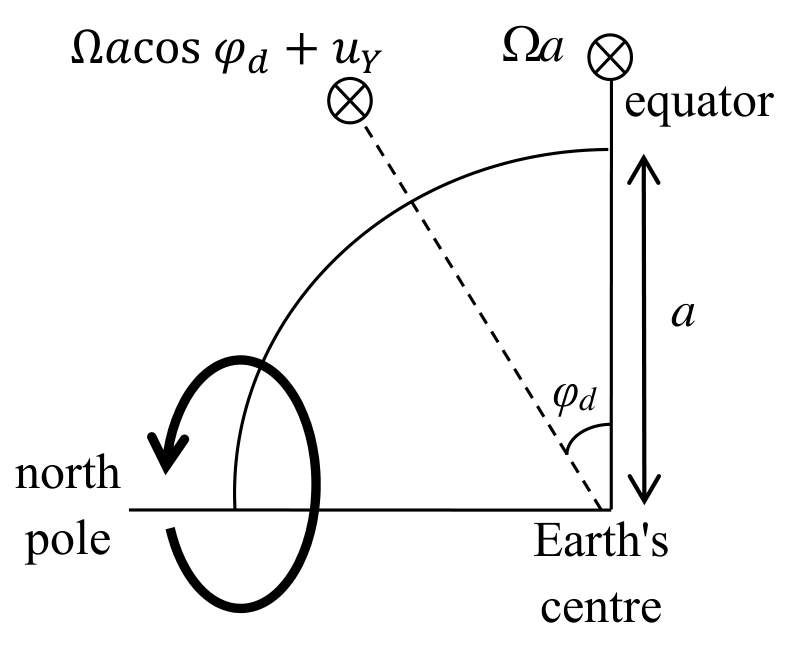
Conservation of angular momentum about the Earth's spin axis implies that:
(b) Solution: (I) & (II) (0.5 point each)
To discourage guessing, minus 0.5 point for each wrong answer.
The minimum points to be awarded in this part is 0.
(c) Solution:
The angular velocity of the Earth about its spin axis is:
so we have:
Conservation of angular momentum about the Earth's spin axis implies that the wind velocity at latitude is:
The required east-west wind velocities are:
(0.5 point for each correct answer, but capped at 1 point maximum)
Thus, the winter hemisphere (I) has a stronger atmospheric jet stream. (0.5 point)
(d) Solution: (0.5 point for each correct arrow)
(e) Solution:
As surface friction nearly balances the Coriolis forces in the east-west direction, the east-west component of surface friction must act eastward and westward north and south of the equator respectively. Since friction always opposes motion, the east-west wind velocity near the surface must be westward and eastward north and south of the equator respectively. So the resultant near-surface wind pattern looks like below.
(0.5 point for consistency with part (d), even if part (d) was wrong)
(0.5 point for correct answer)
(f) Solution:
Since there is less and less air above as one climbs upward in the atmosphere, atmospheric pressure must decrease upwards.
So,
The process EA represents an isothermal expansion as heat is gained from the surface. So,
Since the total heat gain must equal the total heat loss, more heat must be lost in the isothermal compression CD than in the isothermal expansion BC. So net heat loss occurs from B to D and hence
So with the values of the pressure at A and D, we deduce that:
Collecting all inequalities together,
(g) Solution:
Since and , we have .
From the adiabatic compression from D to E, we have:
(h) Solution:
From the adiabatic expansion AB and adiabatic compression DE,
(i) Solution:
(A) Work done per mole in an isothermal process is generally given by
Work done per mole in processes EA and BCD are respectively,
Work done in an adiabatic process is used entirely to raise the internal energy of the air mass. Since the decrease in internal energy in process AB exactly cancels the increase in internal energy in process DE because the respective decrease and increase in temperature cancel, no net work is done in the adiabatic processes.
So the net work done per mole on the air mass is:
using equation in part (h)
(1 point)
(B) The heat loss per mole at the top of the atmosphere is the same as the work done per mole on the air mass because there is no change in internal energy for an isothermal process.
(j) Solution:
(k) Solution:
(l) Solution: (II) & (III) (0.5 point each)
To discourage guessing, minus 0.5 point for each wrong answer.
The minimum points to be awarded in this part is 0.