APhO 2014, Теория — Задача 2. Question 2
APhO 2014 — Theoretical Question 2 · 20 т.
Условие
The two-slit electron interference experiment was first performed by Möllenstedt et al, Merli-Missiroli and Pozzi in 1974 and Tonomura et al in 1989. In the two-slit electron interference experiment, a monochromatic electron point source emits particles at that first passes through an electron “biprism” before impinging on an observational plane; and are virtual sources at distance . In the diagram, the filament is pointing into the page. Note that it is a very thin filament (not drawn to scale in the diagram).
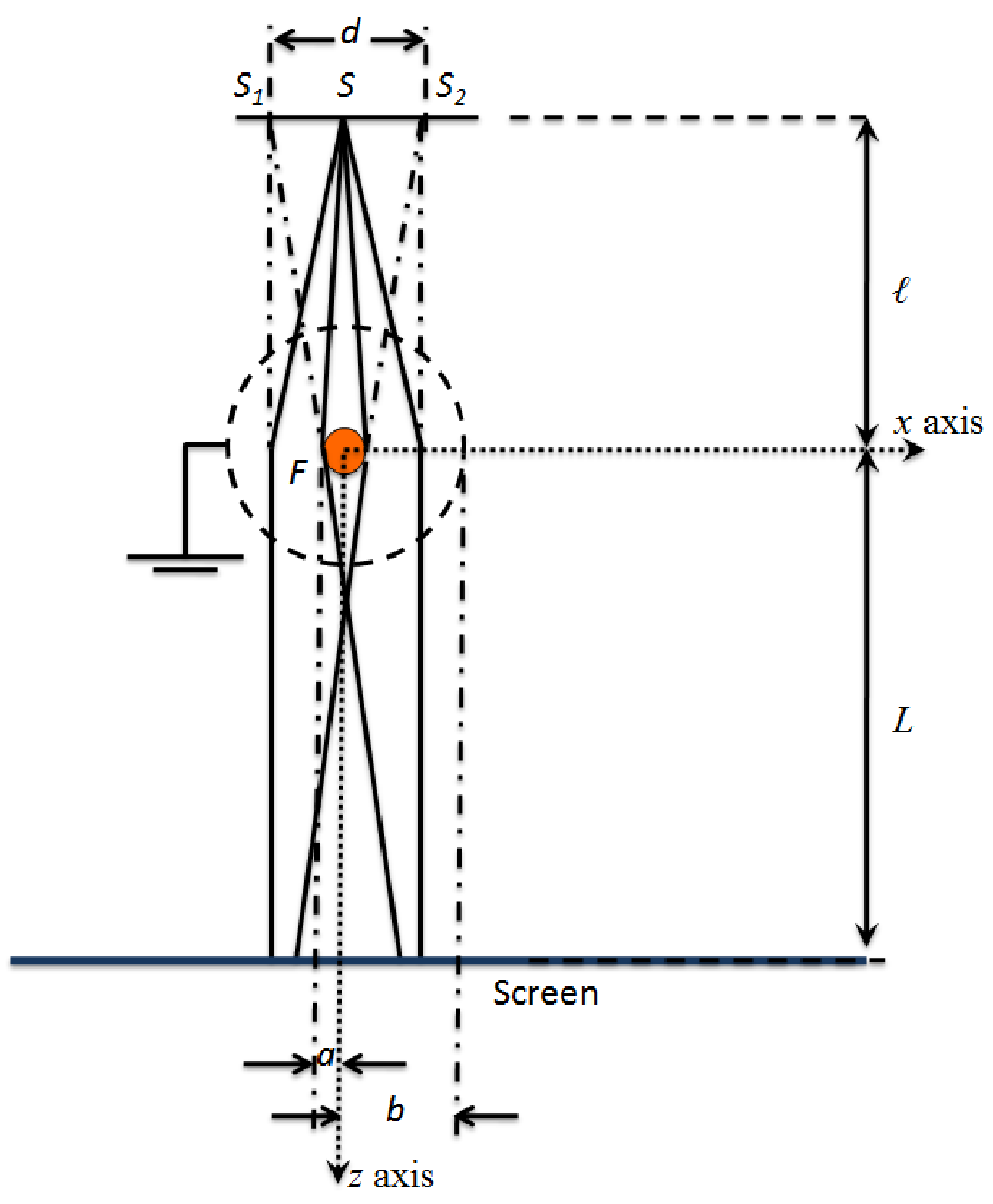
The electron “biprism” consists of a grounded cylindrical wire mesh with a fine filament at the center. The distance between the source and the “biprism” is , and the distance between the distance between the “biprism” and the screen is .
(a) (2 т.)
Taking the center of the circular cross section of the filament as the origin , find the electric potential at any point very near the filament in terms of , and where is the electric potential of the surface of the filament, is the radius of the filament and is the distance between the center of the filament and the cylindrical wire mesh. (Ignore mirror charges.)
(b) (4 т.)
An incoming electron plane wave with wave vector is deflected by the “biprism” due to the -component of the force exerted on the electron. Determine the -component of the wave vector due to the “biprism” in terms of the electron charge, , , , , and where and are the charge and the -component of the velocity of the electrons (). Note that where is the Planck constant.
(c)
Before the point , electrons are emitted from a field emission tip and accelerated through a potential . Determine the wavelength of the electron in terms of the (rest) mass , charge and ,
(i) assuming relativistic effects can be ignored, and [2 т.]
(ii) taking relativistic effects into consideration. [3 т.]
(d)
In Tonomura et al experiment,
| Quantity | Value |
|---|---|
| electron charge, | |
| mass of electron, | |
| and the speed of light in vacuo, |
(i) calculate the value of , [2 т.]
(ii) determine the fringe separation of the interference pattern on the screen, [2 т.]
(iii) If the electron wave is a spherical wave instead of a plane wave, is the fringe spacing larger, the same or smaller than the fringe spacing calculated in (ii)? [1 т.]
(iv) In part (c), determine the percentage error in the wavelength of the electron using non-relativistic approximation. [2 т.]
(v) the distance between the apparent double slits. [2 т.]
Answer Sheet — Question 2
Country Code: □ □ □ Student Code: □ □
| Part | Answer space |
|---|---|
| (a) | __________ |
| (b) | __________ |
| (c) (i) | __________ |
| (c) (ii) | __________ |
| (d) (i) | __________ |
| (d) (ii) | __________ |
| (d) (iv) | __________ |
| (d) (v) | __________ |
(d) (iii) If the electron wave is a spherical wave instead of a plane wave, is the fringe spacing larger, the same or smaller than the fringe spacing calculated in (ii)?
□ Larger
□ Same
□ Smaller
Решение
(a)
Writing out
(1 point)
Note that
Also at the edge of the filament, , so
Giving together
(1 point for final expression)
(b)
There are several ways to work out the solution:
A charge in an electric field will experience a force and hence a change in momentum. Note that potential energy of the electron (charge ) is . Using impulse acting on the electron due to the electric field, (2 points)
(2 points for final expression)
The alternative solution is to write down the equations of motion for the electrons (2 points) and determine the deflection of the electron as it passes through the “biprism”:
Since ,
(2 points for final expression)
(c)
The solution sheet restates the charge as .
(i) Equating the kinetic energy to (1 point)
(1 point for final expression)
(ii) Consider
1 point for knowing relativistic E – p relation
1 point for manipulating the equations
1 point for final expression
(d)
The solution sheet's data use electron charge and mass of electron ; the other given values are unchanged.
(i) Previous equation:
Plugging the relevant numbers into the equation gives:
(1 point for plugging the correct values)
(1 point for final expression)
(ii) Fringe separation is given by
1 point for formula, note the factor
1 point for final expression with units
(iii) Larger. (1 point for the correct answer)
(iv) Non-relativistic:
Relativistic:
Percentage error:
or 2.4 percent.
1 point for working out non – relativistic and relativistic wavelength
1 point for final expression
(v) The double slit formula is given by
where is the order and is the distance for maximum intensity from the central fringe.
In this case, since the fringe spacing is ,
1 point for formula
1 point for final numerical answer
Оригинал в Архива: 2.pdf · официални решения: 2_sol.pdf · допълнителни данни: 2_anssheet.pdf