APhO 2014, Теория — Задача 3. Question 3
15th Asian Physics Olympiad, 11 - 18 May 2014, Singapore — Question 3 · 11 май 2014 г.
Условие
Gravitational lensing is a phenomenon where light from a distant source may be deflected by the curvature of space-time caused by a massive lensing object close to or in the line of sight between an observer and a distant object. This was first directly observed during the solar eclipse of 1919 where the observed positions of stars behind the sun differed from their astrometric positions following Einstein’s earlier predictions.
In the case where the observer, lensing object of mass and source are on a straight line, light from the source is deflected by an angle (in radians) given by
where is the gravitational constant , is the speed of light , and is the Einstein radius which is the least distance between the lensing object and the apparent light path.
(a) Draw a diagram to describe the physical layout of an ideal (observer, lens and point source in a straight line) lensing system. Draw the light path and mark the quantities and . Also mark the angular Einstein radius (the angular deflection of the source image as seen from earth), and the other quantities that an observer on earth can measure. [4 т.]
(b) Sketch the image of the source (such as a star), as seen by an observer on earth, in the case where the source, lensing object and observer are on a straight line. [2 т.]
(c) Sketch the image of the source (such as a star), as seen by an observer on earth, in the non-ideal case where the source, lensing object and observer are not in a straight line. Sketch the source-lens system to explain why this is so. [3 т.]
Gravitational lensing has been proposed as a method to detect massive compact halo objects (MACHOs) in our galaxy, which may be a candidate for dark matter. These objects are often dark stellar remnants such as neutron stars and black holes. As stars and MACHOs orbit in the galaxy, there is a chance that a lensing event may occur when a black hole or neutron star passes in front of a background star.
(d) The Schwarzschild radius of a black hole defines the point of no return. A correct expression for the Schwarzschild radius can be obtained by taking it to be the radius where the escape speed is equal to the speed of light. This means that something inside the Schwarzschild radius cannot escape the black hole.
Using Newtonian mechanics, derive the formula for the escape speed at a distance away from a point object of mass . Hence, derive the Schwarzschild radius for a point object of mass in terms of the gravitational constant and the speed of light . Show your steps and reasoning clearly. (This happens to give the correct expression for the Schwarzschild radius that comes from general relativity.) [3 т.]
(e) In the case where the source, lens and observer are in a straight line, given a measurement of and , how would you calculate the Schwarzschild radius of the lensing object? [1 т.]
(f) Consider the case where we have a lensing object of the order of a few solar masses ( a few kg) in the nearby regions of the galaxy (distance a few m away) and a source object somewhat further out ( a few ). Which of the following apply in this case?
Choose the following conditions that apply to the case as described in the question:
- is large and , , must be calculated exactly
- is small and the small angle approximations to , , are permissible
- is irrelevant and need not be calculated
- is large and , , must be calculated exactly
- is small and the small angle approximations to , , are permissible
- is irrelevant and need not be calculated [2 т.]
(g) Using the conditions in part (f), rewrite your expression in part (e) in terms of measurable quantities (which are , and ) for a lensing object of the order of a few solar masses ( a few kg) and in the nearby regions of the galaxy (distance a few m away) with a source object somewhat further out ( a few ). Show your working. [3 т.]
(h) Suppose we have an event where a lensing object of kg (3.0 solar masses), m away from earth passes in front of a star m away from earth. This happens such that the ideal configuration occurs during the event. What is the angular Einstein radius (as seen from earth) during this event when the source, lens and observer line up? [2 т.]
Отговори
(b) A symmetrical and circular ring around the lensing object.
(c) The Einstein ring becomes an arc (asymmetric image) instead of a complete circle, because the system is asymmetric about the source-observer line.
(d)
(e)
(f) α is small; θE is small (small angle approximations are permissible for both).
(g)
(h) rad
Official solution: θE = 7.0 × 10⁻⁸ radians = 0.014 arcseconds.
Решение
(a) (4 points) Draw a diagram to describe the physical layout of an ideal (observer, lens and point source in a straight line) lensing system. Draw the light path and mark the quantities and . Also mark the angular Einstein radius (the angular deflection of the source image as seen from earth), and the other quantities that an observer on earth can measure.
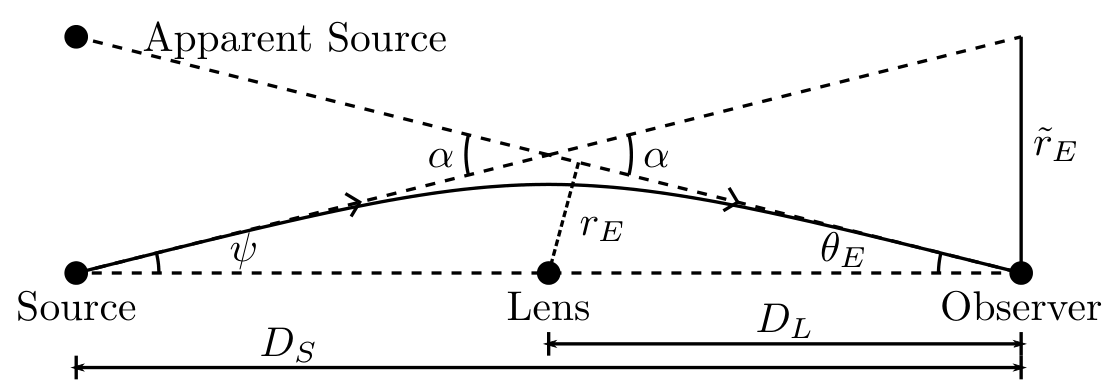
Solution:
Other relevant quantities include the distances to the lens and source and . ( and need not be equal.)
- 1 point for correct layout
- Correct answers should show that light is bent
- Apparent source is not required
- Accept answers that show the system as a thin lens approximation (sharp deflection angles)
- 1 point for light direction correctly marked
- Arrows on the light path
- 1 point for , and correctly identified
- 1 correct: 0.4 points
- 2 correct: 0.7 points
- 3 correct: 1.0 points
- 1 point for and (observables; may have different notation)
- 0.5 points each
Notes:
- and need not be identified, but may be useful in a later part.
- should be perpendicular to the projected light path, but in our astronomical system, it makes no difference if it is perpendicular to the source-observer line since is small. Accept answers that have perpendicular to the source-observer line.
(b) (2 points) Sketch the image of the source (such as a star), as seen by an observer on earth, in the case where the source, lensing object and observer are on a straight line.
Solution: The image of the source should be a symmetrical (1 point) and circular (1 point) ring around the lensing object.
Notes:
- Do not accept solutions that indicate a magnified image of the source. This includes answers which state that the image is a filled in circle.
- 1 point for answers that have 2 source images symmetrically on either side of the lens because the system should be considered in 3 dimensions instead of 2.
- Text answers (without any sketch or diagram) are not accepted. Correct answers must have a sketch (as specified in the question).
(c) (3 points) Sketch the image of the source (such as a star), as seen by an observer on earth, in the non-ideal case where the source, lensing object and observer are not in a straight line. Sketch the source-lens system to explain why this is so.
Solution:
WHAT: (1.5 points) The observer will see light from one side of the lens but not the other side. This means that the Einstein ring should be an arc instead of a complete circle. The ring may be distorted or broken depending on how much deviation from an ideal case. Correct answers should not be a perfect circle or straight line.
Note:
- Solutions that give 2 source images on either side of the lens (with asymmetry) are awarded 1 point instead of 1.5 point because the system should be considered in 3 dimensions instead of 2.
- Text answers (without any sketch or diagram) are not accepted. Correct answers must have a sketch (as specified in the question).
WHY: (1.5 points)
One possible answer:
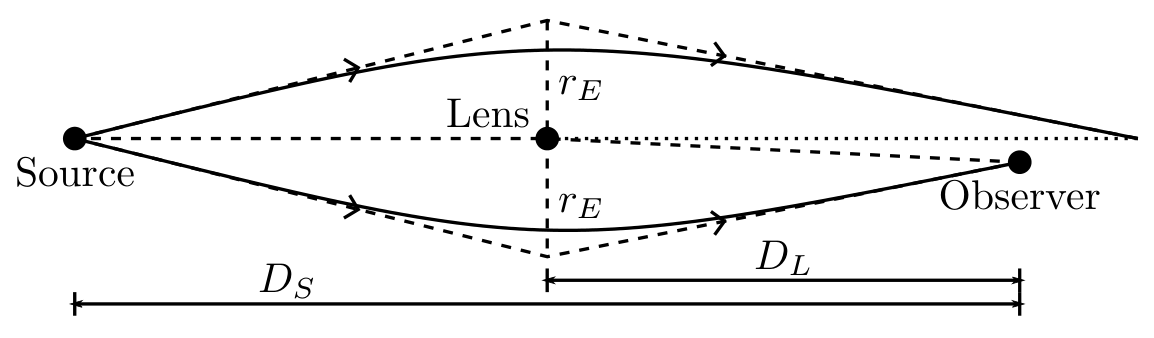
For slight deviations from the ideal case, accept also the following diagram if is smaller than .
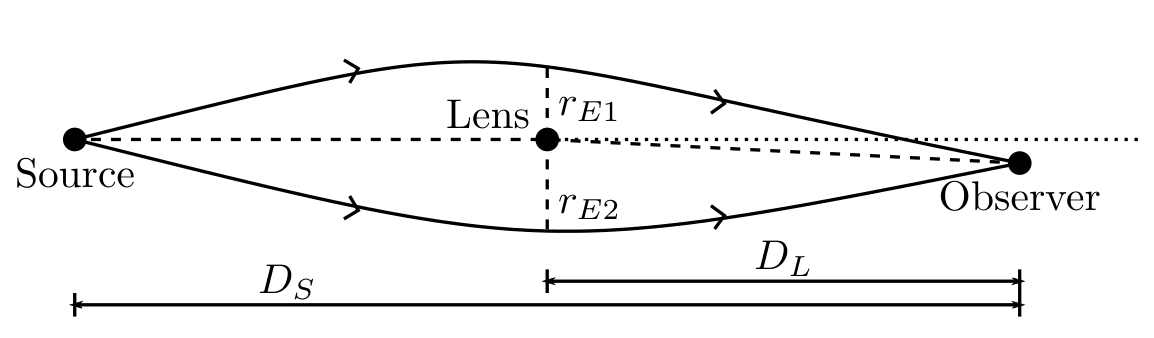
In general, accept answers which show that the asymmetry in the system will cause the observer to see something asymmetrical.
Notes:
The key concept in this question is asymmetry. Correct answers for either part must demonstrate that departures from the ideal case will result in asymmetry in the observed system, and that the asymmetry about the source-observer line is the cause of the asymmetry in the observation.
(d) (3 points) The Schwarzschild radius of a black hole defines the point of no return. A correct expression for the Schwarzschild radius can be obtained by taking it to be the radius where the escape speed is equal to the speed of light. This means that something inside the Schwarzschild radius cannot escape the black hole.
Using Newtonian mechanics, derive the formula for the escape speed at a distance away from a point object of mass . Hence, derive the Schwarzschild radius for a point object of mass in terms of the gravitational constant and the speed of light . Show your steps and reasoning clearly. (This happens to give the correct expression for the Schwarzschild radius that comes from general relativity.)
Solution: By definition, the gravitational potential energy of a test mass at a distance from the mass is (0.5 point)
To escape the gravitational potential, the total energy of the test mass needs to be at least 0 so it should have a kinetic energy of (0.5 point)
Rearranging the above, the escape speed at distance from mass is (1 point)
Substitute and rearrange to get (1 point)
2 points for deriving escape speed (Any reasonable and physically sound method based on Newtonian mechanics)
1 point for deriving the Schwarzschild radius from the escape speed.
(e) (1 point) Using the formula for light deflection, write down an expression for the Schwarzschild radius of a lensing object in the case where the source, lens and observer is in a straight line.
Solution: The Schwarzschild radius is
Notes: Full marks for correct working.
(f) (2 points) Consider the case where we have a lensing object of the order of a few solar masses ( a few kg) in the nearby regions of the galaxy (distance a few m away) and a source object somewhat further out ( a few ). What can we say about and in this case? (Choose your answer on your answer sheet. Points will be deducted for wrong answers.)
- is large and , , must be calculated exactly.
- is small and the small angle approximations to , , are permissible.
- is irrelevant and need not be calculated
- is large and , , must be calculated exactly.
- is small and the small angle approximations to , , are permissible.
- is irrelevant and need not be calculated
Solution:
- is small
- is small
Notes:
- Choices pertaining to and are to be marked independently (1 point each).
- The conditions are mutually exclusive so accept only one condition for each quantity (, ). Answers that select more than one condition for a quantity (, ) are wrong (no point to be awarded).
Reasoning: Working out the numbers, we can find that the Schwarzschild radius is on the order of m. Because has a maximum of (largest possible angle), this means the physical Einstein radius m is very small compared to the distance to the lens m. The geometry of the system therefore means that is actually a very small angle.
Another approximation comes from the geometry of the system which sets bounds on and so that (see figure in part (a))
which suggests that or or both should be small.
Based on the geometry of the setup and what we have already established ( small), we then have the following cases:
- large means that is small which is not the case here.
- small, small is the only valid outcome here
The result and constraints in the question suggests that and are both small
Because is small, the Einstein radius m is very small compared to the distance to the lensing object m or source . We can therefore take the small angle approximation where and is involved.
(g) (3 points) Using the conditions in part (f), rewrite your expression in part (e) in terms of measurable quantities (which are , and ) for a lensing object of the order of a few solar masses ( a few kg) and in the nearby regions of the galaxy (distance a few m away) with a source object somewhat further out ( a few ). Show your working.
Solution: Adding up exterior angles, we see that so where is small ( and defined on the following diagram). Also note that is approximately perpendicular to the source-observer system because is small.
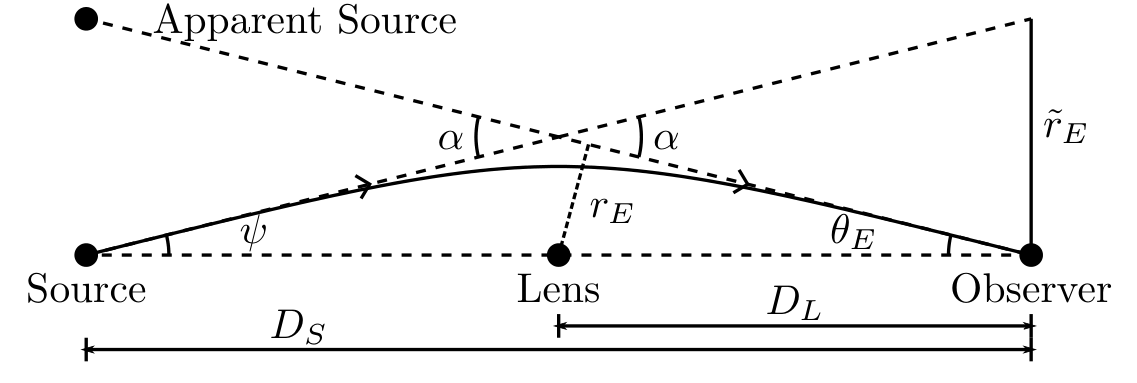
Using the small angle approximation for and , we can write
This gives (1 point)
So that (1 point)
To write this in terms of , and , we use to get (1 point)
Notes:
- 1 point for
- 1 point for
- 1 point for final equation
(h) (2 points) Suppose we have an event where a lensing object of kg (3.0 solar masses), m away from earth passes in front of a star m away from earth. This happens such that the ideal configuration occurs during the event. What is the angular Einstein radius (as seen from earth) during this event when the source, lens and observer line up?
Solution: The Schwarzschild radius of the lens is
From the previous part, the angular Einstein radius is given by
Thus the angular Einstein radius is
(1 point for correct answer, 1 point for correct working)
Notes:
- Students are expected to use the formula derived in part (g) to answer this question.
- For the final answer:
- 0.5 point off for missing units. While angles are mathematically dimensionless, a good student should be cognisant of the fact that there are different physical units for angular measurement, and that units for angles should be specified.
- 0.5 point off for final answers given to 1 significant figure or less.
- 1 point off if the final number is incorrect.