APhO 2015, Теория — Задача 3. Question 3
16th Asian Physics Olympiad 2015, 3rd-11th May, Hangzhou, China — Question 3 · 3 май 2015 г.
Условие
Figure 1 shows a Fabry-Perot (F-P) etalon, in which air pressure is tunable. The F-P etalon consists of two glass plates with high-reflectivity inner surfaces. The two plates form a cavity in which light can be reflected back and forth. The outer surfaces of the plates are generally not parallel to the inner ones and do not affect the back-and-forth reflection. The air density in the etalon can be controlled. Light from a Sodium lamp is collimated by the lens L1 and then passes through the F-P etalon. The transmitivity of the etalon is given by , where , R is the reflectivity of the inner surfaces, is the phase shift of two neighboring rays, n is the refractive index of the gas, t is the spacing of inner surfaces, θ is the incident angle, and λ is the light wavelength.
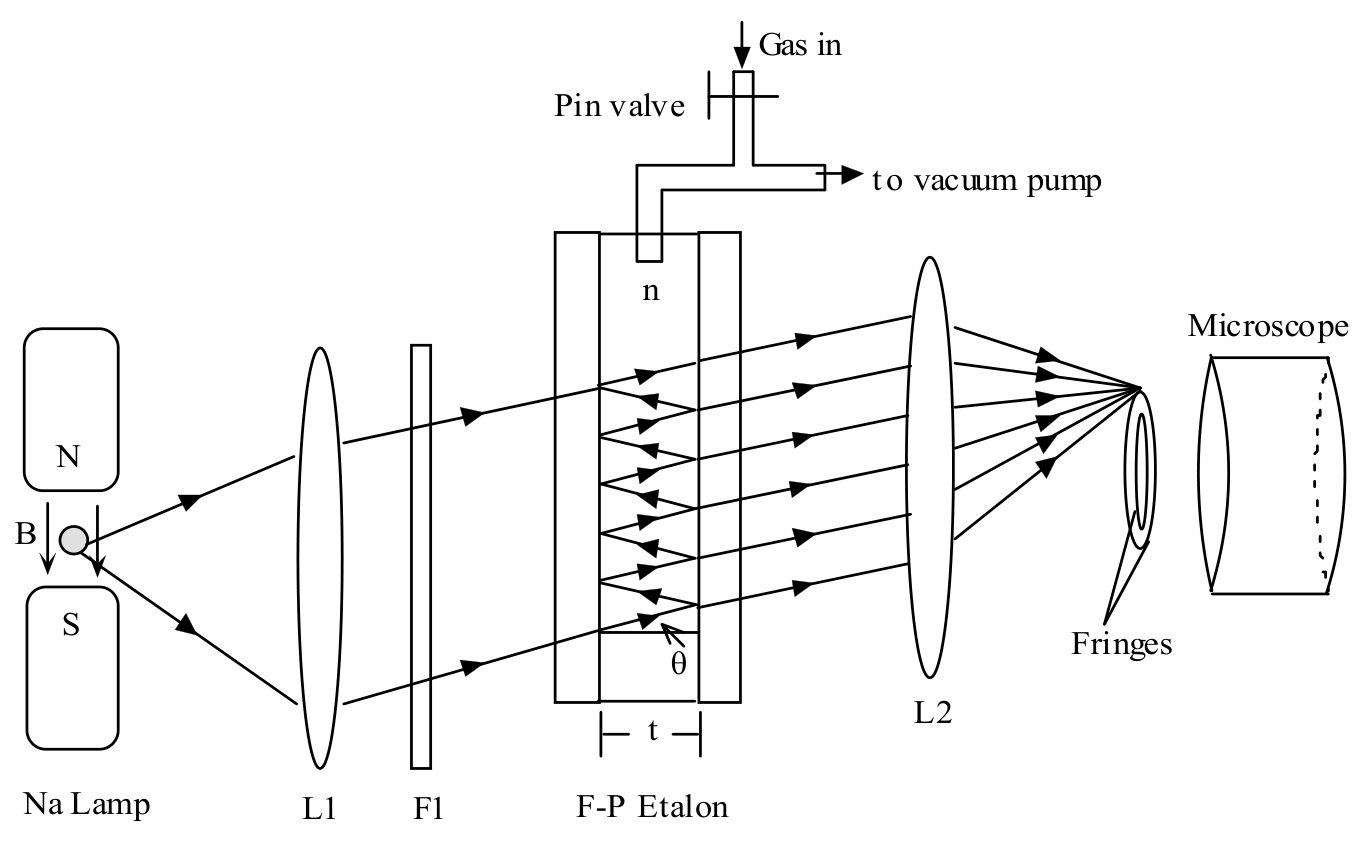
The Sodium lamp emits D1 () and D2 () spectral lines and is located in a tunable uniform magnetic field. For simplicity, an optical filter F1 is assumed to only allow the D1 line to pass through. The D1 line is then collimated to the F-P etalon by the lens L1. Circular interference fringes will be present on the focal plane of the lens L2 with a focal length f=30cm. Different fringes have the different incident angle . A microscope is used to observe the fringes. We take the reflectivity R= 90% and the inner-surface spacing t=1cm.
Some physical constants: , , , .
(a) The D1 line () is collimated to the F-P etalon. For the vacuum case (n=1.0), please calculate (i) interference orders , (ii) incidence angle and (iii) diameter for the first three (i=1, 2, 3) fringes from the center of the ring patterns on the focal plane. [3 т.]
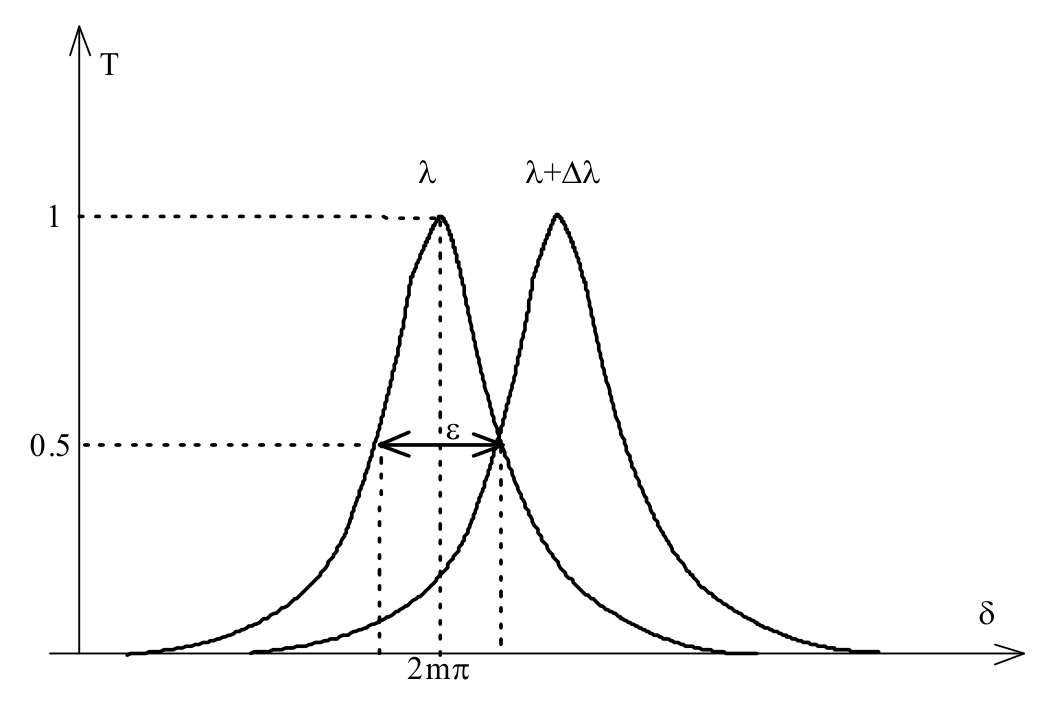
(b) As shown in Fig. 2, the width of the spectral line is defined as the full width of half maximum (FWHM) of light transmitivity T regarding the phase shift . The resolution of the F-P etalon is defined as follows: for two wavelengths and , when the central phase difference of both spectral lines is larger than , they are thought to be resolvable; then the etalon resolution is when . For the vacuum case, the D1 line (), and because of the incident angle , take , please calculate:
(i) the width ε of the spectral line.
(ii) the resolution of the etalon. [3 т.]
(c) As shown in Fig. 1, the initial air pressure is zero. By slowly tuning the pin valve, air is gradually injected into the F-P etalon and finally the air pressure reaches the standard atmospheric pressure. On the same time, ten new fringes are observed to produce from the center of the ring patterns on the focal plane. Based on this phenomenon, calculate the refractive index of air at the standard atmospheric pressure. [1 т.]
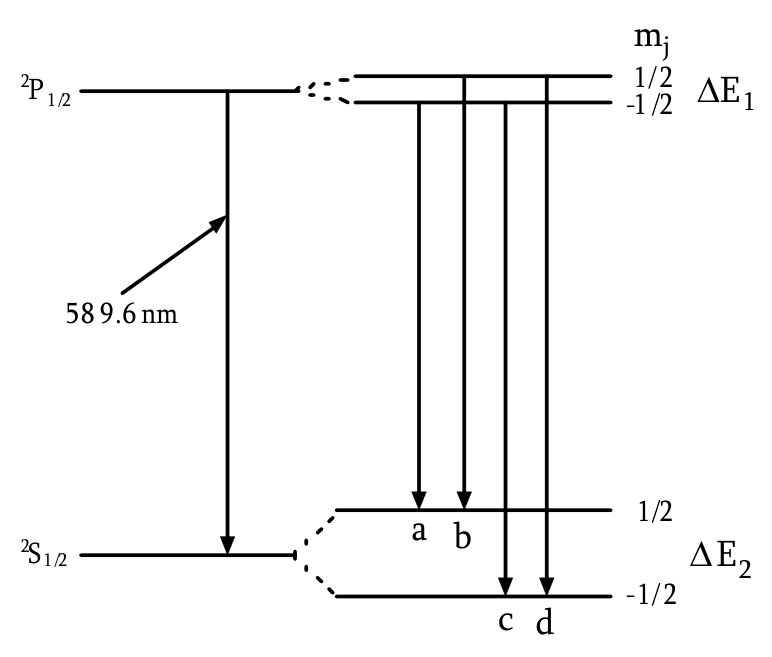
(d) Energy levels splitting of Sodium atoms occurs when they are placed in a magnetic field. This is called as the Zeeman effect. The energy shift given by , where the quantum number can be J, J-1, …, -J+1, -J, J is the total angular quantum number, is the Landé factor, is Bohr magneton, h is the Plank constant, e is the electron charge, is the electron mass, B is the magnetic field. As shown in Fig. 3, the D1 spectral line is emitted when Sodium atoms jump from the energy level down to . We have for both and . Therefore, in the magnetic field, each energy level will be split into two levels. We define the energy gap of two splitting levels as for and for respectively (). As a result, the D1 line is split into 4 spectral lines (a, b, c, and d), as showed in Fig. 3. Please write down the expression of the frequency () of four lines a, b, c, and d. [2 т.]
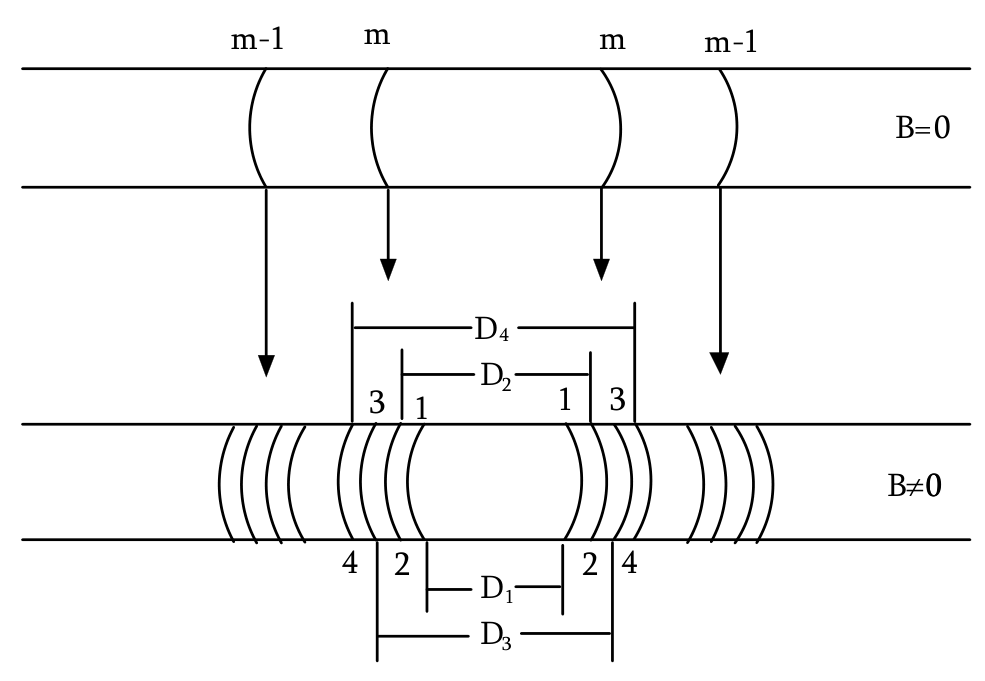
(e) As shown in Fig. 4, when the magnetic field is turned on, each fringe of the D1 line will split into four sub-fringes (1, 2, 3, and 4). The diameter of the four sub-fringes near the center is measured as , , , and . Please give the expression of the splitting energy gap of and of . [3 т.]
(f) For the magnetic field B=0.1T, the diameter of four sub-fringes is measured as: , , , and . Please calculate the Landé factor of and of . [3 т.]
(g) The magnetic field on the sun can be determined by measuring the Zeeman effect of the Sodium D1 line on some special regions of the sun. One observes that, in the four split lines, the wavelength difference between the shortest and longest wavelength is 0.012nm by a solar spectrograph. What is the magnetic field B in this region of the sun? [2 т.]
(h) A Light- Emitting Diode (LED) source with a central wavelength and spectral width is normally incident () into the F-P etalon shown in Fig. 1. For the vacuum case, find (i) the number of lines in transmitted spectrum and (ii) the frequency width of each line? [3 т.]
Отговори
(a) m1 = 33921, m2 = 33920, m3 = 33919; θ1 = 0.241°, θ2 = 0.502°, θ3 = 0.667°; D1 = 2.52 mm, D2 = 5.26 mm, D3 = 6.99 mm.
(b) ε = 0.21 rad (or 12.03 degree); λ/Δλ = 1.01 × 10⁶.
(c) 1.00029
(d)
(e)
(f) gk1 = 0.68 (or 0.72); gk2 = 1.99 (or 1.95). Theory values: 2/3 and 2.
(g) 0.2772 T
Official solution: B = 0.2772 T = 2772.1 Gauss, using gk1 + gk2 = 2.67.
(h) N = 946 lines; Δν = 5.0 × 10⁸ Hz.
Решение
Solution for Question 3
Figure 1 shows a Fabry-Perot (F-P) etalon, in which air pressure is tunable. The F-P etalon consists of two glass plates with high-reflectivity inner surfaces. The two plates form a cavity in which light can be reflected back and forth. The outer surfaces of the plates are generally not parallel to the inner ones and do not affect the back-and-forth reflection. The air density in the etalon can be controlled. Light from a Sodium lamp is collimated by the lens L1 and then passes through the F-P etalon. The transmitivity of the etalon is given by , where , R is the reflectivity of the inner surfaces, is the phase shift of two neighboring rays, n is the refractive index of the gas, t is the spacing of inner surfaces, θ is the incident angle, and λ is the light wavelength.
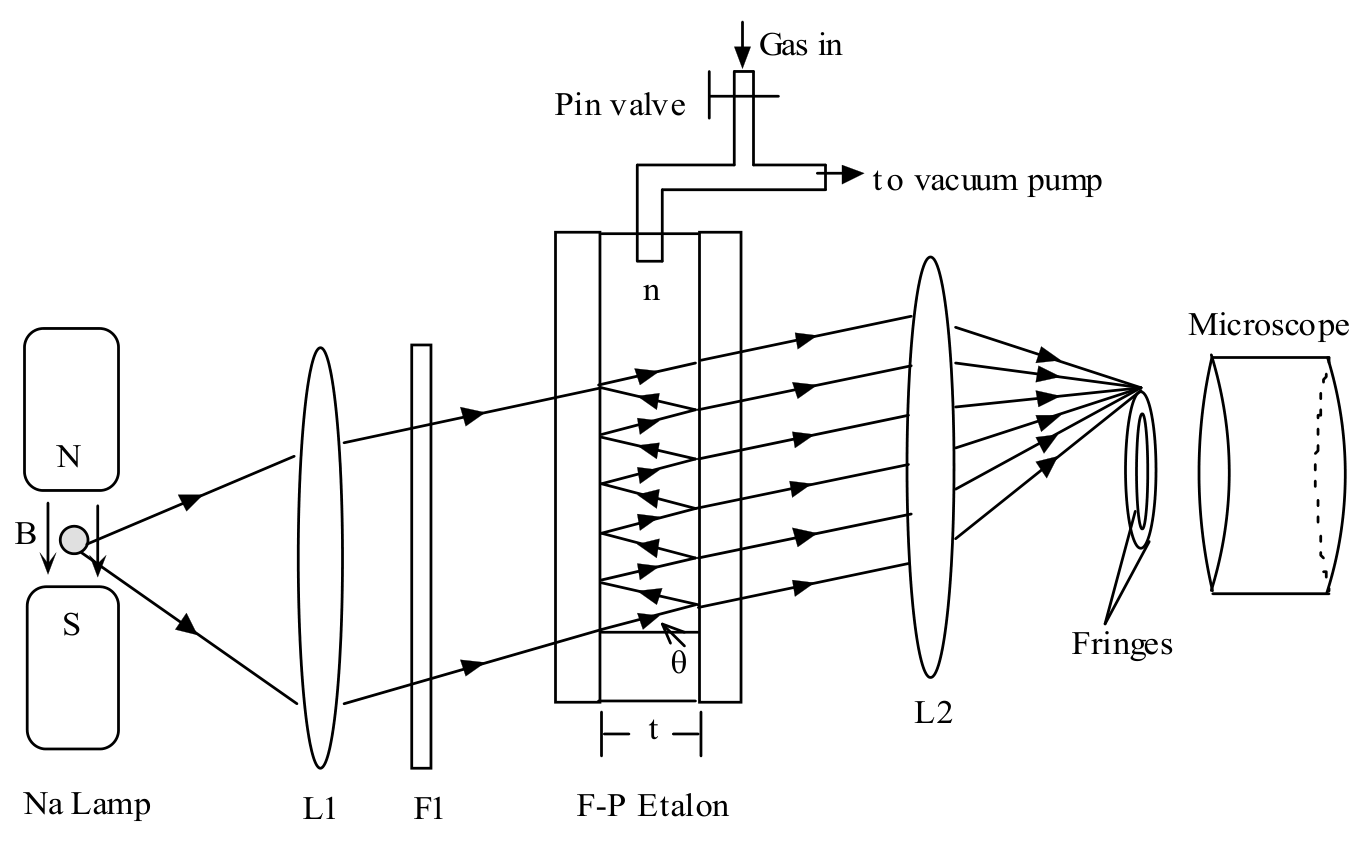
The Sodium lamp emits D1 () and D2 () spectral lines and is located in a tunable uniform magnetic field. For simplicity, an optical filter F1 is assumed to only allow the D1 line to pass through. The D1 line is then collimated to the F-P etalon by the lens L1. Circular interference fringes will be present on the focal plane of the lens L2 with a focal length f=30cm. Different fringes have the different incident angle . A microscope is used to observe the fringes. We take the reflectivity R= 90% and the inner-surface spacing t=1cm.
Some useful constants : , , , .
(a) (3points) The D1 line () is collimated to the F-P etalon. For the vacuum case (n=1.0), please calculate (i) interference orders , (ii) incidence angle and (iii) diameter for the first three (i=1, 2, 3) fringes from the center of the ring patterns on the focal plane.
Solution:
The transmittivity of the F-P etalon is given by:
For bright fringes, we have
For n=1.0, t=1cm, , thus:
(a1) (1 point if Eqs. (a2-a3) are not correct.)
Because of , so the orders of the first three fringes are:
(a2) (1 point)
The incident angles of the first three fringes are:
(a3) (1 point)
The fringe diameter is given by:
(a4) (0.5 point if Eq(a5) is not correct.)
For the focal length f=30cm, thus:
(a5) (1 point)
(b) (3 points) As shown in Fig. 2, the width of the spectral line is defined as the full width of half maximum (FWHM) of light transmitivity T regarding the phase shift . The resolution of the F-P etalon is defined as follows: for two wavelengths and , when the central phase difference of both spectral lines is larger than , they are thought to be resolvable; then the etalon resolution is when . For the vacuum case, the D1 line (), and because of the incident angle , take , please calculate:
(i) the width ε of the spectral line.
(ii) the resolution of the etalon.
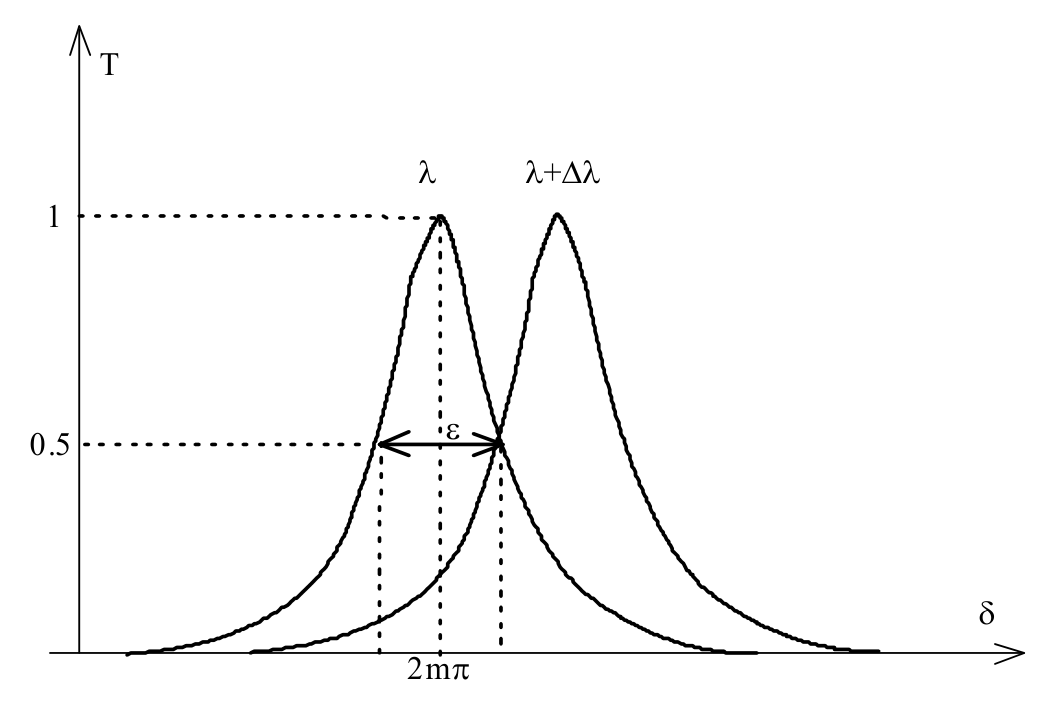
Solution:
The half maximum occurs at:
(b1) (0.2 point if Eq.(b3) is wrong.)
Given that , thus:
(b2) (0.2 point if Eq.(b3) is wrong.)
(b3) (1 point)
The phase shift is given by:
For a small , thus:
(b4) (1 point if Eq. (b5) is wrong.)
For and , we get:
(b5) (2 points)
(1.5 point if the final value of Eq. (b5) is wrong.)
(c) (1 point) As shown in Fig. 1, the initial air pressure is zero. By slowly tuning the pin valve, air is gradually injected into the F-P etalon and finally the air pressure reaches the standard atmospheric pressure. On the same time, ten new fringes are observed to produce from the center of the ring patterns on the focal plane. Based on this phenomenon, calculate the refractive index of air at the standard atmospheric pressure.
Solution:
From Question (a), we know that the order of the 1st fringe near the center of ring patterns is m=33921 at the vacuum case (n=1.0). When the air pressure reaches the standard atmospheric pressure, the order of the 1st fringe becomes m+10, so we have:
(c1) (1 point)
(0.2 point for appearing the term of (m+10) when the final value of Eq.(c1) is wrong.
Or
0.8 point for the correct final expression (including other correct forms) without the correct value.)
(d) (2 points) Energy levels splitting of Sodium atoms occurs when they are placed in a magnetic field. This is called as the Zeeman effect. The energy shift given by , where the quantum number can be J, J-1, …, -J+1, -J, J is the total angular quantum number, is the Landé factor, is Bohr magneton, h is the Plank constant, e is the electron charge, is the electron mass, B is the magnetic field. As shown in Fig. 3, the D1 spectral line is emitted when Sodium atoms jump from the energy level down to . We have for both and . Therefore, in the magnetic field, each energy level will be split into two levels. We define the energy gap of two splitting levels as for and for respectively (). As a result, the D1 line is split into 4 spectral lines (a, b, c, and d), as showed in Fig. 3. Please write down the expression of the frequency () of four lines a, b, c, and d.
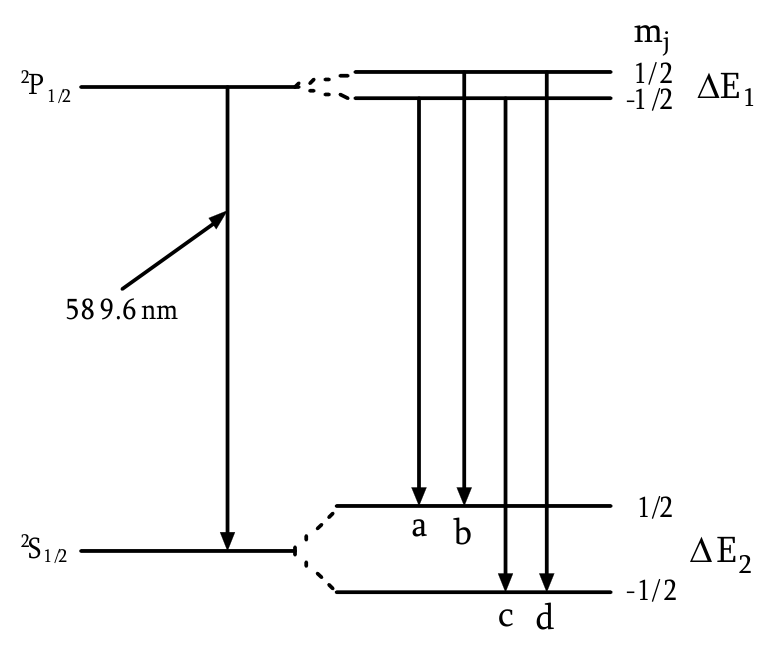
Solution:
The frequency of D1 line ( to ) is given by:
When magnetic field B is applied, the frequency of the line a,b,c,d are expressed as:
(mj=-1/2) → (mj =1/2): frequency of (a): ; (0.5 point)
(mj=1/2) → (mj=1/2): frequency of (b): ; (0.5 point)
(mj=-1/2) → (mj=-1/2): frequency of (c): ; (0.5 point)
(mj=1/2) → (mj=-1/2): frequency of (d): ; (0.5 point)
(The results maybe have other correct forms.
But, 0.4 point for each result without the coefficient of .)
(e) (3 points) As shown in Fig. 4, when the magnetic field is turned on, each fringe of the D1 line will split into four sub-fringes (1, 2, 3, and 4). The diameter of the four sub-fringes near the center is measured as , , , and . Please give the expression of the splitting energy gap of and of .
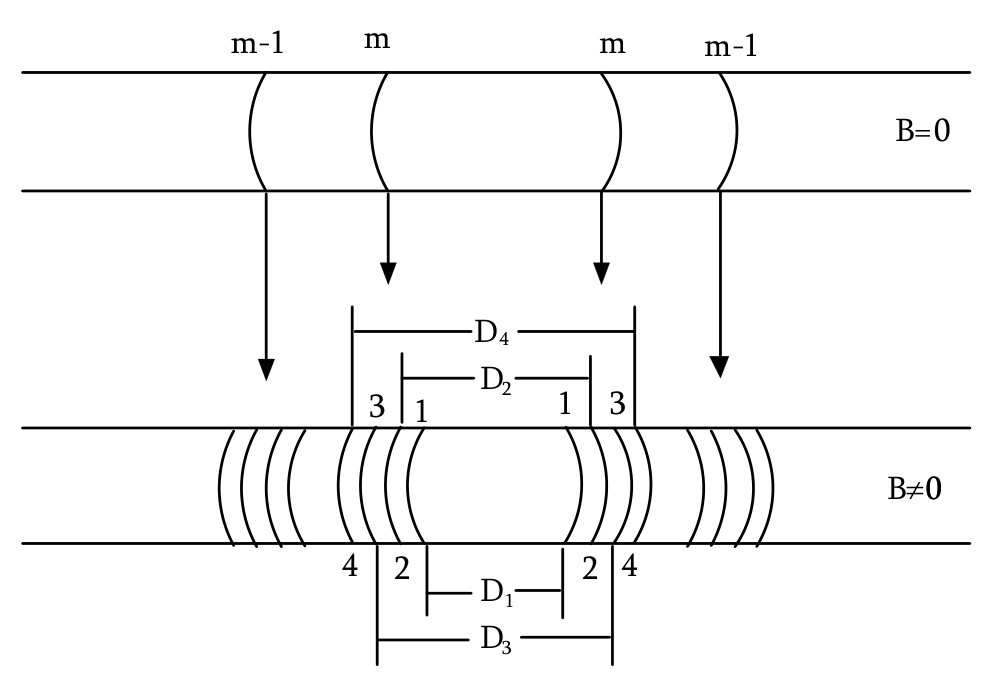
Solution: , (e1) (0.2point if Eq. (e4) is wrong.)
(e2) (0.2point if Eq. (e4) is wrong.)
(e3) (0.2point if Eq. (e4) is wrong.)
(e4) (1 point)
The lines a, b, c, and d correspond to sub-fringe 1, 2, 3, and 4. From Question (d), we have.
The wavelength difference of the spectral line a and b is given by:
or , (e5)
(0.5 point for each subequation in Eq (e5) if Eqs. (e6) and (e7) are totally wrong.)
The wavelength difference of the spectral line a and b is given by:
Then we obtain
(or ) (e6) (1 point)
Similarly, for , we get
(or ) (e7) (1 point)
(Eqs (e6 and e7) have other correct forms which should be in terms of , , , and )
(2.5 points for the final expressions only with the incorrect coefficients. )
(f) (3 points) For the magnetic field B=0.1T, the diameter of four sub-fringes is measured as: , , , and . Please calculate the Landé factor of and of .
Solution:
Given that B=0.1T, so we have:
(f1) (0.2point if Eq. (f4) is wrong.)
(f2)
(or, ) (0.5point if Eq. (f4) is wrong.)
For the D1 spectral line, , so we can get:
(f3) (0.2point if Eq. (f4) is wrong.)
thus:
(1.5 points)
(or )
Similarly, we get:
(1.5 points)
(or )
(2 points for the correct final expressions if the final values are wrong.)
(*Comment: the theory value of and is 2/3 and 2)
(g) (2 points) The magnetic field on the sun can be determined by measuring the Zeeman effect of the Sodium D1 line on some special regions of the sun. One observes that, in the four split lines, the wavelength difference between the shortest and longest wavelength is 0.012nm by a solar spectrograph. What is the magnetic field B in this region of the sun?
Solution:
We have and ;
The line a has the longest wavelength and the line d has the shortest wavelength line. The energy difference of the line a and d is
(g1) (0.5point if Eq. (g3) is wrong.))
(g2) (0.5 point)
(g3) (0.5 point)
So the magnetic field B is given by:
(g4) (1 point)
(0.5 point if the first line in Eq (g4) is correct.)
(h) (3 points) A Light- Emitting Diode (LED) source with a central wavelength and spectral width is normally incident () into the F-P etalon shown in Fig. 1. For the vacuum case, find (i) the number of lines in transmitted spectrum and (ii) the frequency width of each line?
Solution:
The wavelength of transmitted spectral lines is given by:
(h1) (0.5 point if Eq. (h2) is wrong.)
(h2) (1 point)
The frequency width of the input LED is:
(h3)
(0.5point if the first line in Eq. (h3) is correct.)
So we have the number of transmitted spectral line:
(h4) (1 point)
(0.5point if the first line in Eq. (h4) is correct.)
The spectral width of transmitted spectral line is , then we have
(h5) (1 point)
(0.5point if the first line in Eq. (h5) is correct.)