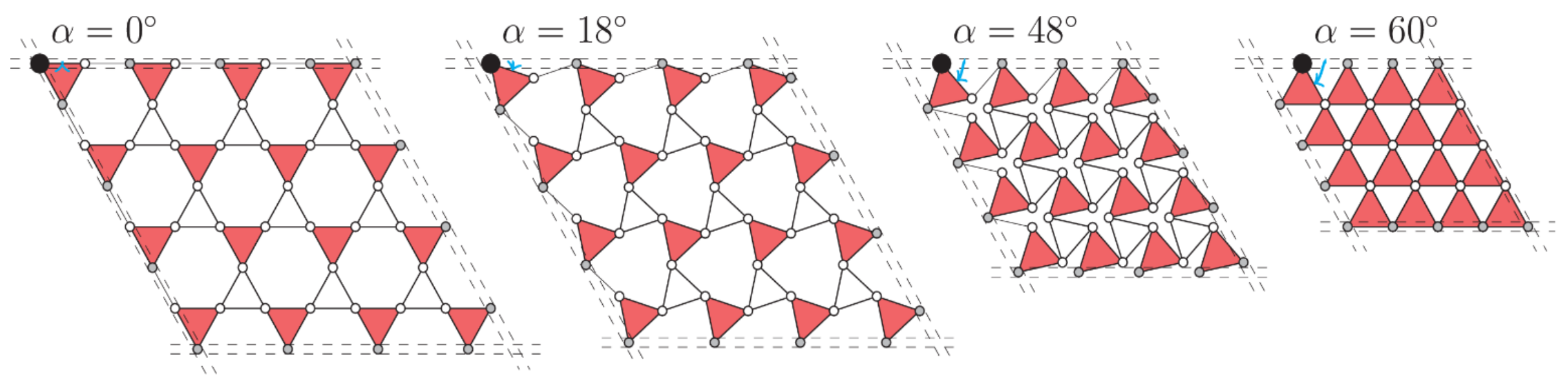
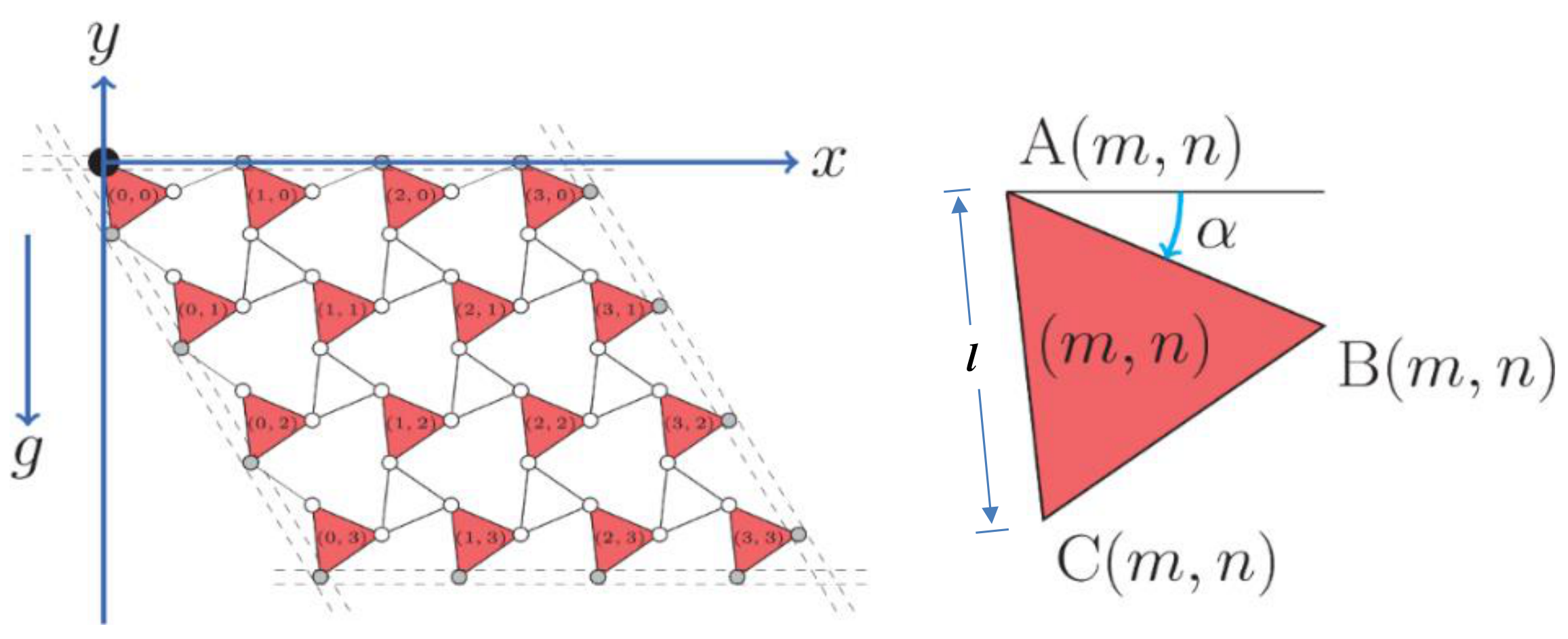
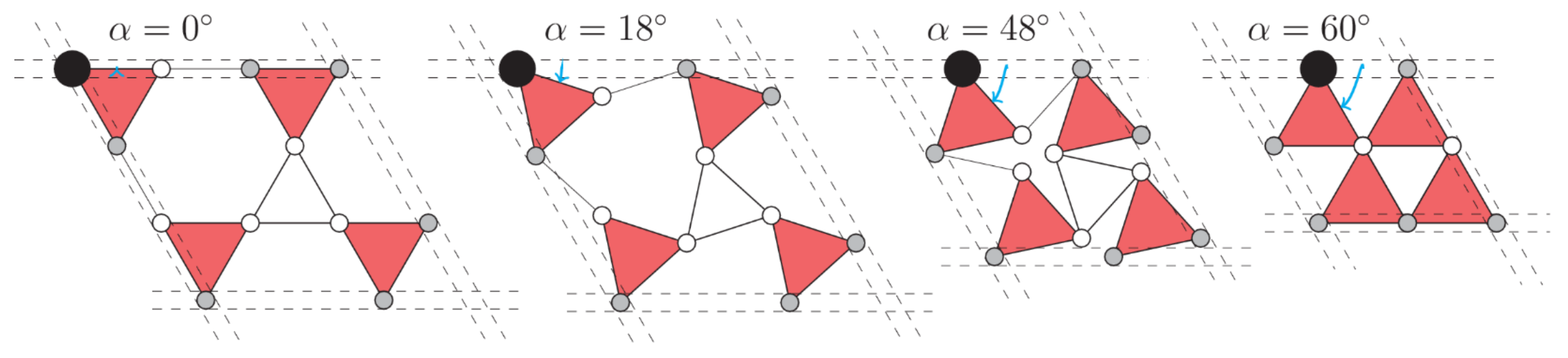
(Full Mark = 20)
A1 — Marks: 2
The potential energy for N = 2 N = 2 N = 2
E p ( α ) = M g ⋅ y c ⋅ m . ( 0 , 0 ) × 4 + M g ⋅ Δ y × 2 (0.5 points) - Eq. (1) E_\mathrm{p}(\alpha) = Mg \cdot y_{\mathrm{c\cdot m.}(0,0)} \times 4 + Mg \cdot \Delta y \times 2 \qquad \textbf{(0.5 points)} \qquad \text{- Eq. (1)} E p ( α ) = M g ⋅ y c ⋅ m. ( 0 , 0 ) × 4 + M g ⋅ Δ y × 2 (0.5 points) - Eq. (1) where
y c ⋅ m . ( 0 , 0 ) = − 3 l 3 sin ( π 6 + α ) (0.5 points) - Eq. (2) y_{\mathrm{c\cdot m.}(0,0)} = -\frac{\sqrt{3}l}{3}\sin\left(\frac{\pi}{6} + \alpha\right) \qquad \textbf{(0.5 points)} \qquad \text{- Eq. (2)} y c ⋅ m. ( 0 , 0 ) = − 3 3 l sin ( 6 π + α ) (0.5 points) - Eq. (2) is the y y y
Δ y = y A ( 0 , 1 ) − y A ( 0 , 0 ) = − l [ sin ( π 3 + α ) + sin ( π 3 − α ) ] = − 3 l cos α (0.5 points) - Eq. (3) \begin{aligned} \Delta y &= y_{\mathrm{A}(0,1)} - y_{\mathrm{A}(0,0)} \\ &= -l\left[\sin\left(\frac{\pi}{3} + \alpha\right) + \sin\left(\frac{\pi}{3} - \alpha\right)\right] \\ &= -\sqrt{3}l\cos\alpha \qquad \textbf{(0.5 points)} \qquad \text{- Eq. (3)} \end{aligned} Δ y = y A ( 0 , 1 ) − y A ( 0 , 0 ) = − l [ sin ( 3 π + α ) + sin ( 3 π − α ) ] = − 3 l cos α (0.5 points) - Eq. (3) is the translational difference of two neighbouring triangles in y y y
E p ( α ) = − 2 3 M g l ( 4 3 cos α + 3 sin α ) (0.5 points) - Eq. (4) E_\mathrm{p}(\alpha) = -\frac{2}{3}Mgl\left(4\sqrt{3}\cos\alpha + 3\sin\alpha\right) \qquad \textbf{(0.5 points)} \qquad \text{- Eq. (4)} E p ( α ) = − 3 2 M g l ( 4 3 cos α + 3 sin α ) (0.5 points) - Eq. (4) A2 — Marks: 1
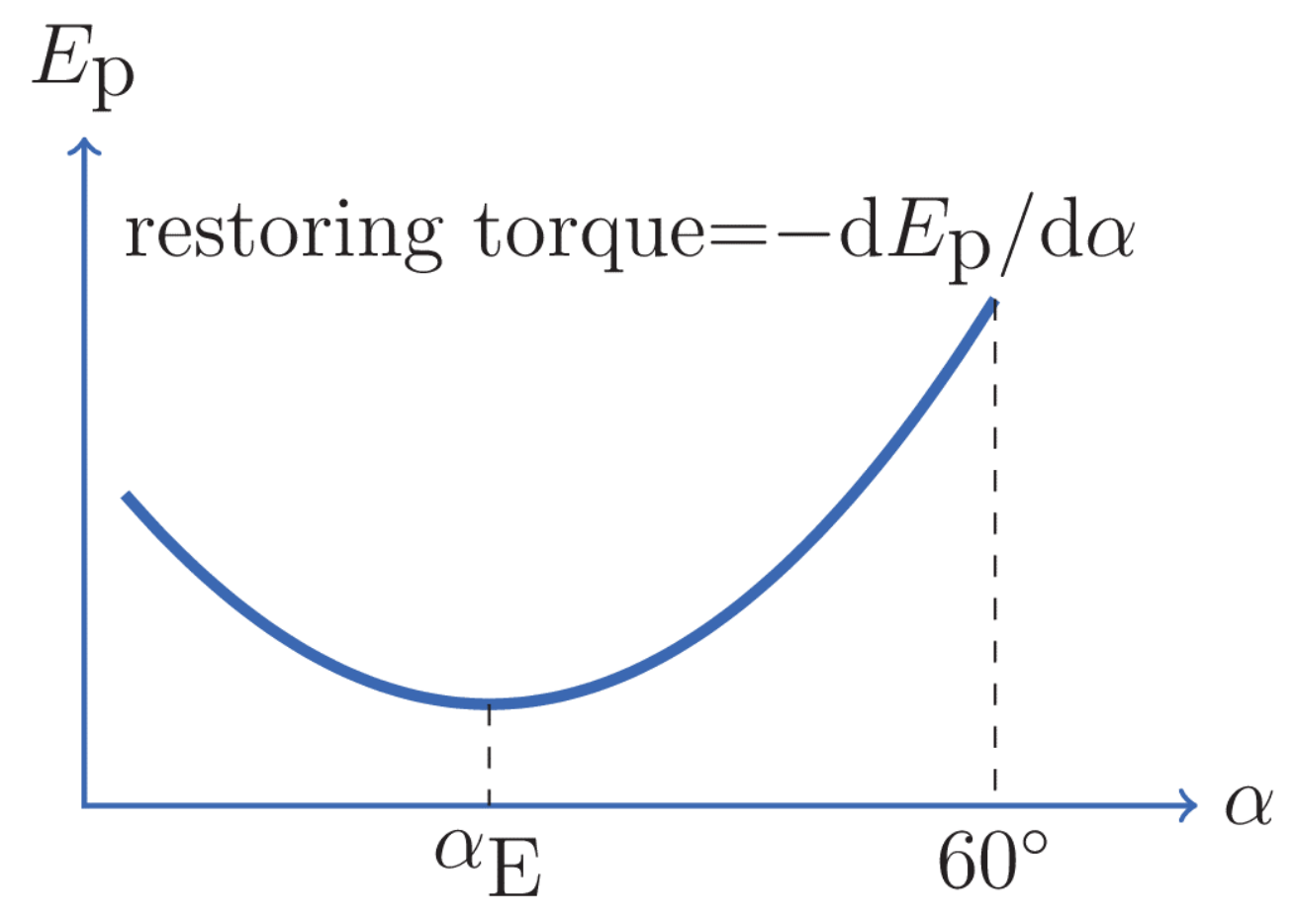
At equilibrium, the potential energy reaches a minimum, which gives:
d E p ( α ) d α ∣ α = α E = 0 (0.5 points) - Eq. (5) \left.\frac{dE_\mathrm{p}(\alpha)}{d\alpha}\right|_{\alpha=\alpha_\mathrm{E}} = 0 \qquad \textbf{(0.5 points)} \qquad \text{- Eq. (5)} d α d E p ( α ) α = α E = 0 (0.5 points) - Eq. (5) 3 sin α E + 3 cos α E = 0 - Eq. (6) \sqrt{3}\sin\alpha_\mathrm{E} + 3\cos\alpha_\mathrm{E} = 0 \qquad \text{- Eq. (6)} 3 sin α E + 3 cos α E = 0 - Eq. (6) or
α E = tan − 1 3 4 (0.5 point) - Eq. (7) \alpha_\mathrm{E} = \tan^{-1}\frac{\sqrt{3}}{4} \qquad \textbf{(0.5 point)} \qquad \text{- Eq. (7)} α E = tan − 1 4 3 (0.5 point) - Eq. (7) A3 — Marks: 5
If the total energy of the oscillation has the following form
E ( Δ α , Δ α ˙ ) = E p + E k = 1 2 K ( Δ α ) 2 + 1 2 I ( Δ α ˙ ) 2 , (0.5 points) - Eq. (8) E(\Delta\alpha, \Delta\dot{\alpha}) = E_\mathrm{p} + E_\mathrm{k} = \frac{1}{2}K(\Delta\alpha)^2 + \frac{1}{2}I(\Delta\dot{\alpha})^2 , \qquad \textbf{(0.5 points)} \qquad \text{- Eq. (8)} E ( Δ α , Δ α ˙ ) = E p + E k = 2 1 K ( Δ α ) 2 + 2 1 I ( Δ α ˙ ) 2 , (0.5 points) - Eq. (8) where E p E_\mathrm{p} E p E k E_\mathrm{k} E k ω = K / I \omega = \sqrt{K/I} ω = K / I Δ α = α − α E \Delta\alpha = \alpha - \alpha_\mathrm{E} Δ α = α − α E
Δ E p ≈ 1 2 d 2 E p d α 2 ∣ α = α E ( Δ α ) 2 = ( 1 2 ) ( 2 3 M g l ) ( 4 3 cos α E + 3 sin α E ) ( Δ α ) 2 = 57 3 M g l ( Δ α ) 2 (1 point) - Eq. (9) \begin{aligned} \Delta E_\mathrm{p} &\approx \frac{1}{2}\left.\frac{d^2E_\mathrm{p}}{\mathrm{d}\alpha^2}\right|_{\alpha=\alpha_\mathrm{E}}(\Delta\alpha)^2 \\ &= \left(\frac{1}{2}\right)\left(\frac{2}{3}Mgl\right)(4\sqrt{3}\cos\alpha_\mathrm{E} + 3\sin\alpha_\mathrm{E})(\Delta\alpha)^2 \\ &= \frac{\sqrt{57}}{3}Mgl(\Delta\alpha)^2 \qquad \textbf{(1 point)} \qquad \text{- Eq. (9)} \end{aligned} Δ E p ≈ 2 1 d α 2 d 2 E p α = α E ( Δ α ) 2 = ( 2 1 ) ( 3 2 M g l ) ( 4 3 cos α E + 3 sin α E ) ( Δ α ) 2 = 3 57 M g l ( Δ α ) 2 (1 point) - Eq. (9) The total kinetic energy of the system includes the translational kinetic energy of every plate and the rotational kinetic energy of every plate relative to its center of mass
E k = ∑ E k t r a n s + ∑ E k r o t - Eq. (10) E_\mathrm{k} = \sum E_\mathrm{k}^{\mathrm{trans}} + \sum E_\mathrm{k}^{\mathrm{rot}} \qquad \text{- Eq. (10)} E k = ∑ E k trans + ∑ E k rot - Eq. (10) The rotational kinetic energy is
∑ E k r o t = 4 × 1 2 M l 2 12 ( Δ α ˙ ) 2 = 1 6 M l 2 ( Δ α ˙ ) 2 (0.5 points) - Eq. (11) \sum E_\mathrm{k}^{\mathrm{rot}} = 4 \times \frac{1}{2}\frac{Ml^2}{12}(\Delta\dot{\alpha})^2 = \frac{1}{6}Ml^2(\Delta\dot{\alpha})^2 \qquad \textbf{(0.5 points)} \qquad \text{- Eq. (11)} ∑ E k rot = 4 × 2 1 12 M l 2 ( Δ α ˙ ) 2 = 6 1 M l 2 ( Δ α ˙ ) 2 (0.5 points) - Eq. (11) E k t r a n s E_\mathrm{k}^{\mathrm{trans}} E k trans N = 2 N = 2 N = 2
x c . m . ( m , n ) = m ( 2 l cos α ) + n ( 2 l cos α ) cos π 3 + l 3 cos ( α + π 6 ) , x_{\mathrm{c.m.}(m,n)} = m(2l\cos\alpha) + n(2l\cos\alpha)\cos\frac{\pi}{3} + \frac{l}{\sqrt{3}}\cos\left(\alpha + \frac{\pi}{6}\right), x c.m. ( m , n ) = m ( 2 l cos α ) + n ( 2 l cos α ) cos 3 π + 3 l cos ( α + 6 π ) , y c . m . ( m , n ) = − n ( 2 l cos α ) sin π 3 − l 3 sin ( α + π 6 ) . (0.5 point) y_{\mathrm{c.m.}(m,n)} = -n(2l\cos\alpha)\sin\frac{\pi}{3} - \frac{l}{\sqrt{3}}\sin\left(\alpha + \frac{\pi}{6}\right). \qquad \textbf{(0.5 point)} y c.m. ( m , n ) = − n ( 2 l cos α ) sin 3 π − 3 l sin ( α + 6 π ) . (0.5 point) Differentiating and substituting
sin α = 3 19 , cos α = 4 19 , sin ( α + π 6 ) = 7 2 19 , cos ( α + π 6 ) = 3 3 2 19 , \sin\alpha = \frac{\sqrt{3}}{\sqrt{19}}, \cos\alpha = \frac{4}{\sqrt{19}}, \sin\left(\alpha + \frac{\pi}{6}\right) = \frac{7}{2\sqrt{19}}, \cos\left(\alpha + \frac{\pi}{6}\right) = \frac{3\sqrt{3}}{2\sqrt{19}}, sin α = 19 3 , cos α = 19 4 , sin ( α + 6 π ) = 2 19 7 , cos ( α + 6 π ) = 2 19 3 3 , x ˙ c . m . ( m , n ) = − ( 2 m + n + 7 6 ) 3 57 l Δ α ˙ , y ˙ c . m . ( m , n ) = 3 ( 2 n − 1 ) 2 19 l Δ α ˙ . \dot{x}_{\mathrm{c.m.}(m,n)} = -\left(2m + n + \frac{7}{6}\right)\frac{3}{\sqrt{57}}l\Delta\dot{\alpha}, \qquad \dot{y}_{\mathrm{c.m.}(m,n)} = \frac{3(2n-1)}{2\sqrt{19}}l\Delta\dot{\alpha}. x ˙ c.m. ( m , n ) = − ( 2 m + n + 6 7 ) 57 3 l Δ α ˙ , y ˙ c.m. ( m , n ) = 2 19 3 ( 2 n − 1 ) l Δ α ˙ . v c . m . ( m , n ) 2 = x ˙ c . m . ( m , n ) 2 + y ˙ c . m . ( m , n ) 2 = ( 12 m + 6 n + 7 ) 2 + 27 228 l 2 ( Δ α ˙ ) 2 , (1 point) v^2_{\mathrm{c.m.}(m,n)} = \dot{x}^2_{\mathrm{c.m.}(m,n)} + \dot{y}^2_{\mathrm{c.m.}(m,n)} = \frac{(12m+6n+7)^2+27}{228}l^2(\Delta\dot{\alpha})^2, \qquad \textbf{(1 point)} v c.m. ( m , n ) 2 = x ˙ c.m. ( m , n ) 2 + y ˙ c.m. ( m , n ) 2 = 228 ( 12 m + 6 n + 7 ) 2 + 27 l 2 ( Δ α ˙ ) 2 , (1 point) E c . m . , k t r a n s = M 2 [ v c . m . ( 0 , 0 ) 2 + v c . m . ( 0 , 1 ) 2 + v c . m . ( 1 , 0 ) 2 + v c . m . ( 1 , 1 ) 2 ] = 164 57 M l 2 ( Δ α ˙ ) 2 . E^{\mathrm{trans}}_{\mathrm{c.m.,k}} = \frac{M}{2}\left[v^2_{\mathrm{c.m.}(0,0)} + v^2_{\mathrm{c.m.}(0,1)} + v^2_{\mathrm{c.m.}(1,0)} + v^2_{\mathrm{c.m.}(1,1)}\right] = \frac{164}{57}Ml^2(\Delta\dot{\alpha})^2. E c.m. , k trans = 2 M [ v c.m. ( 0 , 0 ) 2 + v c.m. ( 0 , 1 ) 2 + v c.m. ( 1 , 0 ) 2 + v c.m. ( 1 , 1 ) 2 ] = 57 164 M l 2 ( Δ α ˙ ) 2 . E k t r a n s = E c . m . , k t r a n s + E k r o t = 347 114 M l 2 ( Δ α ˙ ) 2 . (1 point) E^{\mathrm{trans}}_\mathrm{k} = E^{\mathrm{trans}}_{\mathrm{c.m.,k}} + E^{\mathrm{rot}}_\mathrm{k} = \frac{347}{114}Ml^2(\Delta\dot{\alpha})^2. \qquad \textbf{(1 point)} E k trans = E c.m. , k trans + E k rot = 114 347 M l 2 ( Δ α ˙ ) 2 . (1 point) Alternatively, another way to get E k t r a n s E_k^{\mathrm{trans}} E k trans
E k = ∑ E c . m . , k t r a n s + ∑ E r . c . , k r o t (0.5 points) - Eq. (12) E_\mathrm{k} = \sum E^{\mathrm{trans}}_{\mathrm{c.m.,k}} + \sum E^{\mathrm{rot}}_{\mathrm{r.c.,k}} \qquad \textbf{(0.5 points)} \qquad \text{- Eq. (12)} E k = ∑ E c.m. , k trans + ∑ E r.c. , k rot (0.5 points) - Eq. (12) where
E r . c . , k t r a n s = M 2 [ v r . c . ( 0 , 0 ) 2 + v r . c . ( 1 , 0 ) 2 + v r . c . ( 0 , 1 ) 2 + v r . c . ( 1 , 1 ) 2 ] - Eq. (13) E^{\mathrm{trans}}_{\mathrm{r.c.,k}} = \frac{M}{2}\left[v^2_{\mathrm{r.c.}(0,0)} + v^2_{\mathrm{r.c.}(1,0)} + v^2_{\mathrm{r.c.}(0,1)} + v^2_{\mathrm{r.c.}(1,1)}\right] \qquad \text{- Eq. (13)} E r.c. , k trans = 2 M [ v r.c. ( 0 , 0 ) 2 + v r.c. ( 1 , 0 ) 2 + v r.c. ( 0 , 1 ) 2 + v r.c. ( 1 , 1 ) 2 ] - Eq. (13) is the translational kinetic energy relative to the center of mass of the system and
E c . m . , k t r a n s = 4 M 2 v c . m . 2 - Eq. (14) E^{\mathrm{trans}}_{\mathrm{c.m.,k}} = \frac{4M}{2}v^2_{\mathrm{c.m.}} \qquad \text{- Eq. (14)} E c.m. , k trans = 2 4 M v c.m. 2 - Eq. (14) is the translational kinetic energy of the center of mass of the system.
The center of mass of each of the 2×2 = 4 triangles always form diamond shape with lateral length 2 l 2l 2 l
v r . c . ( 0 , 0 ) = v r . c . ( 1 , 1 ) = d ( 3 l cos α ) d α ∣ α = α E Δ α ˙ v_{\mathrm{r.c.}(0,0)} = v_{\mathrm{r.c.}(1,1)} = \left.\frac{d(\sqrt{3}l\cos\alpha)}{d\alpha}\right|_{\alpha=\alpha_\mathrm{E}}\Delta\dot{\alpha} v r.c. ( 0 , 0 ) = v r.c. ( 1 , 1 ) = d α d ( 3 l cos α ) α = α E Δ α ˙ v r . c . ( 1 , 0 ) = v r . c . ( 0 , 1 ) = d ( l cos α ) d α ∣ α = α E Δ α ˙ - Eq. (15) v_{\mathrm{r.c.}(1,0)} = v_{\mathrm{r.c.}(0,1)} = \left.\frac{d(l\cos\alpha)}{d\alpha}\right|_{\alpha=\alpha_\mathrm{E}}\Delta\dot{\alpha} \qquad \text{- Eq. (15)} v r.c. ( 1 , 0 ) = v r.c. ( 0 , 1 ) = d α d ( l cos α ) α = α E Δ α ˙ - Eq. (15) Substituting Eqs. (14) and (15) into Eq. (13), we obtain
E r . c . , k t r a n s = 4 sin α E 2 M l 2 ( Δ α ˙ ) 2 - Eq. (16) E^{\mathrm{trans}}_{\mathrm{r.c.,k}} = 4\sin\alpha_\mathrm{E}^2 Ml^2(\Delta\dot{\alpha})^2 \qquad \text{- Eq. (16)} E r.c. , k trans = 4 sin α E 2 M l 2 ( Δ α ˙ ) 2 - Eq. (16) For E c . m . , k t r a n s E^{\mathrm{trans}}_{\mathrm{c.m.,k}} E c.m. , k trans
v c . m . = ( d x c . m . d α ) 2 + ( d y c . m . d α ) 2 ∣ α = α E Δ α ˙ - Eq. (17) v_{\mathrm{c.m.}} = \left.\sqrt{\left(\frac{\mathrm{d}x_{\mathrm{c.m.}}}{\mathrm{d}\alpha}\right)^2 + \left(\frac{\mathrm{d}y_{\mathrm{c.m.}}}{\mathrm{d}\alpha}\right)^2}\,\right|_{\alpha=\alpha_\mathrm{E}}\Delta\dot{\alpha} \qquad \text{- Eq. (17)} v c.m. = ( d α d x c.m. ) 2 + ( d α d y c.m. ) 2 α = α E Δ α ˙ - Eq. (17) is the velocity of the center-of-mass of the four triangular plates, with
x c . m . = x c . m . ( 0 , 0 ) + 1 2 ( x B ( 0 , 0 ) + x A ( 1 , 0 ) ) = 3 l 3 cos ( π 6 + α ) + 3 2 l cos α - Eq. (18) y c . m . = y c . m . ( 0 , 0 ) + 1 2 Δ y = − 3 l 3 sin ( π 6 + α ) − 3 2 l cos α - Eq. (19) \begin{aligned} x_{\mathrm{c.m.}} &= x_{\mathrm{c.m.}(0,0)} + \frac{1}{2}\left(x_{\mathrm{B}(0,0)} + x_{\mathrm{A}(1,0)}\right) \\ &= \frac{\sqrt{3}l}{3}\cos\left(\frac{\pi}{6} + \alpha\right) + \frac{3}{2}l\cos\alpha \qquad \text{- Eq. (18)} \\ y_{\mathrm{c.m.}} &= y_{\mathrm{c.m.}(0,0)} + \frac{1}{2}\Delta y \\ &= -\frac{\sqrt{3}l}{3}\sin\left(\frac{\pi}{6} + \alpha\right) - \frac{\sqrt{3}}{2}l\cos\alpha \qquad \text{- Eq. (19)} \end{aligned} x c.m. y c.m. = x c.m. ( 0 , 0 ) + 2 1 ( x B ( 0 , 0 ) + x A ( 1 , 0 ) ) = 3 3 l cos ( 6 π + α ) + 2 3 l cos α - Eq. (18) = y c.m. ( 0 , 0 ) + 2 1 Δ y = − 3 3 l sin ( 6 π + α ) − 2 3 l cos α - Eq. (19) Substituting Eqs. (17), (18) and (19) and into Eq. (14), we obtain
E c . m . , k t r a n s = ( 2 3 + 10 sin 2 α E ) M l 2 ( Δ α ˙ ) 2 (0.5 points) - Eq. (20) E^{\mathrm{trans}}_{\mathrm{c.m.,k}} = \left(\frac{2}{3} + 10\sin^2\alpha_E\right)Ml^2(\Delta\dot{\alpha})^2 \qquad \textbf{(0.5 points)} \qquad \text{- Eq. (20)} E c.m. , k trans = ( 3 2 + 10 sin 2 α E ) M l 2 ( Δ α ˙ ) 2 (0.5 points) - Eq. (20) Combining Eqs. (12), (16) and (20), we obtain
E k = E k r o t + E r . c . , k t r a n s + E c . m . , k t r a n s = ( 5 6 + 14 sin 2 α E ) M l 2 ( Δ α ˙ ) 2 = 347 114 M l 2 ( Δ α ˙ ) 2 (1.5 points) - Eq. (21) \begin{aligned} E_\mathrm{k} &= E^{\mathrm{rot}}_\mathrm{k} + E^{\mathrm{trans}}_{\mathrm{r.c.,k}} + E^{\mathrm{trans}}_{\mathrm{c.m.,k}} \\ &= \left(\frac{5}{6} + 14\sin^2\alpha_E\right)Ml^2(\Delta\dot{\alpha})^2 \\ &= \frac{347}{114}Ml^2(\Delta\dot{\alpha})^2 \qquad \textbf{(1.5 points)} \qquad \text{- Eq. (21)} \end{aligned} E k = E k rot + E r.c. , k trans + E c.m. , k trans = ( 6 5 + 14 sin 2 α E ) M l 2 ( Δ α ˙ ) 2 = 114 347 M l 2 ( Δ α ˙ ) 2 (1.5 points) - Eq. (21) According to Eqs. (8), (9) and (21),
f = 1 2 π 57 3 M g l 347 114 M l 2 = 1 2 π 38 57 347 g l (0.5 points) - Eq. (22) f = \frac{1}{2\pi}\sqrt{\frac{\frac{\sqrt{57}}{3}Mgl}{\frac{347}{114}Ml^2}} = \frac{1}{2\pi}\sqrt{\frac{38\sqrt{57}}{347}\frac{g}{l}} \qquad \textbf{(0.5 points)} \qquad \text{- Eq. (22)} f = 2 π 1 114 347 M l 2 3 57 M g l = 2 π 1 347 38 57 l g (0.5 points) - Eq. (22) [Note 1: 0.5 point should be deducted if there are numerical mistakes, but all steps are correct.
Note 2: A rough estimate of f ∼ g l f \sim \sqrt{\frac{g}{l}} f ∼ l g
B1 — Marks: 3
For arbitrary N N N
E p = ∑ m , n = 0 N − 1 E p ( m , n ) - Eq. (23) E_\mathrm{p} = \sum_{m,n=0}^{N-1}E_\mathrm{p}(m,n) \qquad \text{- Eq. (23)} E p = m , n = 0 ∑ N − 1 E p ( m , n ) - Eq. (23) where
E p ( m , n ) = 1 3 M g [ y A ( m , n ) + y B ( m , n ) + y C ( m , n ) ] - Eq. (24) E_\mathrm{p}(m,n) = \frac{1}{3}Mg\left[y_{\mathrm{A}(m,n)} + y_{\mathrm{B}(m,n)} + y_{\mathrm{C}(m,n)}\right] \qquad \text{- Eq. (24)} E p ( m , n ) = 3 1 M g [ y A ( m , n ) + y B ( m , n ) + y C ( m , n ) ] - Eq. (24) (0.5 points for Eqs. (23) and (24))
and
y A ( m , n ) = − n l sin ( π 3 − α ) − n l sin ( π 3 + α ) = − 3 n l cos α y B ( m , n ) = y A ( m , n ) − l sin α = − 3 n l cos α − l sin α y C ( m , n ) = y A ( m , n ) − l sin ( π 3 + α ) = − 3 n l cos α − l sin ( π 3 + α ) - Eq. (25) \begin{aligned} y_{\mathrm{A}(m,n)} &= -nl\sin\left(\frac{\pi}{3} - \alpha\right) - nl\sin\left(\frac{\pi}{3} + \alpha\right) = -\sqrt{3}nl\cos\alpha \\ y_{\mathrm{B}(m,n)} &= y_{\mathrm{A}(m,n)} - l\sin\alpha = -\sqrt{3}nl\cos\alpha - l\sin\alpha \\ y_{\mathrm{C}(m,n)} &= y_{\mathrm{A}(m,n)} - l\sin\left(\frac{\pi}{3} + \alpha\right) = -\sqrt{3}nl\cos\alpha - l\sin\left(\frac{\pi}{3} + \alpha\right) \qquad \text{- Eq. (25)} \end{aligned} y A ( m , n ) y B ( m , n ) y C ( m , n ) = − n l sin ( 3 π − α ) − n l sin ( 3 π + α ) = − 3 n l cos α = y A ( m , n ) − l sin α = − 3 n l cos α − l sin α = y A ( m , n ) − l sin ( 3 π + α ) = − 3 n l cos α − l sin ( 3 π + α ) - Eq. (25) (0.5 points for all three correct coordinates)
Thus,
E p ( m , n ) = − 1 3 M g l [ 3 3 n cos α + sin α + sin ( π 3 + α ) ] - Eq. (26) E_\mathrm{p}(m,n) = -\frac{1}{3}Mgl\left[3\sqrt{3}n\cos\alpha + \sin\alpha + \sin\left(\frac{\pi}{3} + \alpha\right)\right] \qquad \text{- Eq. (26)} E p ( m , n ) = − 3 1 M g l [ 3 3 n cos α + sin α + sin ( 3 π + α ) ] - Eq. (26) and
E p = ∑ m , n = 0 N − 1 E p ( m , n ) = − 1 3 M g l ∑ m , n = 0 N − 1 [ 3 3 n cos α + sin α + sin ( π 3 + α ) ] (0.5 points) - Eq. (27) \begin{aligned} E_\mathrm{p} &= \sum_{m,n=0}^{N-1}E_\mathrm{p}(m,n) \\ &= -\frac{1}{3}Mgl\sum_{m,n=0}^{N-1}\left[3\sqrt{3}n\cos\alpha + \sin\alpha + \sin\left(\frac{\pi}{3} + \alpha\right)\right] \qquad \textbf{(0.5 points)} \qquad \text{- Eq. (27)} \end{aligned} E p = m , n = 0 ∑ N − 1 E p ( m , n ) = − 3 1 M g l m , n = 0 ∑ N − 1 [ 3 3 n cos α + sin α + sin ( 3 π + α ) ] (0.5 points) - Eq. (27) Using the mathematical relations
∑ m = 0 N − 1 1 = ∑ n = 0 N − 1 1 = N \sum_{m=0}^{N-1}1 = \sum_{n=0}^{N-1}1 = N m = 0 ∑ N − 1 1 = n = 0 ∑ N − 1 1 = N and
∑ m = 0 N − 1 m = ∑ n = 0 N − 1 n = N ( N − 1 ) 2 - Eq. (28), \sum_{m=0}^{N-1}m = \sum_{n=0}^{N-1}n = \frac{N(N-1)}{2} \qquad \text{- Eq. (28),} m = 0 ∑ N − 1 m = n = 0 ∑ N − 1 n = 2 N ( N − 1 ) - Eq. (28), Eq. (27) becomes
E p = − 1 3 N 2 M g l [ 3 3 ( N − 1 ) cos α 2 + sin α + sin ( π 3 + α ) ] or = − 1 3 N 2 M g l [ 3 ( 3 N − 2 ) cos α 2 + 3 2 sin α ] (1 points) - Eq. (29) \begin{aligned} E_\mathrm{p} &= -\frac{1}{3}N^2Mgl\left[\frac{3\sqrt{3}(N-1)\cos\alpha}{2} + \sin\alpha + \sin\left(\frac{\pi}{3} + \alpha\right)\right] \\ \text{or} \quad &= -\frac{1}{3}N^2Mgl\left[\frac{\sqrt{3}(3N-2)\cos\alpha}{2} + \frac{3}{2}\sin\alpha\right] \qquad \textbf{(1 points)} \qquad \text{- Eq. (29)} \end{aligned} E p or = − 3 1 N 2 M g l [ 2 3 3 ( N − 1 ) cos α + sin α + sin ( 3 π + α ) ] = − 3 1 N 2 M g l [ 2 3 ( 3 N − 2 ) cos α + 2 3 sin α ] (1 points) - Eq. (29) At equilibrium, d E p d α = 0 \frac{\mathrm{d}E_\mathrm{p}}{\mathrm{d}\alpha} = 0 d α d E p = 0
− 3 3 ( N − 1 ) sin α E ′ 2 + cos α E ′ + cos ( π 3 + α E ′ ) = 0 - Eq. (30) -\frac{3\sqrt{3}(N-1)\sin\alpha'_\mathrm{E}}{2} + \cos\alpha'_\mathrm{E} + \cos\left(\frac{\pi}{3} + \alpha'_\mathrm{E}\right) = 0 \qquad \text{- Eq. (30)} − 2 3 3 ( N − 1 ) sin α E ′ + cos α E ′ + cos ( 3 π + α E ′ ) = 0 - Eq. (30) α E ′ = tan − 1 ( 3 3 N − 2 ) (0.5 points) - Eq. (31) \alpha'_\mathrm{E} = \tan^{-1}\left(\frac{\sqrt{3}}{3N-2}\right) \qquad \textbf{(0.5 points)} \qquad \text{- Eq. (31)} α E ′ = tan − 1 ( 3 N − 2 3 ) (0.5 points) - Eq. (31) [Remark: Increasing α lowers each triangle relative to its vertex A, but globally raises the system, i.e. the bottom tube is raised higher. When N → ∞ N \to \infty N → ∞ α → 0 \alpha \to 0 α → 0
B2 — Marks: 3
Under a small perturbation, the potential energy change, according to Eq. (29) is
Δ E p ≈ 1 2 d 2 E p d α 2 ∣ α = α E ′ ( Δ α ) 2 ∼ N 3 or γ 1 = 3 (0.5 points) - Eq. (32) \Delta E_\mathrm{p} \approx \frac{1}{2}\left.\frac{d^2E_\mathrm{p}}{\mathrm{d}\alpha^2}\right|_{\alpha=\alpha'_\mathrm{E}}(\Delta\alpha)^2 \sim N^3 \quad \text{or} \ \gamma_1 = 3 \qquad \textbf{(0.5 points)} \qquad \text{- Eq. (32)} Δ E p ≈ 2 1 d α 2 d 2 E p α = α E ′ ( Δ α ) 2 ∼ N 3 or γ 1 = 3 (0.5 points) - Eq. (32) [Remark: There are N 2 N^2 N 2 y y y N N N E p ∼ N 3 E_\mathrm{p} \sim N^3 E p ∼ N 3 γ 1 = 3 \gamma_1 = 3 γ 1 = 3 γ 1 \gamma_1 γ 1
The kinetic energy of a triangle includes the translational energy of its center of mass and the rotational energy about its center of mass. Hence the total kinetic energy of the N 2 N^2 N 2
E k = ∑ m , n E c . m . ( m , n ) + ∑ m , n E r . c . ( m , n ) - Eq. (33) E_\mathrm{k} = \sum_{m,n}E_{\mathrm{c.m.}(m,n)} + \sum_{m,n}E_{\mathrm{r.c.}(m,n)} \qquad \text{- Eq. (33)} E k = m , n ∑ E c.m. ( m , n ) + m , n ∑ E r.c. ( m , n ) - Eq. (33) where
E r . c . ( m , n ) = 1 2 M l 2 12 ( Δ α ˙ ) 2 = 1 24 M l 2 ( Δ α ˙ ) 2 ∼ 1 - Eq. (34) E_{\mathrm{r.c.}(m,n)} = \frac{1}{2}\frac{Ml^2}{12}(\Delta\dot{\alpha})^2 = \frac{1}{24}Ml^2(\Delta\dot{\alpha})^2 \sim 1 \qquad \text{- Eq. (34)} E r.c. ( m , n ) = 2 1 12 M l 2 ( Δ α ˙ ) 2 = 24 1 M l 2 ( Δ α ˙ ) 2 ∼ 1 - Eq. (34) and
E c . m . ( m , n ) = M 2 v c . m . ( m , n ) 2 = M ( Δ α ˙ ) 2 2 [ ( d x c . m . ( m , n ) d α ) 2 + ( d y c . m . ( m , n ) d α ) 2 ] α = α E ′ (0.5 points) - Eq. (35) \begin{aligned} E_{\mathrm{c.m.}(m,n)} &= \frac{M}{2}v^2_{\mathrm{c.m.}(m,n)} \\ &= \frac{M(\Delta\dot{\alpha})^2}{2}\left[\left(\frac{\mathrm{d}x_{\mathrm{c.m.}(m,n)}}{\mathrm{d}\alpha}\right)^2 + \left(\frac{\mathrm{d}y_{\mathrm{c.m.}(m,n)}}{\mathrm{d}\alpha}\right)^2\right]_{\alpha=\alpha'_\mathrm{E}} \qquad \textbf{(0.5 points)} \qquad \text{- Eq. (35)} \end{aligned} E c.m. ( m , n ) = 2 M v c.m. ( m , n ) 2 = 2 M ( Δ α ˙ ) 2 [ ( d α d x c.m. ( m , n ) ) 2 + ( d α d y c.m. ( m , n ) ) 2 ] α = α E ′ (0.5 points) - Eq. (35) Since
x c . m . ( m , n ) = x A ( m , n ) + 3 l 3 cos ( π 6 + α ) = ( 2 m + n ) l cos α + l 2 cos α − 3 l 6 sin α \begin{aligned} x_{\mathrm{c.m.}(m,n)} &= x_{\mathrm{A}(m,n)} + \frac{\sqrt{3}l}{3}\cos\left(\frac{\pi}{6} + \alpha\right) \\ &= (2m + n)l\cos\alpha + \frac{l}{2}\cos\alpha - \frac{\sqrt{3}l}{6}\sin\alpha \end{aligned} x c.m. ( m , n ) = x A ( m , n ) + 3 3 l cos ( 6 π + α ) = ( 2 m + n ) l cos α + 2 l cos α − 6 3 l sin α and
y c . m . ( m , n ) = y A ( m , n ) + 3 l 3 sin ( π 6 + α ) = 3 n l cos α + 3 l 6 cos α + l 2 sin α - Eq. (36) \begin{aligned} y_{\mathrm{c.m.}(m,n)} &= y_{\mathrm{A}(m,n)} + \frac{\sqrt{3}l}{3}\sin\left(\frac{\pi}{6} + \alpha\right) \\ &= \sqrt{3}nl\cos\alpha + \frac{\sqrt{3}l}{6}\cos\alpha + \frac{l}{2}\sin\alpha \qquad \text{- Eq. (36)} \end{aligned} y c.m. ( m , n ) = y A ( m , n ) + 3 3 l sin ( 6 π + α ) = 3 n l cos α + 6 3 l cos α + 2 l sin α - Eq. (36) (0.5 points for correct x x x y y y
d x c . m . ( m , n ) d α = [ − ( 2 m + n ) sin α − 1 2 sin α − 3 6 cos α ] l \frac{\mathrm{d}x_{\mathrm{c.m.}(m,n)}}{\mathrm{d}\alpha} = \left[-(2m + n)\sin\alpha - \frac{1}{2}\sin\alpha - \frac{\sqrt{3}}{6}\cos\alpha\right]l d α d x c.m. ( m , n ) = [ − ( 2 m + n ) sin α − 2 1 sin α − 6 3 cos α ] l d y c . m . ( m , n ) d α = [ − 3 n sin α − 3 6 sin α + 1 2 cos α ] l \frac{\mathrm{d}y_{\mathrm{c.m.}(m,n)}}{\mathrm{d}\alpha} = \left[-\sqrt{3}n\sin\alpha - \frac{\sqrt{3}}{6}\sin\alpha + \frac{1}{2}\cos\alpha\right]l d α d y c.m. ( m , n ) = [ − 3 n sin α − 6 3 sin α + 2 1 cos α ] l we have
E c . m . ( m , n ) = 1 2 M l 2 ( Δ α ˙ ) 2 [ ( 4 m 2 + 4 n 2 + 4 m n + 2 m + 2 n ) sin 2 α E ′ + 2 3 3 ( m − n ) sin α E ′ cos α E ′ + 1 3 ] - Eq. (37) E_{\mathrm{c.m.}(m,n)} = \frac{1}{2}Ml^2(\Delta\dot{\alpha})^2\begin{bmatrix} (4m^2 + 4n^2 + 4mn + 2m + 2n)\sin^2\alpha'_\mathrm{E} \\ + \frac{2\sqrt{3}}{3}(m - n)\sin\alpha'_\mathrm{E}\cos\alpha'_E + \frac{1}{3} \end{bmatrix} \qquad \text{- Eq. (37)} E c.m. ( m , n ) = 2 1 M l 2 ( Δ α ˙ ) 2 [ ( 4 m 2 + 4 n 2 + 4 mn + 2 m + 2 n ) sin 2 α E ′ + 3 2 3 ( m − n ) sin α E ′ cos α E ′ + 3 1 ] - Eq. (37) Since α E ′ ∼ 1 N \alpha'_\mathrm{E} \sim \frac{1}{N} α E ′ ∼ N 1
E c . m . ( m , n ) = A ⋅ N 2 ⋅ 1 N 2 + B ⋅ N ⋅ 1 N + C ∼ 1 (0.5 points) - Eq. (38) E_{\mathrm{c.m.}(m,n)} = A \cdot N^2 \cdot \frac{1}{N^2} + B \cdot N \cdot \frac{1}{N} + C \sim 1 \qquad \textbf{(0.5 points)} \qquad \text{- Eq. (38)} E c.m. ( m , n ) = A ⋅ N 2 ⋅ N 2 1 + B ⋅ N ⋅ N 1 + C ∼ 1 (0.5 points) - Eq. (38) According to Eqs. (33), (34) and (38), we have
E k = ∑ m , n E c . m . ( m , n ) + ∑ m , n E r . c . ( m , n ) ∼ N × N × 1 ∼ N 2 E_\mathrm{k} = \sum_{m,n}E_{\mathrm{c.m.}(m,n)} + \sum_{m,n}E_{\mathrm{r.c.}(m,n)} \sim N \times N \times 1 \sim N^2 E k = m , n ∑ E c.m. ( m , n ) + m , n ∑ E r.c. ( m , n ) ∼ N × N × 1 ∼ N 2 or γ 2 = 2 (0.5 points) - Eq. (39) \text{or} \ \gamma_2 = 2 \qquad \textbf{(0.5 points)} \qquad \text{- Eq. (39)} or γ 2 = 2 (0.5 points) - Eq. (39) [Remarks: E k ∼ N 2 E_\mathrm{k} \sim N^2 E k ∼ N 2 N 2 N^2 N 2 E r . c . ( m , n ) ∼ 1 E_{\mathrm{r.c.}}(m,n) \sim 1 E r.c. ( m , n ) ∼ 1 E c . m . ( m , n ) ∼ 1 E_{\mathrm{c.m.}}(m,n) \sim 1 E c.m. ( m , n ) ∼ 1
Note that E r . c . ( m , n ) ∼ 1 E_{\mathrm{r.c.}}(m,n) \sim 1 E r.c. ( m , n ) ∼ 1 E c . m . ( m , n ) ∼ 1 E_{\mathrm{c.m.}}(m,n) \sim 1 E c.m. ( m , n ) ∼ 1 α E ′ → 0 \alpha'_\mathrm{E} \to 0 α E ′ → 0 N → ∞ N \to \infty N → ∞
Therefore
f E ′ ∼ E p E k ∼ N f'_\mathrm{E} \sim \sqrt{\frac{E_\mathrm{p}}{E_\mathrm{k}}} \sim \sqrt{N} f E ′ ∼ E k E p ∼ N or γ 3 = 0.5 (0.5 points) - Eq. (40) \text{or} \ \gamma_3 = 0.5 \qquad \textbf{(0.5 points)} \qquad \text{- Eq. (40)} or γ 3 = 0.5 (0.5 points) - Eq. (40) C1 — Marks: 1
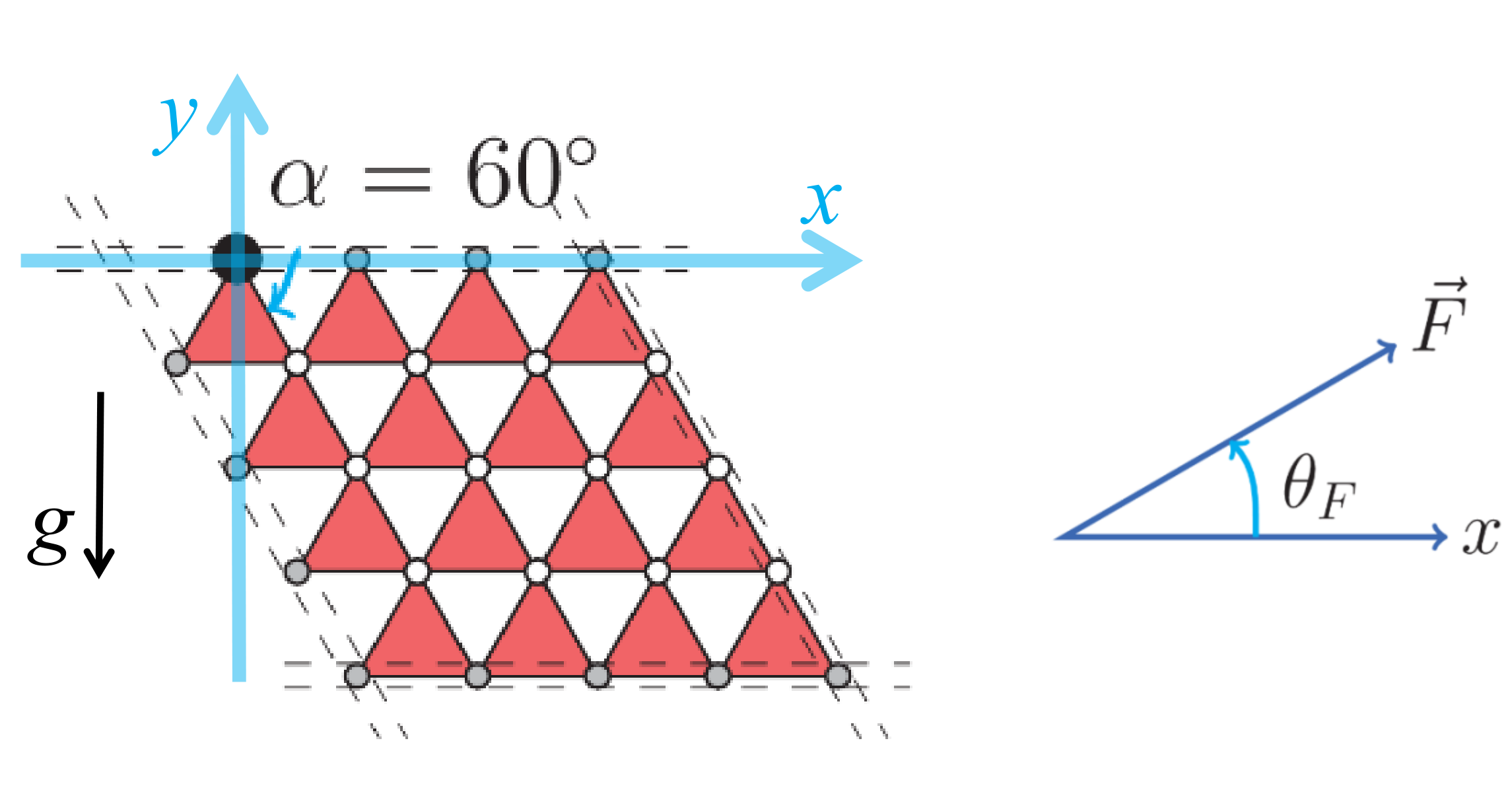
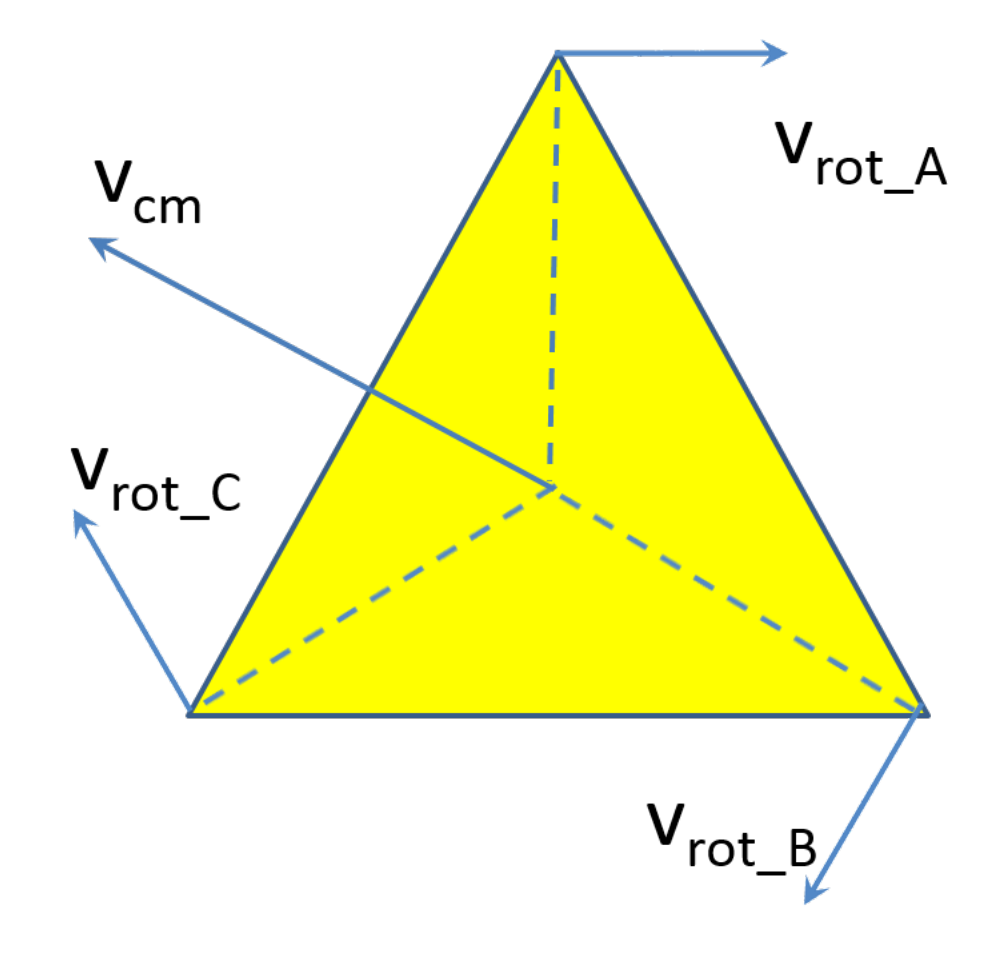
The minimum force should act on the farthest triangle (N − 1 N - 1 N − 1 N − 1 N - 1 N − 1 v ⃗ = v ⃗ c . m . + v ⃗ r o t \vec{v} = \vec{v}_{\mathrm{c.m.}} + \vec{v}_{\mathrm{rot}} v = v c.m. + v rot v ⃗ r o t \vec{v}_{\mathrm{rot}} v rot v ⃗ c . m . \vec{v}_{\mathrm{c.m.}} v c.m. α m ≡ π / 3 \alpha_\mathrm{m} \equiv \pi/3 α m ≡ π /3 N − 1 N - 1 N − 1 N − 1 N - 1 N − 1 (1 point)
[Remarks: A rigorous calculation is given in Appendix 3.]
C2 — Marks: 5
At α = α m ≡ π / 3 \alpha = \alpha_\mathrm{m} \equiv \pi/3 α = α m ≡ π /3 α \alpha α
Δ E p ( α m ) = d E p d α ∣ α = α m Δ α = 1 3 N 2 M g l [ ( 3 3 N 2 − 3 ) sin α m − 3 2 cos α m ] Δ α = 3 4 ( N − 1 ) N 2 M g l Δ α (1 point) - Eq. (41) \begin{aligned} \Delta E_\mathrm{p}(\alpha_\mathrm{m}) &= \left.\frac{dE_\mathrm{p}}{d\alpha}\right|_{\alpha=\alpha_\mathrm{m}}\Delta\alpha \\ &= \frac{1}{3}N^2Mgl\left[\left(\frac{3\sqrt{3}N}{2} - \sqrt{3}\right)\sin\alpha_\mathrm{m} - \frac{3}{2}\cos\alpha_\mathrm{m}\right]\Delta\alpha \\ &= \frac{3}{4}(N - 1)N^2Mgl\Delta\alpha \qquad \textbf{(1 point)} \qquad \text{- Eq. (41)} \end{aligned} Δ E p ( α m ) = d α d E p α = α m Δ α = 3 1 N 2 M g l [ ( 2 3 3 N − 3 ) sin α m − 2 3 cos α m ] Δ α = 4 3 ( N − 1 ) N 2 M g l Δ α (1 point) - Eq. (41) The displacement of C C C m m m n n n
Δ x C ( m , n ) = − [ ( 2 m + n ) sin α m − sin ( π 3 + α m ) ] l Δ α = ( 2 m + n + 1 ) 3 2 l Δ α (0.5 points) Δ y C ( m , n ) = − [ 3 n sin α m − cos ( π 3 + α m ) ] l Δ α = ( 3 n + 1 ) 2 l Δ α (0.5 points) \begin{aligned} \Delta x_{\mathrm{C}(m,n)} &= -\left[(2m + n)\sin\alpha_\mathrm{m} - \sin\left(\frac{\pi}{3} + \alpha_\mathrm{m}\right)\right]l\Delta\alpha \\ &= \frac{(2m+n+1)\sqrt{3}}{2}l\Delta\alpha \qquad \textbf{(0.5 points)} \\ \Delta y_{\mathrm{C}(m,n)} &= -\left[\sqrt{3}n\sin\alpha_\mathrm{m} - \cos\left(\frac{\pi}{3} + \alpha_\mathrm{m}\right)\right]l\Delta\alpha \\ &= \frac{(3n+1)}{2}l\Delta\alpha \qquad \textbf{(0.5 points)} \end{aligned} Δ x C ( m , n ) Δ y C ( m , n ) = − [ ( 2 m + n ) sin α m − sin ( 3 π + α m ) ] l Δ α = 2 ( 2 m + n + 1 ) 3 l Δ α (0.5 points) = − [ 3 n sin α m − cos ( 3 π + α m ) ] l Δ α = 2 ( 3 n + 1 ) l Δ α (0.5 points) For C(N N N N N N Δ r = ( Δ x ) 2 + ( Δ y ) 2 = ( 3 N − 2 ) ( l Δ α ) \Delta r = \sqrt{(\Delta x)^2 + (\Delta y)^2} = (3N - 2)(l\Delta\alpha) Δ r = ( Δ x ) 2 + ( Δ y ) 2 = ( 3 N − 2 ) ( l Δ α ) (1 point)
Hence
F min = Δ E p ( α m ) Δ r max = 3 ( N − 1 ) N 2 4 ( 3 N − 2 ) M g (1 point) - Eq. (42) F_{\min} = \frac{\Delta E_\mathrm{p}(\alpha_\mathrm{m})}{\Delta r_{\max}} = \frac{3(N-1)N^2}{4(3N-2)}Mg \qquad \textbf{(1 point)} \qquad \text{- Eq. (42)} F m i n = Δ r m a x Δ E p ( α m ) = 4 ( 3 N − 2 ) 3 ( N − 1 ) N 2 M g (1 point) - Eq. (42) and
θ F min = tan − 1 [ Δ y C ( N − 1 , N − 1 ) Δ x C ( N − 1 , N − 1 ) ] + π = − tan − 1 3 3 + π = 5 π 6 (1 point) - Eq. (43) \begin{aligned} \theta_{F_{\min}} &= \tan^{-1}\left[\frac{\Delta y_{\mathrm{C}(N-1,N-1)}}{\Delta x_{\mathrm{C}(N-1,N-1)}}\right] + \pi \\ &= -\tan^{-1}\frac{\sqrt{3}}{3} + \pi = \frac{5\pi}{6} \qquad \textbf{(1 point)} \qquad \text{- Eq. (43)} \end{aligned} θ F m i n = tan − 1 [ Δ x C ( N − 1 , N − 1 ) Δ y C ( N − 1 , N − 1 ) ] + π = − tan − 1 3 3 + π = 6 5 π (1 point) - Eq. (43) [Remarks: This θ F min \theta_{F_{\min}} θ F m i n C C C N N N N N N A A A A A A A A A
Appendix 1: — Marks: N/A
(a) Calculation of the exact E p E_\mathrm{p} E p E k E_\mathrm{k} E k f E ′ f'_\mathrm{E} f E ′ N N N
Under a small perturbation, the potential energy change is
Δ E p ≈ 1 2 d 2 E p d α 2 ∣ α = α E ′ ( Δ α ) 2 = 1 3 N 2 M g l ( 3 3 N − 2 3 2 cos α E ′ + 3 2 sin α E ′ ) ( Δ α ) 2 2 = 3 ( 3 N − 2 ) 2 + 9 12 N 2 M g l ( Δ α ) 2 - Eq. (44) \begin{aligned} \Delta E_\mathrm{p} &\approx \frac{1}{2}\left.\frac{d^2E_\mathrm{p}}{d\alpha^2}\right|_{\alpha=\alpha'_E}(\Delta\alpha)^2 \\ &= \frac{1}{3}N^2Mgl\left(\frac{3\sqrt{3}N - 2\sqrt{3}}{2}\cos\alpha'_\mathrm{E} + \frac{3}{2}\sin\alpha'_\mathrm{E}\right)\frac{(\Delta\alpha)^2}{2} \\ &= \frac{\sqrt{3(3N-2)^2+9}}{12}N^2Mgl(\Delta\alpha)^2 \qquad \text{- Eq. (44)} \end{aligned} Δ E p ≈ 2 1 d α 2 d 2 E p α = α E ′ ( Δ α ) 2 = 3 1 N 2 M g l ( 2 3 3 N − 2 3 cos α E ′ + 2 3 sin α E ′ ) 2 ( Δ α ) 2 = 12 3 ( 3 N − 2 ) 2 + 9 N 2 M g l ( Δ α ) 2 - Eq. (44) The kinetic energy of a triangle includes the translational energy of its center of mass and the rotational energy around its center of mass. Hence the total kinetic energy of the N 2 N^2 N 2
E k = ∑ m , n E c . m . ( m , n ) + ∑ m , n E r . c . ( m , n ) - Eq. (45) E_\mathrm{k} = \sum_{m,n}E_{\mathrm{c.m.}(m,n)} + \sum_{m,n}E_{\mathrm{r.c.}(m,n)} \qquad \text{- Eq. (45)} E k = m , n ∑ E c.m. ( m , n ) + m , n ∑ E r.c. ( m , n ) - Eq. (45) where
E r . c . ( m , n ) = 1 2 M l 2 12 ( Δ α ˙ ) 2 = 1 24 M l 2 ( Δ α ˙ ) 2 - Eq. (46) E_{\mathrm{r.c.}(m,n)} = \frac{1}{2}\frac{Ml^2}{12}(\Delta\dot{\alpha})^2 = \frac{1}{24}Ml^2(\Delta\dot{\alpha})^2 \qquad \text{- Eq. (46)} E r.c. ( m , n ) = 2 1 12 M l 2 ( Δ α ˙ ) 2 = 24 1 M l 2 ( Δ α ˙ ) 2 - Eq. (46) and
E c . m . ( m , n ) = M 2 v c . m . ( m , n ) 2 = M ( Δ α ˙ ) 2 2 [ ( d x c . m . ( m , n ) d α ) 2 + ( d y c . m . ( m , n ) d α ) 2 ] α = α E ′ - Eq. (47) \begin{aligned} E_{\mathrm{c.m.}(m,n)} &= \frac{M}{2}v^2_{\mathrm{c.m.}(m,n)} \\ &= \frac{M(\Delta\dot{\alpha})^2}{2}\left[\left(\frac{\mathrm{d}x_{\mathrm{c.m.}(m,n)}}{\mathrm{d}\alpha}\right)^2 + \left(\frac{\mathrm{d}y_{\mathrm{c.m.}(m,n)}}{\mathrm{d}\alpha}\right)^2\right]_{\alpha=\alpha'_\mathrm{E}} \qquad \text{- Eq. (47)} \end{aligned} E c.m. ( m , n ) = 2 M v c.m. ( m , n ) 2 = 2 M ( Δ α ˙ ) 2 [ ( d α d x c.m. ( m , n ) ) 2 + ( d α d y c.m. ( m , n ) ) 2 ] α = α E ′ - Eq. (47) Since
x c . m . ( m , n ) = x A ( m , n ) + 3 l 3 cos ( π 6 + α ) = ( 2 m + n ) l cos α + l 2 cos α − 3 l 6 sin α \begin{aligned} x_{\mathrm{c.m.}(m,n)} &= x_{\mathrm{A}(m,n)} + \frac{\sqrt{3}l}{3}\cos\left(\frac{\pi}{6} + \alpha\right) \\ &= (2m + n)l\cos\alpha + \frac{l}{2}\cos\alpha - \frac{\sqrt{3}l}{6}\sin\alpha \end{aligned} x c.m. ( m , n ) = x A ( m , n ) + 3 3 l cos ( 6 π + α ) = ( 2 m + n ) l cos α + 2 l cos α − 6 3 l sin α and
y c . m . ( m , n ) = y A ( m , n ) − 3 l 3 sin ( π 6 + α ) = − 3 n l cos α − 3 l 6 cos α − l 2 sin α - Eq. (48) \begin{aligned} y_{\mathrm{c.m.}(m,n)} &= y_{\mathrm{A}(m,n)} - \frac{\sqrt{3}l}{3}\sin\left(\frac{\pi}{6} + \alpha\right) \\ &= -\sqrt{3}nl\cos\alpha - \frac{\sqrt{3}l}{6}\cos\alpha - \frac{l}{2}\sin\alpha \qquad \text{- Eq. (48)} \end{aligned} y c.m. ( m , n ) = y A ( m , n ) − 3 3 l sin ( 6 π + α ) = − 3 n l cos α − 6 3 l cos α − 2 l sin α - Eq. (48) Hence,
d x c . m . ( m , n ) d α = [ − ( 2 m + n ) sin α − 1 2 sin α − 3 6 cos α ] l \frac{\mathrm{d}x_{\mathrm{c.m.}(m,n)}}{\mathrm{d}\alpha} = \left[-(2m + n)\sin\alpha - \frac{1}{2}\sin\alpha - \frac{\sqrt{3}}{6}\cos\alpha\right]l d α d x c.m. ( m , n ) = [ − ( 2 m + n ) sin α − 2 1 sin α − 6 3 cos α ] l d y c . m . ( m , n ) d α = [ − 3 n sin α + 3 6 sin α − 1 2 cos α ] l \frac{\mathrm{d}y_{\mathrm{c.m.}(m,n)}}{\mathrm{d}\alpha} = \left[-\sqrt{3}n\sin\alpha + \frac{\sqrt{3}}{6}\sin\alpha - \frac{1}{2}\cos\alpha\right]l d α d y c.m. ( m , n ) = [ − 3 n sin α + 6 3 sin α − 2 1 cos α ] l We have
E c . m . ( m , n ) = 1 2 M l 2 ( Δ α ˙ ) 2 [ ( 4 m 2 + 4 n 2 + 4 m n + 2 m + 2 n ) sin 2 α E ′ + 2 3 3 ( m − n ) sin α E ′ cos α E ′ + 1 3 ] - Eq. (49) E_{\mathrm{c.m.}(m,n)} = \frac{1}{2}Ml^2(\Delta\dot{\alpha})^2\begin{bmatrix} (4m^2 + 4n^2 + 4mn + 2m + 2n)\sin^2\alpha'_\mathrm{E} \\ + \frac{2\sqrt{3}}{3}(m - n)\sin\alpha'_\mathrm{E}\cos\alpha'_\mathrm{E} + \frac{1}{3} \end{bmatrix} \qquad \text{- Eq. (49)} E c.m. ( m , n ) = 2 1 M l 2 ( Δ α ˙ ) 2 [ ( 4 m 2 + 4 n 2 + 4 mn + 2 m + 2 n ) sin 2 α E ′ + 3 2 3 ( m − n ) sin α E ′ cos α E ′ + 3 1 ] - Eq. (49) and
E k = ∑ m , n E c . m . ( m , n ) + ∑ m , n E r . c . ( m , n ) = [ 1 6 ( 11 N − 1 ) ( N − 1 ) sin 2 α E ′ + 5 24 ] N 2 M l 2 ( Δ α ˙ ) 2 = [ ( 11 N − 1 ) ( N − 1 ) 2 ( 3 N − 2 ) 2 + 6 + 5 24 ] N 2 M l 2 ( Δ α ˙ ) 2 - Eq. (50) \begin{aligned} E_k &= \sum_{m,n}E_{\mathrm{c.m.}(m,n)} + \sum_{m,n}E_{\mathrm{r.c.}(m,n)} \\ &= \left[\frac{1}{6}(11N - 1)(N - 1)\sin^2\alpha'_\mathrm{E} + \frac{5}{24}\right]N^2Ml^2(\Delta\dot{\alpha})^2 \\ &= \left[\frac{(11N-1)(N-1)}{2(3N-2)^2+6} + \frac{5}{24}\right]N^2Ml^2(\Delta\dot{\alpha})^2 \qquad \text{- Eq. (50)} \end{aligned} E k = m , n ∑ E c.m. ( m , n ) + m , n ∑ E r.c. ( m , n ) = [ 6 1 ( 11 N − 1 ) ( N − 1 ) sin 2 α E ′ + 24 5 ] N 2 M l 2 ( Δ α ˙ ) 2 = [ 2 ( 3 N − 2 ) 2 + 6 ( 11 N − 1 ) ( N − 1 ) + 24 5 ] N 2 M l 2 ( Δ α ˙ ) 2 - Eq. (50) With Eqs. (44) and (50), we have
f E ′ = 1 2 π 3 ( 3 N − 2 ) 2 + 9 12 N 2 M g l [ ( 11 N − 1 ) ( N − 1 ) 2 ( 3 N − 2 ) 2 + 6 + 5 24 ] N 2 M l 2 = 1 2 π 2 3 ( 3 N − 2 ) 2 + 9 [ 12 ( 11 N − 1 ) ( N − 1 ) ( 3 N − 2 ) 2 + 3 + 5 ] g l - Eq. (51) \begin{aligned} f'_\mathrm{E} &= \frac{1}{2\pi}\sqrt{\frac{\frac{\sqrt{3(3N-2)^2+9}}{12}N^2Mgl}{\left[\frac{(11N-1)(N-1)}{2(3N-2)^2+6} + \frac{5}{24}\right]N^2Ml^2}} \\ &= \frac{1}{2\pi}\sqrt{\frac{2\sqrt{3(3N-2)^2+9}}{\left[\frac{12(11N-1)(N-1)}{(3N-2)^2+3} + 5\right]}\frac{g}{l}} \qquad \text{- Eq. (51)} \end{aligned} f E ′ = 2 π 1 [ 2 ( 3 N − 2 ) 2 + 6 ( 11 N − 1 ) ( N − 1 ) + 24 5 ] N 2 M l 2 12 3 ( 3 N − 2 ) 2 + 9 N 2 M g l = 2 π 1 [ ( 3 N − 2 ) 2 + 3 12 ( 11 N − 1 ) ( N − 1 ) + 5 ] 2 3 ( 3 N − 2 ) 2 + 9 l g - Eq. (51) (b) Center of mass movement of the whole system
According to Eq. (48), we have
x c . m . ( s y s . ) ( α ) = ∑ m , n x c . m . ( m , n ) N 2 = ∑ m , n [ ( 2 m + n ) l cos α + l 2 cos α − 3 l 6 sin α ] N 2 = ( 3 N − 2 2 ) l cos α − 3 l 6 sin α \begin{aligned} x_{\mathrm{c.m.(sys.)}}(\alpha) &= \frac{\sum_{m,n}x_{\mathrm{c.m.}(m,n)}}{N^2} \\ &= \frac{\sum_{m,n}\left[(2m + n)l\cos\alpha + \frac{l}{2}\cos\alpha - \frac{\sqrt{3}l}{6}\sin\alpha\right]}{N^2} \\ &= \left(\frac{3N-2}{2}\right)l\cos\alpha - \frac{\sqrt{3}l}{6}\sin\alpha \end{aligned} x c.m. ( sys. ) ( α ) = N 2 ∑ m , n x c.m. ( m , n ) = N 2 ∑ m , n [ ( 2 m + n ) l cos α + 2 l cos α − 6 3 l sin α ] = ( 2 3 N − 2 ) l cos α − 6 3 l sin α and
y c . m . ( m , n ) ( α ) = ∑ m , n y c . m . ( m , n ) N 2 = − ∑ m , n [ 3 n l cos α + 3 l 6 cos α + l 2 sin α ] N 2 = − ( 3 N − 2 6 ) 3 l cos α − l sin α 2 - Eq. (52) \begin{aligned} y_{\mathrm{c.m.}(m,n)}(\alpha) &= \frac{\sum_{m,n}y_{\mathrm{c.m.}(m,n)}}{N^2} \\ &= -\frac{\sum_{m,n}\left[\sqrt{3}nl\cos\alpha + \frac{\sqrt{3}l}{6}\cos\alpha + \frac{l}{2}\sin\alpha\right]}{N^2} \\ &= -\left(\frac{3N-2}{6}\right)\sqrt{3}l\cos\alpha - \frac{l\sin\alpha}{2} \qquad \text{- Eq. (52)} \end{aligned} y c.m. ( m , n ) ( α ) = N 2 ∑ m , n y c.m. ( m , n ) = − N 2 ∑ m , n [ 3 n l cos α + 6 3 l cos α + 2 l sin α ] = − ( 6 3 N − 2 ) 3 l cos α − 2 l sin α - Eq. (52) Eq. (52) is the trajectory of the center of mass for the whole system, which is not a straight line.
Appendix 2: Calculation of the moment of inertia of a triangular plate — Marks: N/A
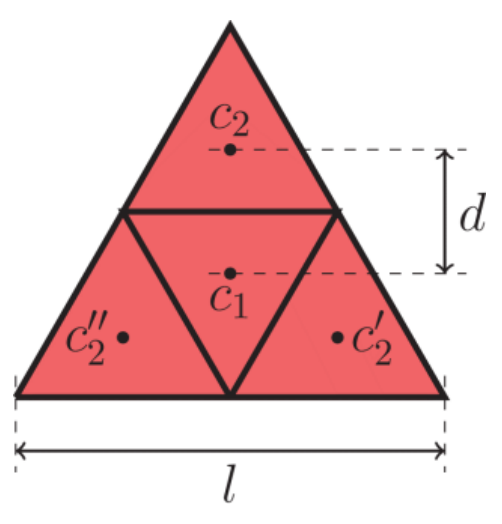
An equilateral triangle with lateral length l l l l l l c 1 c_1 c 1
I 1 = β M 4 ( l 2 ) 2 - Eq. (53) I_1 = \beta\frac{M}{4}\left(\frac{l}{2}\right)^2 \qquad \text{- Eq. (53)} I 1 = β 4 M ( 2 l ) 2 - Eq. (53) For the non-central small triangle centered at c 2 c_2 c 2 c 2 ′ c_2' c 2 ′ c 2 ′ ′ c_2'' c 2 ′′
I 2 = I 1 + M 4 d 2 - Eq. (54) I_2 = I_1 + \frac{M}{4}d^2 \qquad \text{- Eq. (54)} I 2 = I 1 + 4 M d 2 - Eq. (54) where d = 3 l / 6 d = \sqrt{3}l/6 d = 3 l /6
β M l 2 = 4 × β M 4 ( l 2 ) 2 + 3 × M 4 d 2 - Eq.(55) \beta Ml^2 = 4 \times \beta\frac{M}{4}\left(\frac{l}{2}\right)^2 + 3 \times \frac{M}{4}d^2 \qquad \text{- Eq.(55)} βM l 2 = 4 × β 4 M ( 2 l ) 2 + 3 × 4 M d 2 - Eq.(55) Thus
β = 1 12 - Eq. (56) \beta = \frac{1}{12} \qquad \text{- Eq. (56)} β = 12 1 - Eq. (56) Appendix 3: The minimum force corresponds to the maximum displacement of the exerting point of this force. — Marks: N/A
Consider the position of vertices A, B, C of a triangle (m m m n n n
x A ( m , n ) = ( 2 m + n ) cos α m l y A ( m , n ) = − 3 n cos α m l x B ( m , n ) = ( 2 m + n + 1 ) cos α m l y B ( m , n ) = − ( 3 n cos α m + sin α m ) l x C ( m , n ) = [ ( 2 m + n ) cos α m + cos ( π 3 + α m ) ] l y C ( m , n ) = − [ 3 n cos α m + sin ( π 3 + α m ) ] l - Eq. (57) \begin{aligned} x_{\mathrm{A}(m,n)} &= (2m + n)\cos\alpha_\mathrm{m}\,l \\ y_{\mathrm{A}(m,n)} &= -\sqrt{3}n\cos\alpha_\mathrm{m}\,l \\ x_{\mathrm{B}(m,n)} &= (2m + n + 1)\cos\alpha_\mathrm{m}\,l \\ y_{\mathrm{B}(m,n)} &= -\left(\sqrt{3}n\cos\alpha_\mathrm{m} + \sin\alpha_\mathrm{m}\right)l \\ x_{\mathrm{C}(m,n)} &= \left[(2m + n)\cos\alpha_\mathrm{m} + \cos\left(\frac{\pi}{3} + \alpha_\mathrm{m}\right)\right]l \\ y_{\mathrm{C}(m,n)} &= -\left[\sqrt{3}n\cos\alpha_\mathrm{m} + \sin\left(\frac{\pi}{3} + \alpha_\mathrm{m}\right)\right]l \qquad \text{- Eq. (57)} \end{aligned} x A ( m , n ) y A ( m , n ) x B ( m , n ) y B ( m , n ) x C ( m , n ) y C ( m , n ) = ( 2 m + n ) cos α m l = − 3 n cos α m l = ( 2 m + n + 1 ) cos α m l = − ( 3 n cos α m + sin α m ) l = [ ( 2 m + n ) cos α m + cos ( 3 π + α m ) ] l = − [ 3 n cos α m + sin ( 3 π + α m ) ] l - Eq. (57) Taking derivatives on α on the above coordinates we get
Δ x A ( m , n ) = − ( 2 m + n ) sin α m l Δ α = − ( 2 m + n ) 3 2 l Δ α Δ y A ( m , n ) = 3 n sin α m ( l Δ α ) = 3 n 2 l Δ α Δ x B ( m , n ) = − ( 2 m + n + 1 ) sin α m l Δ α = − ( 2 m + n + 1 ) 3 2 l Δ α Δ y B ( m , n ) = − ( − 3 n sin α m + cos α m ) l Δ α = 3 n − 1 2 l Δ α Δ x C ( m , n ) = [ − ( 2 m + n ) sin α m − sin ( π 3 + α m ) ] l Δ = − ( 2 m + n + 1 ) 3 2 l Δ α Δ y C ( m , n ) = − [ − 3 n sin α m + cos ( π 3 + α m ) ] l Δ α = ( 3 n + 1 ) 2 l Δ α - Eq. (58) \begin{aligned} \Delta x_{\mathrm{A}(m,n)} &= -(2m + n)\sin\alpha_\mathrm{m}\,l\Delta\alpha = -\frac{(2m + n)\sqrt{3}}{2}l\Delta\alpha \\ \Delta y_{\mathrm{A}(m,n)} &= \sqrt{3}n\sin\alpha_\mathrm{m}\,(l\Delta\alpha) = \frac{3n}{2}l\Delta\alpha \\ \Delta x_{\mathrm{B}(m,n)} &= -(2m + n + 1)\sin\alpha_\mathrm{m}\,l\Delta\alpha = -\frac{(2m + n + 1)\sqrt{3}}{2}l\Delta\alpha \\ \Delta y_{\mathrm{B}(m,n)} &= -\left(-\sqrt{3}n\sin\alpha_\mathrm{m} + \cos\alpha_\mathrm{m}\right)l\Delta\alpha = \frac{3n - 1}{2}l\Delta\alpha \\ \Delta x_{\mathrm{C}(m,n)} &= \left[-(2m + n)\sin\alpha_\mathrm{m} - \sin\left(\frac{\pi}{3} + \alpha_\mathrm{m}\right)\right]l\Delta = -\frac{(2m + n + 1)\sqrt{3}}{2}l\Delta\alpha \\ \Delta y_{\mathrm{C}(m,n)} &= -\left[-\sqrt{3}n\sin\alpha_\mathrm{m} + \cos\left(\frac{\pi}{3} + \alpha_\mathrm{m}\right)\right]l\Delta\alpha = \frac{(3n+1)}{2}l\Delta\alpha \qquad \text{- Eq. (58)} \end{aligned} Δ x A ( m , n ) Δ y A ( m , n ) Δ x B ( m , n ) Δ y B ( m , n ) Δ x C ( m , n ) Δ y C ( m , n ) = − ( 2 m + n ) sin α m l Δ α = − 2 ( 2 m + n ) 3 l Δ α = 3 n sin α m ( l Δ α ) = 2 3 n l Δ α = − ( 2 m + n + 1 ) sin α m l Δ α = − 2 ( 2 m + n + 1 ) 3 l Δ α = − ( − 3 n sin α m + cos α m ) l Δ α = 2 3 n − 1 l Δ α = [ − ( 2 m + n ) sin α m − sin ( 3 π + α m ) ] l Δ = − 2 ( 2 m + n + 1 ) 3 l Δ α = − [ − 3 n sin α m + cos ( 3 π + α m ) ] l Δ α = 2 ( 3 n + 1 ) l Δ α - Eq. (58) For Δ r = ( Δ x ) 2 + ( Δ y ) 2 \Delta r = \sqrt{(\Delta x)^2 + (\Delta y)^2} Δ r = ( Δ x ) 2 + ( Δ y ) 2
Δ r A ( m , n ) = 3 m 2 + 3 n 2 + 3 m n ( l Δ α ) Δ r B ( m , n ) = 3 m 2 + 3 n 2 + 3 m n + 3 m + 1 ( l Δ α ) Δ r C ( m , n ) = 3 m 2 + 3 n 2 + 3 m n + 3 m + 3 n + 1 ( l Δ α ) - Eq. (59) \begin{aligned} \Delta r_{\mathrm{A}(m,n)} &= \sqrt{3m^2 + 3n^2 + 3mn}(l\Delta\alpha) \\ \Delta r_{\mathrm{B}(m,n)} &= \sqrt{3m^2 + 3n^2 + 3mn + 3m + 1}(l\Delta\alpha) \\ \Delta r_{\mathrm{C}(m,n)} &= \sqrt{3m^2 + 3n^2 + 3mn + 3m + 3n + 1}(l\Delta\alpha) \qquad \text{- Eq. (59)} \end{aligned} Δ r A ( m , n ) Δ r B ( m , n ) Δ r C ( m , n ) = 3 m 2 + 3 n 2 + 3 mn ( l Δ α ) = 3 m 2 + 3 n 2 + 3 mn + 3 m + 1 ( l Δ α ) = 3 m 2 + 3 n 2 + 3 mn + 3 m + 3 n + 1 ( l Δ α ) - Eq. (59) Thus we find
Δ r C ( m , n ) > Δ r B ( m , n ) > Δ r A ( m , n ) - Eq. (60) \Delta r_{\mathrm{C}(m,n)} > \Delta r_{\mathrm{B}(m,n)} > \Delta r_{\mathrm{A}(m,n)} \qquad \text{- Eq. (60)} Δ r C ( m , n ) > Δ r B ( m , n ) > Δ r A ( m , n ) - Eq. (60) Therefore, we should choose point C of the triangle (N − 1 N - 1 N − 1 N − 1 N - 1 N − 1
Δ r max = ( 3 N − 2 ) l Δ α - Eq. (61) \Delta r_{\max} = (3N - 2)l\Delta\alpha \qquad \text{- Eq. (61)} Δ r m a x = ( 3 N − 2 ) l Δ α - Eq. (61) so that the force is minimal.