APhO 2016, Теория — Задача 2. The Expanding Universe
Asian Physics Olympiad 2016 · Theoretical Question – T2 · The Expanding Universe · 20 т.
Условие
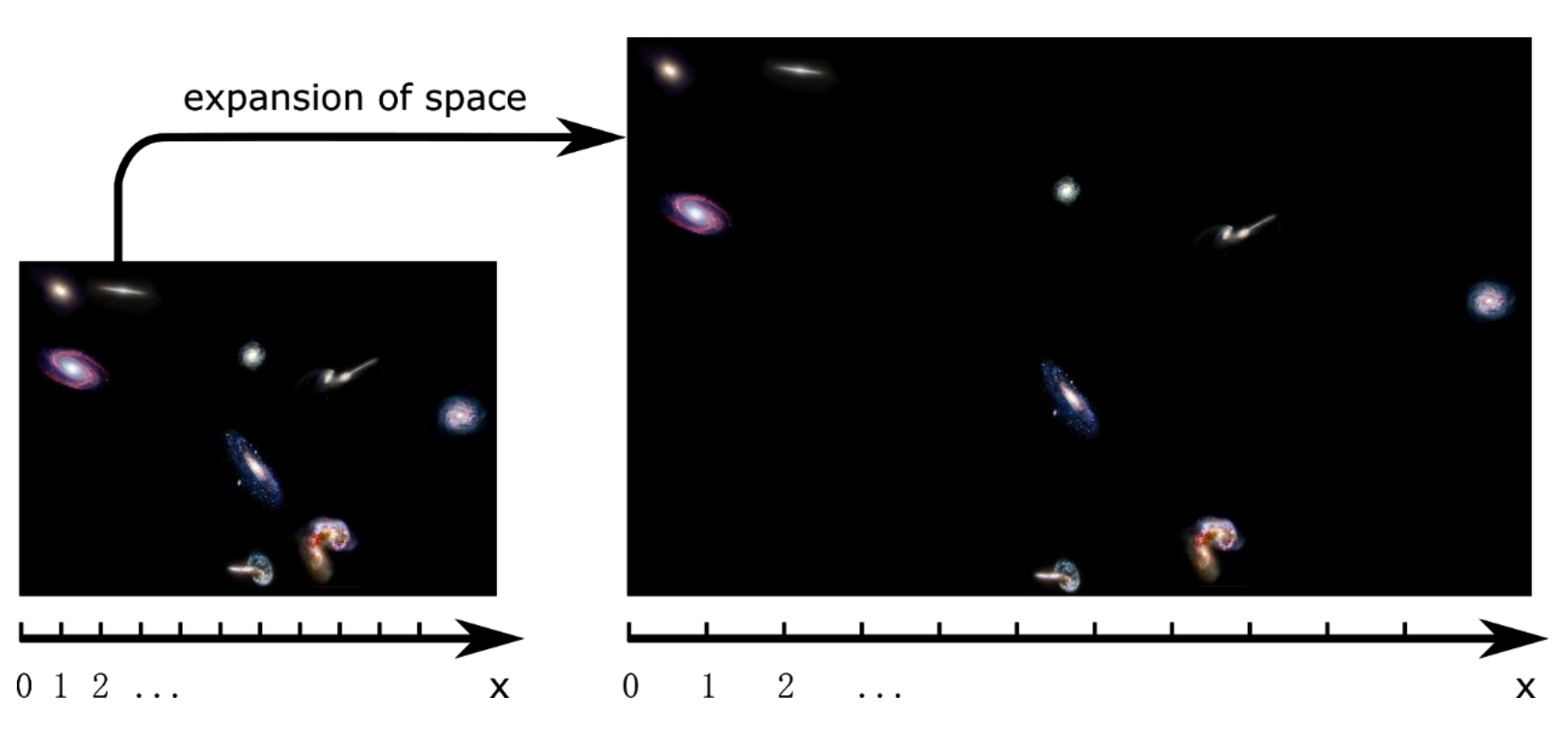
The most outstanding fact in cosmology is that our universe is expanding. Space is continuously created as time lapses. The expansion of space indicates that, when the universe expands, the distance between objects in our universe also expands. It is convenient to use “comoving” coordinate system to label points in our expanding universe, in which the coordinate distance between objects 1 and 2 does not change. (Here we assume no peculiar motion, i.e. no additional motion of those objects other than the motion following the expansion of the universe.) The situation is illustrated in the figure below (the figure has two space dimensions, but our universe actually has three space dimensions).
The modern theory of cosmology is built upon Einstein’s general relativity. However, under proper assumptions, a simplified understanding under the framework of Newton’s theory of gravity is also possible. In the following questions, we shall work in the framework of Newton’s gravity.
To measure the physical distance, a “scale factor” is introduced such that the physical distance between the comoving points and is
The expansion of the universe implies that is an increasing function of time.
On large scales – scales much larger than galaxies and their clusters – our universe is approximately homogeneous and isotropic. So let us consider a toy model of our universe, which is filled with uniformly distributed particles. There are so many particles, such that we model them as a continuous fluid. Furthermore, we assume the number of particles is conserved.
Currently, our universe is dominated by non-relativistic matter, whose kinetic energy is negligible compared to its mass energy. Let be the physical energy density (i.e. energy per unit physical volume, which is dominated by mass energy for non-relativistic matter and the gravitational potential energy is not counted as part of the “physical energy density”) of non-relativistic matter at time . We use to denote the present time.
A Derive the expression of at time in terms of , and . [2 т.]
Besides non-relativistic matter, there is also a small amount of radiation in our current universe, which is made of massless particles, for example, photons. The physical wavelength of massless particles increases with the universe expansion as . Let the physical energy density of radiation be .
B Derive the physical energy density for radiation at time in terms of , and . [2 т.]
Consider a gas of non-interacting photons which has thermal equilibrium distribution. In this situation, the temperature of the photon depends on time as .
C Calculate the numerical value of . [2 т.]
Consider the thermodynamics of one type of non-interacting particle X. Note that the space expansion is slow enough and thermally isolated such that the entropy of X is a constant in time. Let the physical energy density of X be , which includes mass energy and internal energy. Let the physical pressure be .
D Derive in terms of , ,,and . [4 т.]
Consider a star S. At the present time , the star is at a physical distance away from us, where is the comoving distance. Here we ignore the peculiar motion, i.e. assume that both the star and us just follow the expansion of the universe without additional motion.
The star is emitting energy in the form of light at power , which is isotropic in every direction. We use a telescope to observe its starlight. For simplicity, assume the telescope can observe all frequencies of light with 100% efficiency. Let the area of the telescope lens be .
E Derive the power received by the telescope from the star S, as a function of , the scale factor at the starlight emission time , and the present (i.e. at the observation time) scale factor . [4 т.]
If there were no gravity, the expansion speed of the universe should be a constant. In Newton’s framework, this can be understood as that, without force, matter just moves away from each other with constant speed and thus is a constant depending on the initial condition.
Let us now consider how Newton’s gravity affects the scale factor , in a universe filled with non-relativistic matter in a homogeneous and isotropic way.
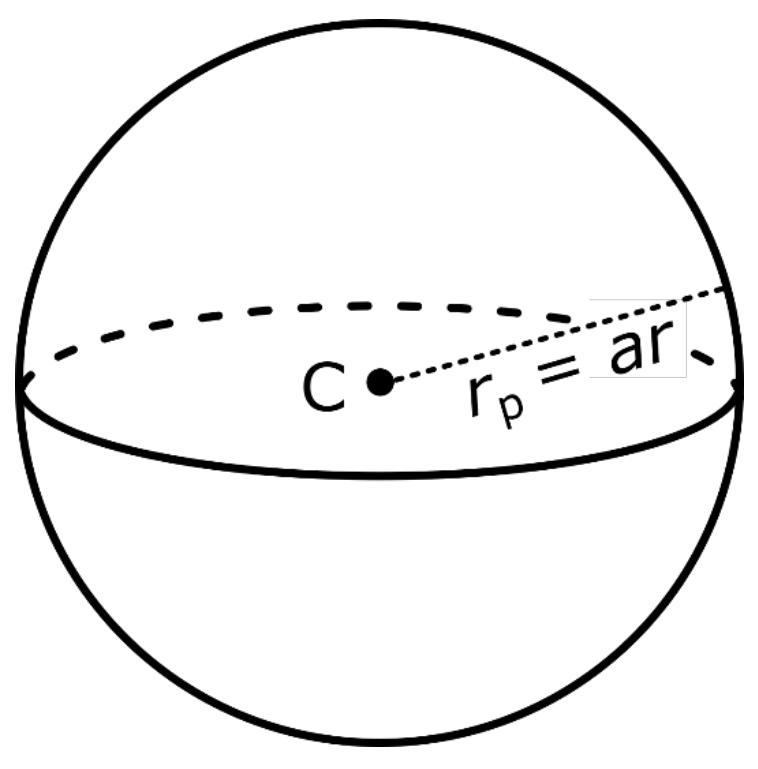
As illustrated in the above figure, let us assume C is the center of our universe (this assumption can be removed in Einstein’s general relativity, which is beyond the scope of this question). We slice matter into thin shells around C. Let us focus on one thin shell (the sphere in the above figure) whose comoving distance from the center is (recall that this comoving distance is a constant in time).
F Use the motion of the shell to find a relation between , and the density of mass energy . (In the final relation, if you encounter a constant depending on the initial condition, it can be kept as it is.) [5 т.]
G Based on the model described in Part (F), is the expansion of the universe (a) accelerating or (b) decelerating? Choose from (a) or (b). [1 т.]
For your information, in 1998, a new type of energy component of our universe is discovered. It actually changes the conclusion in Part (G).
Отговори
- A
- B
- C -1
- D
- E
- F
- G (b) decelerating
Решение
(Full Marks: 20)
Part A (Marks: 2)
The physical volume is
(0.5 points).
The comoving number density is a constant, thus the physical number density is
(0.5 points)
The kinetic energy for non-relativistic particles are negligible, thus the energy density is
(0.5 points)
where is the mass of a particle.
Thus
(0.5 points)
[Remarks: It is acceptable if the student just writes and full points will be given.]
Part B (Marks: 2)
The Einstein’s energy relation for a massless particle is
(0.5 points)
From de Brogile’s relation:
(0.5 points)
[Remarks: No point if only is written because already given.]
Thus
(0.5 points)
Physical number density is .
Energy density is .
Thus
(0.5 points)
[Remarks: It is acceptable if the student just write .]
Part C (Marks: 2)
The photons in thermal equilibrium satisfy Boltzmann distribution
(1 point)
where .
Condition of being non-interacting implies that there is no energy transfer. Thus the energy distribution must be stable.
To be explicit, for two different comoving wavelengths,
[Remarks: All the above steps can be replaced by the intuition of , if the students realize it, the above 1 point can be given.]
Thus
(1 point)
Part D (Marks: 4)
The 1st law of thermodynamics is
(1 point)
Here no entropy term appears, because . No chemical potential appears, because of particle number conservation.
Here .
(1 point)
(0.5 points)
(0.5 points)
Thus
(0.5 points)
(0.5 points)
[Remarks: 0.5 point for relating variation and time derivative no matter in which step it is being used.]
Part E (Marks: 4)
With lens area , we only receive part of the starlight. The area ratio is
(1 point)
The wavelength of each photon emitted from the star gets stretched. Thus energy per photon is lowered, contributing a ratio
(1 point)
The separation among the photons also increases due to cosmic expansion, contributing a ratio
(1 point)
As a result, the power that the telescope receives is
(1 point)
Part F (Marks: 5)
The kinetic energy and gravitational energy of the shell adds up to a constant:
(2 points)
where
(1 point)
(Note: energy conservation without evolving pressure requires the assumption of non-relativistic matter.)
(1 point)
[Remarks: The point is given because the student understand that the shell is not pulled gravitationally from the outside, because the force due to the mass outside cancels.]
Thus
(1 point)
Alternative Solution:
For the gravitational force due to the mass inside:
(2 points)
where is mass of shell.
(1 point)
[Remarks: The point is given because the student understand that the shell is not pulled gravitationally from the outside, because the force due to the mass outside cancels.]
and .
Thus
(1 point)
Integrate the above equation. One gets
(1 point)
where is an integration constant.
Part G (Marks: 1)
(b) decelerating. This is because gravity is attractive for the matter that we are considering here. As a result, is a decreasing function of .
Appendix: Notes about the physics behind this set of problems: (Marks: N/A)
To reduce students’ reading load, we have not mentioned in the problems, that those problems set up the framework of researches in modern cosmology:
A theory of gravity (especially Einstein’s general relativity) contains two aspects: Gravity tells matter how to move (kinematics of matter motion in a gravitational field); and matter determines the gravitational field (dynamics of the gravitational field). Parts (A)-(E) are about kinematics and part (F) is about dynamics in this sense. The two key equations in cosmology are derived in part (D) (this is known as the continuity equation, containing parts (A) and (B) as special cases) and (F), upon which the whole theory of modern cosmology is built.
The equation derived in part (F) is known as the Friedmann equation, which is conventionally written as . This equation governs the dynamics of cosmic expansion and actually not only applies for non-relativistic matter but also for general matter components (which needs general relativity to derive). The constant is related to the curvature of 3-dimensional space, which is observed to be vanishingly small.
Part (C) indicates that the universe was hotter at earlier ages. The hot universe in local thermal equilibrium determines the whole thermal history of our universe, which answers questions such as where the light elements come from, and when the universe becomes transparent for light. Part (E) defines the luminosity distance, which relates the telescope observations to the cosmic reality.