APhO 2017, Теория — Задача 1. Vortices in superfluid
Theory APhO YAKUTSK 2017 RUSSIA Q1 English (Official)
Vortices in Superfluid
MODD-Problems
May 5, 2017
Условие
Introduction
Superfluidity is a property of flowing without friction. Everyday experience tells us that motion of an ordinary fluid (say, water at room temperature) is always accompanied by viscous dissipation of energy, so that the flow gradually becomes slower unless it is maintained by external forces. In contrast, superfluid exhibits no loss of kinetic energy: once excited the motion of superfluid can continue indefinitely. Superfluidity was originally discovered experimentally in liquid helium.
We study properties of superfluid helium at zero temperature. It will be treated as an incompressible fluid with density . Flow continuity (the fact that the mass flowing into and the mass flowing out of a given infinitesimal volume are equal) implies that the flux of helium velocity through a closed surface is always zero. Superfluid velocity in this aspect is analogous to the magnetic field intensity. By analogy with the magnetic field lines, “streamlines” are tangential to the fluid velocity at each point and their density is proportional to its magnitude.
True superflow has an important property of being irrotational: circulation of superfluid velocity along any closed path within helium is zero
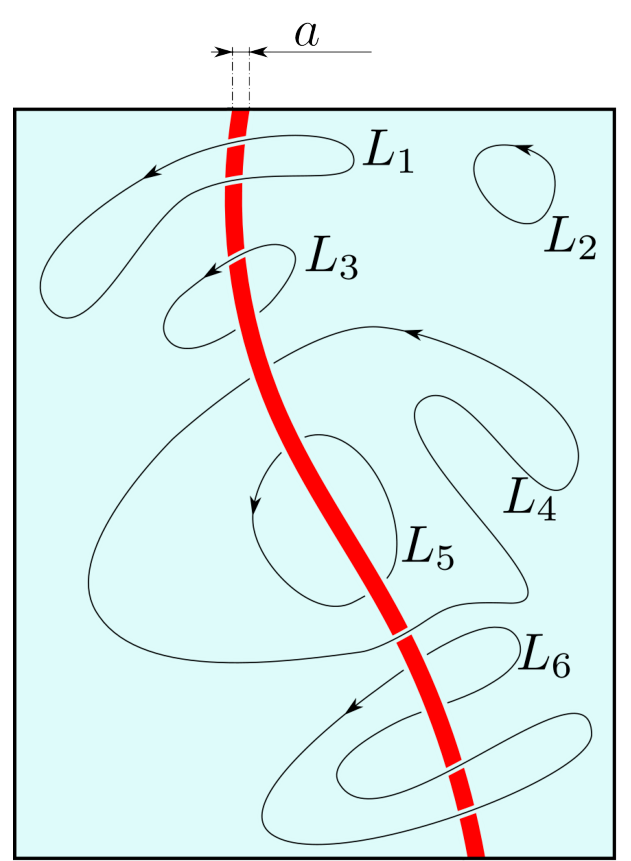
This statement must be amended if superfluidity is absent along a thin “vortex filament”. The thickness of the filament itself is of approximately atomic dimensions , but the vortex induces long range velocity field in surrounding superfluid: velocity circulation around such filament is the circulation quantum
and zero if the path can be contracted to a single point without crossing the vortex, see Fig. 1. This supports the analogy between superflow and the magnetic field created by wires carrying current: superposition of two valid velocity distributions is a valid velocity distribution and the velocity at any point is equal (up to a dimensional factor) to the magnetic field produced by the unit currents running through a system of wires representing vortex filaments.
Circulation quantization is a macroscopic quantum effect and corresponds to the angular momentum quantization in Bohr model. The circulation quantum can be expressed as , where is the mass of helium atom.
Part A. Steady filament (0.75 points) (0,75 т.)
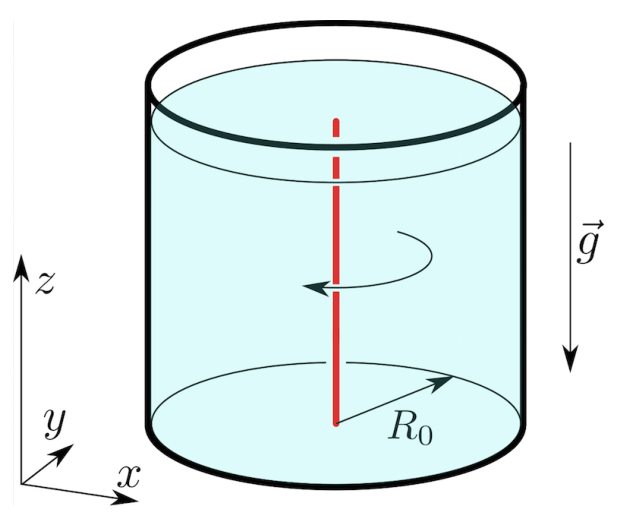
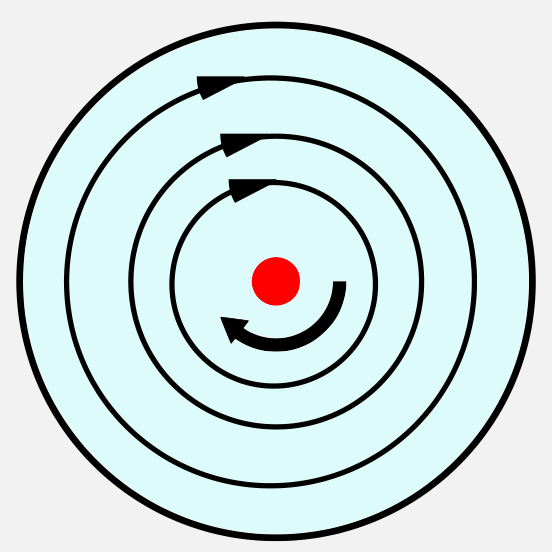
Consider a cylindrical beaker (radius ) of superfluid helium and a straight vertical vortex filament in its center Fig. 2.
A.1 Plot the streamlines. Find out the velocity at a point . [0,25 т.]
A.2 Work out the free surface shape (height as a function of coordinate ) around the vortex. Free fall acceleration is . Surface tension can be neglected. [0,5 т.]
Part B. Vortex motion (1.4 points) (1,4 т.)
Free vortices move about in space with the flow. In other words each element of the filament moves with the velocity of the fluid at the position of that element.
This is a consequence of momentum conservation, see next section.
As an example, consider a pair of counter-rotating straight vortices placed initially at distance from each other, see Fig. 3. Each vortex produces velocity at the axis of another. As a result, the vortex pair moves rectilinearly with constant speed so that the distance between them remains unchanged.
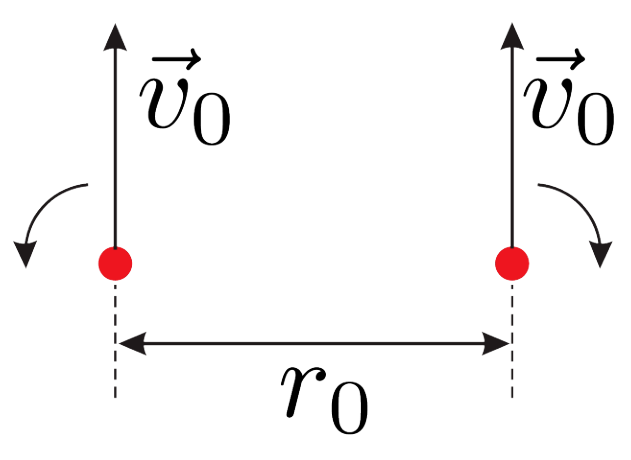
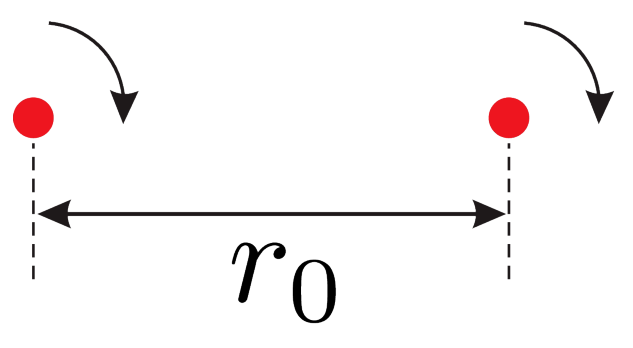
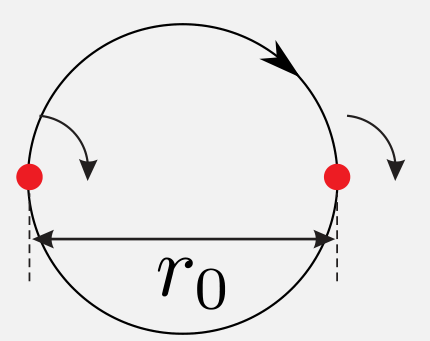
B.1 Consider two identical straight vortices initially placed at distance from each other as shown in Fig. 4. Find initial velocities of the vortices and draw their trajectories. [0,25 т.]
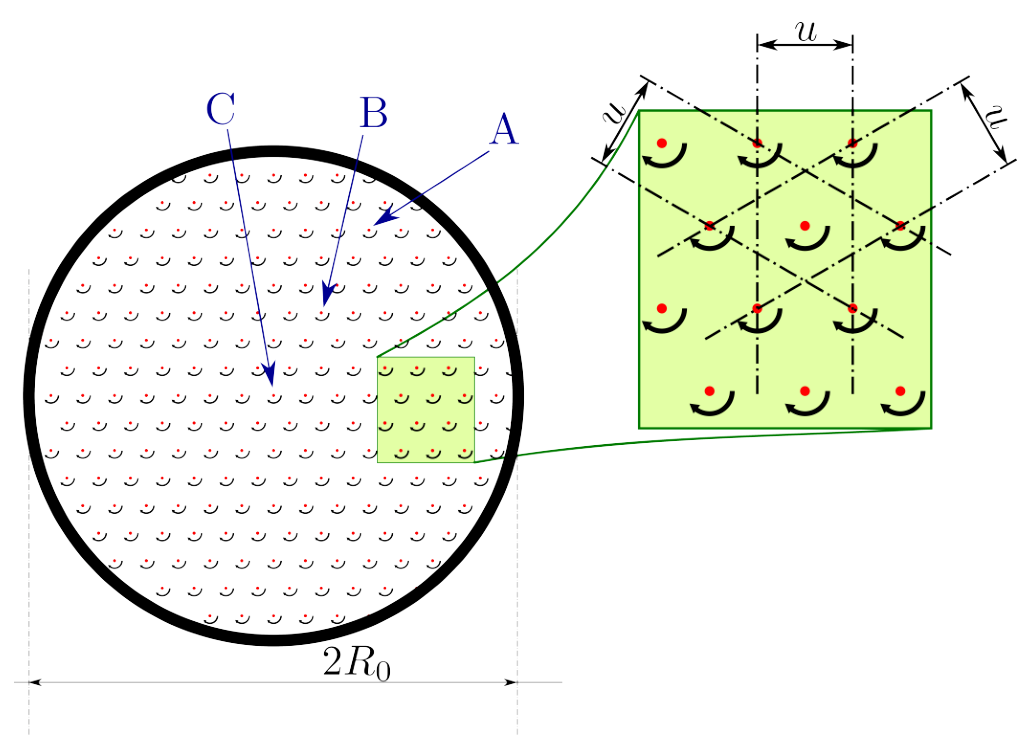
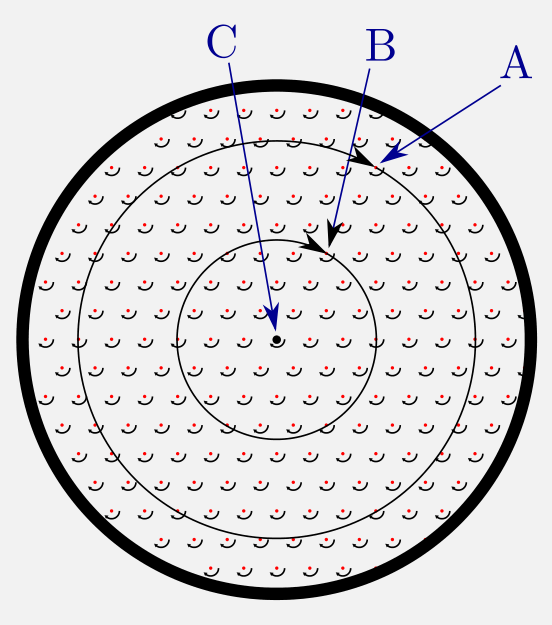
A beaker of helium (see Part A) is filled with triangular lattice () of identical vertical vortices, see Fig. 5.
B.2 Draw the trajectories of vortices A, B, and C (located in the center). [0,15 т.]
B.3 Find velocity of a vortex positioned at . [0,4 т.]
B.4 Find the distance AB between the vortices A and B at time . Treat AB as given. [0,35 т.]
B.5 Work out the "smoothed out" (omitting the lattice structure) free helium surface shape . [0,25 т.]
Part C. Momentum and energy (1.75 points) (1,75 т.)
The long range velocity field is the major contribution to the energy of a system of vortices, it is insensitive to exact structure of the filament. The filament itself can not be properly described by the macroscopic theory and apparent singularities (infinities) are insignificant. Real physical quantities, such as the energy, of the region inside a thin tube of radius around the filament should be neglected. Outside of this tube the density of superflow kinetic energy (where ) is analogous to the energy density of the magnetic field — they are both quadratic in respective variables. This analogy together with the correspondence between magnetic field and superfluid velocity generated by vortices (currents) facilitates calculation of the flow energy for a given system. For instance, given the inductance of a circular wire loop , where is the loop radius and is wire radius, we get the superfluid vortex loop energy
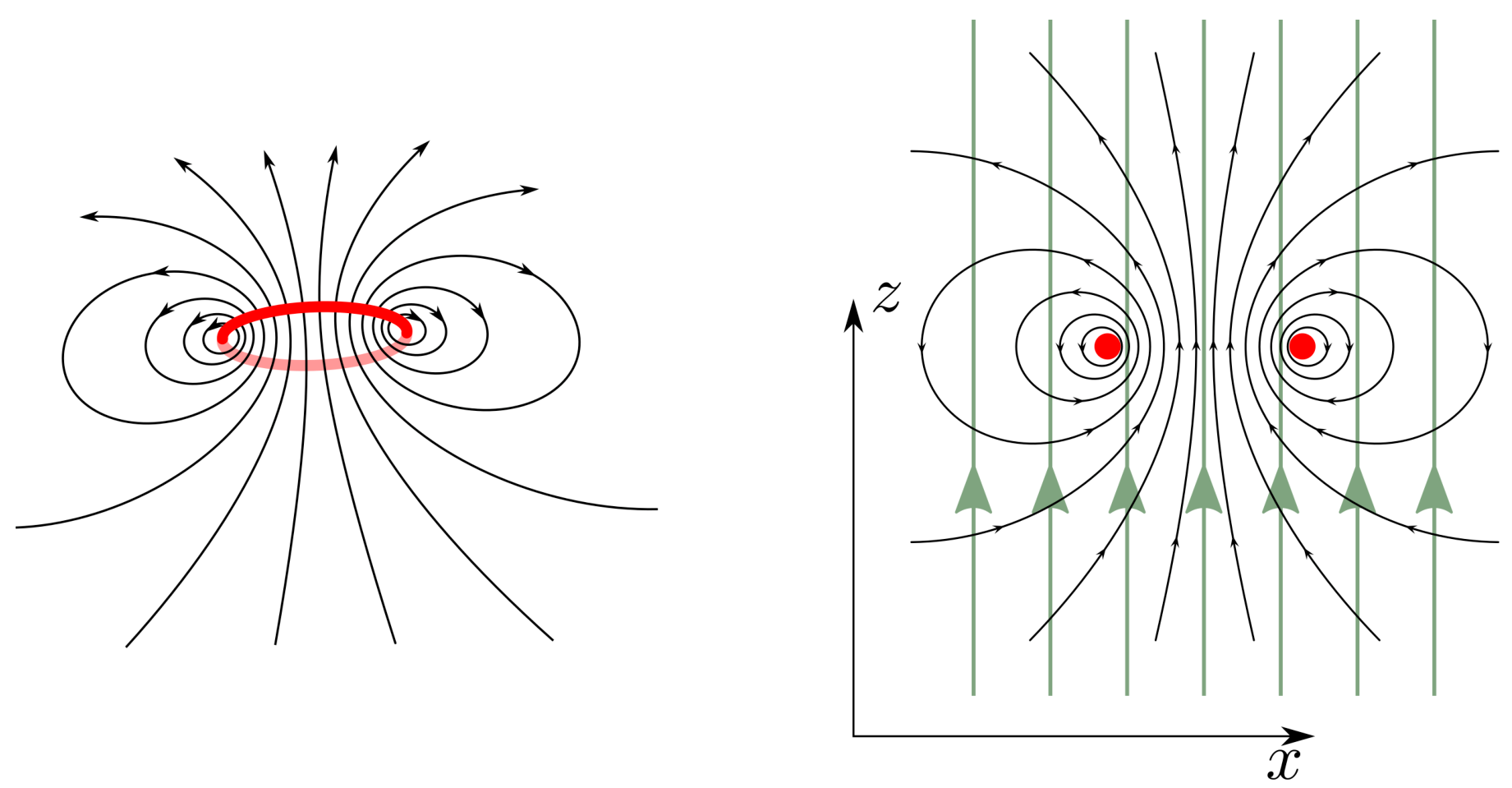
Total fluid momentum is also determined by the long range velocity distribution. It is obtained by integration of the momentum density . Again, consider a flow generated by a circular vortex loop placed in plane. It is obvious from the symmetry considerations, that total momentum has only component:
The innermost integration is in fact an integration along appropriate paths parallel to -axis, see Fig. 6. From the circulation identity (2) it follows that
is piecewise constant. Particularly, it is zero for paths passing outside the ring and for paths inside it. Total momentum is therefore
This expression is also valid only if .
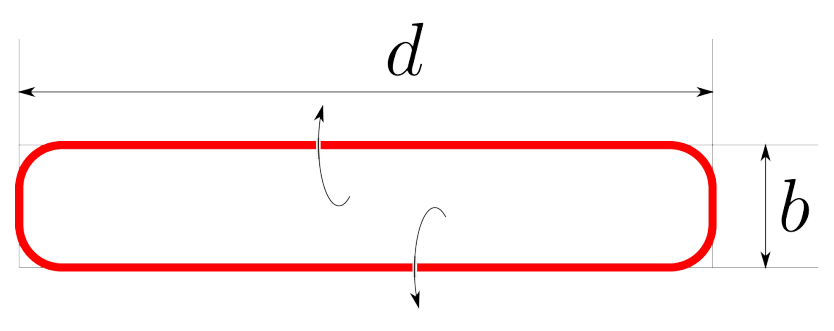
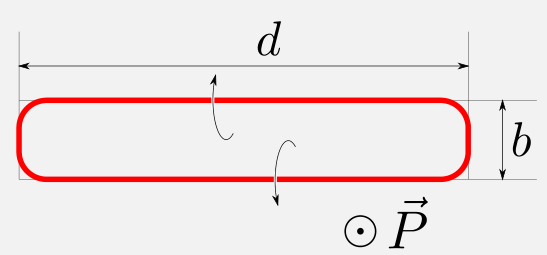
C.1 Consider a nearly rectangular vortex loop , , Fig. 7. Indicate the direction of its momentum . Find out the momentum magnitude. [0,3 т.]
C.2 Calculate its energy . [0,7 т.]
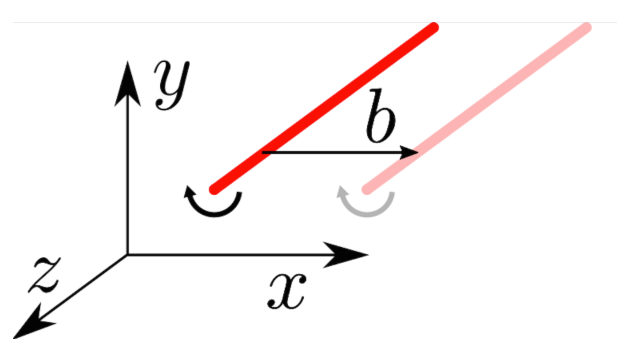
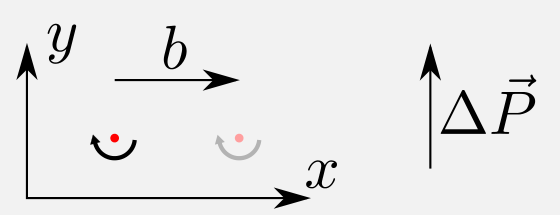
C.3 Suppose we shift a long straight vortex filament by a distance in direction, see Fig. 8. How much does the fluid momentum change? Indicate the momentum change direction. The filament length (constrained by the vessel walls) is . [0,75 т.]
Part D. Trapped charges (2.85 points) (2,85 т.)
Electrons, if injected in helium, get trapped in the vortex filaments. Here and below polarizability of helium can be neglected ().
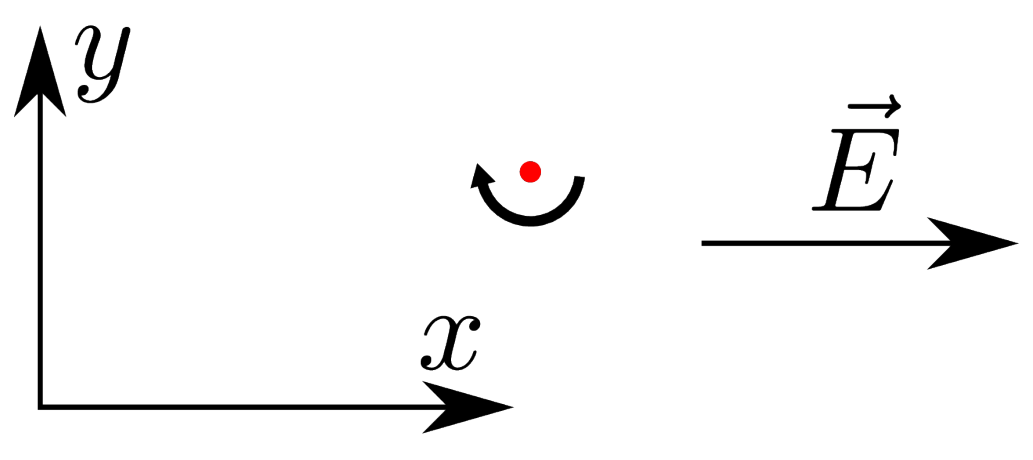
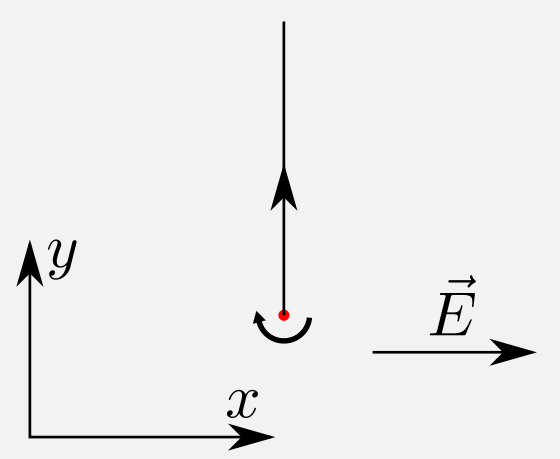
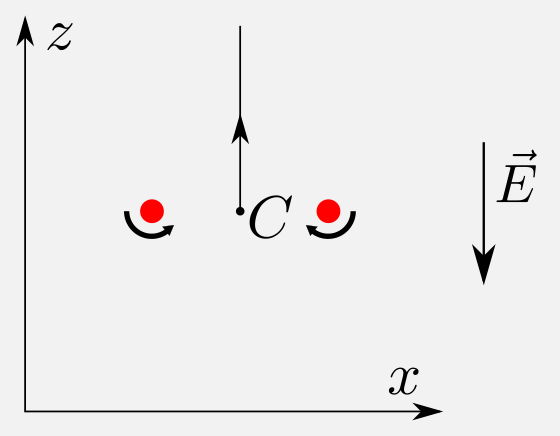
D.1 Consider a straight vortex charged with uniform linear density in a uniform electric field . Draw the vortex trajectory. Find its velocity as a function of time. [0,5 т.]
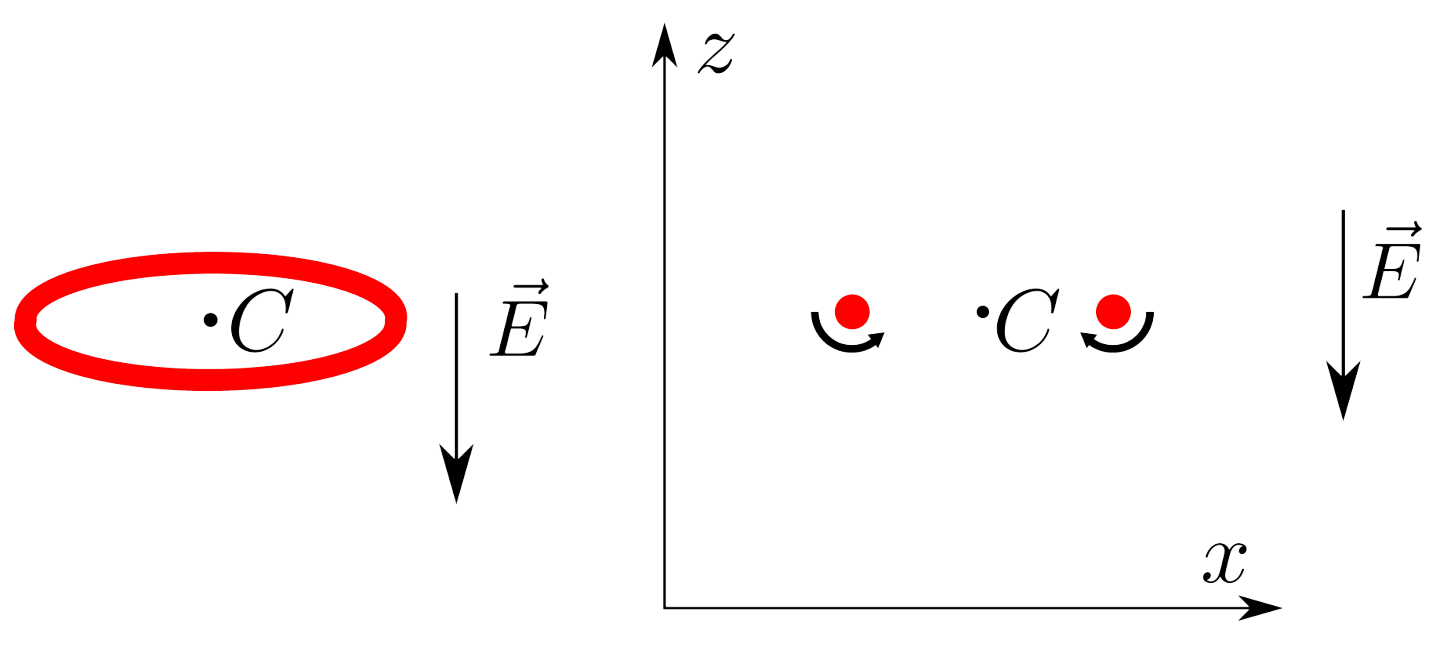
A circular vortex loop of radius initially charged with uniform linear density is placed in a uniform electric field perpendicular to its plane, opposite to its momentum .
D.2 Draw the trajectory of the loop center . Find the radius of the loop as a function of time. [0,6 т.]
D.3 Find its velocity as a function of time. [1,5 т.]
D.4 The field is switched off at a time when the velocity reaches the value . Find the loop velocity at a later time . [0,25 т.]
Part E. Influence of the boundaries (3.25 points) (3,25 т.)
Solid walls alter the velocity field created by a vortex filament, because the fluid cannot flow through them. Mathematically this means that the wall-normal velocity component vanishes at the wall surface.
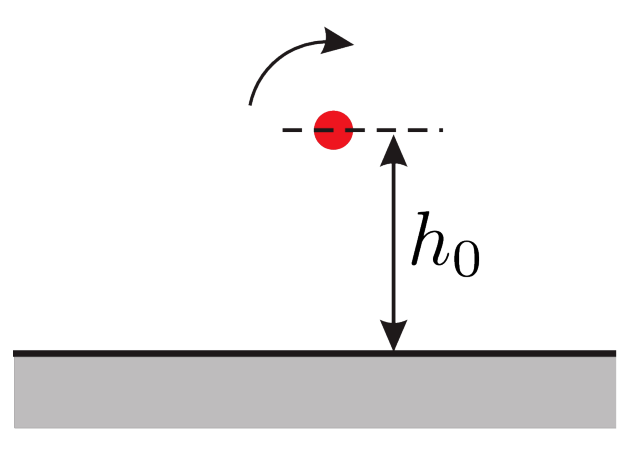
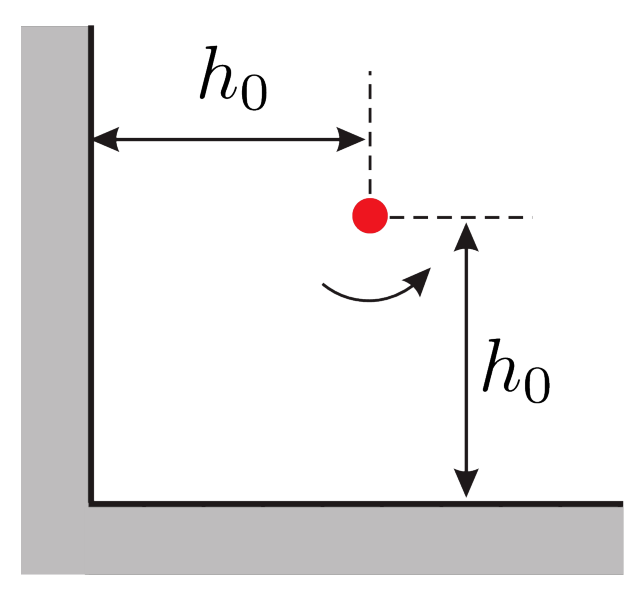
E.1 Draw the trajectory of a straight vortex, initially placed at a distance from a flat wall. Find its velocity as a function of time. [0,5 т.]
Consider a straight vortex placed in a corner at a distance from both walls.
E.2 What is the initial velocity of the vortex? [0,75 т.]
E.3 Draw the trajectory of the vortex. [0,5 т.]
E.4 What is the velocity of the vortex after very long time? [1,5 т.]
Отговори
Part A. Steady filament (0.75 points), A.1
Streamlines are circles around the vortex.
Part A. Steady filament (0.75 points), A.2
Part B. Vortex motion (1.4 points), B.1
The filaments rotate around the point halfway between them.
Part B. Vortex motion (1.4 points), B.3
Part B. Vortex motion (1.4 points), B.4
Part B. Vortex motion (1.4 points), B.5
Part C. Momentum and energy (1.75 points), C.1
The momentum is perpendicular to the plane of the loop.
Part C. Momentum and energy (1.75 points), C.2
Part C. Momentum and energy (1.75 points), C.3
The momentum change is parallel to the y axis.
Part D. Trapped charges (2.85 points), D.1
Constant velocity perpendicular to ; the trajectory is a straight line parallel to the y axis.
Part D. Trapped charges (2.85 points), D.2
Part D. Trapped charges (2.85 points), D.3
Part D. Trapped charges (2.85 points), D.4
Part E. Influence of the boundaries (3.25 points), E.1
The vortex moves along the wall with constant velocity.
Part E. Influence of the boundaries (3.25 points), E.2
Part E. Influence of the boundaries (3.25 points), E.4
Решение
A. Steady filament (0.75) (0,75 т.)
Consider a cylindrical beaker (radius ) of superfluid helium and a straight vertical vortex filament in its center Fig. 2.
A1 (0.25)
Plot the streamlines. Find out the velocity at a point .
The streamlines are circular. From the circulation identity (1) it is obvious that .
- Streamlines are plotted correctly (one at least) .......... 0.1
- .......... 0.15
A2 (0.5)
Work out the free surface shape (height as a function of coordinate ) around the vortex. Free fall acceleration is . Surface tension can be neglected.
Consider a thin circular layer of the radius . Equilibrium condition for its surface is given by the requirement
This equation is satisfied by the surface profile
- or equivalent .......... 0.25
- .......... 0.25
B. Vortex motion (1.4) (1,4 т.)
B1 (0.25)
Consider two identical straight vortices initially placed at distance from each other as shown in Fig. 4. Find initial velocities of the vortices and draw their trajectories.
Being advected by each other’s flow field, filaments will rotate around a point halfway between them. The velocity is given by .
- Trajectories are plotted correctly .......... 0.15
- Correct expression for velocity .......... 0.1
B2 (0.15)
Draw the trajectories of vortices A, B, and C (located in the center).
- Trajectories are plotted correctly .......... 0.15
B3 (0.4)
Find velocity of a vortex positioned at .
Consider a circular path of radius around the beaker center. The circulation along this path is given by the number of vortices within it (vortex density per unit area is ):
The velocity field
- Expression for vortex density .......... 0.2
- Correct expression for .......... 0.2
B4 (0.35)
Find the distance AB between the vortices A and B at time . Treat AB as given.
This velocity pattern corresponds to the rotation of the lattice as a whole around the beaker center with angular velocity
AB AB
- Correct answer .......... 0.35
B5 (0.25)
Work out the “smoothed out” (omitting the lattice structure) free helium surface shape .
The surface shape is
- Correct answer .......... 0.25
C. Momentum and Energy (1.75) (1,75 т.)
C1 (0.3)
Consider a nearly rectangular vortex loop , , Fig. 7. Indicate the direction of its momentum . Find out the momentum magnitude.
Momentum of a flat loop (see Introduction) is perpendicular to its plane and proportional to its area. For a rectangular loop the magnitude is .
- Correct direction of momentum .......... 0.15
- Correct expression for momentum magnitude .......... 0.15
C2 (0.7)
Calculate its energy .
To produce equal magnetic and kinetic energy densities , the magnetic field has to be . This field is generated by a current . Energy of the wire loop can be found from the inductance . Inductance of a nearly rectangular wire loop:
This gives for the energy
- Integration limits are and .......... 0.2
- Analogy with a magnitude field is used (, ) or energy is calculated as , where .......... 0.2
- Correct expression for energy .......... 0.3
C3 (0.75)
Suppose we shift a long straight vortex filament by a distance in direction, see Fig. 8. How much does the fluid momentum change? Indicate the momentum change direction. The filament length (constrained by the vessel walls) is .
The momentum change is equal to the momentum of a long rectangular loop .
- The result of C1 used .......... 0.3
- Momentum change is parallel to Y axis .......... 0.1
- Correct direction of momentum change .......... 0.15
- Correct expression for momentum change magnitude .......... 0.2
Interestingly, this provides an alternative approach to find the energy of such a loop. Namely, if we slowly move one straight vortex in the velocity field of another, then we apply a force
The work
has to be performed to move it from distance to .
D. Trapped charges (2.85) (2,85 т.)
D1 (0.5)
Consider a straight vortex charged with uniform linear density in a uniform electric field . Draw the vortex trajectory. Find its velocity as a function of time.
Electric force moves the vortex with velocity
perpendicular to .
- Trajectory is straight line parallel to Y axis .......... 0.1
- Correct direction of velocity .......... 0.2
- Correct expression for velocity magnitude .......... 0.2
D234
A circular vortex loop of radius initially charged with uniform linear density is placed in a uniform electric field perpendicular to its plane, opposite to its momentum .
D2 (0.6)
Draw the trajectory of the loop center . Find the radius of the loop as a function of time.
Electric force upon the loop is constant and fluid momentum linearly depends on time
The loop is growing and its radius is increasing with time
- Trajectory is straight line along .......... 0.1
- Correct velocity direction .......... 0.15
- .......... 0.15
- .......... 0.15
- Correct expression for .......... 0.05
D3 (1.5)
Find its velocity as a function of time.
The loop velocity can be easily found from a relationship between the energy change rate and the momentum change rate
This gives for the velocity
This means that the vortex is moving in the direction of the force but its velocity is decreasing.
- Expression for .......... 1.0
- Correct expression for .......... 0.5
D4 (0.25)
The field is switched off at a time when the velocity reaches the value . Find the loop velocity at a later time .
When .
- Correct expression for .......... 0.25
E. Influence of the boundaries (3.25) (3,25 т.)
Draw the trajectory of a straight vortex, initially placed at a distance from a flat wall. Find its velocity as a function of time.
E1 (0.5)
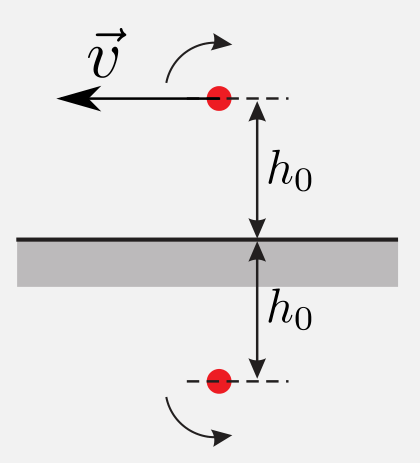
Well known technique of image charges (currents) in electrostatics (magnetostatics) can be directly used to solve this problem. Namely, the wall can be “substituted” with a reflected fictitious vortex on the other side of the wall. The velocity distribution of two vortices together in the upper semi-space is identical to the one produce by a single vortex above the wall. Indeed, the symmetry of the problem ensures that there is no flow through the plane of symmetry. Thus, a straight vortex line situated a distance above a flat wall with its image behave as a pair of vortices of opposite circulation a distance apart. This means that the vortex moves along the wall with velocity
Illustration of the image method for the straight vortex filament near a flat wall
- Trajectory is plotted correctly .......... 0.15
- Correct direction of velocity .......... 0.1
- Correct expression for velocity magnitude .......... 0.25
E234
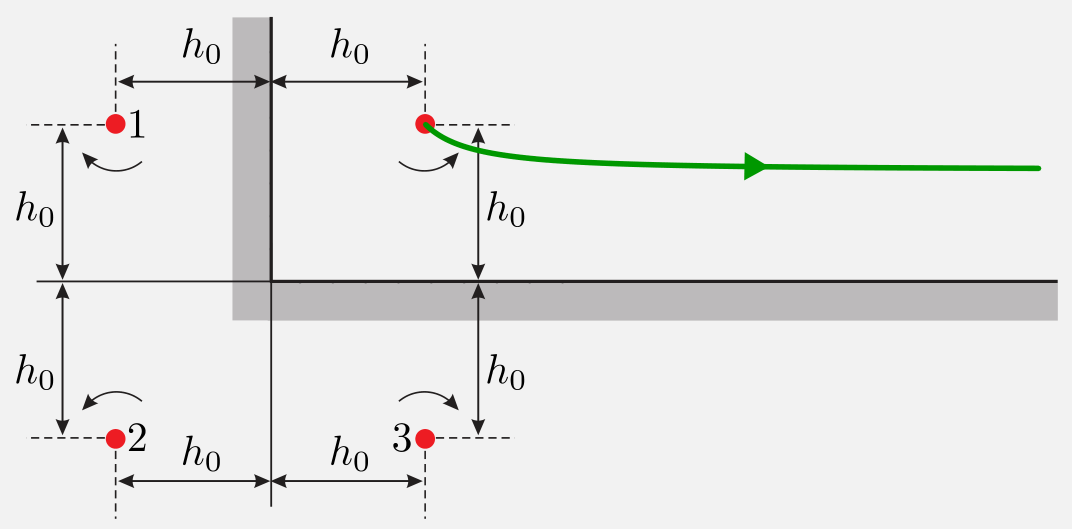
Consider a straight vortex placed in a corner at a distance from both walls.
E2 (0.75)
What is the initial velocity of the vortex?
The velocity of the filament is given by superposition of the velocities , and induced by the image vortices 1, 2 and 3, respectively (see Fig. in E3 solution). One readily obtains
The modulus of the filament velocity at the initial moment is
- Ideas of using superposition principal and technique of image charges .......... 0.25
- Correct expression for initial velocity magnitude .......... 0.5
E3 (0.5)
Draw the trajectory of the vortex.
Image vortices in the corner.
- The trajectory has correct form .......... 0.3
- Correct direction of initial velocity .......... 0.2
E4 (1.5)
What is the velocity of the vortex after very long time?
Energy for the system of vortices is proportional to
The energy conservation implies that
is constant along the trajectory. After very long time and the vortex velocity is
- .......... 0.5
- Correct expression for velocity after very long time .......... 1.5