APhO 2017, Теория — Задача 2. Evolution of Supermassive Black Holes Binary
Theory APhO YAKUTSK 2017 RUSSIA Q2 — Evolution of Supermassive Black Holes Binary · 10 т.
Условие
Introduction
The concept of gravitational waves is one of the most impressive predictions of Einstein's Theory of General Relativity. Gravitational waves are the space-time ripples propagating with the speed of light similarly to electromagnetic waves. Direct detection of gravitational waves is incredibly difficult, however, the first signal was detected on September 14, 2015, by LIGO and VIRGO collaborations.
Gravitational waves are emitted during the rapid motion of massive objects. The most powerful source of gravitational waves is the merging of two Supermassive Black Holes (SBH). Black holes predicted by Theory of General Relativity represent extremely compact objects which might have very large masses. Other specific properties of black holes will not be needed in the solution of this problem.
In the generally accepted theory of galaxies' evolution, it is supposed that there is SBH with the mass ranging from of Solar masses in the galaxy's center. Galaxies are huge stellar systems containing stars. During their evolution, two galaxies can collide and merge into one. What happens to two SBHs initially located in their centers? The evolution of the SBH binary system can be divided into three main stages. At each stage SBHs approach each other, although the underlying physical phenomena differ. We will examine these phenomena separately in the first three parts of the problem. In the fourth part, we will use the obtained relations to calculate the total time of the SBH binary system evolution.
At the end of their evolution, two SBHs will eventually approach each other and merge into a single black hole. The merging process lasts about an hour and is accompanied by an intense burst of gravitational radiation. Future observatories like LISA will be able to detect this gravitational radiation. Still, the research on the SBH evolution is under way now, at the dawn of gravitational-wave astronomy.
General information
- Express all your numerical answers in parsecs (pc) for the distances and giga-years (Gy) for the time intervals. We will use Solar mass () as a reference mass. You might need these values:
,
,
, age of the Universe,
N m/kg,
m/s.
When you encounter the word “estimate”, you are not demanded the exact answer. It is sufficient to obtain a result that differs from the accurate one, not more than by a factor of 10. On the contrary, when you encounter the word “find”, you are supposed to achieve the exact answer. The word “calculate” asks you to bring the numerical answer.
Throughout the problem, assume every star in the galaxy to have the same mass .
Throughout the problem we will not take into account the effects of the Theory of General Relativity except gravitational waves emission. All stars and black holes are considered as point masses governed by Newton's gravitation law.
Part A. Dynamic Friction (1.6 points)
In this part we shall study the simplified model of the galaxy. You can ignore the velocities of the stars in the galaxy and assume the constant stellar concentration . The characteristic size of the galaxy is . The stellar concentration is small enough, so the stellar collisions are extremely rare and negligible. Let us consider a SBH with the mass moving with the velocity through the galaxy. Surprisingly, the SBH experiences nonzero average force from the stars. This force slows the motion of the SBH and is called the force of dynamical friction for this reason. This part is devoted to the determination of this force.
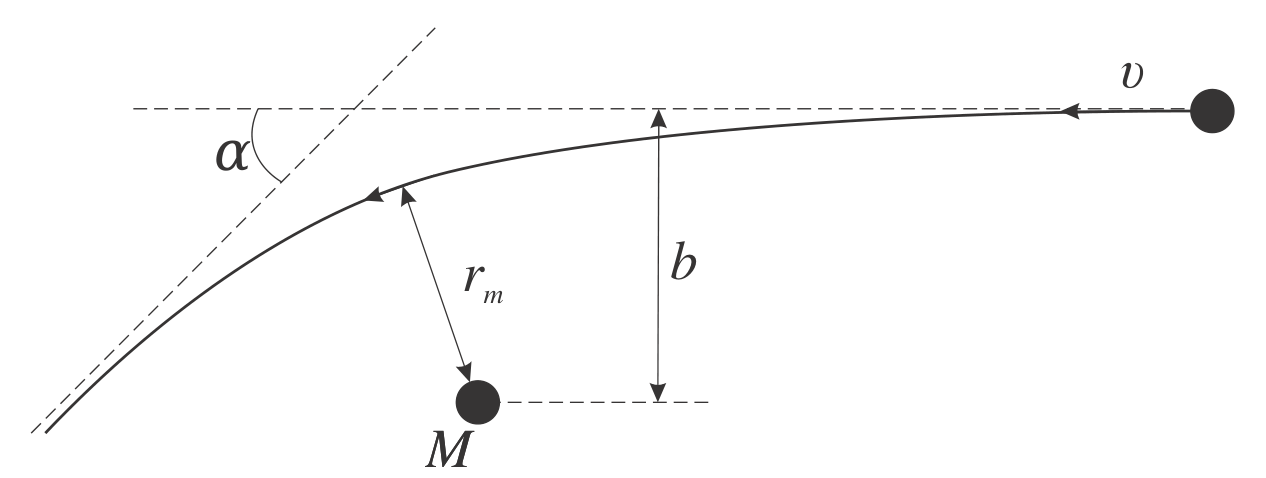
A.1 Let us work in the SBH's reference frame and consider the transit of one star with impact parameter (fig. 1). Assume that
The angular deflection of the star , where is some coefficient. Find the value of . If you cannot find , assume hereafter. [0,75 т.]
A.2 Let Ox axis be directed along the SBH's velocity. Find the momentum component transferred from the star to the SBH. [0,25 т.]
A.3 Estimate the average force acting on the SBH by taking the average over impact parameter . Neglect the contribution of the stars with impact parameters . Assume the SBH to reside in the central part of a galaxy. Express in terms of , , , and stellar density . [0,4 т.]
A.4 As you obtained in the previous task, the expression for includes the factor , which we will denote further as . Calculate the value of for , and velocity . [0,2 т.]
Part B. Gravitational slingshot (3.0 points)
In this part, we will consider the system of two SBHs with equal masses located in the center of the galaxy. Let's call this system a SBH binary. We will assume that there are no stars near the SBH binary, each SBH has a circular orbit of radius in the gravitational field of another SBH.
B.1 Find the orbital velocity of each SBH. Find the total energy of the SBH binary. Express it in terms of , and . [0,25 т.]
There are a lot of stars at distances much larger than from the binary. Stars travel along complex and diverse trajectories in the gravitational field of the whole galaxy. The motion of the stars can be considered chaotic, like the motion of the molecules in an ideal gas. Let us assume that stars' velocities have equal magnitudes and their average mass density is . In this case dynamical friction is no longer affecting the SBH binary and energy losses are caused by other phenomenon.
B.2 Let us solve a related problem. Let a star of mass transit by a point mass being at rest. The minimal distance between the star and the point during the transit is . The velocity of the star at large distance is . Find the exact value of impact parameter . [0,5 т.]
If a star approaches the SBH binary for a distance about , it participates in a complex 3-body interaction with the binary that almost always results in a star being shot out with the velocity about (the velocity of the star at the large distance after interaction). We will call such a strong interaction a collision of a star with the SBH binary. Acceleration and the shot of the star after the collision is called “gravitational slingshot”.
B.3 Estimate the characteristic time between two successive collisions of the SBH binary with stars. Take into account that . [1 т.]
B.4 Estimate the SBH binary energy loss rate . Estimate the radius variation rate . Express it in terms of , , , . [0,25 т.]
B.5 Let us denote the initial radius of the system as . Estimate the time for the radius to decrease by a factor of 2 due to “gravitational slingshot”. Calculate for , , . [1 т.]
Part C. Emission of gravitational waves (1.0 points)
In this part we shall study the SBH binary with equal masses which doesn't interact with the stars. Even in this case the system loses the energy due to gravitational waves emission. The energy loss rate due to gravitational waves is
where is angular velocity of the binary, and is quadrupole moment of the system.
C.1 Find the SBH binary radius variation rate due to the emission of gravitational waves. [0,2 т.]
When the orbit radius of the SBH binary becomes close to the gravitational radius of the black hole:
two SBHs quickly merge.
C.2 Let us denote the initial radius of the system as . Estimate the time it takes for the SBH binary to shrink to the radius about due to the emission of gravitational waves. Express as a function of , , and . [0,7 т.]
C.3 Calculate the initial radius of the binary of SBHs with equal masses if it takes it the age of the Universe to merge: . [0,1 т.]
Part D. Full evolution (4.4 points)
In this part we will use the results obtained above. Let us consider the real astrophysical situation. Two galaxies having SBH of mass in their centers merged into a new stellar system. Let the new galaxy be spherically symmetrical with radius . Let us assume that stellar density varies with radius to the galaxy center as
where .
D.1 Let the body move in circular orbit of radius in gravitational field of the stars. Neglect the force of dynamical friction and find the velocity of the body. [0,25 т.]
Immediately after the merging of galaxies two SBHs have arbitrary positions inside the new galaxy and do not affect each other. Let's consider one SBH. We assume it moves in a circular orbit of radius around the galaxy center and slowly loses energy due to the dynamical friction.
D.2 Estimate the orbit radius variation rate . In part A we ignored the velocities of the stars. Although stars are moving in the real galaxy, not all of them have exactly the same speed . Instead, the speed of the stars is only of the order of , and so is the relative speed of SBH with respect to the stars, hence you can use the result obtained in A.3 for estimation. You should use the density from equation (4). Assume to be a constant calculated in A.4. [0,75 т.]
After a certain time, two SBH will approach the center of the galaxy. Let two SBH move in a circular orbit of radius around the center galaxy in the gravitational field of the stars.
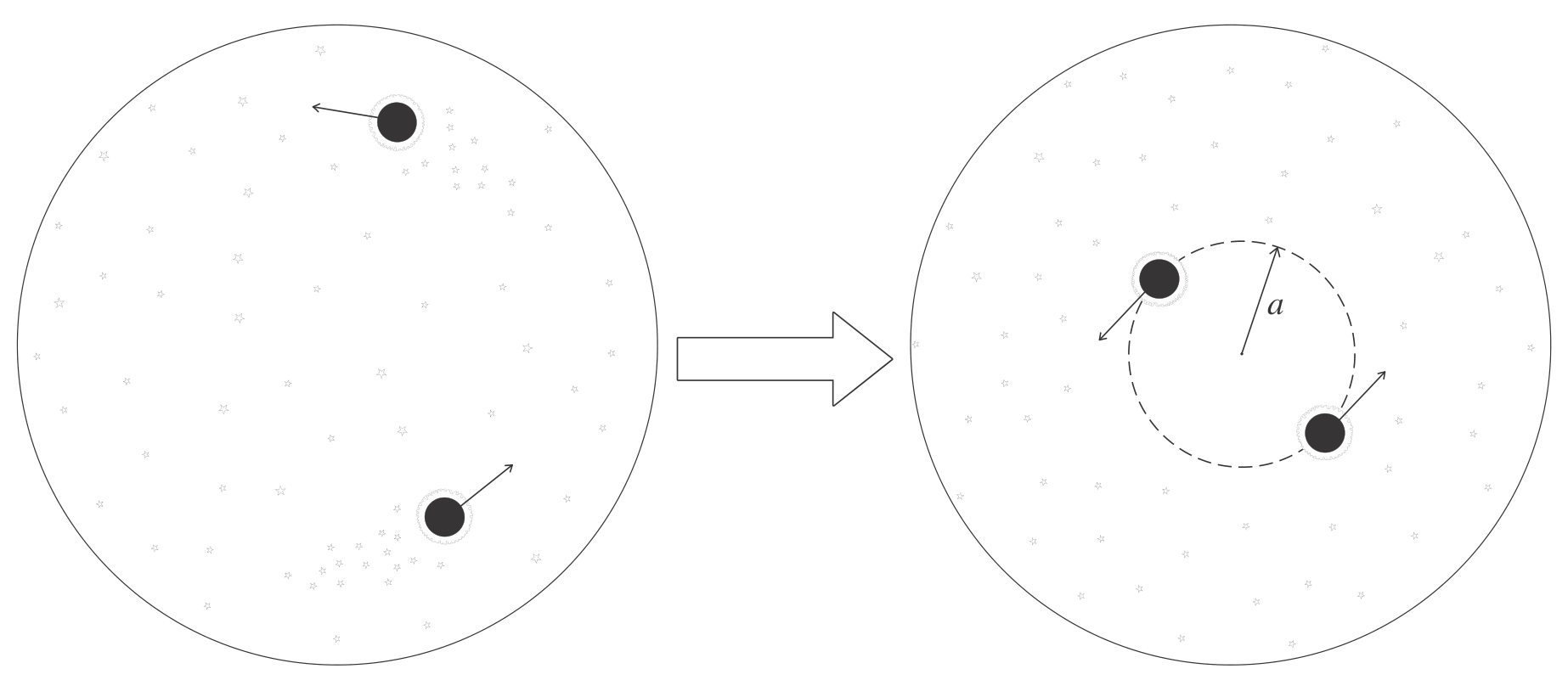
D.3 Estimate the critical radius at which gravitational interaction between two SBHs is no longer negligible and calculate it. We will say that at this moment two SBHs form a binary system (fig. 2). [0,3 т.]
D.4 Let us assume that after the merging of galaxies two SBHs were at distances from the galaxy center. Calculate the time it takes for two SBH to form a binary due to dynamical friction. [0,75 т.]
After forming the binary, two SBHs shoot away all the stars from the center of the galaxy and stay there alone. Since this moment, dynamical friction becomes ineffective and the binary starts to lose the energy because of the slingshot effect. You can assume that the velocities of the stars around the binary are and the stellar density is from the equation (4). Slingshot effect shrinks the radius of the system drastically and after some time the system starts to lose energy mostly due to the radiation of gravitational waves.
D.5 When the binary radius is less than some value the energy loss is caused by gravitational waves emission. Estimate the value and calculate it. [0,3 т.]
D.6 Estimate the time of the binary radius reduction from to (the slingshot stage). Estimate the time of binary radius reduction from to almost zero (the stage of gravitational waves emission). [1,75 т.]
D.7 For the parameters given above, calculate the total time of two SBH evolution from galaxies merging to SBH merging. [0,3 т.]
Historical remark. For a long time astrophysicists have been thinking the SBH binary evolution stops at the slingshot stage, since the binary has shot out all the stars with small impact parameters which might collide with it. It appeared that two SBH would never merge. This fact was called the final parsec problem.
Real galaxies have complicated asymmetric shapes. Few years ago it was found that in galaxies of complex shapes the stars with small impact parameters appear again and again. The SBH binary continues to lose energy, but slower than our estimation gives. The final parsec problem was successfully solved.
Отговори
A.1 2
Official solution: , .
A.2
A.3
A.4 7.5
Official solution: pc, .
B.1
B.2
B.3
B.4
B.5 0.00073 Gy
Official solution: Gy.
C.1
C.2
C.3 0.098 pc
D.1
D.2
D.3 10.8 pc
Official solution: pc; alternative variant accepted: pc.
D.4 0.121 Gy
D.5 0.018 pc
Alternative (with pc): pc.
D.6 T2 ≈ 0.063 Gy, T3 ≈ 0.016 Gy (alternative: T2 ≈ 0.0068 Gy, T3 ≈ 0.0017 Gy)
D.7 0.2 Gy
Alternative: Gy.
Решение
A. Dynamical Friction
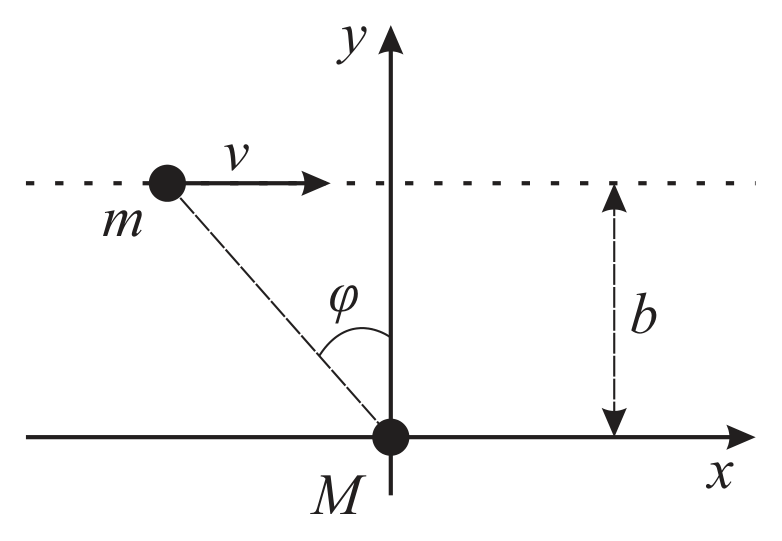
A1. The deflection angle is defined from: , assuming that . One can find , and according to Newton's gravity law
The geometry: , so we change the variable and we have
Here we assume that the body moves along the straight line, due to , see Fig 1. So and
A2. During the transit of a massive body, star's energy remains constant: . Hence
We know that , so the SBH momentum change along the x-axis , so
A3. To calculate net force we might integrate over stars with different impact parameters. The number of stars' transits during the time equals , so force, decelerating the object along the x-axis,
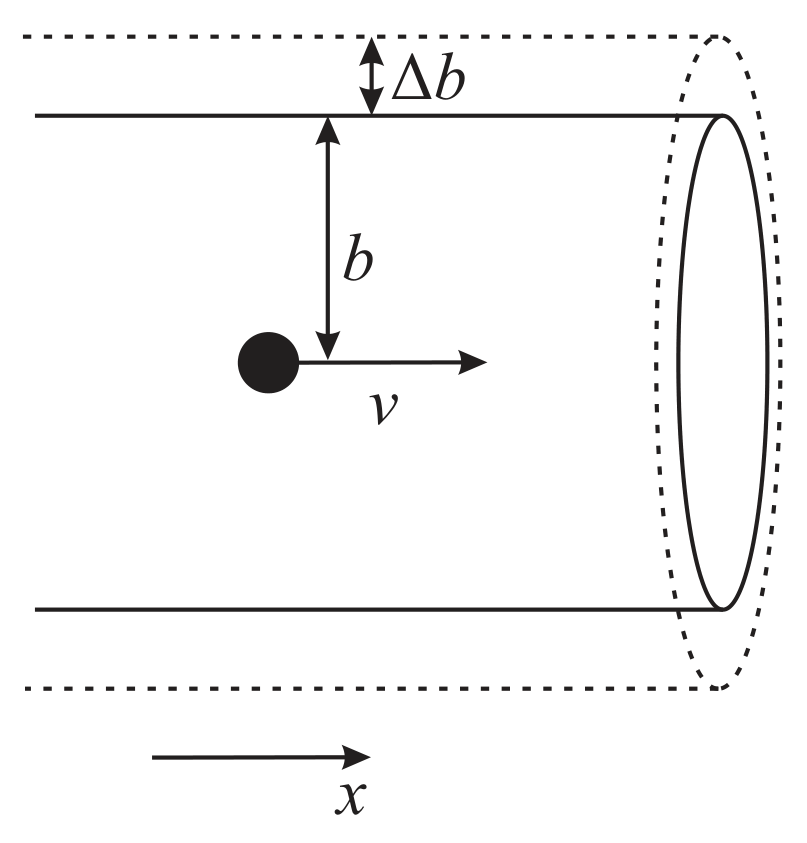
The above formulas are true only for , so the lower integration limit is , and the upper limit is determined by the galaxy size . So we have
where .
A4. We calculate: , .
B. Gravitational slingshot
B1. From the second Newton's law
and we have for the orbital velocity . The system energy is
The answer is
B2. From angular momentum conservation law
express . Write down the energy conservation law
and derive
B3. To estimate the time between collisions let us use an analogy with the gas. As known from the molecular kinetic theory, given that molecules have radii , thermal velocities , and the molecular concentration , the time between collisions of one molecule with the others can be estimated from the relation . In our problem stands in place of the molecule radius, therefore for estimation it can be written
Estimate the maximal impact parameter , corresponding to the star collision with the binary system. The star should reach the distance of to the binary system to collide. The star at large distances from the SBH binary interacts with it as with a point object of mass . From the results of B.2, assuming , we obtain . Taking into account that , simplify:
so we have
B4. During the one act of gravitational slingshot, star energy increases at average by
So the binary energy decreases by the same magnitude . Taking into account that , we derive
Average binary system energy loss rate equals
Taking the time derivative of (3), we have
From (4) and (5) the orbit radius variation rate can be estimated as
B5. Equation (6) can be easily integrated
To reduce the radius twice it takes time
C. Emission of gravitational waves
C1. Using that and formulas from the problem text one can obtain:
Combining (5) and (8) we get the desirable result:
C2. Integrating the equation (9) one can obtain:
And taking into account we derive the final result for :
C3. From the previous equation and :
D. Full evolution
D1. The galaxy is spherically symmetric, so mass enclosed within a sphere of radius equals
Thus the free fall acceleration of the body equals in the gravitational field of stars is
Therefore the body velocity is determined by relation
which means
So the velocity is constant.
D2. The energy of SBH in this gravitational field is
So the kinetic energy is constant and
From the definition of potential energy we have
Using the result of A3 we have
Combining this equations we get the answer
D3. To estimate one can assume that SBHs form a binary when the mass of stars inside the sphere of radius equals to :
so
Alternative variant: the force from another SBH is equal to force from all stars:
so the answer is
D4. Integrating the equation (16) we have
and using that we have
D5. Total energy losses are caused by gravitational slingshot and gravitational waves emission, so combining equations (4) and (8):
where
, alternative:
Energy losses due to GW dominates when i.e. where
Numerical answer is (alternative: ).
D6. For rough approximation it can be considered that at the slingshot stage () energy losses are caused only by slingshot, so is calculated analogously to B5: and
And at the GW emission stage () energy losses are caused only by GW emission, so is calculated directly from C2:
D7. Total time of SBH binary evolution from the moment of galaxies merging to SBH merging equals