APhO 2018, Теория — Задача 1. Optical trap of neutral atoms
19th APhO Asian Physics Olympiad, Hanoi - Viet Nam 2018 — Theory Q1: Optical trap of neutral atoms (12 points) · 12 т.
Условие
Optical traps are versatile tools to create ultracold atom systems that nowadays play very important role in quantum physics and are believed to have highly nontrivial applications in technology as well as in quantum measurements. By shining a laser beam onto an assembly of neutral atoms, we are able to capture and cool these atoms. When atoms are cooled to near absolute zero temperature, they reveal the whole fascinating quantum behavior, in particular their Bose-Einstein condensation (BEC).
In this problem you will study basic concepts of an optical trap of neutral atoms and one of the signatures to recognize the BEC in experiments on sodium atoms.
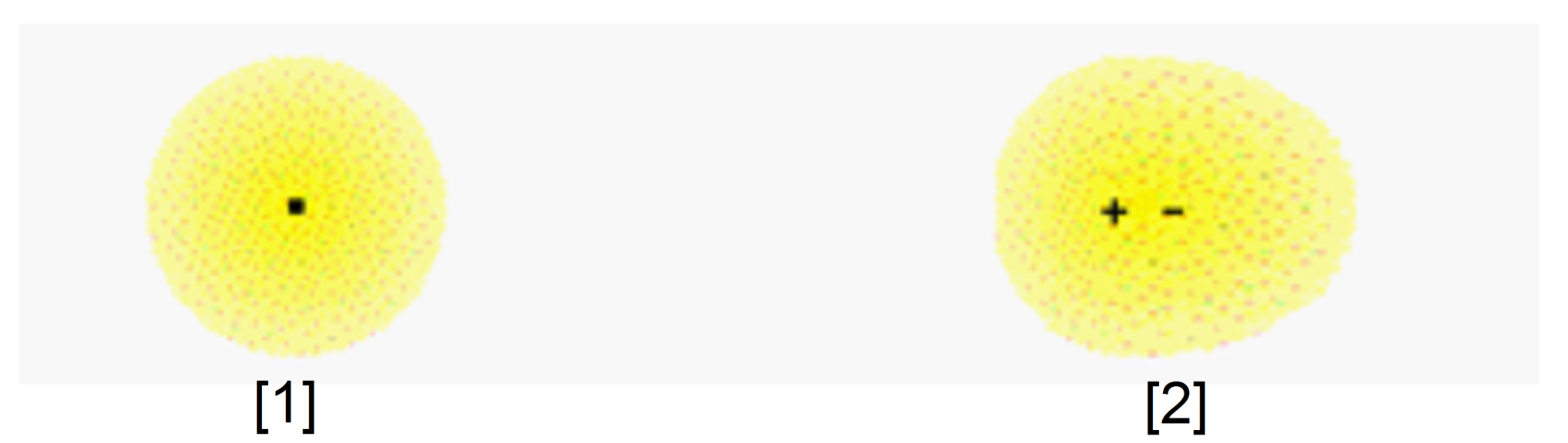
An neutral sodium atom can be well described as a core with positive charge e surrounded by a homogenous electron cloud with negative charge -e. The mass of the core is much larger than the mass of the electron cloud. In the absence of an external electric field, the core and the cloud centers coincide. The electric field of a laser beam interacts with the positive core as well as the electron cloud of the atom, so an electric dipole is induced. In turn, this induced dipole will interact with the electric field of the laser beam and thereby gives rise to a dipole potential energy of the atom. The atom is said to feel an optical potential. The later depends on the intensity profile as well as the frequency of the laser beam in use. By choosing an appropriate laser intensity and frequency, one may form a trap-like potential well to confine the neutral atoms.
We start off by considering the polarization of a neutral atom that is placed in a uniform external electric field , where is a unit vector and is the field magnitude. Then, a dipole moment is induced. Here, is distance between the negative and positive charge centers, and is called polarizability.
1 (1.5 points)
Initially the external field is turned off. Then the field magnitude is increased from zero to very slowly so that the electric field can be considered effectively time-independent in this question. The instantaneous value of the external field is denoted by ,
1.1 Find the instantaneous power absorbed by the atom from the external field in terms of and , where is the rate change of the induced dipole moment. [0,75 т.]
1.2 Find the total work done by the external field on the atom when the electric field is increased from zero to . Hence deduce an expression for the induced dipole potential energy in terms of and . [0,75 т.]
Note that when the external electric field is turned off, the electron cloud oscillates with a natural frequency due to its inertia and the Coulomb restoring force.
2 (1.0 point)
In the following we will study the case where the neutral atoms are placed in an external laser field that varies in time and space as . The induced dipole moments will oscillate with the driving laser field frequency . It is well known that an oscillating dipole itself emits electromagnetic radiation. By doing so, electron receives some recoil momentum that causes an electromagnetic friction resulting in a phase shift between the applied electric field and the induced dipole moment. Therefore, the induced dipole moment takes the form . Here, both the polarizability and the phase shift depend on the driving frequency . Due to the oscillating nature, all physical quantities of our interest reveal themselves only via the corresponding time-averaged values over a period of the laser field. The time-averaged value of a periodically varying quantity is defined as . Hereafter, the notation means time-average of the enclosed quantity.
Laser intensity is related to amplitude of the laser electric field as , where is the permittivity of free space and is the speed of light.
2.1 Find the induced dipole potential energy in term of and . [1 т.]
3 (1.0 point)
Besides capturing neutral atoms in the trap via the induced dipole potential energy, the oscillating electric field may cause a scattering force on atoms that arises from absorption and emission of light. The light scattering processes lead either to heating or to losses of atoms from the trap and may be characterized by the scattering rate, that is related to the number of photons scattered by an atom in unit time and is defined by . Here, is the time-averaged power absorbed from the laser field, and is the photon energy .
3.1 Find the scattering rate in term of and . [1 т.]
4 (2.0 points)
Both quantities and depend on the polarizability . In order to calculate the polarizability , we will adopt the one dimensional oscillator model under the presence of an electric field . Let the axis parallel to the unit vector . In this model motion of the electron is determined by three forces:
i) The restoring force that describes the free oscillation with the natural frequency corresponding to the atomic optical transition frequency. We use x to denote the displacement of the negative charge center from the positive one, which is assumed to be at rest.
ii) The driving force of the laser field
iii) The damping force that originates from the radiation of the accelerating charge, and is characterized by the frequency-dependent damping rate .
Therefore, the equation of motion of the electron is given as . The solution to this equation is . Here and are to be determined.
4.1 Find the polarizability in term of , and . [2 т.]
5 (1.0 point)
In fact the energy damping rate is independent of the electron orbits. Therefore we will adopt another simple model where the electron cloud center performs a circular motion in the absence of the laser field but with the frequency and speed . Being accelerated, the electron radiates an electromagnetic wave with power given by the Larmor formula with denoting acceleration. The damping force is supposed to be related to the damping rate as . We also assume that the total energy of the electron is large compared with the energy loss per cycle.
5.1 Find the energy damping rate in term of , and . [1 т.]
6 (0.5 point)
When the driving frequency is close to the natural frequency , then the polarizability gets larger, leading to a larger value of the dipole potential as well as an increased scattering rate. Therefore, by considering the ratio , one can find an appropriate laser frequency to reduce the scattering rate while maintaining a reasonably deep trapping potential.
6.1 Introducing the damping rate at , as , find the ratio in terms of , and . [0,5 т.]
7 (1.5 points)
From the above result we can see that it is possible to simultaneously achieve a deep trapping potential and low heating rates by choosing the laser frequency not to be too close to the atomic optical transition , as well as high laser intensity. Because the scattering rate is positive, and from the above obtained ratio , if then the dipole potential is negative and the atoms are captured in a focused region of laser beam with maximum intensity. Once atoms are captured in the trap, by reducing the trapping well depth to remove high energy atoms, one may cool the confined atom gas to ultracold temperatures, enabling formation of BEC. A breakthrough progress in BEC physics had been achieved with sodium atoms in the late nineties (D. M. Stamper-Kurn et al., Phys.Rev.Lett. 80, 2027 (1998)).
The physics of BEC can be understood as follows. In nature, there are two kinds of particles: bosons with integer spin and fermions with half integer spin. Two identical fermions cannot exist in the same quantum state. In contrast, multiple bosons are not forbidden to occupy one quantum state: at ultralow temperatures a large fraction of bosons can condensate into the state with lowest possible energy and form a condensate cloud (condensate bosons), while the rest bosons are in the excited state with higher energy (noncondensate or thermal bosons). Let us analyse a practical example of a dilute gas of sodium atoms, which are bosons, confined in the optical trap created by a Gaussian laser beam (Fig 2a). The laser beam has the wavelength corresponding to the frequency (with ). The beam propagates along the z-axis with the intensity profile , where and the waist size is with denoting the Rayleigh length. The total laser power P and the beam waist parameter determine the parameters of the optical trapping potential, one of which is the potential depth . The later is defined by the absolute value of the local minimum of the potential energy, taking as a reference the potential energy energy to be zero at infinity (Fig 2b).
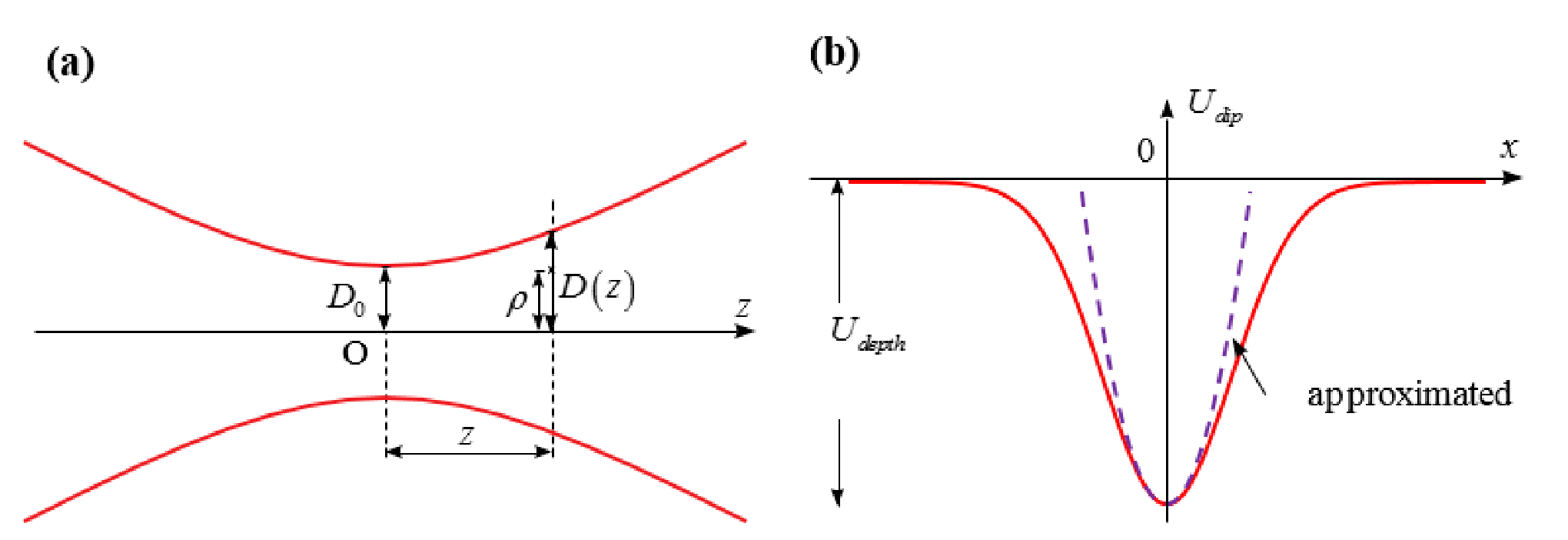
7.1 Find the expression for the dipole potential depth in terms of , and . [0,5 т.]
7.2 Given laser power , laser wavelength , , and natural wave length for sodium , evaluate the potential depth . Express your answer as an equivalent temperature , at which thermal energy of the non-trapped atom is equal to the trap depth. [1 т.]
8 (0.5 point)
When the cloud temperature is much smaller than equivalent temperature , the optical potential can be well approximated by a cylindrically symmetric harmonic potential , where m is the mass of a sodium atom and , are oscillation frequencies in the corresponding directions.
8.1 Find the expression for , in terms of and . Here is the Boltzmann constant. [0,5 т.]
Recall that at ultralow temperatures, the sodium atom cloud consists of condensate atoms and thermal atoms. Condensate bosons behave according to the uncertainty principle that can be used for estimating the spatial size or the momentum distribution of the cloud. On the other hand, thermal bosons are described by classical physics, in particular, they obey the Maxwell-Boltzmann distribution law.
We estimate the size of the condensate cloud, that is, the mean distance of the condensate sodium atoms from the trap center. Moving inside this cloud, each condensate atom has potential energy as well as kinetic energy. The potential energy is a monotonically increasing function of the cloud size, and the particle tries to reduce it to reach the lowest energy level. On the other hand, as the cloud size decreases, the uncertainty principle requires an increase in the particle momentum, that results in an increase of kinetic energy. The particle therefore finds an optimal cloud size to balance the two opposite tendencies of the two different energy contributions.
9 (1.0 point)
For simplicity, let us consider the simplest case of one dimensional trap potential .
9.1 Estimate the size of the condensate fraction in terms of . [0,5 т.]
9.2 Find the expression for - the lowest energy level, in terms of . [0,25 т.]
9.3 Find the average particle velocity in terms of . [0,25 т.]
In what follows we will figure out how to differentiate the condensate cloud from the thermal one by switching off the confining trap. It is necessary to capture the image of the cloud density profile.
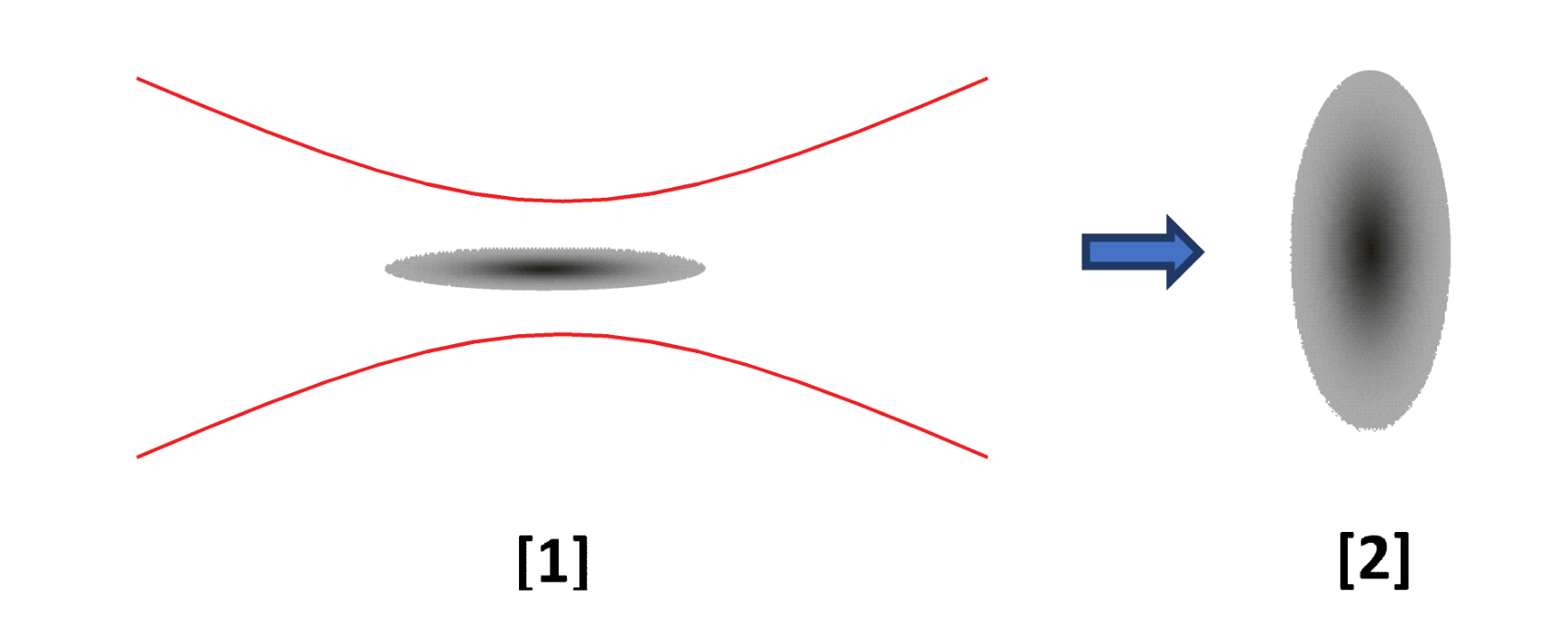
The thermal gas will show an isotropic Maxwell velocity distribution even if the trap is anisotropic. In contrast, the velocity distribution of a BEC is anisotropic. More precisely, the BEC expands faster along the axis of strong confinement than along the axis of weak confinement. The expansion predominantly occurs in the radial direction, and the initially cigar-shaped condensate becomes pancake-shaped. Therefore the density profile after a long time of flight will be anisotropic and inverted with respect to the shape of the cloud in the trap.
10 (2.0 points)
Now we extend the previous results to the three-dimensional potential which is the case of the optical trap in a Gaussian laser beam.
10.1 Find the aspect ratio in terms of , where and are the initial sizes of the condensate cloud. [0,5 т.]
10.2 When the trap is turned off, the condensate will be expanding in different directions with different initial velocities and . Determine the ratio in terms of . [0,5 т.]
10.3 Assuming that the velocities of the cloud expansion remain unchanged during the expansion, find aspect ratio of the condensate cloud after a long period of time when the cloud size is much greater than its initial size, that is and . [0,5 т.]
10.4 Same as question 10.3., find the aspect ratio of the thermal cloud after a long period of time when the cloud size is much greater than its initial size, that is and . [0,5 т.]
Отговори
1.1
1.2
2.1
3.1
4.1
5.1
6.1
7.1
7.2 4.13 μK
The official solution gives f·T0 = 4.13 μK with Udepth = f kB T0; the factors f = 3/2, 1/2, 1 are all accepted. γ = 6.4·10⁷ s⁻¹.
8.1
9.1
9.2
The official solution also gives full mark for Emin = ħΩz/2 obtained from En = ħΩz(n + 1/2).
9.3
10.1
10.2
10.3
10.4
Решение
Optical trap of neutral atoms (12 points), Solution and Marking Scheme
1.1 (0.75pt)
At the instance when the separation between charge centers is , the external field exerts on them opposite forces . [0.15]
After a time interval , the separation is changed to , work done by the external field on the charges is thus [0.3]
The power received by the atomic dipole
[0.3]
1.2 (0.75pt)
Total work can be obtained by integration [0. 5]
Potential energy of the dipole is
[0.25]
If the sign of is incorrect or the factor 1/2 is missing, students get 0pt.
2.1 (1.0pt)
The time average of any time dependent function is denoted by
[0.5]
[0.5]
If student gets directly to eq. (2) – full mark (1.0pt)
If the answer is still correct but expressed in any quantity other than those requested – 0.5 pt.
3.1 (1.0pt)
The power absorbed by the oscillator from the driving field (and re-emitted as dipole radiation) is given by
[0.5]
[0.25]
The corresponding scattering rate is [0.25]
4.1 (2.0pt)
In one dimensional Lorentz’s model, we replace . One can find the solution of the form thus from the equation of motion,
[0.25]
[0.25]
Comparing coefficients before and on both sides, one has
[0.5]
[0.25]
[0.25]
[0.25]
[0.25]
Note: students can obtain via any of sin, cos, tan functions: full mark (0.25 pt)
5.1 (1.0pt)
The power radiated due to the damping force, thus
[0.25]
[0.25]
[0.5]
6.1 (0.5pt)
Substituting the on-resonance damping rate .
Using Eq. (1), (4), (5) and (6) one has
[0.5]
7.1 (0.5pt)
From (1), (5) and (6) one has
[0.5]
7.2 (1.0pt)
Trap depth when , laser wavelength , and For sodium .
One has:
And [0.5]
(factors f = 3/2, 1/2,1 are all accepted) [0.25]
[0.25]
8.1 (0.5pt)
Using linear expansion, we have [0.25]
and [0.25]
9.1 (0.5pt)
Mean potential energy
To estimate the particle momentum, we assume [0.2]
The uncertainty principle is written now [0.1]
Kinetic energy
Total energy of the particle [0.1]
Minimal energy corresponds to the energy balance [0.1]
If the student followed a correct analysis any obtained correct answer upto some multiplication factor: full mark
If the student obtained correct answer using dimensional analysis: only 0.1 pt is granted
9.2 (0.25pt)
Insert the expression of the cloud size to the energy expression
one obtains [0.25]
If the student obtained the answer by using : full mark
9.3 (0.25pt)
From the uncertainty principle, the particle velocity therefore is estimated to be [0.25]
Alternative estimation is constructed from kinetic energy:
10.1 (0.5pt)
For the three dimensional trap, one has: [0.2]
Similarly for coordinates and thus [0.2]
The condensate aspect ratio: [0.1]
Student may use either or in estimating the radial size of the cloud. Correct answers upto multiplication factor: full mark
10.2 (0.5pt)
[0.25]
[0.25]
Student may use either or in estimating expansion velocity in the radial direction. Correct answers upto some multiplication factor: full mark
10.3 (0.5pt)
After the time , the sizes of the condensate cloud are:
[0.25]
The cloud aspect ratio after the time , [0.25]
Correct final answers upto some multiplication factor: full mark
10.4 (0.5pt)
Due to isotropic nature of thermal cloud, described by the Maxwell distribution:
[0.2]
one can easily find , . [0.2]
After a very long time, the aspect ratio of the thermal cloud therefore:
[0.1]
Note: students use different velocities (arithmetical, rms, projection….etc.) to estimate the expansion of the cloud, as long as they give the correct ratio , full mark of this sub question is granted. In this question, the correct multiplication factor is requested. For incorrect multiplication factor: zero mark