APhO 2018, Теория — Задача 2. Space elevator
19th APhO Asian Physics Olympiad, HANOI - VIET NAM 2018 — Theory Q2: Space elevator (8.0 points) · 8 т.
Условие
Useful mathematics formula:
Presently, the use of rockets is the only viable method of transporting material from Earth to Moon, Mars, and beyond. However, this method of space travel is not so efficient. A space elevator, if it could be built, would provide a completely new technology for space travel (Fig. 1). This is a long structure that is anchored at the equator and reaches a higher altitude than geostationary orbit (GEO). Geostationary orbit is a circular orbit positioned approximately from the Earth's center and having a period of the same duration and direction as the rotation of the Earth. An object in this orbit will appear stationary relative to the rotating Earth. The modern ideas of the space elevator were first proposed by Artsutanov (Artsutanov, Y. et al., Science, 158, 946, 1967). However, only modest attention was paid to the subject until Pearson published an inspiring paper “The Orbital Tower: a Spacecraft Launcher Using the Earth's Rotational Energy” (Pearson J., Acta Astronautica. Vol. 2, p. 785, 1975). In Pearson's paper, many useful features of the space elevator were pointed out and it was made clear that for the space elevator to ever become a reality, the use of a material that is much stronger but much lighter than steel would be necessary. Due to the lack of such a material, there was little continuation of this research for many years, until the 1990s when carbon nanotubes, a new material composed of hexagonal arrays of carbon atoms, were discovered. In 2003, the Port project (http://www.port.com/) was launched to build and operate a space elevator with current technology.
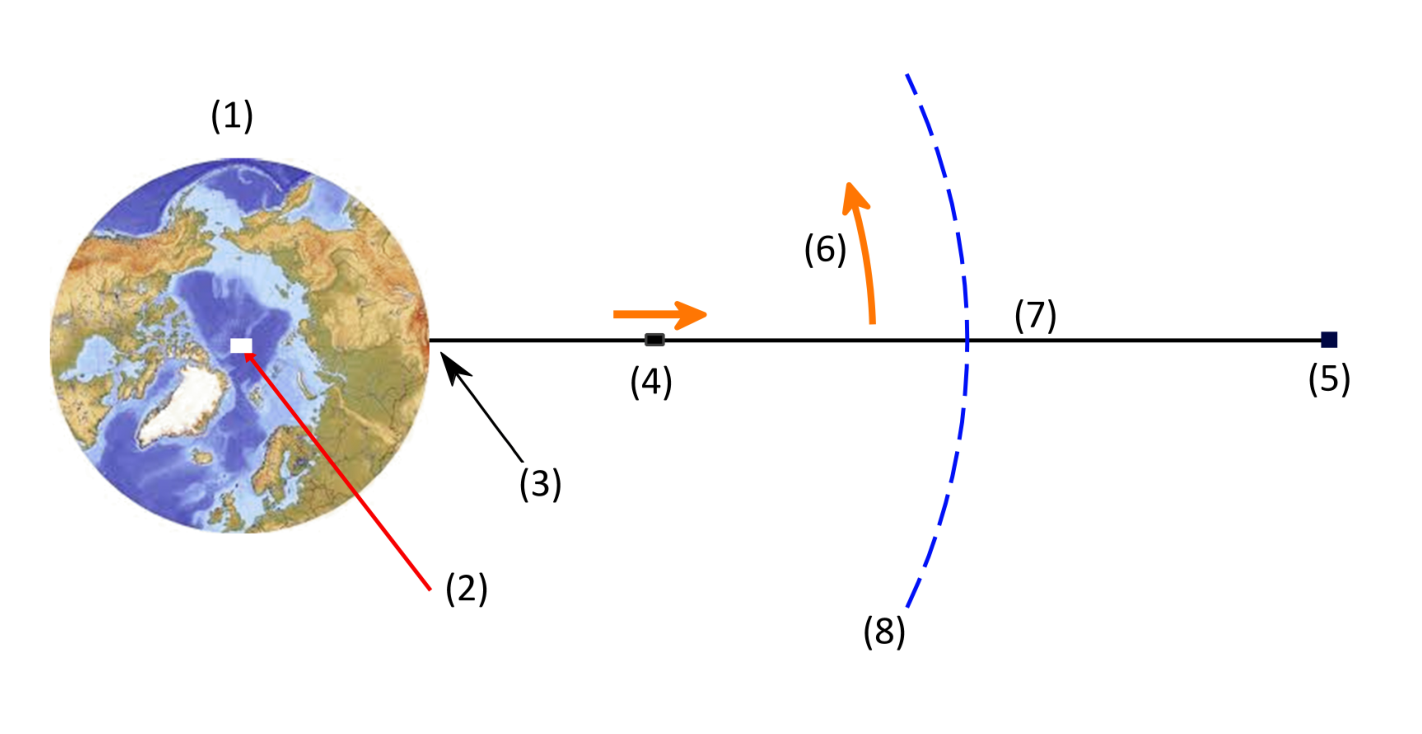
In this part we will study two designs of a space elevator, mechanical properties of carbon nanotubes, and explore some applications of space elevator. You are given the mass of Earth , radius of the Earth , geostationary orbit radius , solar mass , orbital radius of the Earth around the Sun = 1AU (AU – the astronomical unit), the orbital speed of the Earth 30.9 km/s, and the speed of rotation of the Earth around its axis rad/s.
1. The cylindrical space elevator with a uniform cross section (1.5 points)
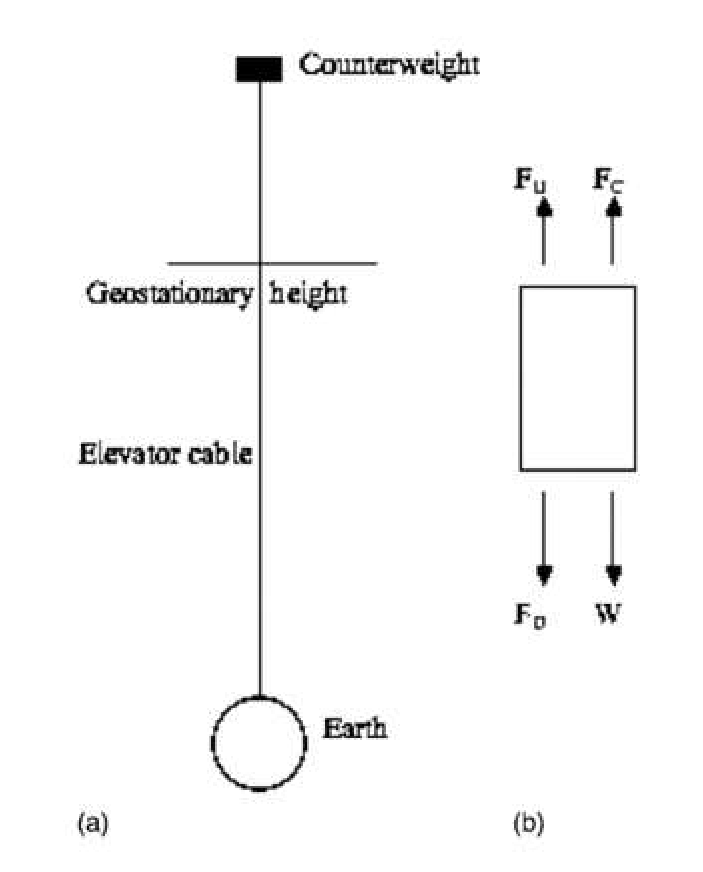
Let us first consider a space elevator, which is a cylindrical wire with a uniform cross section A and is homogeneous with density . It is a cylinder positioned vertically at the equator. Its height is greater than the height of the geostationary satellite orbit, so that the stress (force per unit area) on the bottom of the cylinder is zero. The cylinder is in tension along its entire length, with the stress adjusting itself so that each element of the cylinder is in equilibrium under the action of the gravitational, centrifugal, and tension forces.
1.1 Calculate the height of the upper end of the cylinder above the Earth’s surface [0,5 т.]
1.2 Find the distance from the Earth’s center to the point where the stress in the cylinder is maximum. [0,5 т.]
1.3 Find the expression for maximum stress of the cylinder in terms of , , and the gravitational acceleration . If the cylinder is made of steel whose density is 7900 , tensile strength is 5.0 GPa, evaluate the ratio between the maximum stress and the tensile strength of steel. Tensile strength is the maximum stress a material can withstand. [0,5 т.]
2. Carbon nanotubes (2.5 points)
Calculation in the previous part shows that in order to build the space elevator, it is necessary to have light materials with very high tensile strength. Carbon nanotubes are materials that meet such requirements because of strong chemical bondings between very light atoms. Two natural polymorphs of carbon are diamond and graphite. In diamond every carbon atom is surrounded by four nearest neighbor (NN) atoms to form a tetrahedron. Graphite has a layer structure. In each layer, carbon atoms are arranged in a hexagonal plane lattice with three NNs. Although diamond is known as the hardest materials, covalent bondings between carbon atoms in hexagonal layers of graphite is stronger than those between carbon atoms in diamond tetrahedra. Graphite is much softer than diamond because of the van der Waals bonding between carbon atoms of different layers, which is much weaker than covalent bonding.
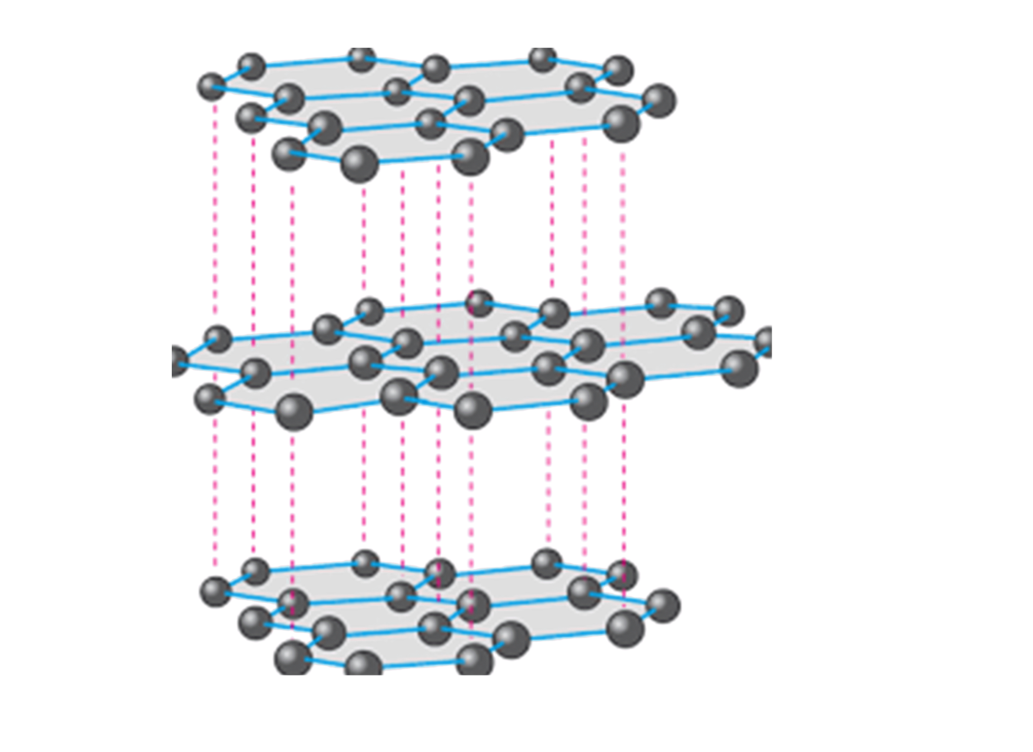
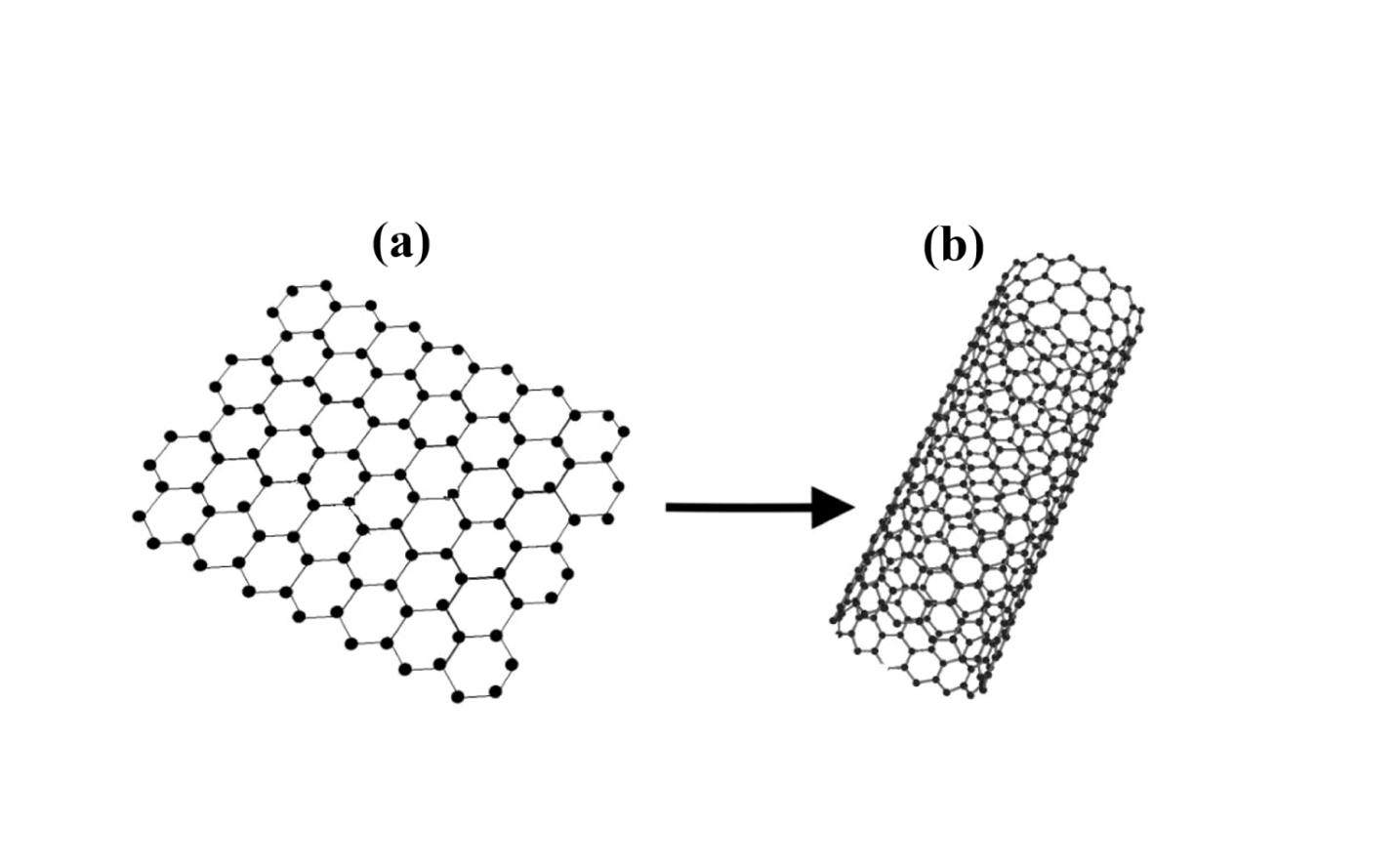
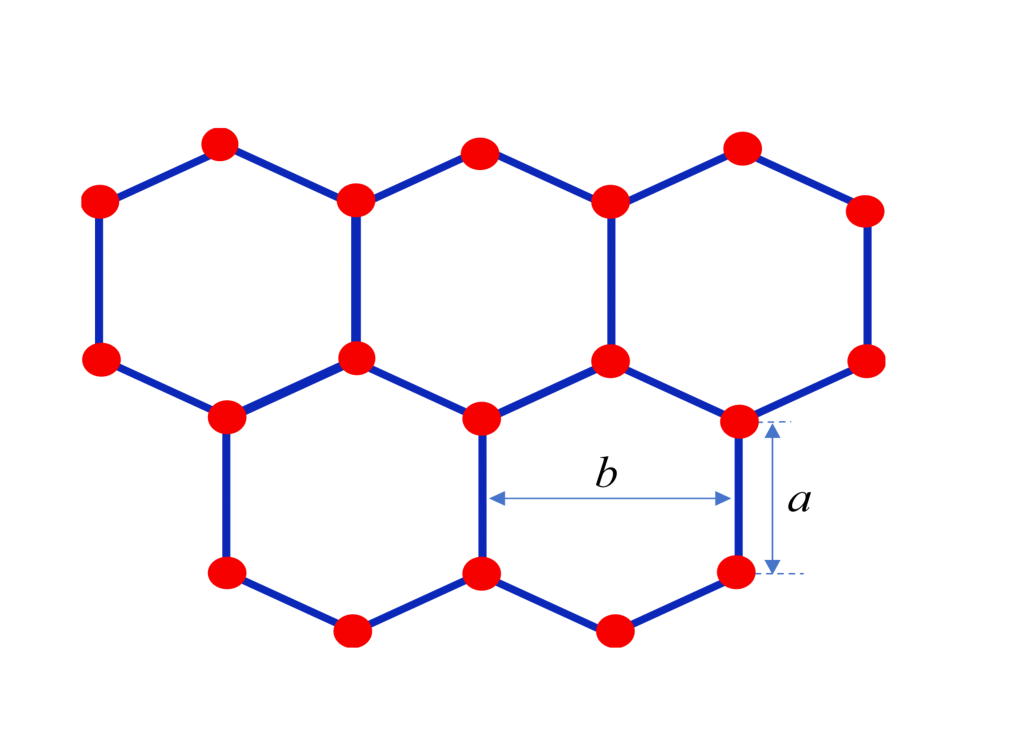
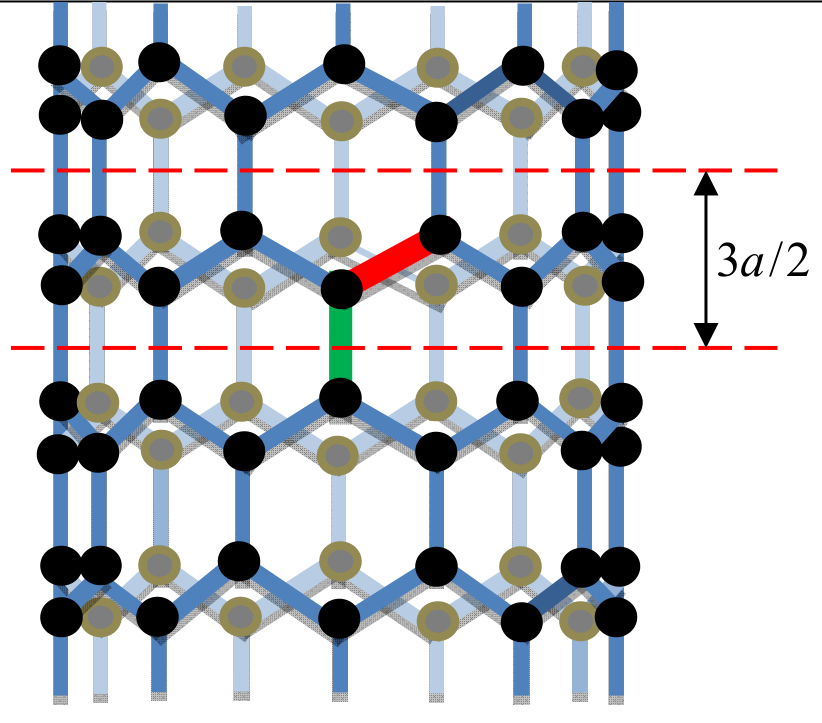
A monatomic layer in graphite is called graphene and has monoatomic thickness. Isolated graphene sheet is not stable and has a tendency to roll up to form carbon spheres or carbon nanotubes. The hexagonal crystal lattice of graphene is depicted in Fig. 4. The distance between two NN carbon atoms is and the distance between two closest parallel bondings is . Because the covalent bondings between carbon atoms in graphene are very strong, mechanical properties of carbon nanotubes are very special. They have an extremely large Young’s modulus and tensile strength, as well as a very light density. Young's modulus is defined as the ratio of the stress along an axis to the strain (ratio of deformation over initial length) along that axis in the range of stress in which Hooke's law holds.
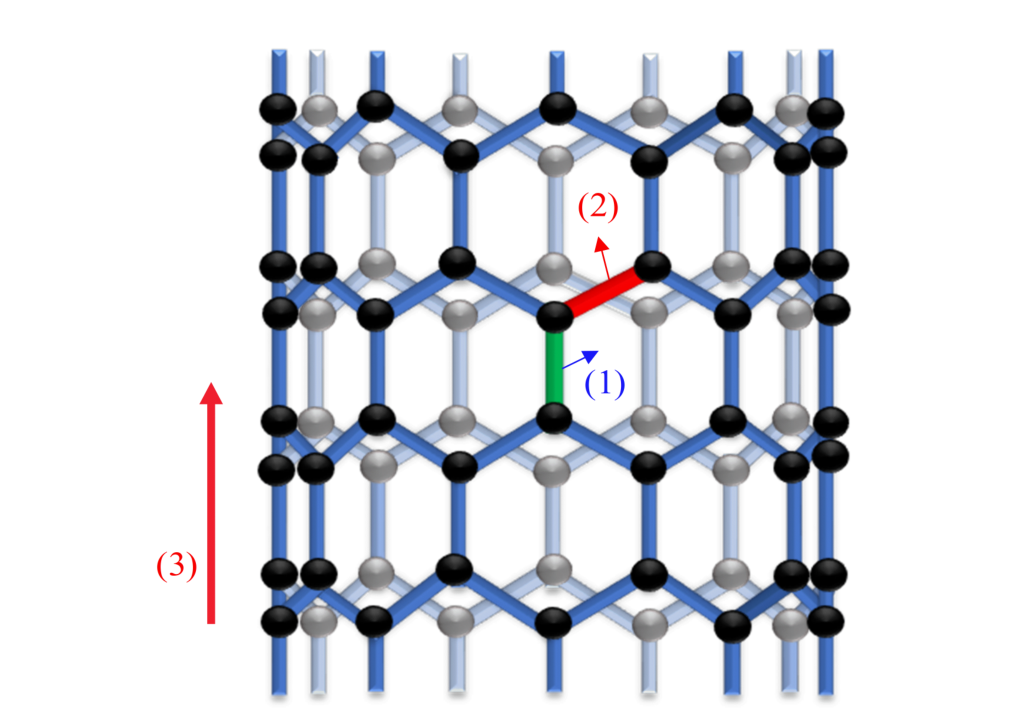
Now we examine some mechanical properties of a carbon nanotube having 27 carbon-carbon bondings parallel to the tube axis (for an illustration, see Figure 5). The bonding between two carbon atoms can be described by the Morse potential . Here is the equilibrium distance between two NN carbon atoms, is the bonding energy, and is the displacement of the atom from the equilibrium position. Hereafter, we approximate the Morse potential by a quadratic potential . All non-nearest-neighbor interactions are neglected. In this approximation, one can propose that carbon atoms are bonded through “springs” with the spring constant . Changes in angles between bonds are neglected.
2.1 Find coefficients and in term of and [0,25 т.]
2.2 Calculate the value of the spring constant . [0,25 т.]
2.3 Calculate the value of the Young’s modulus of the carbon nanotube. [0,5 т.]
In order to estimate the tensile strength, we assume that when the “spring” connecting carbon atoms has the maximum extension the harmonic potential energy equals to the bonding energy.
2.4 Calculate the value of the maximum extension of the spring. [0,5 т.]
2.5 Estimate the tensile strength of the carbon nanotube. [0,5 т.]
2.6 Given that the molar mass of carbon is 12 g, estimate the density of the carbon nanotube. [0,5 т.]
3. The tapered space elevator with a uniform stress (2.5 points)
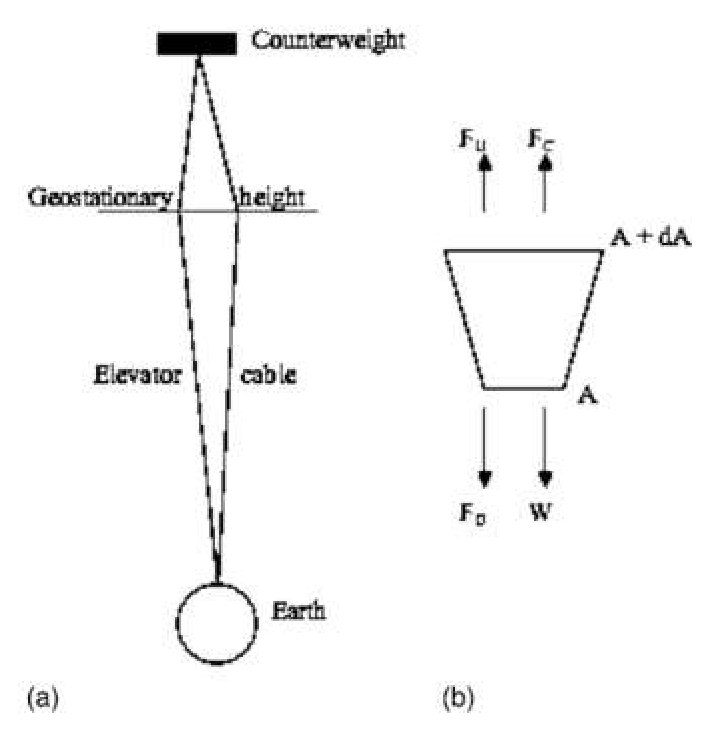
In the previous section, the density and the tensile strength of carbon nanotubes have been evaluated theoretically. These evaluated values indeed depend on the specific structure of carbon nanotubes. Nevertheless, the idea of space elevator construction is truly feasible. Now we will study a new space elevator design of the so-called tapered tower whose cross section varies with height in such a way that both the stress and mass density are uniform over the entire tower length. The tower has axial symmetry and is positioned vertically at the equator; its height is greater than the height of the geostationary satellite orbit. Denote the cross sectional area of the tapered tower on the Earth surface by and at geostationary height .
3.1 Find the cross section as a function of distance up the tower from the ground. [0,5 т.]
3.2 The tower is designed symmetrically so that the cross sections at the two ends are equal, find the distance from the center of the Earth to the upper end of the tower. [0,5 т.]
3.3 The taper ratio is defined as . Find the taper ratio of the tower made of carbon nanotubes with tensile strength 130 GPa and density . [0,5 т.]
3.4 We can considerably shorten the length of the elevator by terminating it at the upper end by a counterweight of the appropriate mass. Let be the height of the tower relative to the geostationary height, and find the relation of mass of the counterweight and . [1 т.]
4. Applications: launching payload into orbit and spacecraft to the other planets (1.5 points)
The main application of space elevator is the use of the tower's rotational energy to launch payload into orbit or send spacecraft to the other planets. It is very easy to get payload into space: we simply have to make it ride up the elevator to an altitude r and release it from rest. For simplicity in the calculations, let us assume that the motion of the tower occurs in the plane of Earth's orbit.
4.1 Find the critical height up the tower, measured from Earth’s center, at which the object would have to be released from rest to escape Earth’s gravity. [0,5 т.]
Building a tower of greater height than is necessary if we wish to use it to launch spacecraft on voyages to other planets. Given that the tower height is 107000 km from Earth’s center.
4.2 Find the minimal and the maximal distances from the Sun that a spacecraft released from rest from the top of the tower can reach. Give your answers in astronomical units. We neglect the Earth's gravitational attraction at this height. [1 т.]
Отговори
1.1 145000 km
Official: km, with km from the Earth's center.
1.2
1.3 ≈
Maximum stress 383 GPa; ratio 76.5.
2.1
2.2 ≈ N/m
2.3 342 GPa
2.4 ≈ nm
2.5 171 GPa
2.6 1440 kg/m³
3.1
3.2 151000 km
3.3 1.623
3.4
4.1 ≈ km
4.2 rmin = 0.43 AU, rmax = 5.3 AU
Решение
Theory Q2 — Space elevator (8 points) — Solution and Marking Scheme
1 Cylindrical Space Elevator with Uniform Cross Section
1.1 (0.5pt) Consider a small element of the cylinder of thickness at position , there are four forces acting on that element: gravitational , centrifugal , cable tension at position , tension at position . Positive direction is chosen from the Earth center outward. The net force must be zero, therefore:
[0.1]
Hence
[0.1]
Note that, the tensions at the ends of the cylinder are zero. Integrating the above equation from to , one obtains the stress at
[0.1]
Similarly, integrating from to H (the distance from the Earth center to the upper end of the cylinder), one obtains the same stress at
[0.1]
Equating the two above expressions, one arrives to the equation:
from where H is determined: km.
The height of the cylinder km. [0.1]
Note: Students can just equalize the net gravitational force and the net centrifugal force acting on the cylinder to obtain H correctly: full mark.
1.2 (0.5pt) The maximal stress is determined from the requirement
[0.25]
which yields [0.25]
1.3 (0.5pt) Maximal stress is expressed by
[0.25]
Numerical calculation with one obtains the ratio:
[0.25]
This ratio is much larger than 1, therefore steel is not suitable to build this kind of elevator.
If eq. (2) is not obtained and other correct equation like eq. (1) is derived - 0.1pt from full mark (get only 0.15pt for maximal stress).
2 Carbon Nanotubes
2.1 (0.25pt) Expand exponential function in series, and limit to the lowest power of , one has and gets and [0.1]
. [0.15]
2.2 (0.25pt)
[0.1]
then . [0.15]
2.3 (0.5pt) Young’s modulus of the carbon nanotube. Denote the diameter of the carbon nanotube, one has .
[0.25]
[0.25]
2.4 (0.5pt)
[0.25]
[0.25]
2.5 (0.5pt) Tensile strength of the carbon nanotube, . [0.5]
2.6 (0.5pt) Volume contains 18 carbon atoms, therefore the density of the carbon nanotube,
[0.25] [0.25]
3 Tapered Space Elevator with Uniform Stress
3.1 (0.5pt) The solution to this section is analogous to that given in the previous section, however, now one has to take into account the fact that the stress is constant, but the cross section area A varies along the tower.
[0.25]
where is gravitational acceleration at the Earth surface. By integration one can obtain the tower cross section as:
[0.25]
3.2 (0.5pt) Using the condition one arrives to the equation , which allows to determine [0.25]
[0.25]
3.3 (0.5pt) The ratio where [0.5]
3.4 (1.0pt) Net force exerted on the counterweight must be zero
replacing from the equation for cross section area, one can determine the counterweight mass. [0.5]
[0.50]
4 Applications
4.1 (0.5pt) An object can leave the Earth if its energy at the distance satisfies
[0.25]
In order to launch an object, the upper end of the tower must locate above the distance . [0.25]
4.2 (1.0pt) We denote the Earth orbital velocity as , the spacecraft velocity when it’s released from the tower top as . The spacecraft can reach the furthest distance from the Sun if is parallel to . The spacecraft velocity relative to the Sun is . The Earth orbital radius also is the smallest distance from the sun (if one neglects the tower length compared to the radius of the Earth’s orbit). is the apogee distance of the spacecraft from the Sun, is its velocity at apogee. Angular momentum and energy conservation laws read
[0.1]
[0.1]
Here the energy term due the earth’s gravity is neglected. Eliminating one has
[0.1]
from which
[0.1]
Numerical calculation gives =5.3AU, that covers Jupiter’s orbit. [0.1]
Similarly, for the spacecraft to approach as close as possible to the Sun, the released velocity must be antiparallel to . The spacecraft velocity relative to the Sun is , is the perigee distance of the spacecraft from the Sun, is its velocity at perigee.
The previous angular momentum and energy conservation laws still hold,
[0.1]
[0.1]
Here the energy term due the earth’s gravity is neglected. Eliminating one has
[0.1]
from which
[0.1]
Numerical calculation gives , meaning the Mercury’s orbit is within our reach. [0.1]
References
[1] Artsutanov, Y. Kosmos na elektrovoze. Komsomolskaya Pravda July 31 (1960); contents described in Lvov Science 158, 946–947 (1967).
[2] Pearson, J. The Orbital Tower: a Spacecraft Launcher Using the Earth's Rotational Energy. Acta Astronautica 2, 785 (1975)
[3] Aravind, P. K. The physics of the space elevator. American Journal of Physics 75, 125 (2007).
[4] Bochníček, Z. A Carbon Nanotube Cable for a Space Elevator. The Physics Teacher 51, 462 (2013).