APhO 2019, Теория — Задача 2. X-ray jets from active galactic nuclei
Theory Q2 — Asian Physics Olympiad Adelaide 2019 — English (Official) — X-ray jets from active galactic nuclei
Условие
Introduction
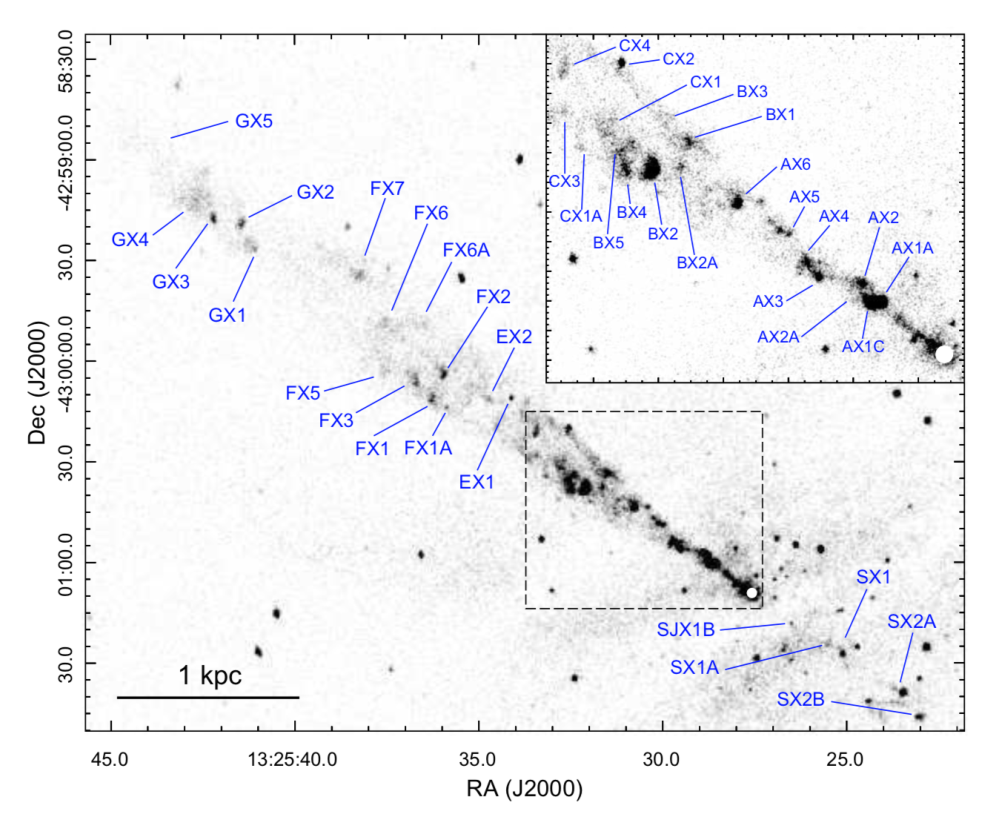
Active galactic nuclei (AGN) are supermassive black holes which form the centres of galaxies, and emit large amounts of energy in radiation and particle flows. One feature of many AGN are jetted outflows, which can be observed through radio emission, and sometimes also in other parts of the electromagnetic spectrum, including x-rays. These jets are large flows of plasma at relativistic speeds, over lengths of order m, which is tens of thousands of light years. The x-ray emission from jets is usually dominated by synchrotron emission from relativistic electrons gyrating in the magnetic field of the jet.
Part A: 1D fluid model of a jet
A simple model of the flow of jets assumes that the flow is steady and directed radially away from the central AGN, so approximately one dimensional, and that the plasma in the jet is in pressure equilibrium with its surroundings. There is assumed to be a constant rate per volume of mass injected into the jet from stars which lose their outer layers as they move through their life cycle.
The jet is described in terms of the coordinate representing distance from the AGN, , and the opening radius of the conical jet. These distances are measured in parsecs, where . The speed of the jet flow is assumed to be directed radially away from the central AGN, and be a function of only. The plasma in the jet is comprised of electrons, protons, and some heavier ionised nuclei. The average energy carried by each particle in the jet, in the reference frame of the bulk flow of the jet (which we will call the jet frame), is , where the term includes all thermal kinetic energy and potential energies in terms of the pressure and is the number density of the plasma.
As the stars, which the jet flows past, move through their life cycles they can lose part of their atmosphere. This results in a uniform rate of injection of mass per unit volume into the jet, and the injected particles are assumed to be at rest relative to the AGN.
This model can be applied to the Centaurus A jet. Centaurus A is one of the nearest AGN, so it is possible to observe its jet at relatively high spatial resolution. The total power carried by the jet is estimated to be J.s. See below for a diagram of a simple geometrical description of the Centaurus A jet, including measurements of some jet parameters. is the coordinate of the start of the jet, and the coordinate of the end of the jet. In Centuarus A the average mass per particle is and .The pressure in the plasma surrounding the jet is , where .
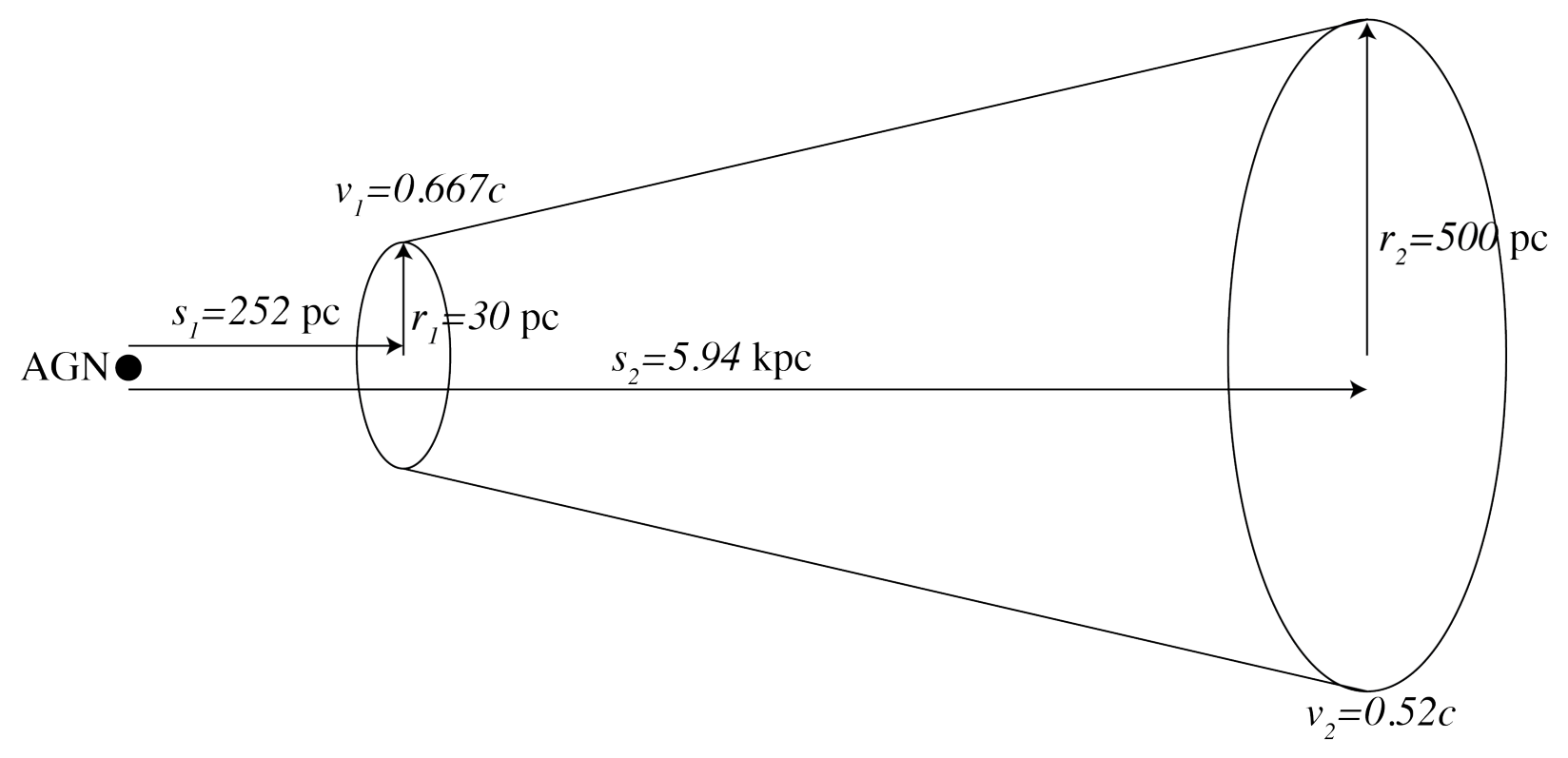
The jet is described by the following parameters, all of which depend on the distance from the AGN:
- the opening radius of the jet in the AGN frame
- the cross sectional area of the jet in the AGN frame
- the speed of the jet in the AGN frame
- the lorentz gamma factor of the jet in the AGN frame
- the number density in the frame of the jet
Any of these parameters can be used in your answers to A1-4.
A.1 Find the number density of particles, , in the frame of the AGN, in terms of the proper number density, and other jet parameters. The proper number density is the number density in the frame which is locally co-moving with the jet plasma outflow, which we will call the jet frame. [0,3 т.]
A.2 Find the flux of particles, , across a cross section of the jet with area , at a distance from the AGN. [0,2 т.]
A.3 Write a continuity relationship between the particle flux into the jet and out of the jet in terms of the jet parameters at and , and , the total volume of the Centaurus A jet and other required parameters. [0,5 т.]
A.4 Write a relationship between the energy flux into the jet, and the energy flux out of the jet in terms of the jet speeds, cross sectional areas and proper number densities at and , the volume, , of the jet and any other required parameters of the Centaurus A jet. [0,6 т.]
The power carried by a jet is defined to be the sum of the total bulk kinetic energy flux and the total thermal energy flux, so
where is the flux of energy through the cross section of the jet at , and is the mass flux through the jet cross section at the same distance from the AGN.
A.5 Using your answers to previous parts find . [0,6 т.]
A.6 Find numerical values for the mass fluxes , into the Centaurus A jet at , and also , out of the Centaurus A jet at , [0,4 т.]
A.7 Find an expression for the total momentum flux, , into the Centaurus A jet. Also numerically evaluate this expression. [0,5 т.]
A.8 Find a numerical value for the total force due to external pressure, , on the Centaurus A jet. [0,5 т.]
A.9 Write the expected relationship between and . Also, calculate the percentage difference between the model value of , which you found in A7, and the expected value. [0,2 т.]
Part B: Gas of ultra relativistic electrons
Consider a gas of ultra relativistic electrons (), with an isotropic distribution of velocities (does not depend on direction). The proper number density of particles with energies between and is given by , where is the energy per particle. Consider also a wall of area , which is in contact with the gas.
B.1 Write an integral expression for the total energy per volume of the electron gas. [0,2 т.]
B.2 Find an expression for the total rate of change in momentum of the gas, in the z-direction which is normal to the wall, due to collisions with the wall. [0,8 т.]
B.3 Derive an equation of state for an ultra relativistic electron gas, relating the pressure, volume and total internal energy. [0,6 т.]
B.4 Derive a relationship between the pressure and volume of an ultra relativistic electron gas undergoing an adiabatic expansion. [0,6 т.]
Part C: Synchrotron emission
In the jets from AGN, we have populations of highly energetic electrons in regions with strong magnetic fields. This creates the conditions for the emission of high fluxes of synchrotron radiation. The electrons are often so highly energetic, that they can be described as ultra relativistic with .
C.1 Find an expression for , the angular frequency of gyration of an electron with lorentz factor and travelling at an angle to the magnetic field . [0,7 т.]
As the electron is accelerated due to the magnetic field it emits electromagnetic radiation. In a frame at which the electron is momentarily at rest, there is no preferred direction for the emission of the radiation. Half is emitted in the forward direction, and half in the backward direction. However, in the frame of the observer, for an electron moving at an ultra relativistic speed, with , the radiation is concentrated in a forward cone with (so the total angle of cone is ). As the electron is gyrating around the magnetic field, any observer will only see pulses of radiation as the forward cone sweeps through the line of sight.
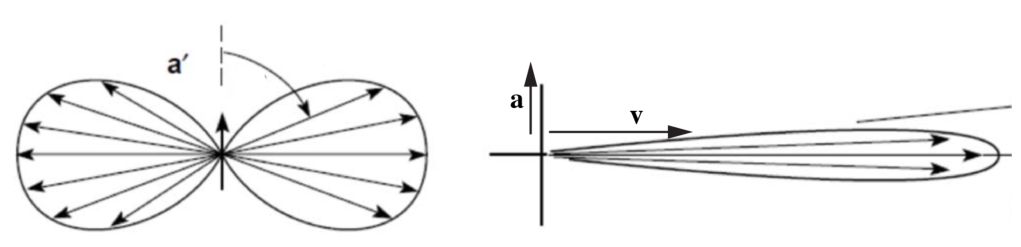
C.2 Find the duration of a pulse, , of synchrotron radiation observed from an electron with lorentz factor , travelling at an angle to the magnetic field. [0,5 т.]
C.3 Hence, estimate the characteristic frequency, , of the synchrotron radiation. [0,3 т.]
The total synchrotron power emitted is
C.4 Estimate the time, , for an electron of energy to lose its energy through synchrotron cooling. [0,2 т.]
Part D: Synchrotron emission from an AGN jet
The distribution of electron energies in a jet from an AGN is typically a power law, of the form , where is the number density of particles with energies between and . The corresponding spectrum of synchrotron emission depends on the electron energy distribution, rather than the spectrum for an individual electron. This spectrum is
Here is the energy per unit volume emitted as photons with frequencies between and
Observations of the Centaurus A jet, and other jets, show a knotty structure, with compact regions of brighter emission called knots. Observations of these knots at different times have shown both motion and brightness changes for some knots. Two possible mechanisms for the reductions in brightness are adiabatic expansion of the gas in the knot, and synchrotron cooling of electrons in the gas in knot.
The magnetic field in the plasma in the jets is assumed to be frozen in. Considering an arbitrary volume of plasma, the magnetic flux through the surface bounding it must remain constant, even as the volume containing the plasma changes shape and size.
D.1 For a spherical knot which expands uniformly in all directions from a volume of to a volume , with an initial uniform magnetic field Find the magnetic field in the expanded knot. [0,4 т.]
D.2 Find , the distribution of electron energies after adiabatic expansion of a spherical knot to a volume on the distribution of electron energy densities, given that the knot of volume has an initial distribution of electrons , where is the number density of particles with energies between and . [1 т.]
D.3 How will synchrotron cooling affect the distribution of the electrons? After a time interval where electrons have been undergoing synchrotron cooling, will the distribution of electron energies as a function of be steeper, shallower or leave it unchanged. Justify your answer with equations, by considering two electron energies . [0,3 т.]
The table below summarises some observations of knots (brighter regions) in jets from two AGN, Centaurus A (Cen A) and M87.
| AGN | Time between observations | Knot | Brightness change in x-rays | Spectral changes in x-rays | Brightness changes in other bands (e.g. UV, optical) |
|---|---|---|---|---|---|
| Cen A | 15 years | AX1C | -23% | No change | No data |
| Cen A | 15 years | BX2 | -15% | No change | No data |
| M87 | 5 years | HST-1 | -73% | No data | No change |
| M87 | 5 years | Knot A | -12% | No data | No change |
(Data from Snios et al., 2019a; 2019b.)
D.4 In the table in the answer sheet, identify the more likely cause of reduced brightness for each knot, and identify which previous part or parts support your conclusion. [0,6 т.]
Отговори
A.1
A.2
A.3
A.4
A.5
A.6
The official solution accepts answers correct to one or two significant figures.
A.7 ≈ kg m s⁻²
A.8 N
A.9 Π = FPr; deviation |(Π − FPr)/FPr| ≈ 40%
B.1
B.2
B.3
B.4
C.1
C.2
C.3
C.4
D.1
D.2
D.3 Steeper: the power law of the electron energy distribution steepens.
D.4 Cen A knots (AX1C, BX2): adiabatic cooling (Part D3). M87 knots (HST-1, Knot A): synchrotron cooling (Part D2).
Решение
Part A: 1d fluid model of a jet
A1
If you consider a prism of plasma in the jet frame, it contains a number of particles , has length in the direction of motion, and cross sectional area . The total number of particles in the volume is invariant on transformation into the AGN frame, however the volume occupied by the plasma changes as lengths are contracted in the direction of motion, while perpendicular lengths are unchanged. Hence, , and .
This gives us two relationships:
and
Equating these gives
which leads to
A2
The particles in the jet have a bulk flow speed of , so in a time a volume crosses the cross section of the jet. Using the number density in the AGN frame,
A3
As the plasma travels along the jet there are no particles passing through the side boundary of the jet. Hence, the total flux through the curved edges of the jet is zero, and the total flux into the jet is the flux in through the cross section at is and the total flux out of the jet is . There is an additional term in the continuity equation due to the mass injection. There are particles injected.
This gives
A4
Similarly, in the AGN frame the energy flux
We use previous results for all quantities except average energy per particle.
Consider the total energy in a volume of the plasma, in the jet frame. As this is the proper frame v(s)=0.
Transforming to the AGN frame, , and .
Hence,
Energy conservation requires that the total energy flux out of the jet is equal to the energy added through injection of mass, so
A5
From the definition of jet power and also (8),
Here is the flux of mass flux across the surface, so and
In order to find how jet power varies along the jet, we consider jet power at two points along the jet.
We can identify the two terms with to be those from the left hand side of (8), and the two terms with are times the left hand side of (6). Making these substitutions,
This argument applies to arbitrary and , so the jet power is constant along the jet and .
A6
We start from (10) and substitute , to arrive at
Rearranging to find gives
Using the relationship and substituting values for and respectively into (18), give and .
Note: some of the input values are given to one significant figure only. Hence, answers which are correct to this degree of precision and are given to one or two significant figures are accepted as correct.
A7
From lorentz transforming from the jet frame where to the AGN frame, the average momentum per particle is . As the momentum is directly proportional to the total energy, the flux argument is the same, and
This can be related to the jet power and ,
Again, there is no particle flux, and hence no momentum flux through the sides of the jet, so the total momentum flux out of the jet is
Substituting values for the jet at and gives .
A8
The total force on the jet due to external pressure has contributions from the cross section at , , at , , and from the pressure on the curved surface. We have a linear relationship .
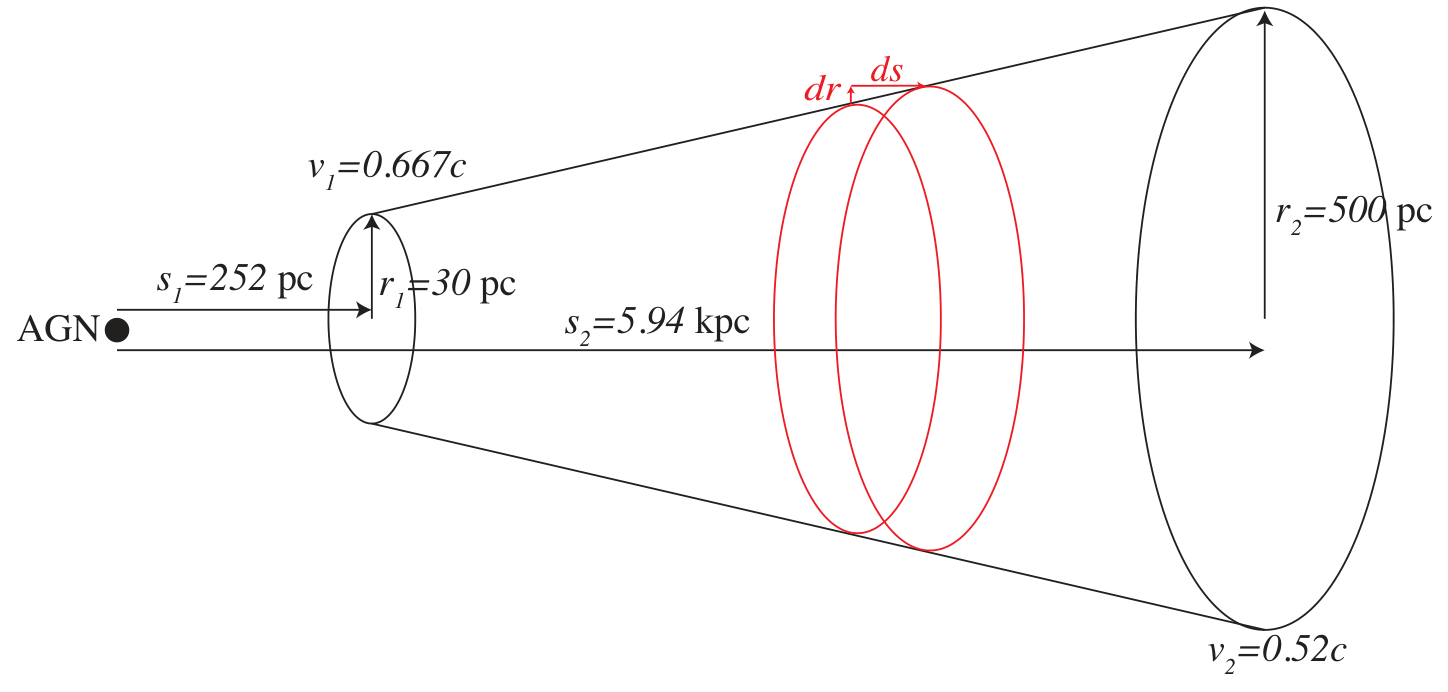
The nett pressure force on the surface is only the component in the direction. As the force is perpendicular to the surface, this results in a factor of . Consequently
where .
The total force due to the external pressure,
Evaluating the integral gives , so .
A9
As there are no other forces on the jet, it is expected that .
The % deviation is
Gas of ultrarelativistic electrons
B1
The total energy per volume is
B2
Consider the particles colliding with a surface ,with the normal to the surface in the -direction, in time . As the electrons are ultrarelativistic, theirs speeds are all approximately . We assume that the collisions with wall are elastic, and electrons depart with their parallel momentum unchanged and . Hence, , where , since the electrons are ultrarelativistic and .
The distribution is isotropic so electrons are equally likely to be travelling in any direction.
All electrons within a parallelepiped of length which approach the surface at an angle will hit it in the time . The volume of the parallelepiped is . From here, the total change in momentum is
B3
As the remaining integral in the expression above was identified as the energy per volume in B1, . The pressure is the force per area normal to the wall, so . Combining these gives , or , which is the equation of state.
B4
For an adiabatic process so . , so equating these expressions gives
Synchrotron emission
C1
An electron in a magnetic field has a component of its velocity, along the magnetic field, and perpendicular to the field. The parallel component of the velocity remains constant, but in the perpendicular direction the electron experiences a force in a direction perpendicular to its motion, so it undergoes simple harmonic motion. The perpendicular component of its velocity is where is its angular frequency and the radius of the circular motion. The force on the electron is . The acceleration of the electron is perpendicular to the direction of motion, so , where is the acceleration and the mass of the electron. For uniform circular motion, , so
C2
The observer only sees the synchrotron emission when they are within the forward light cone. As the electron is gyrating around the magnetic field, this direction is changing. The observer is in this light cone for time . However, the emitting electron is moving directly toward the observer over this time, so although the light emitted at the start of the pulse is ahead of the light at the end of the pulse, it is only ahead by . The pulse then has an apparent duration of
Since , we can write . As the electrons are ultrarelativistic, , and
C3
C4
Making a linear approximation,
Synchrotron emission from an AGN jet
D1
As the magnetic field is frozen in, and magnetic flux is constant, the magnetic field must decrease as the area increases in the expansion.
For a small area , . Since ,
D2
A volume of plasma with number density contains a total number of particles . As the volume expands, the total number remains constant, so .
The internal energy of the plasma , and since , . The scaling for particle energy with volume is then . This means that the particles initially with energies between and , will have energies between and . As .
Hence, we can write
The value of is determined by the relationship
Given
, and
D3
As the energy loss rate due to synchrotron emission increases as , and the cooling time decreases as , the more energetic electrons lose energy more rapidly. If we consider electrons with energies , both will move to lower energies in the distribution, but , so . This will reduce the relative number of electrons with higher energies, and steepen the power law of the electron energy distribution.
D4
For the knots in Centaurus A there is no change in the x-ray spectrum, so this rules out synchrotron cooling as in that case the spectrum would steepen (Part D3). Hence adiabatic cooling is more likely for these two knots.
For the knots in M87, there is no change in brightness in other bands. Adiabatic expansion would reduce the number density at all energies (Part D2) and hence brightness at all wavelengths, so this is not likely. Hence, synchrotron cooling is more likely for these two knots.