Asian Physics Olympiad Adelaide 2019 — Theory Q3: Tippe top · 10 т.
Условие
Part A (10.0 points)
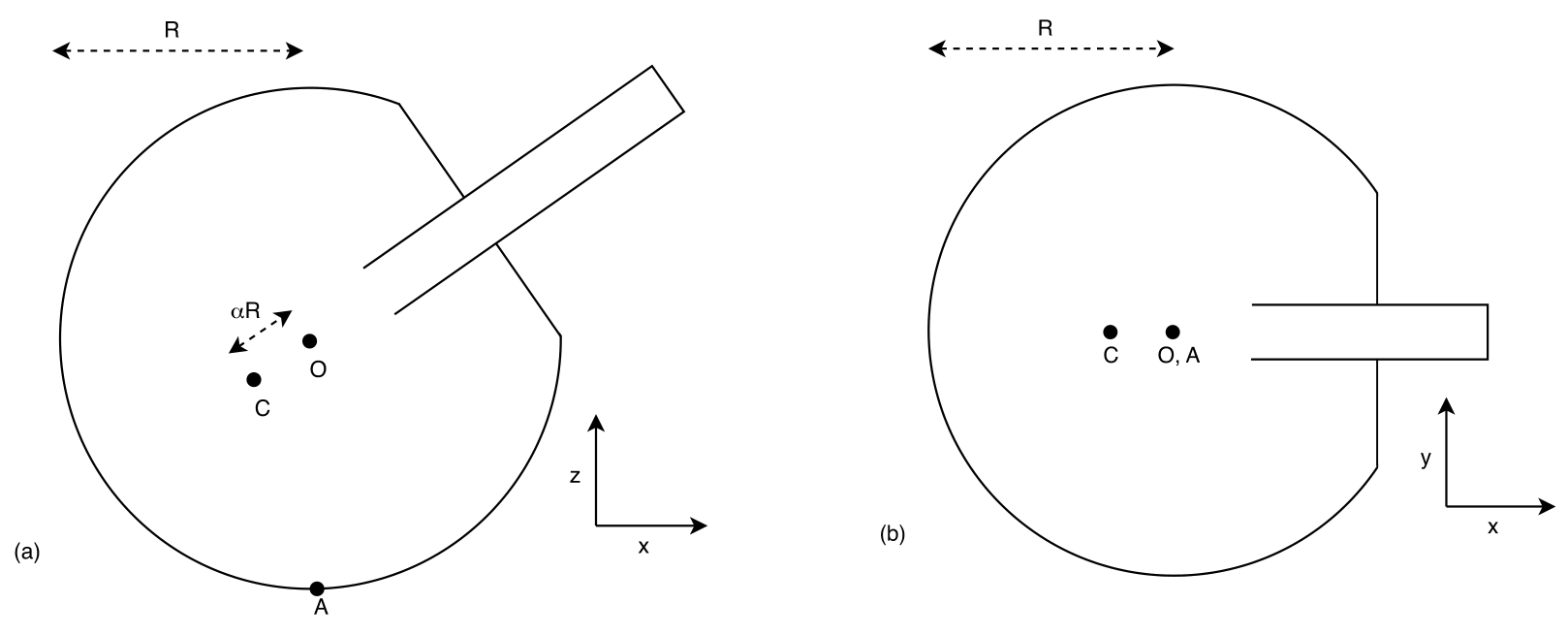
A Tippe top is a special kind of top that can spontaneously invert once it has been set spinning. One can model a Tippe top as a sphere of radius R that is truncated, with a stem added. It has rotational symmetry about an axis through the stem, which is at angle θ from the vertical. As shown in Figure 1(a), its centre of mass C is offset from its geometric centre O by αR along its symmetry axis. The Tippe top makes contact with the surface it rests on at point A; we assume this surface is planar, and refer to it as the floor. Given certain geometrical constraints and if spun fast enough initially, the Tippe top will tip so that the stem points increasingly downwards, until it starts to spin on in its stem, and eventually comes to a stop.
Figure 1. Views of the Tippe top (a) from the side and (b) from above
Let xyz be the rotating reference frame defined such that z^ is stationary and upwards, and the top's symmetry axis is within the xz-plane. Two views of the Tippe top are shown in Figure 1: from the side, and from above. As shown in Figure 1(b), the top's symmetry axis is aligned with the x-axis when viewed from above.
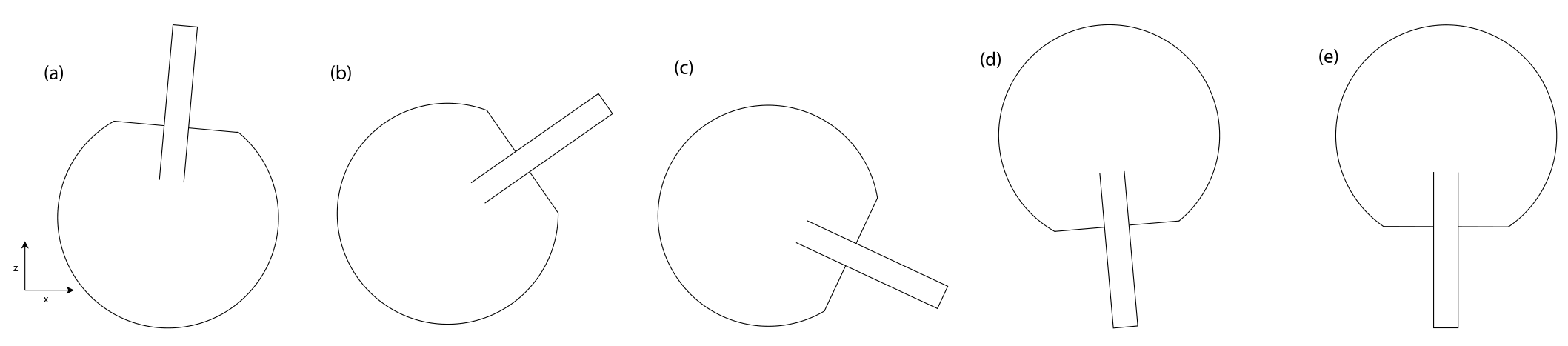
Figure 2 shows the top's motion at several phases after it is started spinning:
(a) phase I: immediately after it is initially set spinning, with θ∼0
(b) phase II: soon after, having tipped to angle 0<θ<2π
(c) phase III: when the stem first touches the floor, with θ>2π
(d) phase IV: after inversion, when the top is spinning on its stem, with θ∼π
(e) phase V: in its final state, at rest on its stem θ=π.
Figure 2. Phases I to V of the Tippe top's motion, shown in the xz-plane
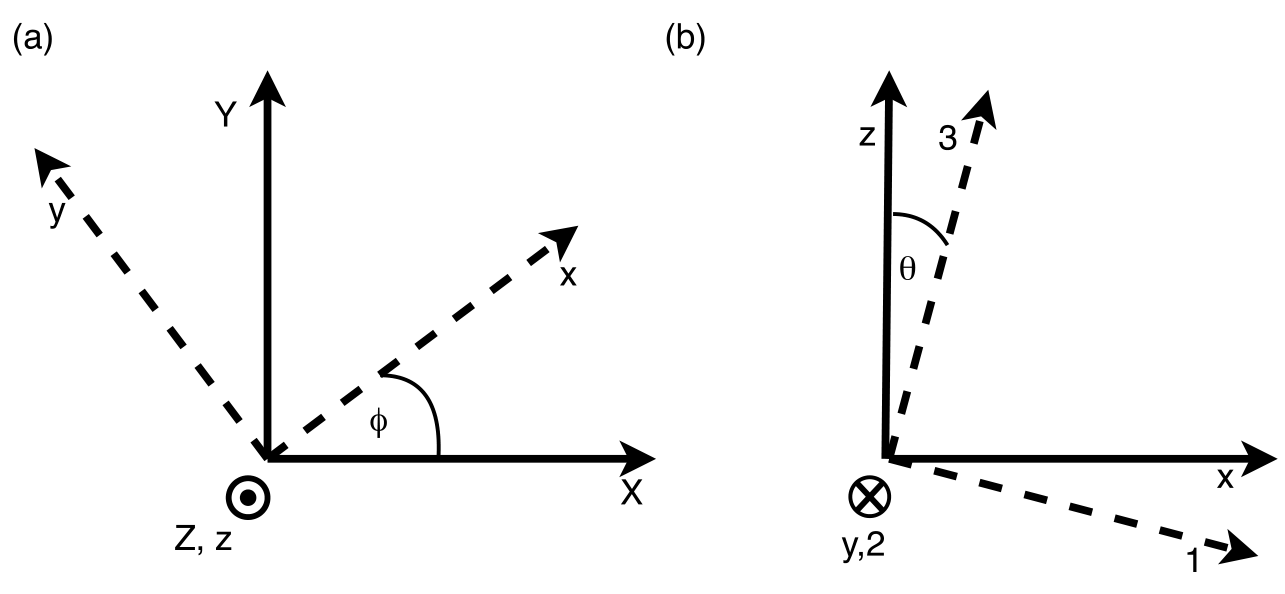
Let XYZ be the inertial frame, where the surface the top is on is wholly in the XY-plane. The frame xyz is defined as above, and reached from XYZ via rotation around the Z axis by ϕ . The transformation from the XYZ frame to frame xyz is shown in Figure 3(a). In particular, z^=Z^.
Figure 3. Transformations between reference frames: (a) to xyz from XYZ , and (b) to 123 from xyz
Any rotational motion in 3-dimensional space can be described by the three Euler angles (θ,ϕ,ψ). The transformations between the inertial frame XYZ, the intermediate frame xyz, and the top's frame 123 can be understood in terms of these Euler angles.
In our description of the Tippe top's motion, the angles θ and ϕ are the standard zenith and azimuthal angles respectively, in spherical polar coordinates. In the XYZ frame they are defined as follows: θ is the angle of the top's symmetry axis from the vertical Z-axis, representing how far from vertical its stem is, while ϕ represents the top's angular position about the Z-axis, and is defined as the angle between the XZ-plane and the plane through points O,A,C (i.e. the vertical projection of the top's symmetry axis).
The third Euler angle ψ describes the rotation of the top about its own symmetry axis, i.e. its 'spin', which has angular velocity ψ˙.
The reference frame of the spinning top is defined as a new rotating frame 123, which is reached by rotating xyz by θ around y^: 'tilting' the z^-axis down by θ to meet the top's symmetry axis 3^. The transformation from the xyz frame to the 123 frame is shown in Figure 3(b). In particular, 2^=y^.
NOTE: For a reference frame K rotating in inertial frame K with angular velocity ω , the time derivatives of a vector A within both frames K and K are related via:
(∂t∂A)K=(∂t∂A)K+ω×A(1)
The motion that a Tippe top undergoes is complex, involving the time evolution of the three Euler angles, as well the translational velocities (or positions) and the motion of the top's symmetry axis. All of these parameters are coupled. To solve for the motion of a Tippe top, one would use standard tools including Newton's laws to prepare the system of equations, then program a computer to solve them numerically via simulation.
In this question, you will perform the first part of this process, investigating the physics of the Tippe top to set up the system of equations.
Friction between the Tippe top and the surface it is moving on drives the motion of the Tippe top. Assume that the top remains in contact with the floor at point A, until such time as the stem contacts the floor. It is in motion at point A with velocity vA relative to the floor. The frictional coefficient μk between the top and floor is kinetic, with ∣Ff∣=μkN, where Ff=Ff,xx^+Ff,yy^ is the frictional force, and N is the magnitude of the normal force. Assume that the top is initially set spinning only, i.e. there is no translational impulse given to the top.
Let the mass of the Tippe top be m. Its moments of inertia are: I3 about the axis of symmetry is, and I1=I2 about the mutually perpendicular principal axes. Let s be the position vector of the centre of mass, and a=CA be the vector from the centre of mass to the point of contact.
Unless otherwise specified, give your answers in the xyz reference frame for full marks. All torques and angular momentum are considered about the centre of mass C, unless otherwise specified. You may give your answers in terms of N. Except for part A.8, you need only consider the top where θ<2π, and the stem is not in contact with the floor.
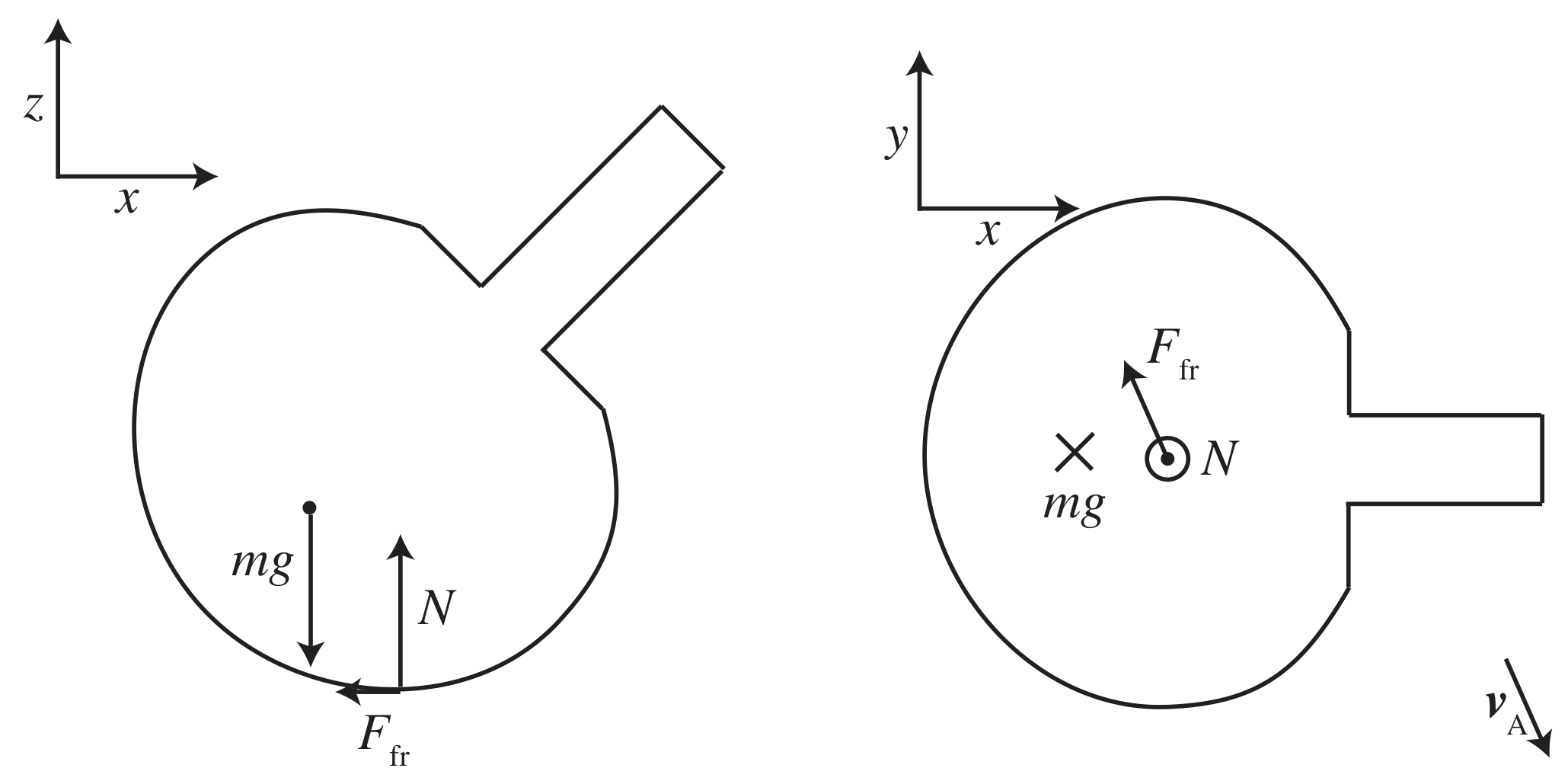
A.1 Find the total external force Fext on the Tippe top. Draw a free body diagram of the top, projected onto each of the xz- and xy-planes. Indicate the direction of vA in the space provided, on your diagram in the xy-plane. [1 т.]
A.2 Find the total external torque τext on the Tippe top about the centre of mass. [0,8 т.]
A.3 Given the contact condition, i.e. (s+a)⋅z^=0, show that the velocity at A has no component in the z-direction, i.e. we can write vA=vxx^+vyy^. [0,4 т.]
A.4 Find the total angular velocity ω of the rotating top about its centre of mass C in terms of the time derivatives of the Euler angles: θ˙=dtdθ, ϕ˙=dtdϕ, and ψ˙=dtdψ. Use Figure 3 if this is helpful. Give your answer in the xyz frame, and in the 123 frame. [0,8 т.]
A.5 Find the total energy of a spinning Tippe top, in terms of time derivatives of the Euler angles, vx, and vy. For partial marks, you may leave your answer in terms of s˙=dtds. [1 т.]
A.6 Find the rate of change of the angular momentum about the z-axis. [0,4 т.]
A.7 Which force(s) do work against gravity? Find an expression for the instantaneous rate of change of the top's energy - you may leave your answer in terms of vA. Identify and identify the components of the force and the torque that cause the change(s) in energy terms in A.5. [1,4 т.]
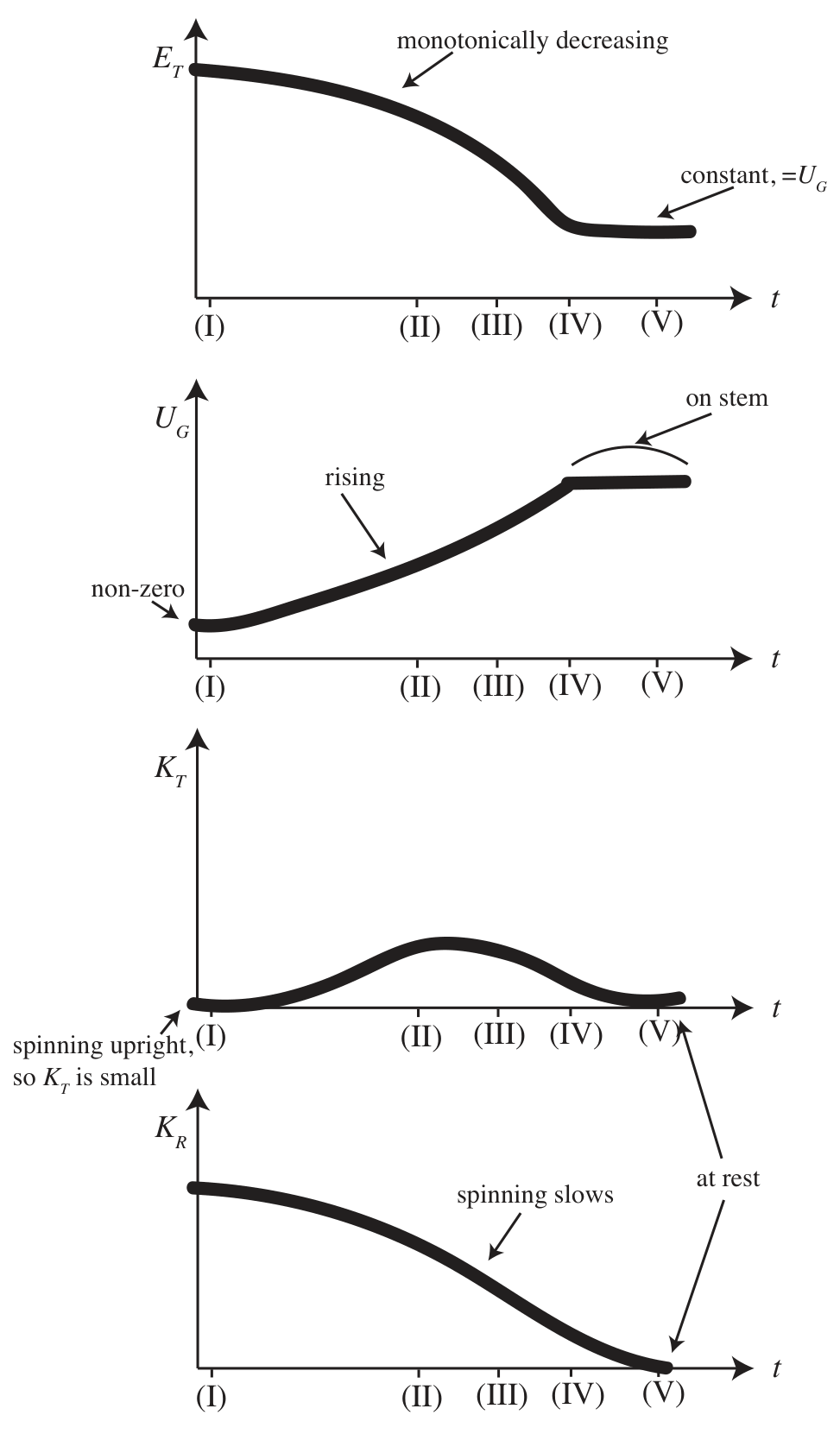
A.8 Qualitatively sketch the following energy terms in the answer sheet as a function of time, over the top's motion through the five phases I to V shown in Figure 2: the total energy ET, gravitational potential energy UG, translational kinetic energy KT, and rotational kinetic energy KR. The energy axes of your sketches are not required to be to scale. [2 т.]
A.9 Show that the components of the angular momentum L and angular velocity ω that are perpendicular to the 3^ direction are proportional, i.e.
L×3^=k(ω×3^),(2)
and find the proportionality constant k. [0,5 т.]
Combining your answers to A.1 and A.2 with subsequent results will give you the magnitude N of the normal force, as well as a system of equations, relating the Euler angles, the components vx and vy of the velocity at A, the unit vector for the axis of symmetry 3^, and their time derivatives. This system is not integrable, but instead could be solved numerically.
Integrals of motion are quantities which remain constant, and can reduce the dimensionality of the system (i.e. number of simultaneous equations to solve, whether analytically or numerically). Typically quantities such as energy, momentum, and angular momentum are conserved in closed systems, and significantly simplify the problem.
A.10 As you have seen, neither the energy nor the angular momentum are conserved for a Tippe top, due to a dissipative force and external torque. However, there is a related quantity known as Jellett's integral λ, which represents a component of the angular momentum that is conserved, i.e. some vector v. such that λ=L⋅v is constant in time.
Use your understanding of the Tippe top and results found to far, to give an expression for such a vector v. Show that the time derivative of λ is zero. [1,7 т.]
Отговори
Derivation-type question; see the official solution for each part.
A.9k=I1
A.10v=a
Решение
Reference sheet for markers
Note: some results below were used for the previous version of part A.10, and are no longer needed.
Coordinate systems for convenience (note: use of matrices not needed) xyz from XYZ
x^y^z^=cosϕ−sinϕ0sinϕcosϕ0001X^Y^Z^
123 from xyz
1^2^3^=cosθ0sinθ010−sinθ0cosθx^y^z^
Position of point A from centre of mass, in xyz and 123 frames:
At start and end (phases I and V) there is little translation so KT∼0 at I and V. Thus, energy transfer is from KR to UG.
Normal force does no work. Frictional force does work at point A. Direction is −vA:
W⇒dtdET=∫Ff⋅vAdt<0=−μkN∣vA∣
Thus Ff decreases the total energy monotonically.
16 implies only the Ff.y^ acts to decrease L⋅z^. Energy transfer from KR to UG, caused by component of frictional force in y^ direction, so component of resultant torque is in the a×y^ direction.
(2.0 marks)
Expectation (see figure):
ET: monotonically decreasing
KR: monotonically decreasing; zero at V
KT: zero at I and V; higher between; close to zero at IV
UG: flat at start and finish; higher at end; increases from I to IV then flat; increase roughly at same time that Krot decreases
(0.5 marks)
From 15,
L=Iω=I1(−ϕ˙sinθ1^+θ˙2^)+I3(ψ˙+ϕ˙cosθ)3^(17)
Taking cross product with 3^:
L×3^=I1(ϕ˙sinθ2^+θ˙1^)=I1(ω×3^)(18)
(1.7 marks)
About any axis through the centre of mass,
dtdL=0⇔τext=0
External torque given by 9,
τextdtdL⋅a=a×(Nz^+Ff)⇒τext⋅a=0=0
Thus, angular momentum in the direction of a must be constant, so v=a.
To demonstrate this mathematically, 5, 10, 18 allow