APhO 2021, Теория — Задача 2. Ray tracing and generation of entangled light
Theory Q2: Ray tracing and generation of entangled light · 10 т.
Условие
Useful formula:
Introduction
Let represent the electric field, the magnetic field, the electric displacement, and the magnetic induction. We have , with being the polarization of the medium and being the permittivity of free space. Only nonmagnetic dielectric media are considered in this problem, hence , with being the permeability of free space. The energy density and energy flow density associated with the electromagnetic field are given by and Poynting's vector , respectively.
In homogeneous dielectric media, a monochromatic plane wave of light can be described by its angular frequency , wave vector , , and . According to Maxwell’s equations, we have and . For such a wave, variations of and with position and time are given by sinusoidal functions of the phase .
Part A. Light propagation in isotropic dielectric media (1.0 points)
If the medium is isotropic, we have and , with and being the electric susceptibility and permittivity, respectively, of the medium. For a light wave of angular frequency in such a medium, a given phase will propagate in the direction with a velocity (called phase velocity) . Here is the speed of light in vacuum and is the refractive index of the medium. One can also use rays to represent a train of light waves. The propagation of a light ray is characterized by the direction and speed of the electromagnetic energy flow.
Consider a plane wave of light with angular frequency and wave vector in a homogeneous isotropic dielectric medium.
A.1 Express its phase velocity in terms of and . [0,4 т.]
A.2 What is the refractive index of the dielectric medium for the wave? [0,2 т.]
A.3 What are the direction and speed of its electromagnetic energy flow? [0,4 т.]
Part B. Light propagation in uniaxial dielectric media (4.8 points)
We now assume the dielectric medium to be uniaxial, i.e, it is electrically anisotropic along a special direction fixed in the medium, called the optic axis, which we presently call it the direction. In such a case, the displacement and the electric field are related by , , and , where , , and axes are mutually orthogonal. Consequently, the phase velocity of a light wave is anisotropic and depends additionally on the directions of and . Let and , answer the followings questions: B.1, B.2, and B.3.
B.1 Suppose the wave vector of a monochromatic plane light wave is in the plane so that . At each angle , what directions of and are permissible for the light wave? Find all possible refractive indices and express the refractive indices in terms of , , and . Find the angle for which only one value is permitted for the refractive index. [1,5 т.]
B.2 The polarization of a light wave, i.e., the direction of its electric field , can be either perpendicular (called an ordinary wave or ray ) or parallel (called an extraordinary wave or ray) to the plane. For each of the light waves you found in B.1, specify its polarization as a unit vector and indicate whether it is an ordinary or extraordinary wave. Also compute , where is the angle between and ( is positive when going from to is clockwise). [0,8 т.]
B.3 Extend the results in B.1 and B.2 to the general case when the angle between and the positive direction is still , but is not in the plane. Find all possible values of the refractive indices and the corresponding polarizations. [0,6 т.]
In a uniaxial medium, the direction of of a light wave may differ from the direction of the light ray. The phase velocity of the wave is still given by with being the refractive index along , while the ray velocity is defined jointly by the direction and the rate of energy flow.
B.4 Following problems B.1-3, consider a light wave with . Let the angle between and the direction of the ray, , be ( is positive when going from to is clockwise). Find all possible values of , speed of the ray and . Using these results, express the ray index in terms of , , , , and . [0,8 т.]
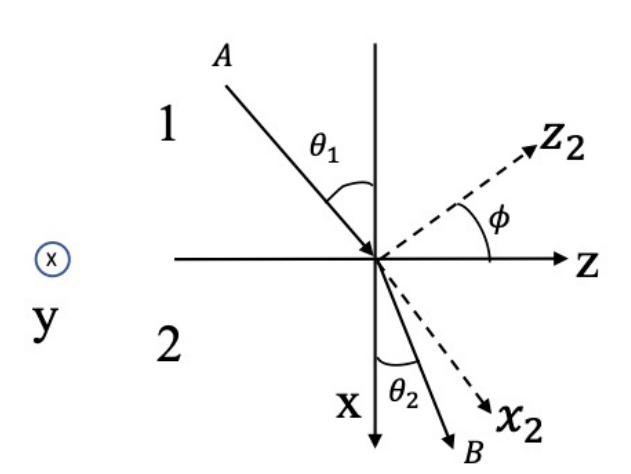
Consider the propagation of a light ray from A to B through an interface between an isotropic medium, labelled 1, and an anisotropic medium, labelled 2, as shown in Fig. 1. The interface coincides with the plane, while the plane of incidence is the plane. Let the angle of incidence be . The refractive index of medium 1 is , while the refractive indices of medium 2 for axes , , are , , and , respectively. Here axis coincides with axis. Fermat’s principle states that the propagation time for the path that the light ray goes from A to B is a minimum. For light with polarization parallel to plane and incident at the angle , Fermat’s principle leads to the following equation:
B.5 Find , , and in terms of , , , and , where , , and . From Eq. (1), find corresponding to two special orientations: and . [1,1 т.]
Part C. Entanglement of light (4.2 points)
In a nonlinear medium, the electric field is related to the polarization by . Here , , each can be any one of the three components , , , and are constants representing the second-order nonlinear susceptibility of the medium. Non-vanishing of implies that as a light wave travels through a nonlinear medium, it can split into two light waves.
Suppose that because are not all zero, the electric field in the medium is made up of a superposition of three plane waves of angular frequencies , , and , propagating with wave vectors , , and , respectively. Assume and .
C.1 Find all possible relations (known as the phase matching conditions) between these angular frequencies and wave vectors. Viewing light as composed of photons, what kinds of conservation laws do these conditions imply for the three photons involved? Write down equations expressing these conservation laws for the case that a photon with angular frequency and wave vector being split into two photons of angular frequencies and , propagating with wave vectors and , respectively. [0,8 т.]
C.2 Consider a light wave in a uniaxial medium. Denote an ordinary ray as o and an extraordinary ray as e. There are 8 possible ways of splitting for the light wave: o → o + o, o → e + o, o → o + e, o → e + e, e → o + o, e → e + o, e → o + e, and e → e + e. Assume that the refractive indices and are both increasing functions of . Using the same notations for wave vectors as in problem C.1 and considering the case that , , and are collinear, indicate which of the 8 ways of splitting are not possible. [0,8 т.]
Consider an incoming e ray traveling along direction with wave vector and in an uniaxial medium with refractive index . Suppose that, in a collinear splitting e → e + o, the phase-matching conditions are realized with , , , and . Here subscripts 1 and 2 refer to e ray and o ray. , and all point in the direction. As shown in Fig. 2(a), the optic axis (OA) of the medium lies in the plane and makes an angle with the axis. Therefore, is a function of and , i.e., . For the same incoming e ray with wave vector and , suppose its non-collinear splitting into e + o rays causes the latter two rays to separate but remain on two cones with , , as shown in Fig. 2(b). Note that in the collinear splitting, is already close to , and here is only slightly less than . In a plane perpendicular to , two circles on the cones for and intersect at points and with the line parallel to axis. As shown in Fig. 2(a), makes an angle with the optic axis and has angular coordinates with being its projection in the plane. Each vector deviates from axis only slightly so that , and . Using approximations which agree with the component of to terms of the order and the angle to , one finds that must satisfy .
C.3 Let . Evaluate , , and in terms of , , , , and and the group velocities and for the o and e rays. Estimate the angle between the axis of the cone and , and also the angle of the cone in terms of , , and . [1,3 т.]
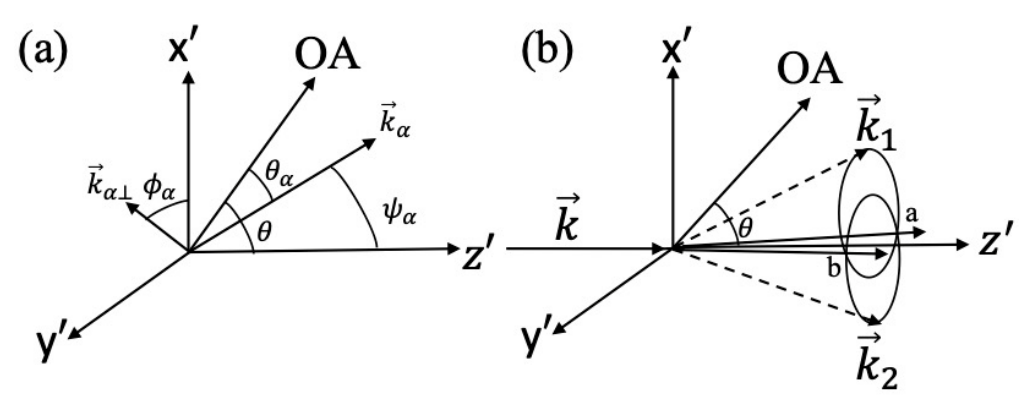
Problem C.3 shows that a photon may split into two photons which when passing through points a and b are polarized in perpendicular directions. These two photons are called entangled photon pair because if one photon that passes (called -photon) is polarized in a direction , the other that passes (called -photon) will be polarized in the direction , and if the -photon is polarized in , then the -photon will be polarized in . The entangled photon-pair state can be prepared experimentally. It is a superposition of the above two alternative states and can be expressed as . Here represents the state when -photon is polarized in direction and -photon is polarized in direction; similar meaning applies to . The coefficient can be viewed as the product of electric field amplitudes (expressed in suitable units) of - and -photons. As illustrated in Fig. 3, two linear polarizers 1 and 2 have transmission axes at angles and respectively with respect to . We may use them to perform coincidence measurement on the two photons that pass and . Let the probability of simultaneously finding two photons passing through polarizers 1 and 2 be . Alternatively, can also be regarded as being proportional to the product of intensities (after appropriate superpositions) of light passing through the two polarizers. Denote and by and respectively.
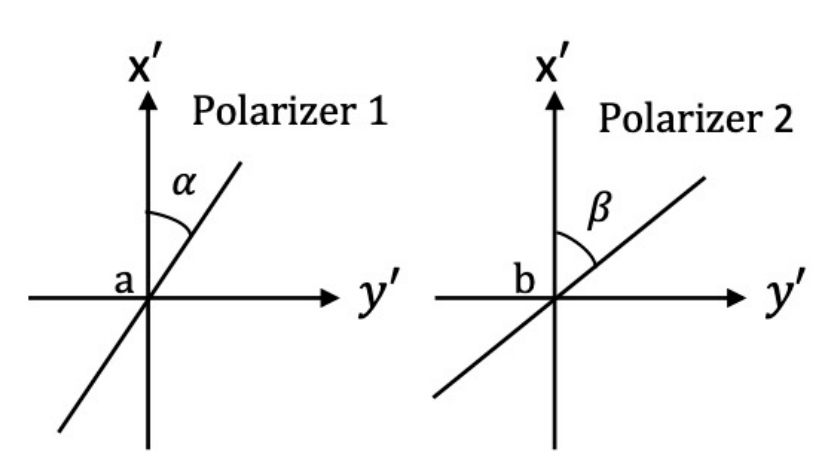
C.4 Consider the total electric field projected by linear polarizers. Find the probabilities , , , and . [0,8 т.]
C.5 Assign when polarizer 1 with angle finds an -photon and when polarizer 1 with angle finds an -photon. Similarly, or is assigned when polarizer 2 with angle or finds a -photon. If denotes the average of , the quantity has important meaning. For classical theories of light, . This is a variant form of Bell’s inequality (the Clauser-Horne-Shimony-Holt inequality). Find the expression of and evaluate for the case , , , . Indicate if is consistent with the classical theories. [0,5 т.]
Отговори
A.1
A.2
A.3
B.1 n = no with D̂ = ±ŷ, B̂ = ±(−cos θ, 0, sin θ); or n = no ne / √(no² sin²θ + ne² cos²θ) with B̂ = ±ŷ, D̂ = ±(cos θ, 0, −sin θ). Only one refractive index for θ = 0.
B.2 n = no: Ê = ±ŷ, ordinary ray, tan α = 0. n = no ne / √(no² sin²θ + ne² cos²θ): Ê = ±(−ne² cos θ, 0, no² sin θ)/√(ne⁴ cos²θ + no⁴ sin²θ), extraordinary ray, tan α = (no² − ne²) tan θ / (ne² + no² tan²θ).
B.3 n = no, Ê = ±k̂ × ẑ / sin θ (ordinary ray); n = no ne / √(no² sin²θ + ne² cos²θ), Ê = ±[−ne² cos θ k̂ + (no² sin²θ − ne² cos²θ) ẑ] / (sin θ √(ne⁴ cos²θ + no⁴ sin²θ)) (extraordinary ray).
B.4
Ordinary wave: tan αr = 0, vr = c/no, Ŝ = (sin θ, 0, cos θ). Extraordinary wave: tan αr = (no² − ne²) tan θ/(ne² + no² tan²θ), vr = (c/(no ne))√((ne⁴cos²θ + no⁴sin²θ)/(ne²cos²θ + no²sin²θ)), Ŝ = (no² sin θ, 0, ne² cos θ)/√(ne⁴cos²θ + no⁴sin²θ).
B.5 Ā = P1(n² sin²θ1 − P1), B̄ = −2P3(n² sin²θ1 − P1), C̄ = P2 n² sin²θ1 − P3². ϕ = 0: tan θ2 = n ne sin θ1 / (no √(no² − n² sin²θ1)); ϕ = π/2: tan θ2 = n no sin θ1 / (ne √(ne² − n² sin²θ1)).
C.1 ω = ω1 ± ω2, k⃗ = k⃗1 ± k⃗2 (energy and momentum conservation of photons, ħω = ħω1 ± ħω2, ħk⃗ = ħk⃗1 ± ħk⃗2). Splitting of a photon: ω = ω1 + ω2, k⃗ = k⃗1 + k⃗2.
C.2 o → o + o and e → e + e are not possible.
C.3 Official answer as printed: M = {Ko[1 − Ne(Ωe, θ) cot θ] + Ke/(2KeKo), E = −Ne/2M and F = −(Ω − Ωe)(1/uo − 1/ue) + Ne²/(4M); the angle between the axis of the cone and z′ is N/Ko = −2KeNe/{Ko[1 − Ne(Ωe, θ) cot θ] + Ke; the angle of the cone is about √(L/M)/Ko.
The official answer names the constants E and F where the problem asks for N and L; its printed expression for the cone angle equates √(L/M)/Ko to an expression without the square root.
C.4
C.5
S > 2: not consistent with classical theories.
Решение
Theoretical Question 2: Ray tracing and generation of entangled light
Part A. Light propagation in isotropic dielectric media
A.1 0.4 pt
Ans:
Solution:
From and , one obtains . By using the given identity , one finds . Since and , we find and the relation reduces to .
Now the phase velocity is determined by , we find that the phase velocity . Clearly, we have . Hence .
A.2 0.2 pt
Ans:
Solution:
From , we find
A.3 0.4 pt
Ans: ,
Solution:
To find the speed of the ray, we first note that the direction of the energy flow, given by the Poynting vector , is in the same direction of . The electromagnetic energy density with and .
Now, from , one has . Hence .
Similarly, from , we find . Hence .
We find .
Part B. Light propagation in in uniaxial dielectric media
B.1 1.5pt
Ans: , , or , , . For , there is only one permitted value for the refractive index
Solution:
From and , one obtains . Writing out components and using , we find
After a bit rearrangement, we obtain
The vanishing of the determinant yields
Clearly, for a general , we have two solutions for :
(1)
In this case, . is parallel to the axis. From and , we obtain the directions of and as and .
(2) .
After rearrangement, we find . Clearly, at , , there is only one refractive index. This is the direction of the optic axis.
In this case, . Hence lies in the plane. Hence the relation implies . The relation implies .
B.2 0.8 pt
Ans: (1) when , and this is an ordinary ray. .
(2) when , and this is an extraordinary ray. .
Solution:
(1) For , both and are parallel to the axis. This is an ordinary ray with .
(2) For , , . By substituting back into the equations of and , we find that . Hence the electric field lies in plane with ( points in direction.). Therefore, is not perpendicular to and lies in the plan in together with and . This is the extraordinary ray.
Since , is perpendicular to . Hence . Let , the relative orientation of and for a given are shown in the following figure for the case when .
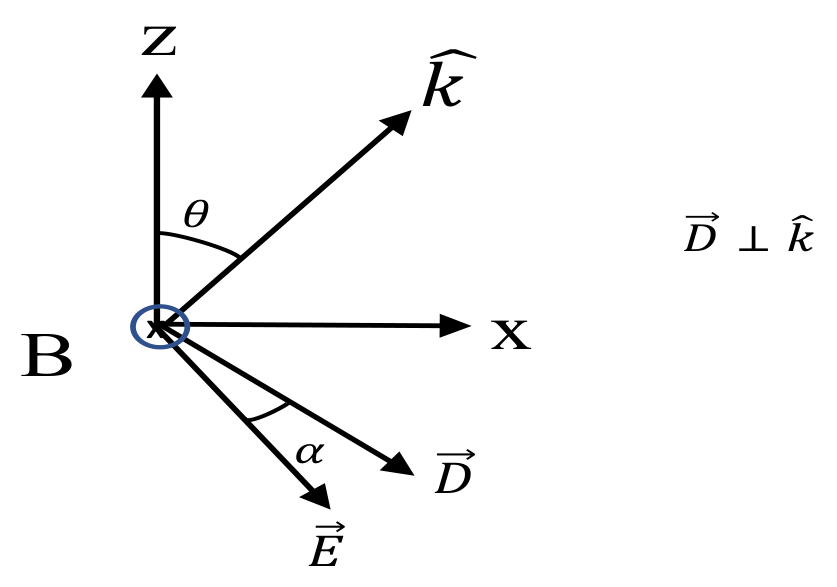
Let the angle relative to axis be and for and . We have and . Hence . The same result remains when except that , indicating that the relative orientation of and is reversed.
B.3 0.6 pt
Ans: , and this is an ordinary ray.
when , and this is an extraordinary ray.
Solution: The problem has an axial symmetry so that in the plane formed by the axis and , one can write and , where is perpendicular to . Clearly, we , , , and . Writing out the components for the equation: , we get exactly the same equations except that is replaced by . Hence all of the solutions are the same except is replaced by . Since , we obtain that when , .
B.4 0.8 pt
Ans: (1) , , ,
(2) , , .
(3)
Solution:
The direction of the energy flow is given by the Poynting vector, . Let the energy density of EM wave be and the ray velocity be . Then . Here with and . There are two cases:
(i), , , , .
, and are mutually perpendicular to each other. Hence is parallel to , i.e., and .
Now from , one has . Hence .
Similarly, we find . Hence . Since , we find . Hence .
(ii) . In this case, we can take (negative direction works as well). , and are in the plane and is perpendicular to . Therefore, the angle between and is equal to the angle between and , i.e., . This is shown in the following figure when (for , both and are negative, the relative orientation of and is reversed and ordering of and are switched).
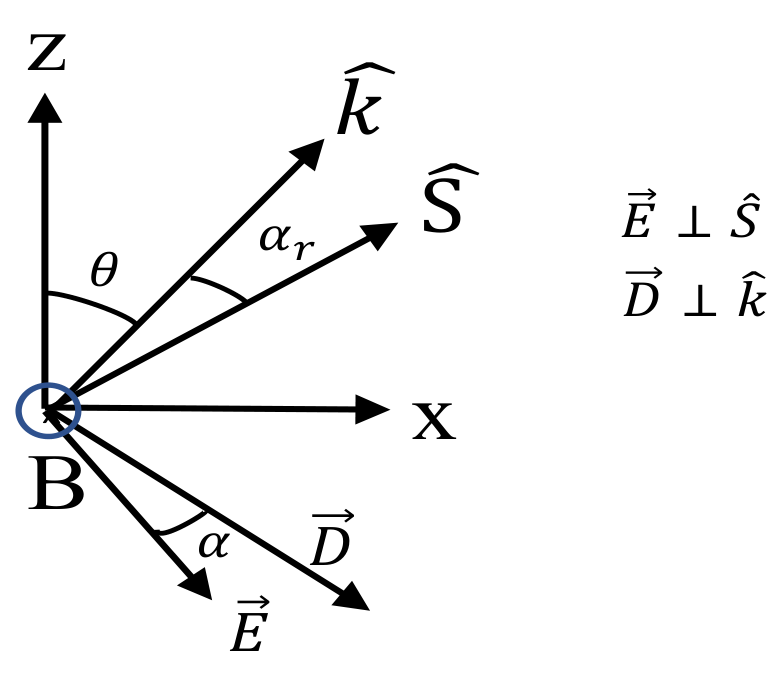
Therefore, from problem (d) (ii), we get . Now, because , we obtain . Hence the phase speed and the ray speed are related by . From , one finds .
Hence .
Clearly, . Since and , we find .
From , we find .
B.5 1.1 pt
Ans: , , .
, .
, .
Solution:
Let the distance along axis between and be and the point of the interface that the ray passes be the origin . The coordinates of B and A points can be expressed as and . The distances are then given by and . The propagation time from A to B is determined by the ray speed as , where are ray indices for medium . According to the Fermat’s principle, we need to minimize the optical path length defined by . According to problem (e), we have . For an isotropic medium, the ray index is simply the refractive index, i.e., . Using the following relations
we find
The minimum occurs when . We obtain
Recognizing , moving the second term to the left and taking square of the equation, we obtain
where , , and . By expanding the above equation out, we find
Hence , , and .
For , we have , , and . We find . Hence .
For , we have , , and . We find . Hence .
Part C. Entanglement of light
C.1 0.8 pt
Ans:(1) ,
(2) , represents the energy conservation and momentum conservation of photons.
(3) Splitting of photon: Energy conservation , momentum conservation: .
Solution:
For a light wave with frequency and , the corresponding polarization density and the electric field are in the form of , which can be rewritten as . By substituting the above form into the equation and equating the relevant exponents, we find all possible relations are
where we have made use of the fact that the frequency is positive. The meaning for the these relations is clear if one recall that the energy and momentum of a photon is given by and . The relation of represents the energy and momentum conservations when a photon with (, ) is annihilated and split into two photons with (, ) and (, ), while the relation of represents the energy and momentum conservations when a photon with (, ) is annihilated and split into two photons with (, ) and (, ).
C.2 0.8 pt
Ans: ,
Solution:
For the collinear case, the phase matching conditions become , , where , , and are indices of either o or e. Assuming that , one can solve as . We obtain
Clearly, because , if , and , the above equation cannot be satisfied. For other cases, because there is no relation between and , the phase matching conditions can be satisfied. Hence only and are not possible.
C.3 1.5 pt
Ans: (1) , and
(2) the angle between the axis of the cone and is
(3) the angle of cone is about .
Solution:
To satisfy the phase matching condition, we expand the angular frequencies and into and . Clearly, because , to satisfy , . Similarly, the conditions for the wavevectors, , can be written as and . For the o light ray, we have with . One finds that . Expanding the dependence of in to , we obtain
where is the group velocity for the ordinary ray. Hence to the second order of corrections, we get
Similarly, for the e light ray, we have with . One finds that . The expansion of is different from that for due to its angle dependence. Let the spherical angles for be and . We have
Here , is with being the group velocity for the extraordinary ray and is given by
Because , we find . Note that for , . To find , we note that for any , one has (cf. Fig. 2(a))
Since and , to the second order, we can replace by and obtain
On the other hand, . Comparing this equation to the equation for , we obtain
Putting all together, we find
The above equation when combined with the equation of and the relation , we find
Because , . The above equation can be rewritten in the form
Here . Hence () and . Clearly, the cone axis formed by is characterized by . We find that the angle between the axis of the cone and is , which is about . The angle of the cone is given by .
C.4 0.8pt
Ans: , , ,
Solution:
For -photon, let the electric field along the polarizer and perpendicular to the polarization represented by and . Here and are essentially the electric field amplitudes in appropriate units. The electric fields (the states) along and can be written as
Similarly, for -photon, we have
Hence we obtain
The state of the entangled photon pair can be written as
From the above equation, we obtain
C.5 0.5pt
Ans:
. indicates that it is not consistent with classical theories.
Solution:
One first realizes that . Using expressions for , we find
Hence . For , , , , we find . Hence classical theories do not apply.
Оригинал в Архива: Theory Q2 english.pdf · официални решения: Theory Q2 solution.pdf