APhO 2022, Теория — Задача 1. The Stern-Gerlach Experiment
22nd Asian Physics Olympiad, INDIA 2022 — Theory Q1: The Stern-Gerlach Experiment — Official (English)
General Grading Guidelines
When student’s solutions are correct and s/he also show how solutions were obtained, the student gets full credit. The scheme outlined below is helpful if the student’s answers are partially correct. Attention will be paid to the detailed solution so, if the final answer is correct but it is obtained by incorrect method(s) then no credit will be given. Alternative solutions may exist and will be given due credit.
Partial or full outcomes obtained for later sections in the problem which are incorrect solely because of errors being carried forward from previous sections, but are otherwise reasonable, will not be further penalized. For example a dimensionally wrong answer when carried forward will not get any credit in the subsequent sections. A numerically wrong evaluation when carried forward will get credit in subsequent sections unless the numerical answer is patently wrong (e.g. the value of g is 981 m/sec! )
Incorrect or no labeling of an axis is penalized by -0.1 points
The numerical answer (i) must be correct to +/- 10% AND (ii) must respect significant figures.
It maybe noted that NO micro-marking scheme takes care of all contingencies. A certain amount of discretion rests with and a certain level of judgement is invested in the academic committee.
Условие
The Stern-Gerlach experiment was performed in 1922 and it eventually led to the determination of the magnetic moment of the electron. In this experiment a beam of silver atoms each of mass kg emerges from an oven kept at temperature T= K (see Figure 1). Assume that on emerging from the oven all the atoms have the same momentum along the direction of the beam (-direction). Ignore gravity.
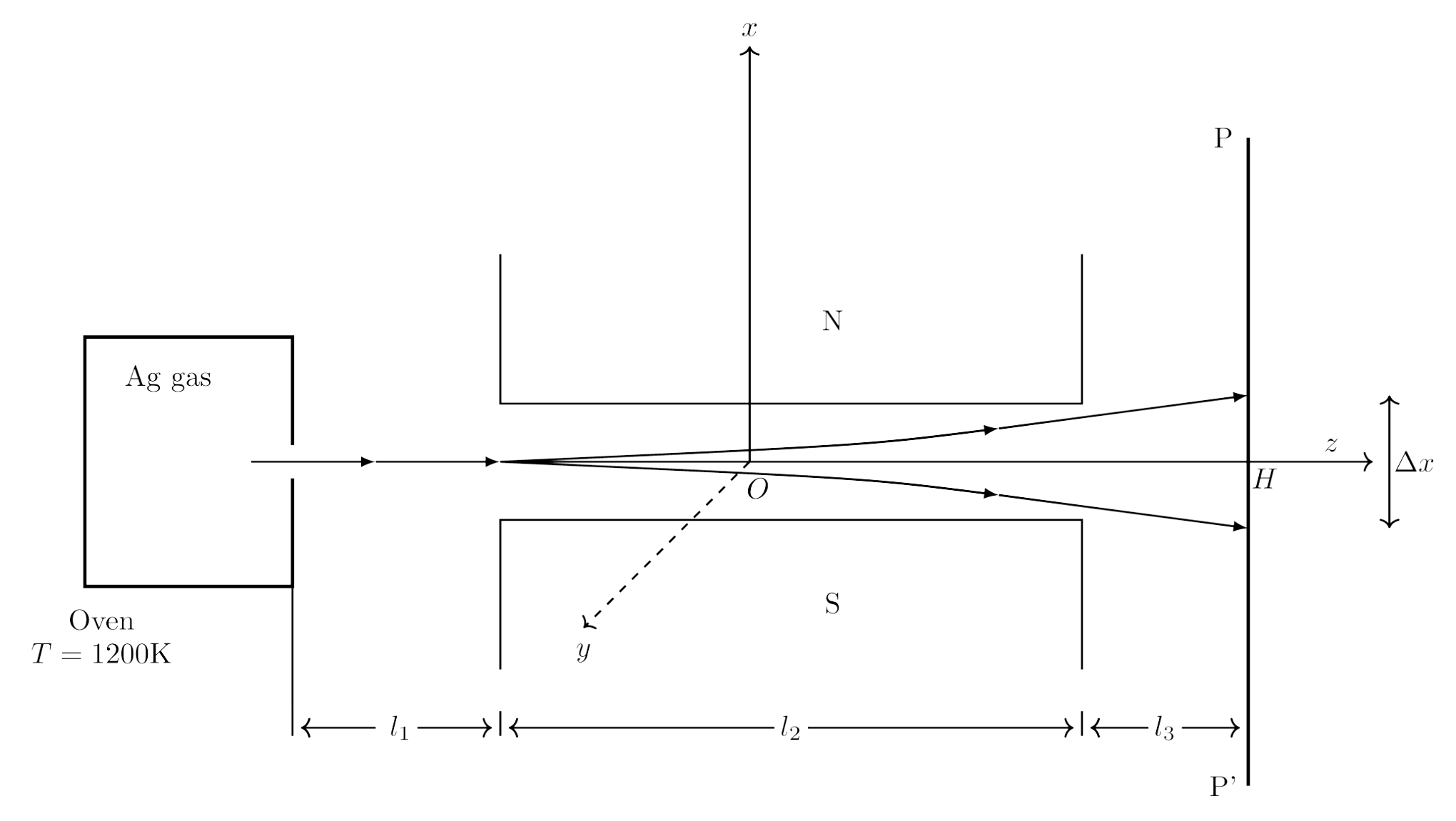
A.1 Speed of the Silver Atoms: The speed of the silver atoms emerging from the oven can be estimated to be using the equipartition theorem. Calculate this value. [0,5 т.]
B.1 The Basic Expression: After emerging from the oven the silver atoms move along the - direction over a distance m. Next, the silver atoms pass between two magnets over a distance m. The magnets produce inhomogeneous magnetic field in the -direction with constant gradient . Assume that the silver atom has a magnetic moment pointing either in + -direction or - -direction, i.e. . After passing through the magnets the silver atoms pass through a further distance m before striking the screen . The distance between the two striking beams on the screen is . Derive the expression for the splitting distance on the screen. [2 т.]
The Inhomogeneous Magnetic Field:
This part is concerned with the setup to create the inhomogeneous magnetic field (). It consists of a number of sub-parts. Two very long wires parallel to the -axis carry currents of magnitude and are located at and (see figure below). The direction of the current passing through is and for the one passing through is . The entire system is inside a medium of high relative magnetic permeability . We take = . The wires are insulated and no current leaks into the medium.
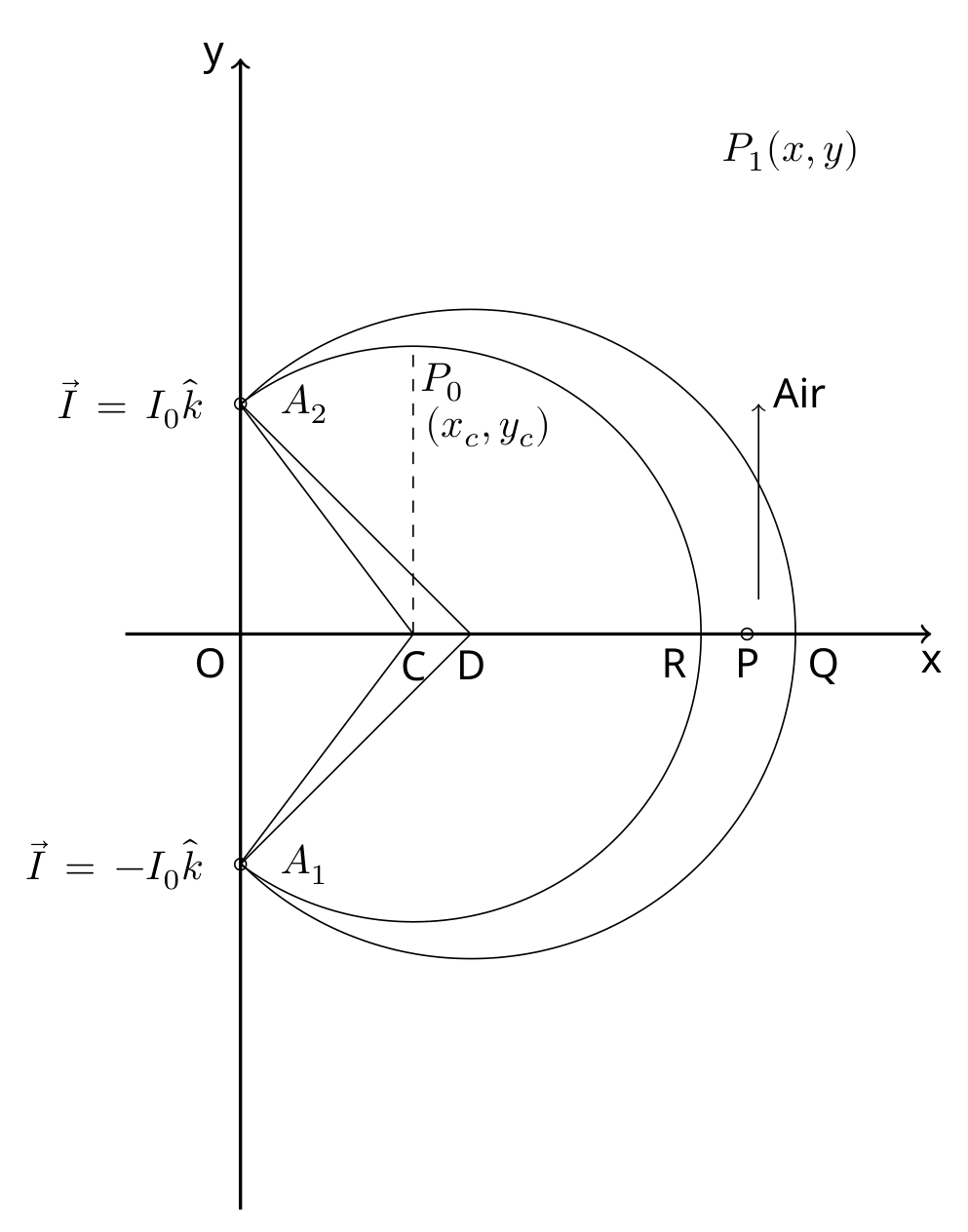
C.1 Derive the expression for the magnetic field vector at a point in the - plane (see Fig. 2). [1,5 т.]
C.2 Consider a circle with its centre C on the -axis () and with radius equal to the distance (see Figure 2). Obtain the direction of the magnetic field at circumferential points (on the axis) and at ( is parallel to the axis). [0,5 т.]
C.3 Now a small slice of the high magnetic permeability medium between the circles with radii AC and AD is removed and replaced with air at very low pressure (see Fig. 2). One can show from continuity considerations that the magnetic field in this gap region is given by the same expression as if the magnetic medium were not removed. (We shall assume this and you are not required to prove this). Hence state the expression for the magnetic field at the point in the air gap region. [0,5 т.]
D.1 The Force: As mentioned earlier the silver atoms are travelling in the plane with their velocities parallel to the z-axis and given by . Recall also that the magnetic dipole of the silver atom is . Obtain the expression for the magnitude of the force acting on a silver atom along the x-direction in terms of , , and relevant coordinates. [0,5 т.]
E.1 The Magnetic Field and its Gradient: We assume that this same force acts over a small distance along the axis (Figure 1). Assume also that the silver atoms pass through the mid-point of (Figure 2). The following experimental values are given:
Here is the magnetic permeability of free space. Obtain the numerical value of the magnitudes of the magnetic field and its gradient at this mid-point in S.I. units. [2 т.]
F.1 The Magnetic Moment of the Silver Atom: If and magnetic field is calculates as above, the Stern-Gerlach experiment yields a split of cm. Obtain the value of the magnetic moment of the silver atom in S.I. units. [1,5 т.]
G.1 The spread of the line: The silver atoms may not all have the same speed. Let there be a spread of 20 % in the beam speed. What would be the consequent spread of the dot on the screen? [0,5 т.]
H.1 The error in the magnetic moment: What is the consequent error bar on the evaluation of the magnetic moment ? [0,5 т.]
Отговори
A.1 525.5 m/s
Official solution: 5.255×10² m·s⁻¹.
B.1
C.1
C.2 At R the field is along î; at P0 the field is along ĵ (the field is radial on the circle).
C.3
D.1
E.1 BP = 0.16 T; dBP/dx = 17.34 T·m⁻¹
F.1 J/T
G.1 δ(Δx/2) = 0.04 cm; each line spreads from 0.06 cm to 0.14 cm from the centre.
H.1 μs = (1.04 ± 0.42) × 10⁻²³ J·T⁻¹
The official solution prints μs = 1.04 ± 0.42 J·T⁻¹, omitting the factor 10⁻²³ stated in the line above it.
Решение
The Stern-Gerlach Experiment: THE SOLUTION
A.1 Speed of the Silver Atoms: (0.5pt)
We employ the equipartition theorem. Let be the mean square speed of the silver atoms in the oven kept at 1200 K. Then
where is the Boltzmann constant. This yields the root mean square speed to be m·s.
[0.5]
B.1 The Basic Expression (2pt)
The length is irrelevant and will not be part of the expression.
The magnitude of the acceleration of the silver atoms in the region defined by is
[0.4]
and it will be either in the + or - direction. At the same time it has a constant horizontal velocity . It traverses the region in time . Thus after traversing the inhomogeneous region the deflection in say the + direction is
[0.6]
For the remaining part of the flight the atom will have a constant horizontal speed and a constant vertical speed . On account of the component the atom will acquire an additional deflection
This yields
[0.4]
The total deflection in the + direction is . The splitting seen on the screen in this idealized case is twice this amount, e.g. 2 . Thus we obtain
-0.3 if factor of 2 is missing.
[0.6]
C.1 The Inhomogeneous Magnetic Field: (1.5pt)
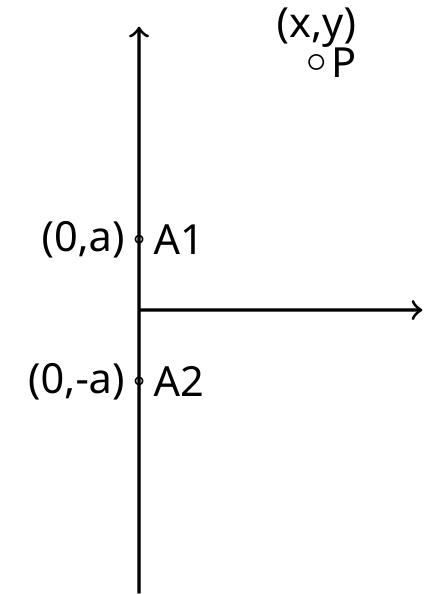
Let and . This gives for
[0.4+0.4]
[0.7]
Writing the final expression as any correct function of x and y will get full marks. If collecting all the terms component-wise not done, then penalize by -0.1. If an error has been made in simplification then penalize by -0.1.
C.2 Direction at point : (0.5pt) Field at the point ( is given by substituting . On simple inspection the component vanishes. Thus
[0.2]
Direction at point : Field at () is given, using Eq.(2)
The component is zero. Thus
[0.3]
First Alternative Solution
We can show in general that the field at any point on the circle will be radial (i.e. normal to the circle). We will confine our discussion to the z=0 plane. Consider a point with radius . The equation of a circle with as centre and as radius is
or
If at the point the magnetic field is along then the component along is zero. is identified with the point C on the figure. The point is then,
or
Now consider a line joining C to any point lying on the circle given by eq.(3). The radial vector is . The magnetic field at is
To show that they are in the same direction, we evaluate the cross product, . The cross product is proportional to which is a unit vector along the direction which is normal to both and and is along
which simplifies to
Using eq.(3), this is zero, proving the result.
Second Alternative Solution
To show that the field lines are radial over the circle one may merely show the proportionality of the components of the field and the radius vector. The radius vector is while the magnetic field is proportional to . Thus
and
The last step is obtained by observing that the equation of the circle is .
C.3 (0.5pt) Field in the airgap because of the argument presented in the problem continues to be given by Eq.(2). So the field ( ), is again
[0.5]
D.1 (0.5pt) The force on a magnetic dipole along the - direction is
[0.5]
E.1 (2.0pt)
and
and so at the midpoint P,
[0.5]
where we have used and . This gives for
[1]
We also have
[0.5]
F.1 The magnetic moment of the silver atom: (1.5pt)
We use
to rewrite
[0.5]
[1]
G.1 The spread in the line: (0.5pt) The two lines on the screen are separated symmetrically about the centre by . So the upper (lower) line is at from the centre. From Part (2)
This depends on the beam speed . The spread in this speed leads to a consequent spread in the splitting.
[0.3]
Hence the spread in the line from the centre is 0.1 - 0.04 = 0.06 cm to 0.1 + 0.04 = 0.14 cm.
- Credit will also be given if 20% is interpreted as 10% on each side
- Answer reported in terms of percentages receive full credit
[0.2]
H.1 Error in the evaluation of the magnetic moment: (0.5pt)
From the previous part we have that the splitting ranges from 0.12 cm to 0.28 cm whereas earlier it was 0.2 cm. The relationship between the splitting and the magnetic moment is linear. So the magnetic moment ranges from (0.12/0.2) to (0.28/0.2) the original value. This yields 0.62 10 J·T to 1.46 10 J·T. The total spread is 0.84 10 J·T about the mean value of 1.04 10 J·T
[0.3]
or in other words
[0.2]
Бележка под линия
H. S. Mani (former Director, HRI, Prayagraj) and Gautam Datta (DAIICT, Gandhinagar) were the principal authors of this problem. The contributions of the Academic Committee, Academic Development Group, and the International Board are gratefully acknowledged.
Оригинал в Архива: theory-Q1-question.pdf · официални решения: theory-Q1-solution.pdf