APhO 2022, Теория — Задача 3. Maxwell, Rayleigh and Mount Everest: THE PROBLEM
22nd Asian Physics Olympiad, India 2022 — Theory Q3: Maxwell, Rayleigh and Mount Everest: THE PROBLEM
Условие
Lord Rayleigh visited Darjeeling, India in 1897. On viewing Mount Everest at a distance of 170 km he was reminded of a query by James Maxwell 26 years earlier on the attenuation of light by air and the visibility of far-off peaks. Lord Rayleigh authored a famous research paper two years later in 1899 in which he investigated this problem. In the present problem we attempt to reconstruct, at least partially, a modern version of Lord Rayleigh's line of reasoning.
Oscillation of the electron cloud: We model a typical neutral air molecule by a stationary positive charge surrounded by a spherical uniform charge cloud of mass , radius and charge . The natural angular frequency of vibration of the molecule is . Light is incident on it and the negative cloud oscillates maintaining its spherical shape with angular frequency as,
under the influence of the electric field
of the light wave. Here represents the separation between the stationary positive charge and the centre of the negative charge cloud of the molecule.
Amitabh Virmani (CMI, Chennai) and A. C. Biyani (retired Govt. Nagarjuna P.G. College of Science. Raipur) were the principal authors of this problem. The contributions of the Academic Committee, Academic Development Group, and the International Board are gratefully acknowledged.
Philosphical Mag. “On the transmission of light through an atmosphere ... and the origin of the blue of the sky”, Vol. 47, pg 375-384 1899
A.1 Set up the equation for the motion for . Take the contribution to the magnitude of the acceleration due to the electric field to be . [0,5 т.]
A.2 Based on the information provided above, solve the equation for . Find the amplitude. [0,5 т.]
A.3 Find the magnitude of the dipole moment of the air molecule as a function of time for . [0,5 т.]
A.4 Obtain an expression for in terms of , and . [0,5 т.]
Power radiated: The sinusoidal time dependent dipole radiates electromagnetic radiation. The power radiated depends on the amplitude of the dipole moment , the permittivity of vacuum , the speed of light , and the frequency of oscillation .
B.1 Use dimensional analysis to express the average power radiated in terms of these quantities. [1 т.]
B.2 Take the proportionality constant to be . Express the answer for the power radiated in terms of , , and related quantities. Take . [0,2 т.]
Attenuation of the Intensity : Recall that the intensity of EM waves is
The intensity decreases along the path of light because the power
is lost per unit volume. Here is the number of molecules per unit volume.
C.1 Set up the differential equation for the intensity as a function of the distance . [1 т.]
C.2 Obtain the expression for the intensity as a function of in terms of the characteristic length scale associated with the drop in intensity. Take the initial intensity to be . [0,5 т.]
C.3 Take to be the mass of the electron (typically only one electron constitutes the charge cloud) and take
Obtain the numerical value of in kilometers. [0,3 т.]
D.1 Height of the Mountains as seen by an observer: In the figure the point denotes Darjeeling, a hill station in the eastern Himalayas at height = 2042 m above the sea level. The line denotes Mt Everest which is = 170 km away from Darjeeling and is of height = 8848 m. Another peak Mount Kanchenjunga (not shown in the figure) is 75 km away from Darjeeling and is of height 8586 m. Obtain an expression and the numerical values of the vertical height of these mountains as seen by an observer from Darjeeling in terms of the above-mentioned quantities. Assume that the observer is unable to see below the local horizon. Draw an appropriate figure. Take the radius of the Earth to be 6378 km. [2 т.]
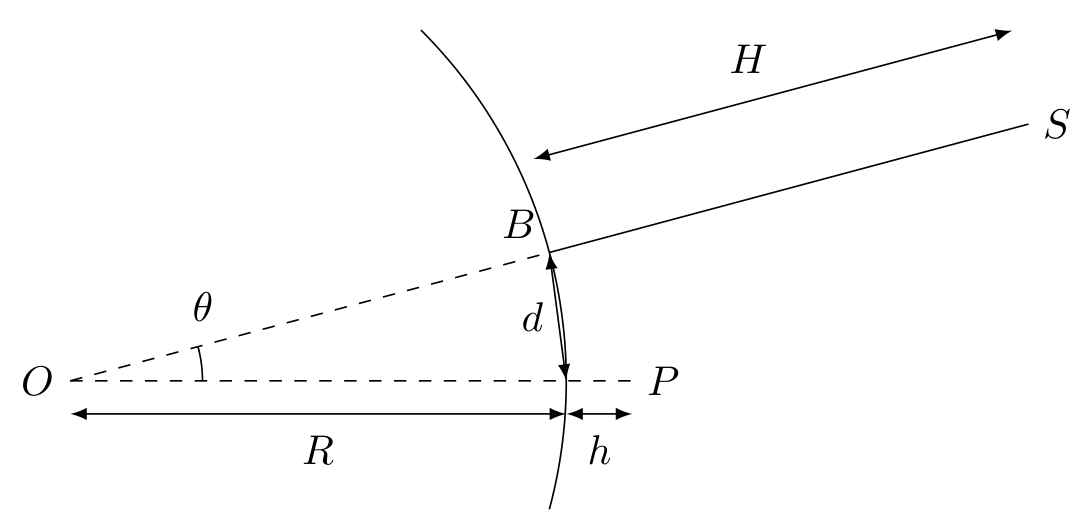
E.1 Take the intensity of Mt Kanchenjunga at Darjeeling to be the reference value. What would be the intensity of Mt Everest relative to Mt Kanchenjunga as seen from Darjeeling? In this problem we ignore the variation in the number density of air molecules with height. If the intensity is 5 % or more of the reference value the mountain is said to be visible. Will Mt Everest be visible from Darjeeling? [1 т.]
F.1 Attenuation length due to aerosol pollution: Above, we calculated the characteristic length scale associated with the drop in intensity due to scattering with air molecules. We are now interested in the characteristic length associated with the drop in intensity due to scattering with aerosol particles (pollution). depends on the number density of particles and the cross sectional area of the aerosol particle of radius . Obtain this dependence using physical insight and dimensional analysis. Take the dimensionless constant to be 1/8. Given mild pollution the average aerosol density at Darjeeling is , and their average radius is 500 nanometres. What is the length ? Let the density of an individual aerosol particle be . Note 1 g = 10 kg and 1 nm = 10 m. [1 т.]
G.1 Relative intensity and Visibility of Mt. Kanchenjunga and Mt. Everest: Estimate the relative intensity of Mt Kanchenjunga and Mt Everest with the above level of pollution with respect to the reference value. Which, if any of these peaks will be visible from Darjeeling? Assume that pollution is uniform throughout the path the light travels. [1 т.]
Отговори
A.1
A.2
A.3
A.4
B.1
B.2
C.1
C.2
C.3 130 km
D.1
E.1 0.093
Yes, Mt Everest is visible.
F.1 50 km
G.1 Mt Kanchenjunga: 0.22 (22 % of the reference value), visible; Mt Everest: 0.003 (0.3 % of the reference value), not visible.
Решение
General Grading Guidelines
When student’s solutions are correct and s/he also show how solutions were obtained, the student gets full credit. The scheme outlined below is helpful if the student’s answers are partially correct. Attention will be paid to the detailed solution so, if the final answer is correct but it is obtained by incorrect method(s) then no credit will be given. Alternative solutions may exist and will be given due credit.
Partial or full outcomes obtained for later sections in the problem which are incorrect solely because of errors being carried forward from previous sections, but are otherwise reasonable, will not be further penalized. For example a dimensionally wrong answer when carried forward will not get any credit in the subsequent sections. A numerically wrong evaluation when carried forward will get credit in subsequent sections unless the numerical answer is patently wrong (e.g. the value of g is 981 m/sec! )
Incorrect or no labeling of an axis is penalized by -0.1 points
The numerical answer (i) must be correct to +/- 10% AND (ii) must respect significant figures.
It maybe noted that NO micro-marking scheme takes care of all contingencies. A certain amount of discretion rests with and a certain level of judgement is invested in the academic committee.
Maxwell, Rayleigh and Mount Everest: THE SOLUTION
Oscillation of the electron cloud:
A.1 (0.5 pt)
is the electric field at the location of the molecule. The equation of motion of the charge in the absence of would be
and under forced oscillations
[0.5]
[a sign mistake or a term missing 0.3]
A.2 (0.5 pt)
In equation (2) we substitute to obtain
[0.2]
This implies that the amplitude of oscillation is
[0.3]
[a sign mistake or a term missing 0.1]
A.3 (0.5 pt)
Since is the separation between the positive and negative charge clouds, the magnitude of the dipole moment is
[0.5]
[sign mistake 0.1]
[answer without approximation 0.2]
A.4 (0.5 pt)
We model the atom as a stationary positive point charge surrounded by a spherical negative charge cloud of total charge , radius and mass . Now let the charge cloud be displaced by a small distance . The electrostatic force on the electron cloud by the central positive charge is (see Figure)
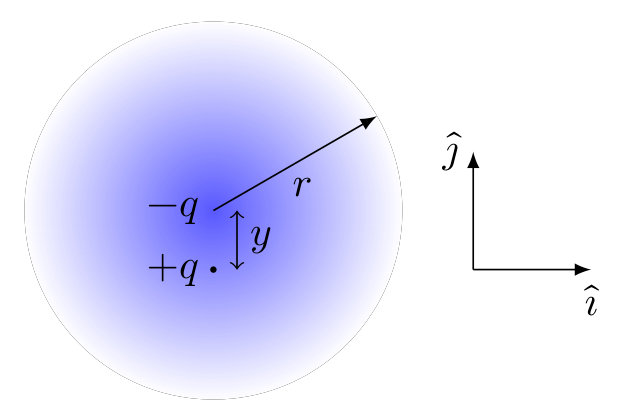
[0.4]
Thus, the natural frequency of oscillation is
[0.1]
Power radiated:
B.1 (1 pt)
Dimension of power is
[0.1]
Dimension of dipole moment is
[0.1]
We are using SI units. C stands for Coloumb. Dimension of is
[0.1]
Dimension of is
[0.1]
Dimension of speed of light is
[0.1]
Let us take the ansatz , i.e.,
[0.1]
We get four equations for the four variables,
This gives
Implying,
[0.4]
B.2 (0.2 pt)
We have
[0.2]
Attenuation of the Intensity :
C.1 (1 pt)
Recall that the intensity is the power incident per unit area. Consider a horizontal column of the atmosphere of cross-sectional area and length . Let the incident intensity be . Let the transmitted intensity be . The drop in the intensity is due to the scattering of light by the air molecules. If the number density of air molecules is then the total power radiated per unit volume is . Therefore,
[0.8]
This gives
[0.2]
C.2 (0.5 pt)
Since and we have
[0.2]
where
[0.2]
The solution to the differential equation as a function of is
with given above.
[0.1]
C.3 (0.3 pt)
Substituting the numbers we find
[points are for numerical calculation 0.3]
Height of the Mountains as seen by an observer:
D.1 (2 pt)
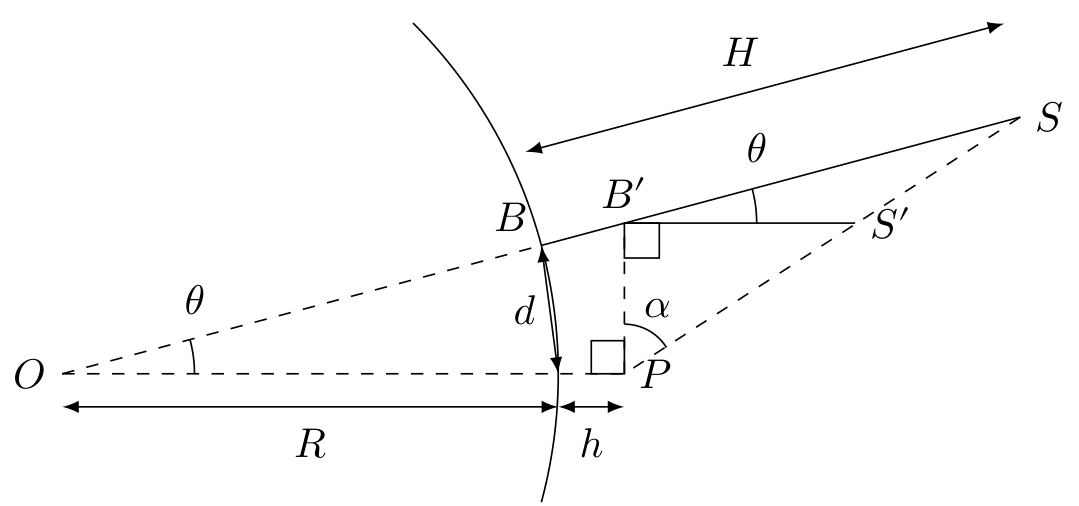
[0.7]
In ,
Now, and , hence and are similar. Thus
Noting that and using Eq. (26), we obtain
Or
[0.8]
Noting that and we get,
Alternative answers such as
are given credit.
The numerical values are = 6096 m for Mt Kanchenjunga and = 4534 m for Mt Everest.
[0.5]
E.1 (1 pt)
In Eq.(23) represents the intensity of the source which would have been perceived by an observer at that location if attenuation effects were absent. If the power of the source is taken to be , then for the location at distance .
[points only if is recognised 0.5]
The relative intensity of Mt Everest as seen from Darjeeling would be
[0.3]
Yes, Mt Everest is visible.
[0.2]
Attenuation length due to aerosol pollution:
F.1 (1 pt)
From the information given in the problem we have
[ 0.3]
This yields
[ 0.2 (expression)]
[ 0.5 (evaluation)]
where,
Relative intensity and Visibility of Mt. Kanchenjunga and Mt. Everest:
G.1 (1 pt)
The new relation for the intensity attenuation is
For Mt Kanchenjunga
[0.3 (expression) + 0.1 (numerical answer)]
The drop in intensity is to 22 % of the reference value. Mt Kanchenjunga will be visible from Darjeeling. For Mt Everest
[0.1]
[0.3 (expression) + 0.1 (numerical answer)]
The drop in intensity is to 0.3 % of the reference value. Mt Everest will not be visible from Darjeeling.
[0.1]
Оригинал в Архива: theory-Q3-question.pdf · официални решения: theory-Q3-solution.pdf