APhO 2023, theory — Задача 1. Theoretical Problem 2: A ball on a turntable
Автор: Olympiads XYZ · транскрипция на официалните материали
Проверена срещу оригинала на 13.9.2026 от същия модел, който я е транскрибирал (без независима проверка)
Theoretical Problem 2: A ball on a turntable [10.0 points] — XXIII APhO MONGOLIA 2023, Theory, Q2 (English Official) · 10 т.
Внимание: Бележка към темата
Прозорецът покрива само стр. 6–11 от решенията; решението е непълно (продължава на стр. 12+), а условието на задачата е в отделния документ с проблеми.
Условие
Preamble
Notations and conventions: The length of a vector is simply denoted as . It's components are denoted by , respectively. The time derivative of a quantity is denoted by the dot over the quantity: , . The unit vector along the direction of vector is denoted as . The unit vectors along the Cartesian coordinates are, therefore, , and . The definitions of scalar and vector products are:
where is the angle between and . You may need the following properties of vectors and their multiplications. Triple product rules for vectors:
The vector products are very useful in describing many relations in physics. For example:
and, often, saves time combining three equations for vector components into a single equation.
The statement
A ball of mass and radius is rolling on a horizontal turntable without slipping (see Figure 1). Its mass density has a spherical symmetry, i.e. only depends on the distance from its center. The moment of inertia of the ball is . In part B and C, where the turntable can rotate freely, the moment of inertia of the turntable is denoted as . The purpose of the problem is to analyze the motion and trajectory of the ball with respect to the laboratory frame. Throughout the problem, assume the turntable is large enough so that the ball does not fall off. The following notations are used:
- the magnitude of the turntable angular velocity,
- the spinning angular velocity of the ball with respect to its spinning axis,
- the horizontal position of the ball center with respect to the rotation axis of the turn table,
- the velocity of the ball at with respect to the laboratory frame.
Assume that the initial position and velocity of the ball, the angular velocity of the turn table are known. For the initial vector quantities and , assume that their directions are known. In addition, whenever you need to express a vector quantity, you may use in your expression. Also, if asked to write your expression in terms of the known quantity you may use any or all of , , and . Unless otherwise stated, keep as general. The following notations are recommended:
You may write the final answers as vector expressions involving cross product (vector product), dot product (scalar product) and unit vectors in axis directions.
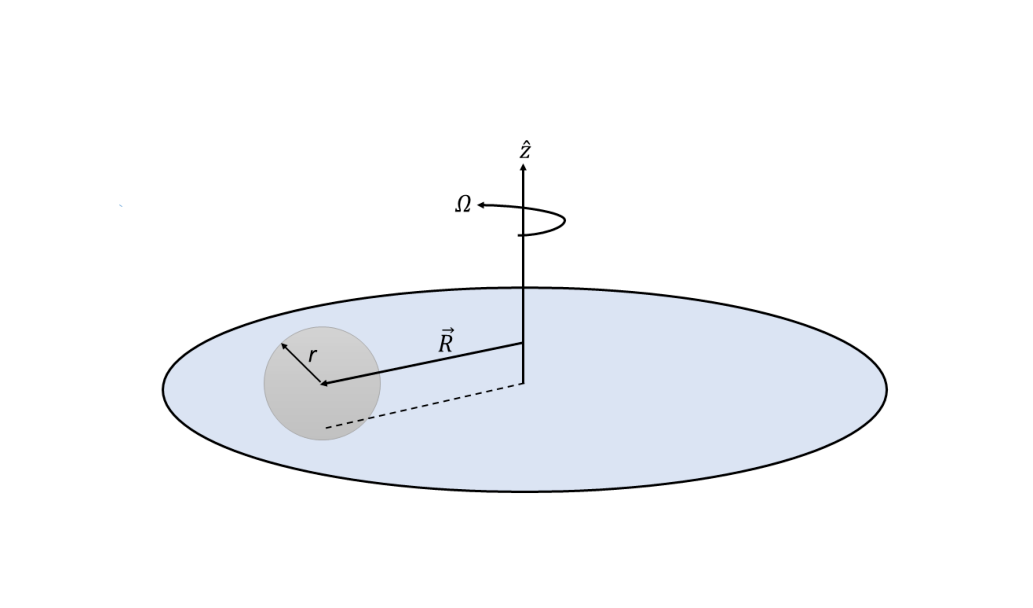
Part A: Ball on turntable with constant angular velocity [1.5 points] First we start with the simplest case wherein the turntable angular velocity with respect to vertical axis is constant, therefore .
A.1 Express the ball's velocity in terms of and from a kinematic constraint. [0,1 т.]
A.2 Using Newton's equation and torque equation with respect to its center, find the acceleration of the ball in terms of and . [0,2 т.]
A.3 Find the velocity in terms of and . [0,2 т.]
A.4 Write an explicit solution for the trajectory of the ball given the initial conditions and . [0,5 т.]
A.5 Assume this time that the ball has a uniform mass density, i.e. . Trajectory you have found is a circle and it's radius is . Choose its magnitude to be the same as . How long does it take for the ball to approach the initial spot on the table (the position on the turntable at ) with the closest distance? [0,5 т.]
Part B: Ball on freely rotating turntable [4.0 points] In this part, the turntable can rotate freely without any friction around -axis. Therefore its free rotation is hindered only by the ball's friction.
B.1 Find the velocity and acceleration of the ball in terms of and . [0,2 т.]
B.2 Find the magnitude of the angular acceleration of the turntable in terms of and . You may use the constants and defined in the beginning of the problem. [0,6 т.]
B.3 Find the magnitude of the angular velocity of the turntable as a function of only. Use this constants in your expression: . [0,6 т.]
B.4 From the result of B.3, for a given , find the maximum possible . [0,1 т.]
B.5 Write down the vertical component the angular momentum of the whole system. Subtract any constant term and rename the remaining part as . In part B.1 you found the velocity of the ball , which can be written as the sum of a part that depends on the position of the ball and a constant vector. Let us call this constant vector . Choose the direction of -axis along this vector and -axis along . In this frame of reference, find in terms of and . Combining this with the result of B.3, write down an equation only containing and variables and and . Here is the magnitude of . Substituting , write down an expression containing only and variables and describing a curve. From this, list all possible types of trajectories. [2,5 т.]
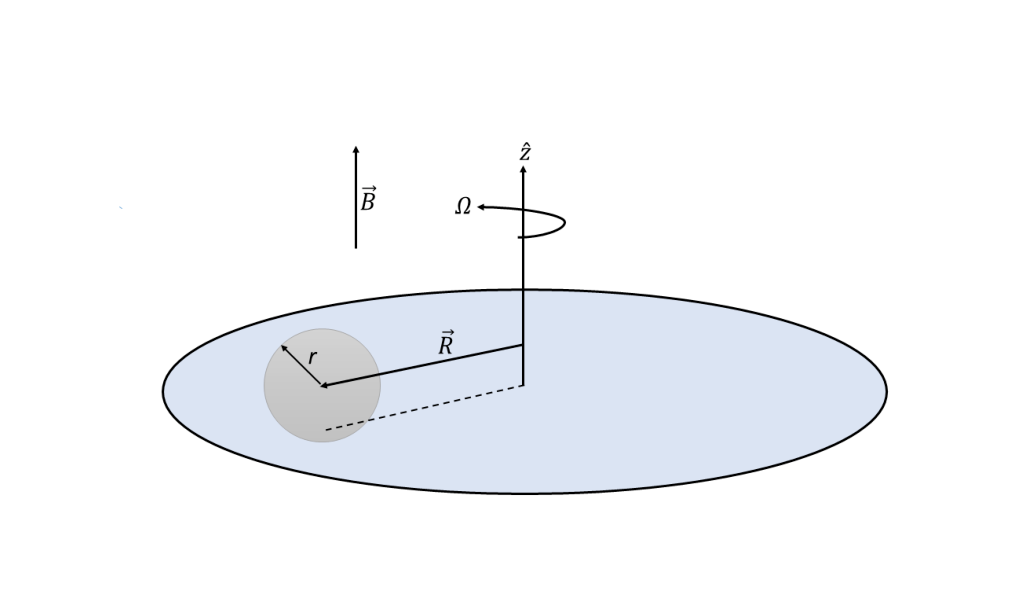
Part C: Ball on turntable in magnetic field [4.5 points] In this part, we consider a density profile so that . This can be realized, for example, if the ball is filled up to half of its radius with uniform density and the remaining part has a negligible mass. In addition, on its outer surface, the ball has a uniform charge density , where is the total surface charge. The whole setup is in a uniform magnetic field that is in direction. The turntable rotates with constant like in Part A.
C.1 Write down Newton's equation and the torque equation for the ball. Find expression for the torque due to the spinning of the ball around its axis in terms of and . [0,5 т.]
C.2 Using the results of C.1, find expression for the linear acceleration of the ball with respect to the laboratory frame in terms of and . [0,5 т.]
C.3 We assume all quantities of unit lenght are measured by meter, all angular velocities have unit of 1 Hertz, and all quantities of time have the unit of 1 second. The equation for the linear acceleration you found in part C.2 is a second order differential equation for of the following form:
Write down and constants in terms of . Make the following transformation to a polar coordinates for the components of :
so that the new equations do not have the first time derivative term. Here the polar angle is a function of time. Find the form of this function.
Express the coefficient of in the new equation in terms of and .
Write down the conditions for different types of behavior of with respect to time: harmonic, exponential etc. [1 т.]
C.4 Consider the following initial conditions for the solution found in part C.3:
, , , , .
From these conditions, find and . Using them find the corresponding .
Sketch the trajectory. Is the charge of the surface negative or positive? For the negative write and for the positive write on your answer sheet. [0,9 т.]
C.5 Consider the solution you have found in part C.4. If you identified it correctly your solution should have a rotating . Find the expressions for the total and per rotation changes in energy for number of rotations. Here you may ignore the terms small compared to . In this part assume the mass and the radius of the ball are and so that . [1,6 т.]
Решение
Покажи официалното решение
Оригинал в Архива: T2.pdf · официални решения: T2_sol.pdf