APhO 2026, Теория — Задача 1. Physics of Weighing Scales
Theoretical Exam Q1 — Physics of Weighing Scales — Asian Physics Olympiad 2026, Busan, Korea · 10 т.
Условие
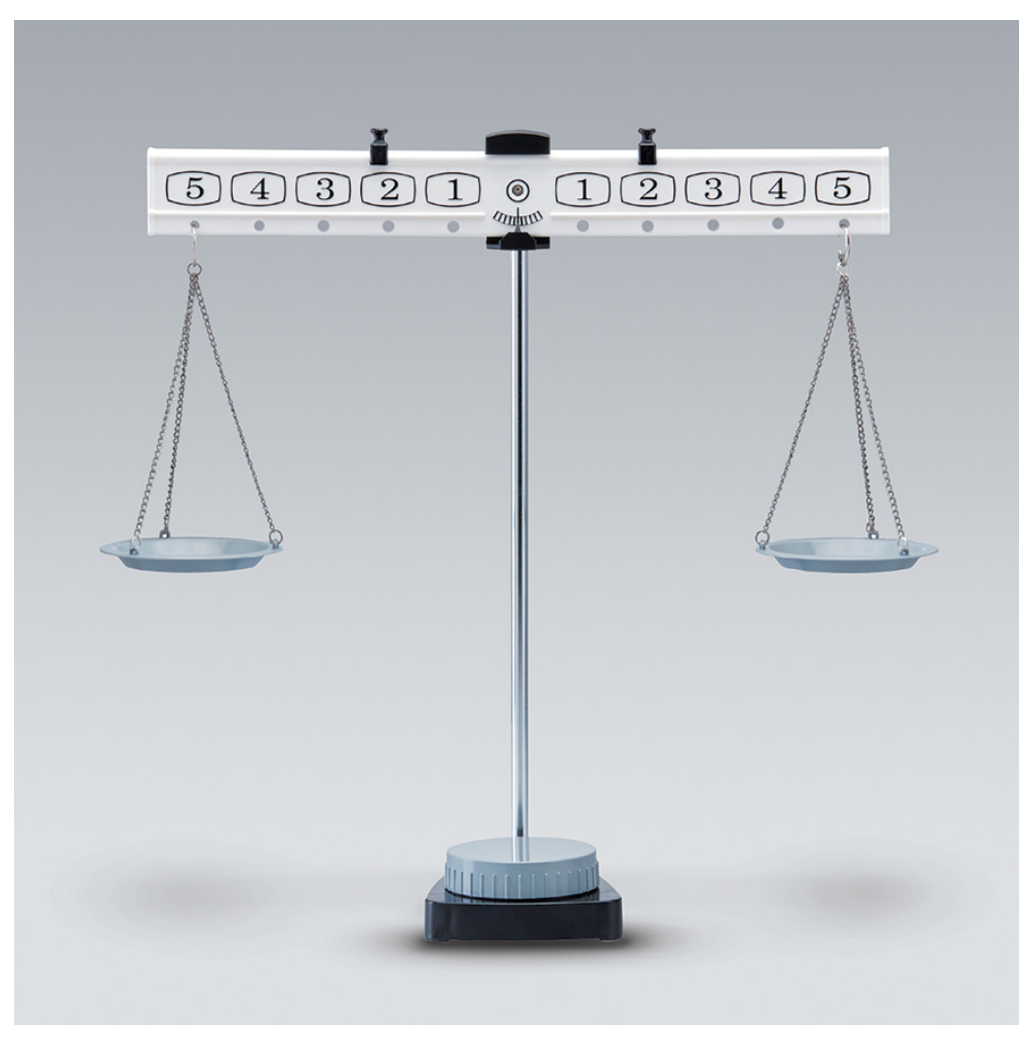
Various scales for measuring the mass of objects are used in daily life. This question is about the physical principles related to the beam balance, the Roberval balance. While these balances look similar, they have slightly different structures and behave differently.
We assume that small friction at the pivots allows the balance to eventually come to rest. However, this friction is sufficiently small that it does not affect the equilibrium angle determined from torque balance. Therefore, friction and air resistance may be neglected in the calculations.
A. Sensitivity of the Beam Balance (2.5 pts) (2,5 т.)
A beam balance consists of a beam(lever arm) that rotates about a fixed axis(pivot or fulcrum) and two pans of equal mass suspended from each side of the beam. If the masses placed on the pans differ, the beam tilts toward the heavier side to reach equilibrium.
During the motion of the beam, the suspended pans may swing. Although the force exerted by the system consisting of the pan and the object on the beam may vary over time due to this swinging, we approximate the force as the total weight of the pan and the object, neglecting the swinging effect.
If the beam tilts at a large angle for even a small mass difference, the scale is considered sensitive. Part A of the question examines the issue of sensitivity.
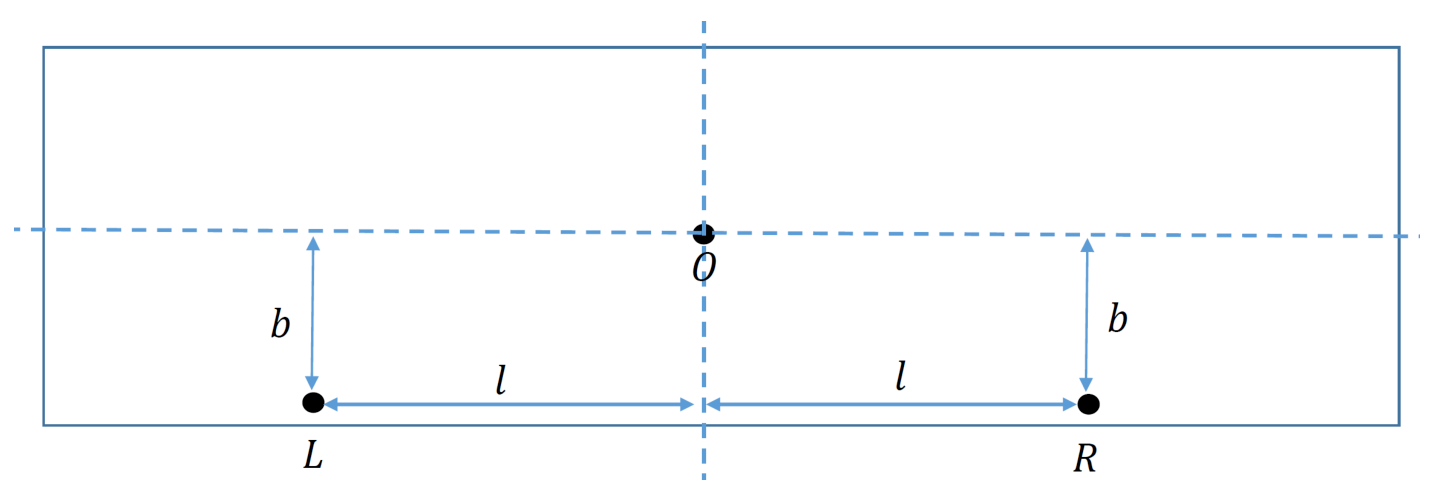
The beam is assumed to be a flat sheet with negligible thickness. Let be the fixed point, and and be the points where the left and right pans are suspended, respectively. The center of mass of the beam coincides with point , as in fig.2. The axis of rotation passes through and is perpendicular to the beam. The physical parameters and variables that may be related to the beam balance and its sensitivity are as follows.
- : the vertical distance between and the line connecting and
- : the horizontal distance from the perpendicular bisector passing through to points and
- : gravitational acceleration
- : Mass of the beam
- : Total mass of the left pan and its load
- : Total mass of the right pan and its load
When , the beam tilts counter-clockwise by an angle to reach equilibrium.
A.1 When the beam is tilted by an angle counter-clockwise from the horizontal, find the magnitude of the torque about O exerted by the left pan and its load, taking the counter-clockwise direction as positive. [0,3 т.]
A.2 When the beam is tilted by an angle counter-clockwise from the horizontal, find the torque exerted by the right pan and its load (total mass ) that tends to rotate the beam clockwise. [0,3 т.]
A.3 Express the tilt angle at equilibrium in terms of the given variables and parameters. [0,4 т.]
A.4 To make the scale more sensitive (a larger for a small mass difference), which of the following conditions for and is correct? (Selecting an incorrect option will result in a 0.1-point deduction.)
- Larger or larger leads to a larger .
- Smaller or smaller leads to a larger .
- Larger or smaller leads to a larger .
- Smaller or larger leads to a larger . [0,3 т.]
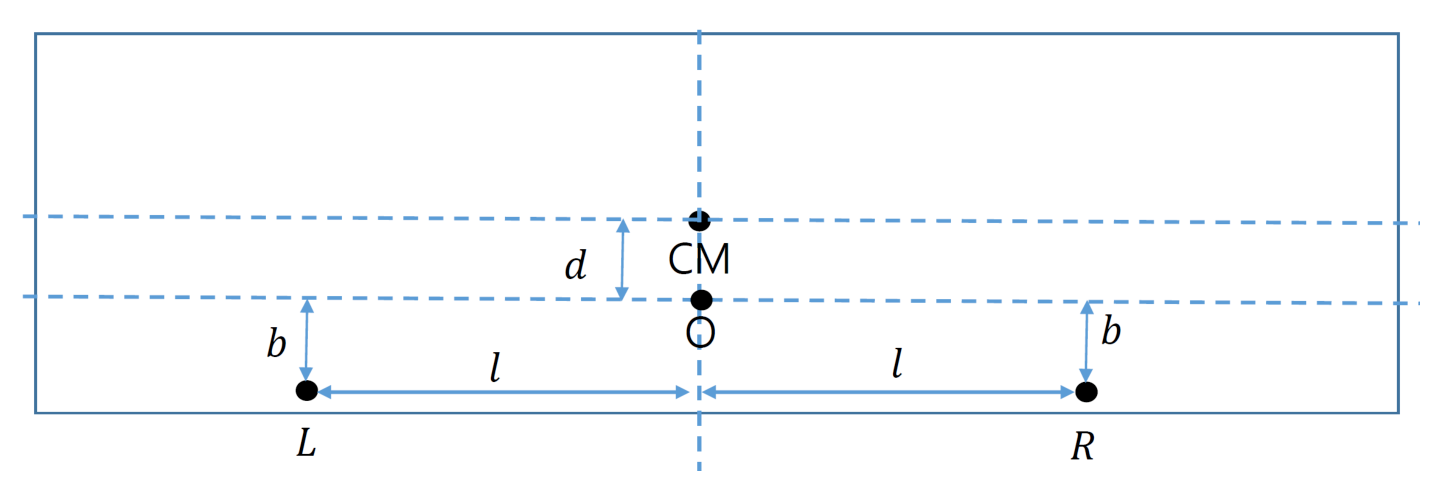
The beam of a commercially available beam balance is often made so that the rotation axis (pivot point ) is higher than the center of mass (CM) of the beam. However, making the beam this way reduces the sensitivity of the beam balance. To solve this problem and design a more sensitive scale, we intend to change the structure of the beam. As a candidate, the beam is designed by modifying it so that the pivot point () of the beam is below the center of mass (CM) of the beam as shown in the fig. 3. Let the pivot point of the beam positioned at a distance underneath the center of mass. The beam is assumed to be a flat sheet with negligible thickness. The meanings of for the scale are the same as in the previous problem.
A.5 When the beam tilts by an angle from the horizontal to reach equilibrium, express the tilt angle in terms of the given variables and parameters. [0,8 т.]
A.6 Obtain the condition under which the beam reaches a stable equilibrium angle . Express the condition as an inequality independent of . [0,4 т.]
B. Basic Model of Roberval Balance (3.6 pts) (3,6 т.)
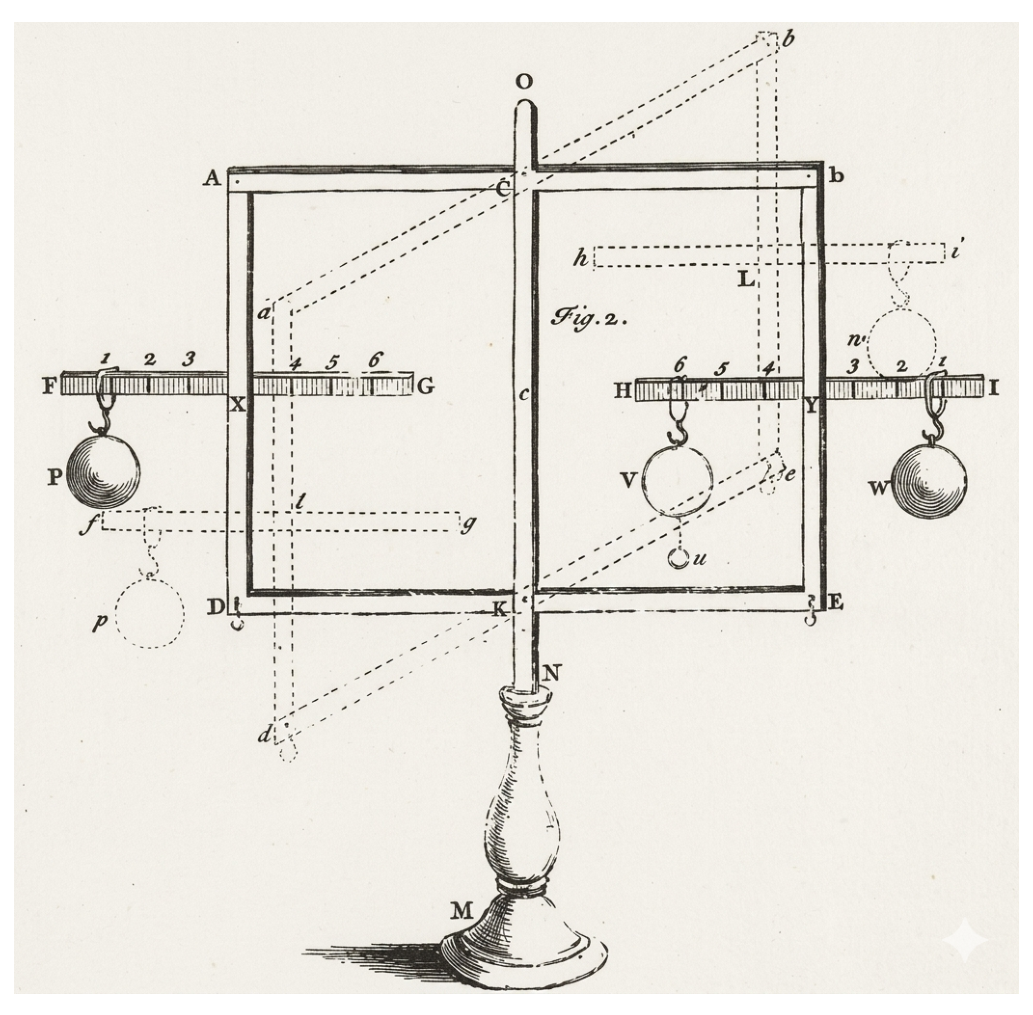
The Roberval balance uses a parallel-linkage structure, where the pans are connected to two horizontal beams (upper and lower). These two beams are joined to the pans by pivots, which act like hinges. This special connection allows each pan of two pivots to stay perfectly vertical even when the beams tilt (Fig.4). As the beams rotate, the pans move together in a synchronized way. A unique feature of this design is that the balance depends only on the total mass on each side; it does not matter where you place the weights on the pans. The physical parameters, variables and notations that may be related to the beam balance is as follows (Fig.5).
- : Fixed pivots for the two horizontal beams
- : The moment of inertia of the upper beam about its axis of rotation
- : The moment of inertia of the lower beam about its axis of rotation
- : The distance from the central pivot to the pan suspension point
- : Horizontal offsets of the weights from the center of the left and right pans, respectively.
- : Mass of each pan
- : Mass of the load placed on the left and right pans, respectively. ()
- : Gravitational acceleration.
Assume that the Center of mass (CM) of each beam coincides with its pivot and that pivots of pans and pivot of the beam lays on one line.
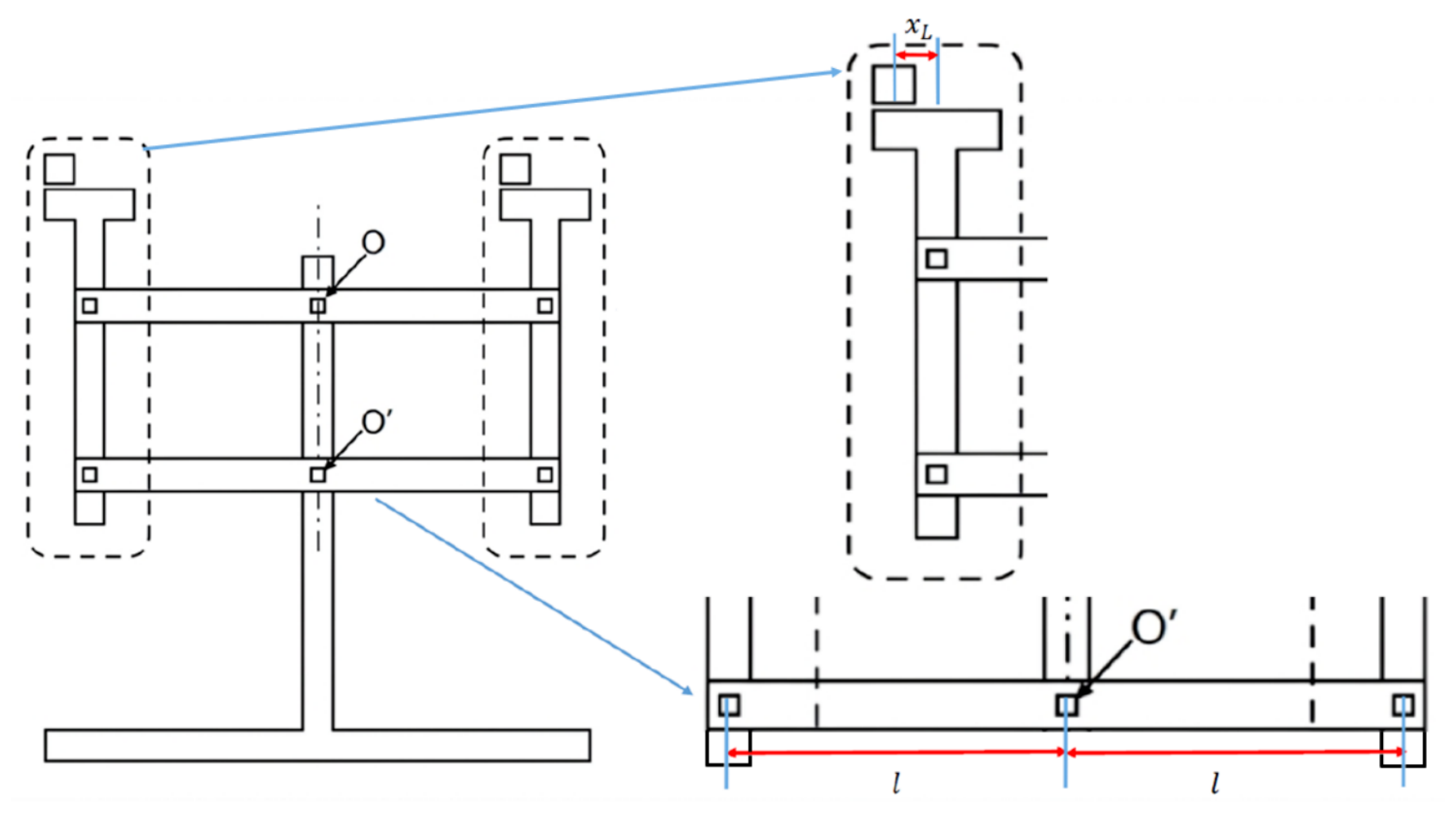
B.1 Calculate the total potential energy of the system , when the beam is tilted counter-clockwise by an angle from the horizontal (). Define the potential energy to be zero at the initial horizontal position. [0,3 т.]
B.2 Express the total kinetic energy of the system in terms of the given variables and parameters and the angular velocity . [0,5 т.]
B.3 Obtain the second-order differential equation governing the rotation angle . [0,6 т.]
The angular acceleration at the instant the beam is released from the horizontal position is as follows:
B.4 At the instant with zero initial velocity, let be the magnitudes of the vertical components of forces acting between the left pan and the upper and lower beams, respectively, and Similarly, let be the magnitudes of the vertical components of the forces for the right pan. Calculate the values of in terms of the given variables and parameters. [1 т.]
B.5 Assuming that all components of the balance, including the beams and pans, are rigid bodies, determine whether each of the following forces can be calculated at the moment of release. (Answer with Yes, No, or blank for each. A penalty of 0.1 points will be applied for each incorrect answer.)
- Vertical component of force exerted by the central pivot on the upper beam
Set up all the necessary relational equations required to solve this problem. Note that you are only required to provide the forms of the equations; explicit final calculations are not necessary. [0,6 т.]
B.6 Let be the mass of the balance without any weights. Weights of mass and () are placed on the left and right pans, respectively. The beam is initially held horizontal by hand and then released. Find the normal force exerted by the floor on the balance immediately after release. [0,6 т.]
C. Practical Model of Roberval Balance (3.9 pts) (3,9 т.)
In the basic model of Roberval balance discussed in Part B, a mass imbalance causes continuous angular acceleration, making it impossible to determine a static equilibrium angle. In contrast, a practical Roberval balance reaches a stable equilibrium at a specific tilt angle depending on the mass difference. In Part C, we analyze the physical structure of such practical Roberval balances.
To calculate the equilibrium angle as a function of the mass difference, consider the following variables and parameters:
- Upper Beam: The pivot point (fixed axis of the beam) is located at a vertical distance directly above the beam's center of mass. The beam has a mass and a moment of inertia about its pivot(fixed axis).
- Lower Beam: The pivot point(fixed axis of the beam) coincides with the beam's center of mass. The beam has a moment of inertia about its pivot(fixed axis).
- (): The combined mass of the pan and any objects placed upon it for the left and right sides, respectively. (Please note the difference in notation from part B.)
- : The horizontal distance from the perpendicular bisector passing through the central pivot to the pan suspension point
- : Gravitational acceleration.
It is assumed that the weights remain stationary relative to the pans and move in unison with them and that pivots of pans and pivot of the beam lays on one line.
C.1 With two weights of different masses placed on the pans (), the beam is initially held in a horizontal position and then released from rest. In the situation, the second-order differential equation of motion for the tilt angle takes the form: . Determine the coefficients and in terms of the given variables and parameters. Set at the horizontal position. [1,4 т.]
C.2 When the balance is at its equilibrium state (), a slight disturbance causes the beams and pans to oscillate about the equilibrium angle. To analyze this small oscillation, we define a new variable . By approximating the equation of motion obtained in Part C.1, derive the governing equation for in terms of the given variables and parameters. The answer must not include . [1,9 т.]
C.3 If the total mass is constant, determine how the mass should be distributed between the pans to maximize the period of small oscillations. Calculate the period of small oscillations in the limit where . [0,6 т.]
Решение
Notes on Grading Criterion: Full credit is awarded for a correct complex result that is clearly unattainable by simple estimation,
Part A
A.1)
The magnitude of the anticlockwise torque exerted by the left pan and the weights, resulting from an anticlockwise tilt of is given by
| Criteria | Partial Credit |
|---|---|
| If Eq (1) is correctly obtained (The sign (+/-) does not affect the score.) | 0.3 |
A.2)
The magnitude of the clockwise torque exerted by the left pan and the weights, resulting from an anticlockwise tilt of is given by
| criteria | partwise marks |
|---|---|
| If Eq (1) is correctly obtained (The sign (+/-) does not affect the score.) | 0.3 |
A.3)
When the torques are in equilibrium, the beam balance remains stationary at a tilted position. Condition for rotational equilibrium:
Rearranging for
| criteria | partwise marks |
|---|---|
| If the torque equilibrium (Eq.(1))is correctly obtained | 0.2 |
| If the Eq.(2) or Eq.(2*) is correctly obtained | 0.4 |
A.4)
The correct answer is ③. For a given set of weights, the balance beam tilts further as increases and decreases.
| criteria | partwise marks |
|---|---|
| If option ③ is correctly selected, | 0.3 |
| If an incorrect answer is selected, | -0.1 |
A.5)
When equilibrium is reached at an inclination of , the magnitude of the clockwise torque about the pivot O is given by:
Meanwhile, the magnitude of the anticlockwise torque about the pivot O is as follows:
Condition for rotational equilibrium:
By applying the equilibrium condition for the beam balance, the following relationship holds for the equilibrium angle .
| criteria | partwise marks |
|---|---|
| If the expression for the anticlockwise torque (Eq.(1))is correctly obtained (The sign (+/-) does not affect the score.) | 0.3 |
| If the torque equilibrium condition(Eq.(2)) is correctly obtained | 0.3 |
| If Eq.(3) or Eq.(3*) is correctly obtained | 0.8 |
A.6)
From the initial state, the beam begins to tilt toward the heavier side (), and the following inequality holds:
If the coefficient of satisfies , the left-hand side of the equation remains greater, causing the beam to undergo continuous angular acceleration without reaching equilibrium. Conversely, if is met, there exists an angle at which the two torques achieve equilibrium.
The answer is:
| criteria | partwise marks |
|---|---|
| If the inequality including (Eq.(1)) is correctly obtained | 0.2 |
| If the final inequality for stable equilibrium (Eq.(2)) is correctly is correctly obtained | 0.2 |
Part. B.
B.1)
The distance the heavier mass descends and the lighter mass ascends are both which is independent of .
Due to the symmetry of the balance itself, its potential energy does not change. The potential energy of the entire system is given by
| criteria | partwise marks |
|---|---|
| When the obtained potential energy differs from Eq. (1) by a constant | 0,2 |
| If Eq (1) is correctly obtained | 0.3 |
B.2) Let be the rotation angle of the arms; the beam undergoes fixed-axis rotation, and the kinetic energy of the beam itself is:
The speed at the contact point between the pan and the arm is , and the pan undergoes translational motion at the same speed without rotation. The weights on the pan also move at this speed, maintaining their orientation. Therefore, the kinetic energy of the pans and the weights is:
The total kinetic energy of the system, including the beam, is:
| criteria | partwise marks |
|---|---|
| If the kinetic energy of the beam (Eq.(1)) is correctly obtained | 0.2 |
| If the kinetic energy of the pans and weights (Eq.(2)) is correctly obtained | 0.3 |
| If the kinetic energy of the total system (Eq.(3)) is correctly obtained | 0.5 |
B.3)
The total mechanical energy of the system is:
The equation of motion obtained by differentiating with respect to time is:
| criteria | partwise marks |
|---|---|
| Correct expression for the conservation of mechanical energy (Eq.(1)) is correctly obtained | 0.2 |
| Attempting to differentiate Eq. (1) with respect to time | 0.2 |
| If the equation of motion (Eq.(2)) is correctly obtained | 0.6 |
B.4)
The relationship between the forces acting on the left pan and its acceleration is:
Eliminating using the relationship given in the problem for the horizontal position results in:
Meanwhile, the torque relationship for the upper beam is:
Eliminating using the given relationship for the horizontal position results in:
| criteria | partwise marks |
|---|---|
| If Eq (1) is correctly obtained | 0.2 |
| If Eq (2) or Eq.(2*) is correctly obtained | 0.2 |
| If Eq (3) is correctly obtained | 0.2 |
| If Eq (4) is correctly obtained | 0.2 |
| If Eq (5) is correctly obtained | 1 |
B.5)
No values can be determined.
From the translational motion of the two pans and the rotational motion of the beam, the forms of four linear simultaneous equations can be obtained with , , , as unknowns.
Here, and are values expressed in terms of the variables and parameters given in the problem. Since their specific calculated values are not crucial to the form of the equation, they are represented simply as constants and . Since the four equations are not independent (no unique solution), , , , cannot be determined individually.
Finding the force exerted by the pivot on the upper beam is equivalent to finding . If this were found, then and could be determined. Since and cannot be found, also cannot be determined.
| criteria | partwise marks |
|---|---|
| For correctly determining each value | 0.1(Max 0.2 pt) |
| penalty for each incorrect determination | -0.1 |
| For each of the four equation forms (Eq.(1)~(4)) correctly obtained | 0.1 (maximum of 0.4 points, 0.1×4) |
B.6)
Let the acceleration of the entire system (balance and weights) be :
Therefore, the normal force is:
| criteria | partwise marks |
|---|---|
| If Eq. (1) or Eq (1*) is correctly obtained | 0.4 |
| If Eq (2) is correctly obtained | 0.6 |
Part. C.
C.1)
The conservation of energy when tilted by an angle anticlockwise is:
The equation of motion obtained by differentiating with respect to time is:
Thus,
| criteria | partwise marks |
|---|---|
| Conservation of mechanical energy (Eq.(1)) is correctly obtained | 0.6 (potential energy part in Eq.(1) is 0.2 pt) (kinetic energy part in Eq.(1) is 0.2 pt) |
| Attempting to differentiate Eq. (1) with respect to time | 0.2 |
| If is correctly obtained (Full credit is given if the values of , , and are scaled by the same factor.) | 0.4 |
| If is correctly obtained (Full credit is given if the values of , , and are scaled by the same factor.) | 0.4 |
| If is correctly obtained (Full credit is given if the values of , , and are scaled by the same factor.) | 0.6 |
C.2)
The equation of motion is:
At equilibrium, .
Thus,
The form of the equation:
Expressing the rotation angle as :
Combining Eq. (2) and Eq. (3), we obtain,
Even if a student fails to determine , , and in Question C.1, the following conclusion can be obtained if they carry out the calculations correctly while leaving , , and as variables/parameters.
| criteria | partwise marks |
|---|---|
| If Eq.(8) or (8*) correctly obtained | 1.9 |
| If Eq.(1) or Eq.(1*) is correctly obtained | 0.2 |
| If (Eq.(2)) is correctly obtained | 0.2 |
| If (Eq.(3)) is correctly obtained | 0.2 |
| If Eq.(5) or Eq.(5*) is correctly obtained using approximation | 0.5 (0.3 points for correctly obtaining Eq. (4) without approximation) |
| If Eq.(6) is correctly obtained | 0.3 |
| If Eq.(7) is correctly obtained | 0.3 |
C.3)
Since the restoring torque is approximated as simple harmonic motion proportional to , the period of simple harmonic oscillation is as follows:
The period is maximized under the condition
For the case
| criteria | partwise marks |
|---|---|
| If Eq.(1) is correctly obtained | 0.2 |
| Identifying the condition | 0.2 |
| If Eq.(3) is correctly obtained | 0.2 |
Оригинал в Архива: T1.pdf · официални решения: T1_sol.pdf