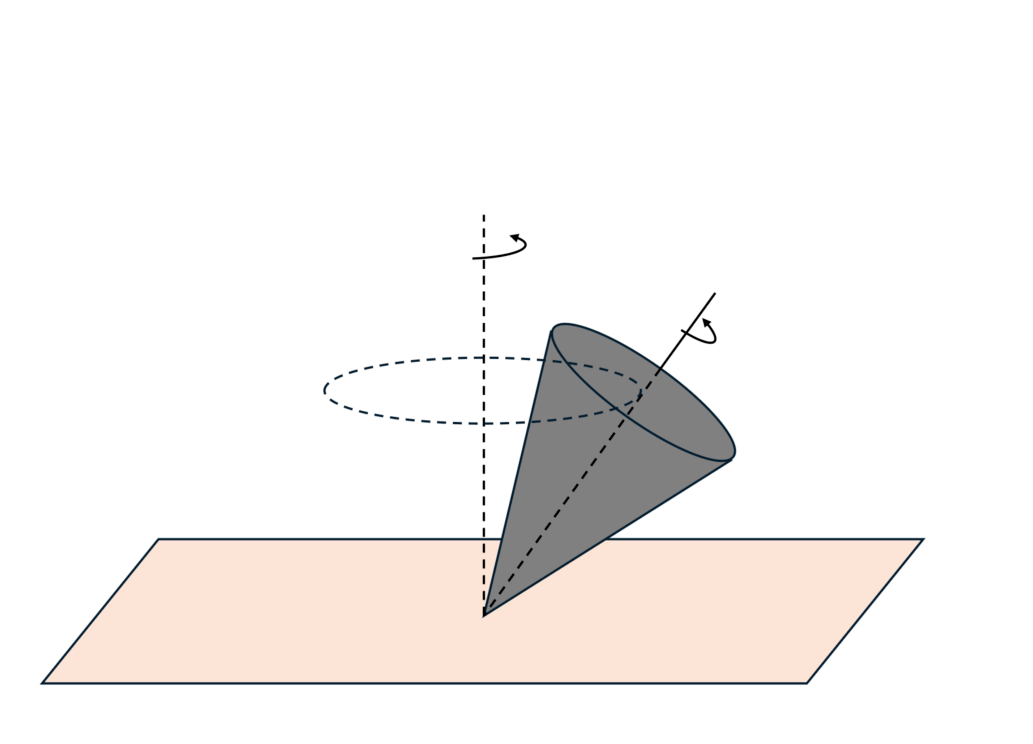
The origin of a material's magnetic property is the magnetic moment from the angular momentum of its microscopic constituent such as electrons and the nuclei. For some material the tiny magnetic moments are aligned along a particular direction to produce a net magnetic field. In other words, the material has non-zero magnetization. For different kinds of material the tiny magnetic moments are randomly oriented, but when the material is put in an external magnetic field, the tiny magnetic moments rotate around the direction of the external magnetic field and in average the material develops a nonzero magnetization. If we turn off the external magnetic field the magnetization of the material may gradually decrease until it returns to its original value. It is due to the interaction between the magnetic moments, or their interaction with other microscopic degrees of freedom such as lattice vibration. This process is called the relaxation, which will be considered below using classical mechanics models.
Part A. Forced harmonic oscillator (3.6 pts)
We consider the problem of nuclear spin relaxation due to random fluctuation of other physical degrees of freedom such as lattice vibration or electron's magnetic dipole moments. In order to familiarize ourselves with a randomness in the solutions of a classical mechanics system, let us start with a forced harmonic oscillator of mass m and angular frequency ω0. The energy of the oscillator changes because of the effect of a time-dependent external force.
mdt2d2q(t)+mω02q(t)=F(t)(1)
where the external force is given by the following step-wise function.
Here ω0=2π/T0 is the angular frequency of the oscillator q(t). Suppose that the initial condition is given as q(0)=Asinδ, q˙(0)=Aω0cosδ.
Before turning on the external force, energy is conserved and its value is E0=2mω02A2. Without losing generality we assume −π≤δ<π.
A.1 Find the position q and the velocity q˙=dtdq at t=T0. Express them in terms of A,δ,f0,ω0. [1,2 т.]
A.2 Consider the total mechanical energy E(t)=2m(q˙2+ω02q2). Calculate the difference of E(t) between t=T0 and t=0, due to the effect of the external force F(t). In other words, calculate ΔE≡E(t≥T0)−E(t≤0) and express it in terms of A,δ,f0,ω0. [1,2 т.]
A.3 Suppose that δ is a random variable with a uniform distribution in the range of −π≤δ<π. In other words, we have a large number of identical forced harmonic oscillators which all follow the same equation (1). Their initial conditions are given so that A is the same, but δ is chosen randomly from −π≤δ<π. Calculate the statistical average of the absorbed energy ⟨ΔE⟩, and also the 2nd moment ⟨(ΔE)2⟩. [1,2 т.]
B.1 Part B: Precession of magnetic dipole moment and the use of rotating frame variables (6.4 pts)
The energy of a magnetic dipole moment under magnetic field B is given as
E=−μ⋅B=−γS⋅B
When we consider an infinitesimal rotation of the angular momentum S and equate the energy difference with the product of torque (τ) and angular displacement, we obtain the equation for S.
τ=dtdS=γS×B
According to this equation, when B is constant the angular momentum S precesses around the direction of the magnetic field B. This phenomenon is known as Larmor precession, and the frequency of the precession is given by γ∣B∣ and in particular it is independent of the angle between S and B.
Irradiation of circularly polarized light
Let us now consider turning on an oscillating magnetic field in xy-plane, in addition to a constant part along z-direction. The magnetic energy is then
E=−ω0Sz−ω1cos(ω2t)Sx−ω1sin(ω2t)Sy(2)
where ω0,ω1 are given by the relevant components of the magnetic field and γ, while ω2 is the frequency of the oscillating magnetic field. We assume ω0,ω1,ω2 are all positive. The equations for S are
S˙x=+ω0Sy−ω1sin(ω2t)Sz
S˙y=−ω0Sx+ω1cos(ω2t)Sz
S˙z=−ω1cos(ω2t)Sy+ω1sin(ω2t)Sx
It is convenient to write these equations in terms of S±≡Sx±iSy. We have
S˙+=−iω0S++iω1e+iω2tSz
S˙−=+iω0S−−iω1e−iω2tSz
S˙z=2iω1(e−iω2tS+−e+iω2tS−)
For the next step, let us introduce spin in rotating frame using S±≡e±iω2tΣ±, Sz≡Σz. One can show that the equations for Σx≡21(Σ++Σ−), Σy≡2i(Σ−−Σ+), and Σz can be written as
dtdΣ=M×Σ
where Σ=(Σx,Σy,Σz) and M=(Mx,My,Mz).
Find the expressions for Mx,My,Mz in terms of ω0,ω1,ω2. [1,5 т.]
B.2 The equations are simplified even further, if we consider a static rotation in xz-plane and define new variables ΣX,ΣY,ΣZ as follows.
ΣX=cosΘΣx−sinΘΣz
ΣY=Σy
ΣZ=sinΘΣx+cosΘΣz
Derive the equations of motion for ΣX,ΣY,ΣZ and express them using Mx,My,Mz and Θ. [0,9 т.]
Then in terms of the new variables in doubly-rotating frame, the equations can be reduced to the following form,
Σ˙X=+ΩΣY
Σ˙Y=−ΩΣX
Σ˙Z=0
if Ω and tanΘ are chosen appropriately.
B.3 By combining the answers of B.1 and B.2, find the expressions for Ω and tanΘ in terms of ω0,ω1,ω2. [1 т.]
Let us now consider a large number of spins with a statistical distribution of initial configurations: at t=0, the average values satisfy ⟨Sx(0)⟩=⟨Sy(0)⟩=0 and ⟨Sz(0)⟩>0. The spins all satisfy the same equation derived from Eq.(2).
B.4 Calculate ⟨Sz(t)⟩. [1,5 т.]
B.5 If ⟨Sz(t)⟩=0 at odd multiples of T1 (i.e. t=T1,3T1,5T1,⋯) and ⟨Sz(t)⟩>0 otherwise, what is the value of ω1T1? [1,5 т.]
Решение
Solution to A.1
The equation is easily solved if we define q~=q−f0/ω02 for 0<t<T0/2. The equation becomes
q~¨+ω02q~=0
For T0/2<t<T0, we may define qˉ=q+f0/ω02 to obtain
qˉ¨+ω02qˉ=0
Before turning on the external force f(t), the motion was given as
qt<0(t)=Asin(ω0t+δ)
A is related to the initial energy, E=21mω02A2 and the other initial condition (i.e. the value q(0)) is given by δ. For 0<t<T0/2, the general solution is
q0<t<T0/2(t)=A~sin(ω0t+δ~)+f0/ω02
Equating the configuration at t=0, we have
Asinδ=A~sinδ~+f0/ω02
Acosδ=A~cosδ~
Now we turn to the motion during T0/2<t<T0. Then the general solution is
qT0/2<t<T0=Aˉsin(ω0t+δˉ)−f0/ω02
And equating the configuration at t=T0/2, using ω0T0=2π we have
We thus have ΔE=−4mf0(Asinδ−2f0/ω02)=4mf0(2f0/ω02−Asinδ).
Question part
Total marks
Partial marks
Explanation for partial marks and special cases
A.2
1.2
1.2
ΔE=4mf0(2f0/ω02−Asinδ) correct
Solution to A.3
Since ⟨sinδ⟩=2π1∫−ππsinθdθ=0 and ⟨sin2δ⟩=2π1∫−ππsin2θdθ=21,
⟨ΔE⟩=ω028mf02
⟨(ΔE)2⟩=8m2f02A2+64m2f04/ω04
Question part
Total marks
Partial marks
Explanation for partial marks and special cases
A.3
1.2
0.6
⟨ΔE⟩=8f02m/ω02 correct
0.6
⟨(ΔE)2⟩=8f02m2(A2+8f02/ω04) correct
Solution to B.1
Since S˙±=±iω2e±iω2tΣ±+e±iω2tΣ˙± and S˙z=Σ˙z, the equations for Σ±,Σz are
Σ˙+=−i(ω0+ω2)Σ++iω1Σz
Σ˙−=+i(ω0+ω2)Σ−−iω1Σz
Σ˙z=2iω1(Σ+−Σ−)
Then there is no explicit time-dependent function any more. Using the definition Σ±=Σx±iΣy, the above equations become
Σ˙x=(ω0+ω2)Σy
Σ˙y=−(ω0+ω2)Σx+ω1Σz
Σ˙z=−ω1Σy
In other words, Mx=−ω1,My=0,Mz=−ω0−ω2.
Question part
Total marks
Partial marks
Explanation for partial marks and special cases
B.1
1.5
0.5
Mx=−ω1 correct
0.5
My=0 correct
0.5
Mz=−ω0−ω2 correct
Solution to B.2
As we perform rotation of the axes, the vector in the original frame has components (vx,vy,vz) and after the rotation the same vector has coordinates (vX,vY,vZ). When the general relation is vx=vXcosΘ+vZsinΘ,vy=vY,vz=−vXsinΘ+vZcosΘ and as we apply it to Σ, we obtain
Σ˙X=MyΣZ−[MzcosΘ+MxsinΘ]ΣY
Σ˙Y=[MzcosΘ+MxsinΘ]ΣX+[MzsinΘ−MxcosΘ]ΣZ
Σ˙Z=−MyΣX+[−MzsinΘ+MxcosΘ]ΣY
If we further substitute the answer to B.1 and express the equations using ω0,ω1,ω2 instead of Mx,My,Mz,
The equation for Σ˙X correct; 0.2pt if B.1 already substituted
0.3
The equation for Σ˙Y correct; 0.2pt if B.1 already substituted
0.3
The equation for Σ˙Z correct; 0.2pt if B.1 already substituted
Solution to B.3
Now we choose tanΘ=ω1/(ω0+ω2). Then the above equation is simplified to give
Σ˙X=+ΩΣY
Σ˙Y=−ΩΣX
Σ˙Z=0
where Ω=(ω0+ω2)2+ω12.
Question part
Total marks
Partial marks
Explanation for partial marks and special cases
B.3
1.0
0.5
tanΘ=ω1/(ω0+ω2) correct
0.5
Ω=(ω0+ω2)2+ω12 correct
Solution to B.4 and B.5
Since the equations for different spins (with distinct initial conditions) are all independent of each other, we can simply solve the equations for a single spin with initial condition Sx(0)=Sy(0)=0 and Sz(0)=μ=0.
Relationship for Sz
By definition, Sz is equal to Σz, which can be expressed as:
Sz(t)=−ΣX(t)sinΘ+ΣZ(t)cosΘ
Substituting ΣX(t) and ΣZ(t)
Applying the initial conditions Sz(0)=μ and Sx(0)=Sy(0)=0, the solutions to the differential equations are:
Σ˙Z=0⟹ΣZ(t)=μcosΘ
Σ¨X=−Ω2ΣX⟹ΣX(t)=−μsinΘcos(Ωt)
Substituting these two solutions into the equation from step 1 and by recalling the linearity of the equation:
⟨Sz(t)⟩=⟨Sz(0)⟩(sin2Θcos(Ωt)+cos2Θ)
The given condition is satisfied only if Θ=π/4 and ΩT1=π. Since tanΘ=ω1/(ω0+ω2)=1, Ω=ω12+(ω0+ω2)2=2ω1. We thus have ω1T1=22π.
Question part
Total marks
Partial marks
Explanation for partial marks and special cases
B.4
1.5
1.5
The solution for ⟨Sz(t)⟩ correct. Or mathematically equivalent form via the answer of B.3, e.g. ω12+(ω0+ω2)2⟨Sz(0)⟩[ω12cos(t(ω0+ω2)2+ω12)+(ω0+ω2)2]