BAAO 2016, Теория — Задача 1. Asteroid Belt
British Astronomy and Astrophysics Olympiad 2015-2016 — Astronomy & Astrophysics Competition Paper — Monday 18th January 2016 · 18 януари 2016 г.
Внимание: Бележка към темата
The official solutions cover Questions 1–3 only (Question 3 as a handwritten scan); there are no official solutions for Questions 4 and 5.
Указания
Time: 3 hours (approximately 35 minutes per question).
Questions: All five questions should be attempted.
Marks: The questions carry similar marks.
Solutions: Answers and calculations are to be written on loose paper or in examination booklets. Students should ensure their name and school is clearly written on all answer sheets and pages are numbered. A standard formula booklet may be supplied.
Instructions: To accommodate students sitting the paper at different times, please do not discuss any aspect of the paper on the internet until 8 am Saturday 23rd January.
Clarity: Solutions must be written legibly, in black pen (the papers are photocopied), and working down the page. Scribble will not be marked and overall clarity is an important aspect of this exam paper.
Eligibility: The International Olympiad will be held during December 2016; all A Level students are eligible to participate, even if they will be attending university in December.
Training Dates and the International Astronomy and Astrophysics Olympiad
Following this round the best students eligible to represent the UK at the International Olympiad in Astronomy and Astrophysics (IOAA) will be invited to attend the Training Camp to be held in the Physics Department at the University of Oxford, (Monday 4th April –Thursday 7th April 2016). Astronomy material will be covered; problem solving skills and observational skills (telescope and naked eye observations) will be developed. At the Training Camp a practical exam and a short theory paper will be sat. Five will be selected for further training. From May there will be mentoring by email to cover some topics and problems, followed by a training camp at the beginning of July and a weekend training camp in autumn.
The IOAA this year will be held in Bhubaneswar, India, from 9th to 19th December 2016.
Important constants
| Speed of light in free space | ||
| Earth’s rotation period | 1 day | 24 hours |
| Earth’s orbital period | 1 year | 365.25 days |
| Parsec | pc | |
| Astronomical Unit | AU | |
| Radius of the Earth | ||
| Radius of the Earth’s orbit | 1 AU | |
| Radius of the Sun | ||
| Mass of the Sun | ||
| Mass of the Earth | ||
| Luminosity of the Sun | ||
| Gravitational constant |
You might find the diagram of an elliptical orbit below useful in solving some of the questions: (see the ellipse figure attached to Qu 2)
Elements of an elliptic orbit:
- a = OA (=PO) semi-major axis
- b = OB (=CO) semi-minor axis
- eccentricity
- F – focus
- P – periapsis (point nearest to F)
- A – apoapsis (point furthest from F)
Kepler’s Third Law: For an elliptical orbit, the square of the period, T, of orbit of an object about the focus is proportional to the cube of the semi-major axis, a (the average of the minimum and maximum distances from the Sun). The constant of proportionality is , where is the mass of the central object.
Magnitudes: The apparent magnitudes of two objects, and , are related to their apparent brightnesses, and , via the formula:
Условие
In science fiction films the asteroid belt is typically portrayed as a region of the Solar System where the spacecraft needs to dodge and weave its way through many large asteroids that are rather close together. However, if this image were true then very few probes would be able to pass through the belt into the outer Solar System.
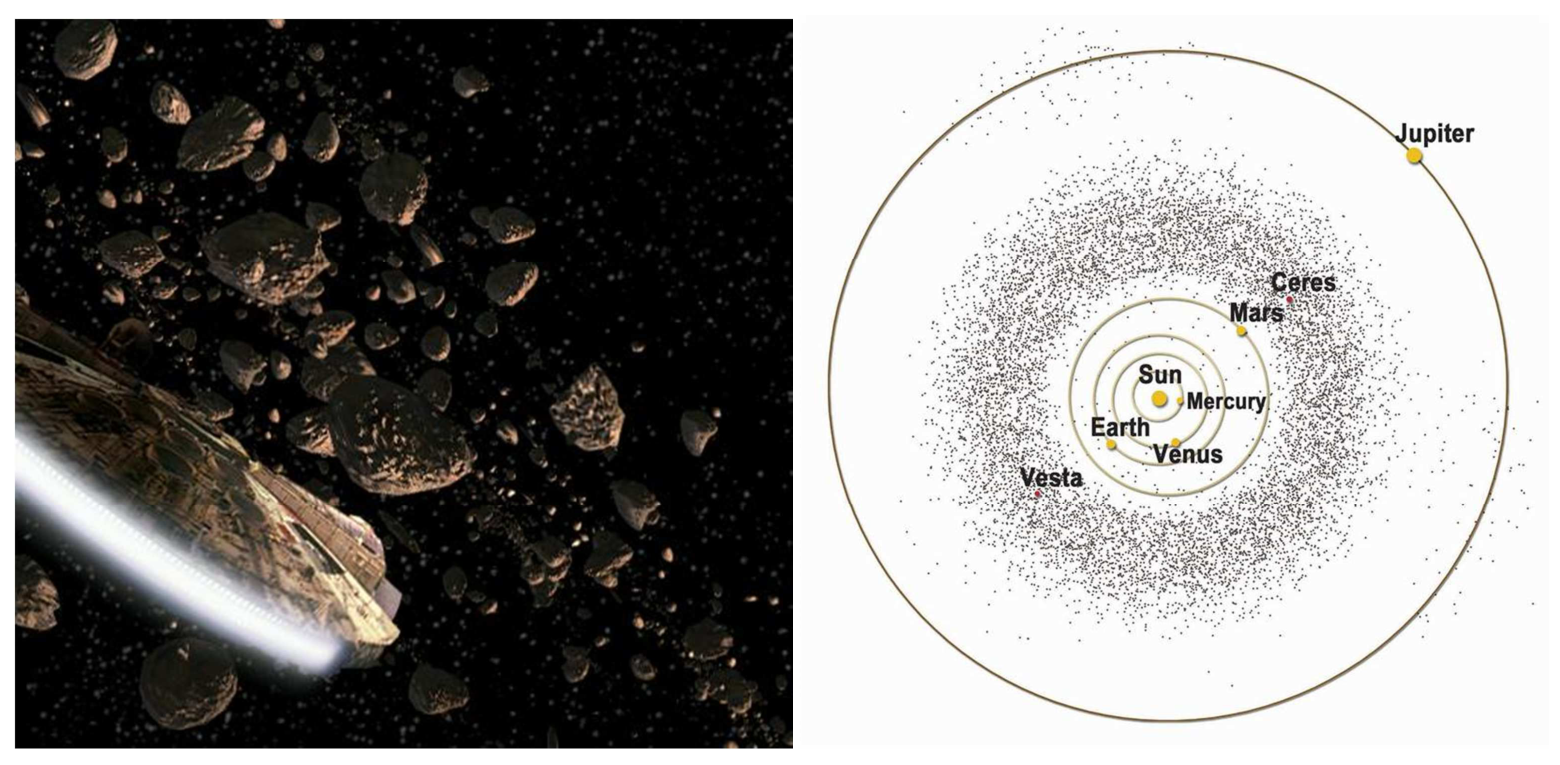
This question will look at the real distances between asteroids.
a. Given that the total mass of the asteroid belt is approximately calculate the radius of the object that could be formed, assuming it has a density typical of rock (). Compare this to the radius of the largest member of the asteroid belt, Ceres. ( = 473 km)
b. The main part of the asteroid belt extends from 2.1 AU to 3.3 AU, and has an average angular width of 16.0°, as viewed from the Sun. Calculate the average thickness of the belt, and hence its total volume, .
c. Assuming this volume is uniformly filled by spherical rocky asteroids of average radius , derive a relationship between the average distance between asteroids, , and their radius , remembering to keep the total mass equal to .
d. If = 2.0 km, calculate . How does this compare to the Earth-Moon distance? ( 384,000 km)
An object with an apparent magnitude has an apparent brightness .
e. Using the luminosity of the Sun, calculate the total power incident on an asteroid in the middle of the asteroid belt.
f. Assuming only 30% of that is reflected by its rocky surface, calculate the apparent magnitude of the asteroid when viewed from its nearest neighbour. Given that objects with are too faint for the naked eye, would it be visible to an astronaut stood on the asteroid surface?
Отговори
a. 660 km
r = 660 km = 1.4 RCeres
b. m³
Total thickness 0.76 AU; Vbelt = 15.45 AU³ = 5.1 × 10³⁴ m³
c.
d. m
dav = 1.1 × 10⁹ m = 2.9 dE→M
e. W
f. 6.9
m = 6.9, so the nearest asteroid is not visible to the naked eye
Решение
a. Given that the total mass of the asteroid belt is approximately = 1.8 × 10 M, calculate the radius of the object that could be formed, assuming it has a density typical of rock (ρ = 3.0 g cm). Compare this to the radius of the largest member of the asteroid belt, Ceres. ( = 473 km)
= 1.8 × 10 M = 3.6 × 10 kg
density = 3.0 g cm = 3.0 × 10 kg m
[1]
[1]
[1]
[This means Ceres contains a sizeable fraction of the material in the whole belt, although it has a lower density than we have assumed, so less mass than implied here]
b. The main part of the asteroid belt extends from 2.1 AU to 3.3 AU, and has an average angular width of 16.0°, as viewed from the Sun. Calculate the average thickness of the belt, and hence its total volume, .
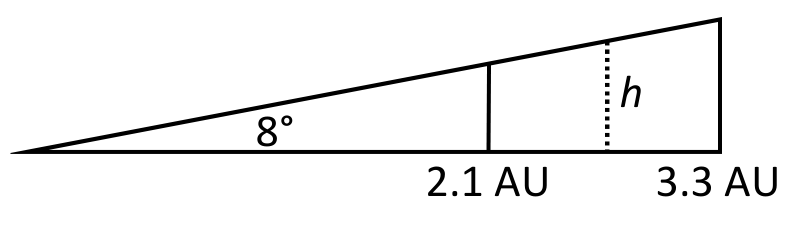
Average height above the orbital plane, [0.5]
So total thickness = 2h = 2 × 0.38
= 0.76 AU [0.5]
Volume of belt = area of disk × total thickness
[1]
[1]
[This is a huge volume, which explains why each asteroid gets so much space to itself]
c. Assuming this volume is uniformly filled by spherical rocky asteroids of average radius , derive a relationship between the average distance between asteroids, , and their radius , remembering to keep the total mass equal to .
Assuming there are N asteroids, each filling a cube with side length then [1]
Conserving the volume of rock in the belt means [1]
so we can cancel N to give
[1]
(a spherical approximation for the volume of belt allocated to each asteroid can also gain full credit so long as it is clear that in that case is equal to double the radius of the spherical volume used)
i.e. leading to
d. If = 2.0 km, calculate . How does this compare to the Earth-Moon distance? ( = 384,000 km)
[1]
[1]
(using a spherical approximation in the previous question yields = 1.4 × 10 m = 3.6 )
[An average separation of about 1 million km is close to the real value for our asteroid belt and emphasises the vast space between asteroids, which is why many probes can travel through unharmed, although the real value of is somewhat smaller – this is because the real asteroid belt contains far more small asteroids than big ones]
e. Using the luminosity of the Sun, calculate the total power incident on an asteroid in the middle of the asteroid belt.
Distance to middle of the belt,
Apparent brightness of the Sun in the middle of the belt:
[1]
[1]
Incident power, = apparent brightness × cross-sectional area of an asteroid
[1]
[1]
f. Assuming only 30% of that is reflected by its rocky surface, calculate the apparent magnitude of the asteroid when viewed from its nearest neighbour. Given that objects with m > 6 are too faint for the naked eye, would it be visible to an astronaut stood on the asteroid surface?
Apparent brightness of one asteroid as viewed from another with only 30% reflectivity:
[1]
[1]
[1]
[1]
This means that the astronaut could not see the nearest asteroid with their naked eye [1]
(Using a spherical approximation gives b = 2.9 × 10 W m and m = 7.3, so the same conclusion)
[In practice even though asteroids come in a wide variety of sizes, and the spacing can vary quite far from our values of , most asteroids only reflect about 10% of their light and so despite all the simplifying approximations we have made we still get the same result – that without binoculars you would be unable to tell you were flying through an asteroid belt, which is rather different to the picture painted by science fiction films!]
Оригинал в Архива: BAAO_2016.pdf · официални решения: BAAO_2016_solutions.pdf