BAAO 2019, Теория — Задача 2. 360 Days in a Year
British Astronomy and Astrophysics Olympiad 2018-2019 — Astronomy & Astrophysics Competition Paper — Monday 21st January 2019 · 21 януари 2019 г. · 25 т.
Указания
This question paper must not be taken out of the exam room
Time: 3 hours plus 15 minutes reading time (no writing permitted). Approx 45 minutes per question.
Questions: All four questions should be attempted.
Marks: The questions carry similar marks.
Solutions: Answers and calculations are to be written on loose paper or in examination booklets. Students should ensure their name and school is clearly written on all answer sheets and pages are numbered. A standard formula booklet with standard physical constants should be supplied.
Instructions: To accommodate students sitting the paper at different times, please do not discuss any aspect of the paper on the internet until 8 am Saturday 26th January.
Clarity: Solutions must be written legibly, in black pen (the papers are photocopied), and working down the page. Scribble will not be marked and overall clarity is an important aspect of this exam paper.
Eligibility: The International Olympiad will be held during August 2019; all sixth form students are eligible to participate, even if they will be attending university from October.
Training Dates and the International Astronomy and Astrophysics Olympiad (IOAA)
The IOAA this year will be held in Zanka, Hungary, from 2nd to 11th August 2019.
The best students taking this paper that are eligible to represent the UK at the IOAA will be invited to attend the Training Camp to be held in the Physics Department at the University of Oxford, (Saturday 13th April to Wednesday 17th April 2019). Astronomy material will be covered; problem solving skills and observational skills (telescope and naked eye observations) will be developed. At the Training Camp a data analysis exam and a short theory paper will be sat. A team of five students (plus one reserve) will be selected for further training. From May there will be mentoring by email to cover some topics and problems, followed by additional training camps in the summer.
Important Constants
| Constant | Symbol | Value |
|---|---|---|
| Speed of light | ||
| Earth’s rotation period | 1 day | 24 hours |
| Earth’s orbital period | 1 year | 365.25 days |
| parsec | pc | |
| Astronomical Unit | au | |
| Semi-major axis of the Earth’s orbit | 1 au | |
| Radius of the Sun | ||
| Radius of the Earth | ||
| Mass of the Sun | ||
| Mass of the Earth | ||
| Luminosity of the Sun | ||
| Stephan-Boltzmann constant | ||
| Gravitational constant | ||
| Boltzmann constant | ||
| Permittivity of free space | ||
| Permeability of free space | ||
| Planck’s constant | ||
| Elementary charge | ||
| Proton rest mass | ||
| Electron rest mass |
Important Formulae
You might find the diagram of an elliptical orbit below useful in solving some of the questions:
Elements of an elliptic orbit:
| semi-major axis | |
| semi-minor axis | |
| eccentricity | |
| F | focus |
| P | periapsis (point nearest to F) |
| A | apoapsis (point furthest from F) |
Kepler’s Third Law: For an elliptical orbit, the square of the period, , of an object about the focus is proportional to the cube of the semi-major axis, (as defined above), such that
where is the total mass of the system (typically dominated by the central object) and is the universal gravitational constant.
Magnitudes: The apparent magnitudes of two objects, and , are related to their apparent brightnesses, and , via the formula
The absolute magnitude of an object, , is the same as its apparent magnitude when viewed from 10 pc, hence the relationship between apparent and absolute magnitude and distance is
where is measured in parsecs.
Note for markers
BAAO 2018/19 Solutions and Marking Guidelines
Note for markers:
- Answers to two or three significant figures are generally acceptable. The solution may give more in order to make the calculation clear. Units should be present on final answers when appropriate.
- There are multiple ways to solve some of the questions; please accept all good solutions that arrive at the correct answer. If a candidate gets the final (numerical) answer then allow them all the marks for that part of the question (as indicated in red), so long as there are no unphysical / nonsensical steps or assumptions made.
Условие
A day on Earth can be defined in two ways: relative to the Sun (called solar or synodic time) or relative to the background stars (called sidereal time). The mean solar day is 24 hours (within a few milliseconds), whilst the mean sidereal day is shorter at 23 hours 56 minutes 4 seconds (to the nearest second). The solar day is longer as over the course of a sidereal day the Earth has moved slightly in its orbit around the Sun and so has to rotate slightly further for the Sun to be back in the same direction (see Figure 4).
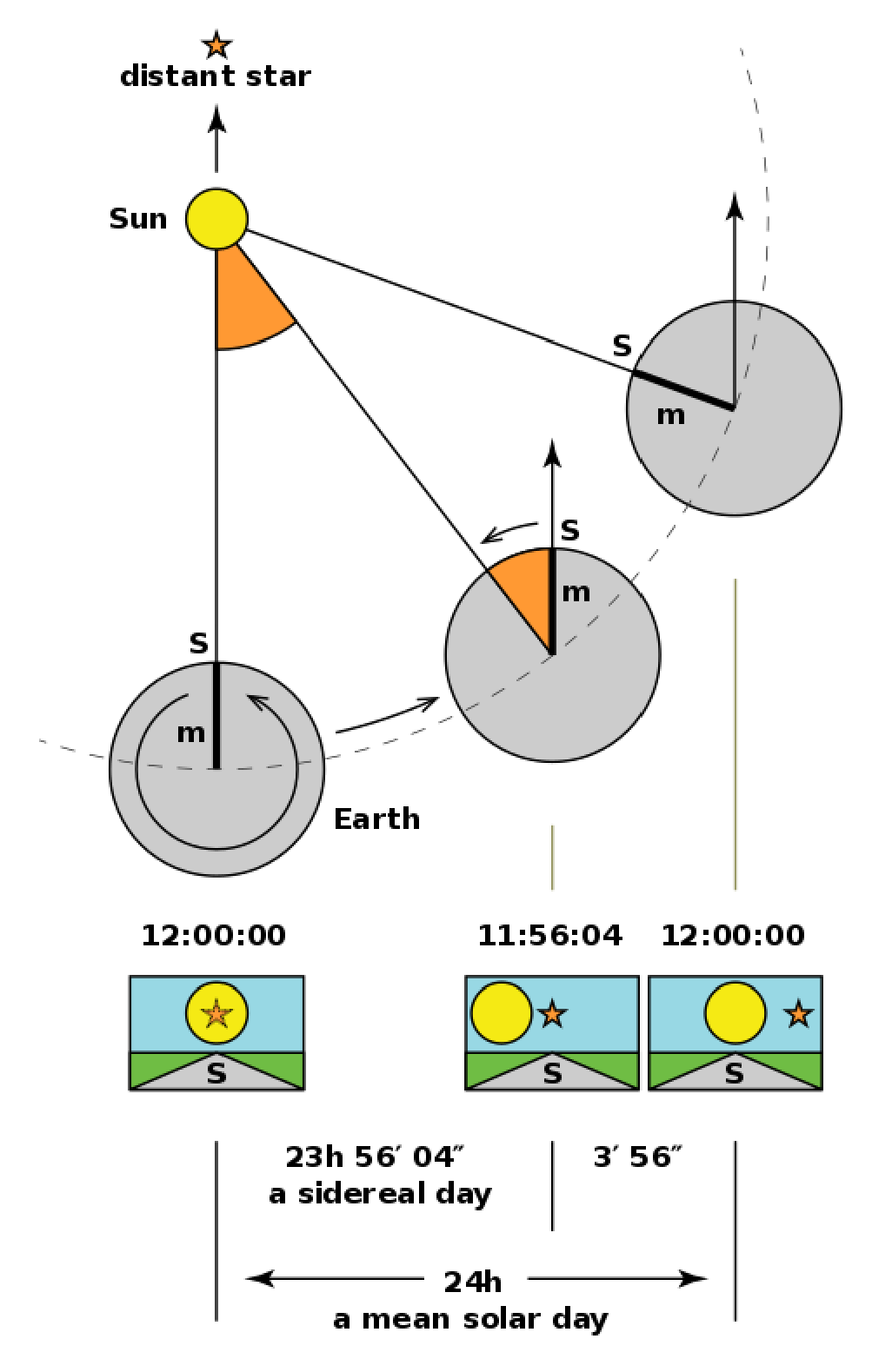
The length of a year on Earth is 365.25 solar days (to 2 d.p.), however some ancient civilizations used to believe that there were once exactly 360 solar days in a year, with various myths explaining where the extra days came from. In this question you will look at how to return the Earth to this time.
[Note that this question is very sensitive to the precision of the fundamental constants used, so throughout please take , km, kg, kg and 1 au = m.]
a. How many sidereal days elapse during a year? Give your answer to 2 d.p. [2 т.]
b. Without further calculation, suggest how many sidereal days there would be if a year was in fact only 360 solar days. [1 т.]
c. What reduction in the Earth’s semi-major axis would be required for the year to be shortened down to 360 solar days? [3 т.]
d. (i) Imagine creating an incredibly powerful rocket, positioned on the Earth’s equator, that when fired once can apply a huge force to the Earth in a very short time period, delivering a total impulse of . Assuming the Earth’s orbit is initially circular, calculate:
(i) The total impulse required to slow the Earth’s rotation to give a year of 360 solar days, but with no change in the orbit. [6 т.]
d. (ii) The total impulse required to change the orbit to give a year of 360 solar days, but with no change in the length of a solar day, also explaining how the rocket needs to be fired. [7 т.]
e. Tidal interactions between the Moon and the Earth mean that the Earth’s rotation rate is slowing down, such that a solar day has lengthened over the last 2800 years by an average of 2.3 ms per century. Similar interactions between the Earth and the Sun, as well as mass loss by the Sun due to nuclear fusion and the solar wind, mean that the distance between them is increasing by about 1.5 cm per year. Assuming these rates have stayed constant over time and that the Earth’s orbit has remained circular throughout, is there any time in either the Earth’s past or future when it had or when it will have a year with 360 solar days? Give your answer in Myr (where 1 Myr = years). [For reference, the age of the Earth is 4543 Myr.] [6 т.]
Helpful equations:
The moment of inertia, , of a sphere of mass and radius is .
The angular momentum, , of a spinning object with an angular velocity of is , where is the linear momentum of a point particle a distance from the axis of rotation.
The speed, , of an object in an elliptical orbit of semi-major axis around an object of mass when a distance away can be calculated as
Отговори
a. 366.25 sidereal days
b. 361 sidereal days
c. m
d. (i) kg m s⁻¹
d. (ii) Δp = 8.44 × 10²⁶ kg m s⁻¹; the rocket needs to be fired towards the horizon at sunrise
e. 54.5 Myr
54.5 Myr in the future (positive value).
Решение
Q2 – 360 Days in a Year [25 marks]
a.
[1]
(sidereal days) [1] [2]
[Must be 2 d.p. for the final mark]
b.
361 (sidereal days) [1] [1]
c.
Using Kepler’s third law to work out the new semi-major axis,
[1]
[1]
[1] [3]
[If they don’t use the values of fundamental constants given in the question, resulting in a value of m, give 2 marks max]
d. (i)
The sidereal day describes the actual rate of rotation of the Earth, so we need to work out the change in angular velocity going from 366.25 sidereal days to 361 sidereal days
[1]
[1]
[1]
Evaluating the moment of inertia for the Earth,
[1]
[1]
[1] [6]
[If students use solar days rather than sidereal days giving then give 5 marks max (though it will give the same to 4 s.f.). If they don’t use the values of fundamental constants given in the question, don’t penalise them in this part]
d. (ii)
We need to change the orbital speed of the Earth so that that point becomes an aphelion in an elliptical orbit with the same semi-major axis as calculated in part c.
[1]
[1]
[1]
[1]
[1]
[1] [6]
[If they don’t use the values of fundamental constants given in the question, resulting in a value of , give 5 marks max for this calculation. Allow a tolerance of to account for intermediate rounding errors. Give full ecf on value for taken from part c.]
The rocket needs to be fired towards the horizon at sunrise [1] [1]
[Accept a clear diagram showing the reaction force of the rocket on the ground creating a clockwise moment in the orbit and pointed at the centre of the Earth. Allow sunset if it’s clearly consistent with the direction of rotation of the Earth on its axis and as it moves around the Sun, since they weren’t explicitly specified as anti-clockwise in the question]
e.
In 1 Myr, has increased by 15 km and has lengthened by 23 s [need both] [1]
We want to satisfy the condition
[1]
Using Kepler’s third law for the new year duration,
[1]
(positive value indicates it’s in the future) [3] [6]
[Allow any valid method to solve the cubic, such as using their graphical calculator to plot the graph and find roots, or even a trial and error iteration. Some will use a first order binomial expansion to expand the brackets and get a linear expression leading to 54.88 Myr – give full marks for this approach. Using less precise fundamental constants gives a value of 69.98 Myr (and 70.63 Myr for the linear approach) – give 5 marks max. If the student suggests it is in the past give 5 marks max]
Questions proposed by
END OF PAPER
Questions proposed by:
Dr Alex Calverley (Royal Grammar School, Guildford)
John Hayton (University of Cambridge)
Josh Brown (University of Cambridge)
Оригинал в Архива: BAAO_2019.pdf · официални решения: BAAO_2019_solutions.pdf