BAAO 2024, II кръг — Задача 1. Maximum Payload to Mars
British Astronomy and Astrophysics Olympiad 2023-2024 — Astro Round 2 — Tuesday 27th February 2024 · 27 февруари 2024 г. · 35 т.
Указания
Time: 3 hours ( minutes for Q1, minutes for Q2 and minutes for Q3).
Questions: All three questions should be attempted. Each question contains independent parts so that later parts can be attempted even if earlier parts are incomplete.
Solutions: Answers and calculations are to be written on loose paper. START EACH QUESTION ON A NEW PAGE. Students should ensure their name and school is clearly written on the first answer sheet and that all pages are numbered. A standard formula booklet may be used.
Clarity: Solutions must be written legibly, in black pen, and working down the page. Scribble will not be marked and overall clarity is an important aspect of this exam.
Instructions: To accommodate students sitting the paper at different times, please do not discuss any aspect of the paper on the internet until 8 am Saturday 2nd March.
Calculators: Any standard calculator may be used, but calculators cannot be programmable and must not have symbolic algebra capability.
Training Dates and the IOAA
Training Dates and the IOAA (Vassouras, Rio de Janeiro, Brazil, 17th - 26th August 2024)
The team will be chosen from students taking this paper. The best students that are eligible to represent the UK at the IOAA will be invited to attend the Training Camp to be held in Oxford from Tuesday 2nd to Saturday 6th April 2024. Astronomy material will be covered; problem solving skills and observational skills (telescope and naked eye observations) will be developed. At the Training Camp a Data Analysis exam along with a Round 3 theory paper will be sat. A team of five students (plus one reserve) will be selected for further training, including additional training camps in the summer.
The BAAO are very proud to be sponsored by G-Research
Important Constants
| Constant | Symbol | Value |
|---|---|---|
| Speed of light | ||
| Earth’s rotation period | 1 day | 24 hours |
| Earth’s orbital period | 1 year | 365.25 days |
| parsec | pc | |
| Astronomical Unit | au | |
| Radius of the Sun | ||
| Radius of the Earth | ||
| Mass of the Sun | ||
| Mass of the Earth | ||
| Luminosity of the Sun | ||
| Absolute magnitude of the Sun | ||
| Hubble constant | ||
| Stephan-Boltzmann constant | ||
| Gravitational constant | ||
| Boltzmann constant | ||
| Permittivity of free space | ||
| Permeability of free space | ||
| Planck’s constant | ||
| Elementary charge | ||
| Proton rest mass | ||
| Electron rest mass | ||
| Wien’s displacement law | ||
| Avagadro’s constant |
Basic calculus formulae:
Chain rule
Product rule
Quotient rule
Integration by parts
Standard integral
Important Formulae
You might find the diagram of an elliptical orbit below useful in solving some of the questions:
Elements of an elliptic orbit:
- semi-major axis
- semi-minor axis
- eccentricity
- focus
- periapsis distance (shortest distance from )
- apoapsis distance (longest distance from )
Kepler’s Third Law:
Vis-Viva Equation:
Wien’s Displacement Law:
Stephan-Boltzmann Law:
Brightness (Intensity):
Magnitudes:
Distance-Parallax Relation:
Rayleigh Criterion:
Redshift:
Hubble’s Law:
Note for markers
Astro Round 2 2024 Paper Solutions and Marking Guidelines
Note for markers:
- Answers to two or three significant figures are generally acceptable. The solution may give more in order to make the calculation clear. Units should be present on final answers when appropriate.
- There are multiple ways to solve some of the questions; please accept all good solutions that arrive at the correct answer. Students getting the answer in a will get all the marks available for that calculation / part of the question (as indicated in red), so long as there are no unphysical / nonsensical steps or assumptions made (students may not explicitly calculate the intermediate stages and should not be penalised for this so long as their argument is clear).
In these solutions a black [1] is a marking point and a bold [n] is the total for that calculation or part (printed in red in the source).
Условие
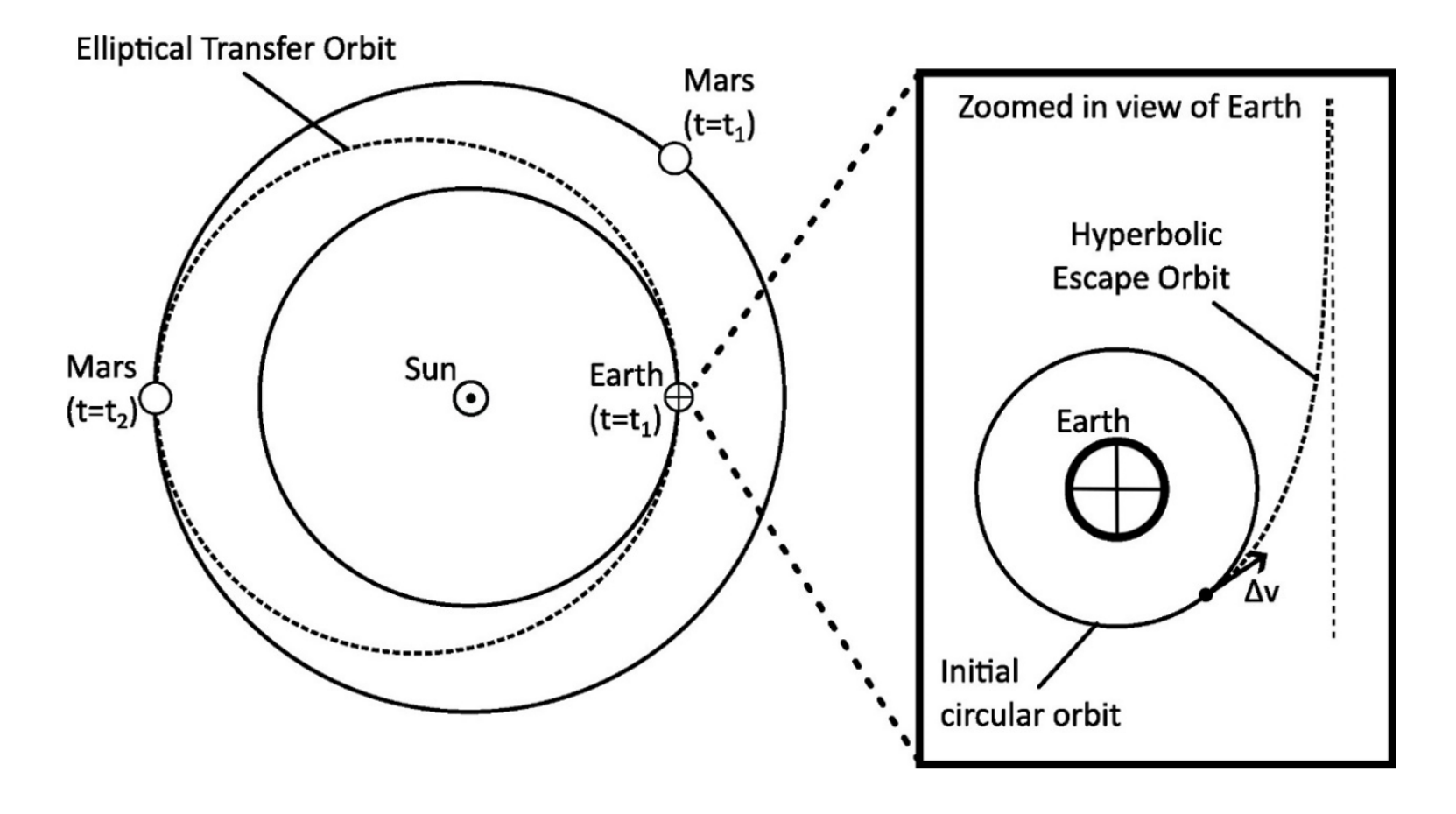
In order to travel from Earth to Mars, a spacecraft must travel on an elliptical orbit around the Sun. To make the transfer as efficient as possible, this ellipse should be chosen to have its perihelion (distance of closest approach to the sun) equal to the radius of the Earth’s orbit, and its aphelion (greatest distance from the sun) equal to that of Mars, as shown in Figure 1 below below. This is known as a Hohmann transfer orbit (HTO), and one can classically calculate the increase in speed between the Earth and a spacecraft necessary to get onto the ellipse. However, this simplistic calculation does not account for the energy needed to escape the Earth’s gravitational pull. This means it would only be accurate for a spacecraft orbiting the Sun at au with no planet nearby - in reality, the change in speed of the spacecraft must be larger so it can get onto a hyperbolic orbit around the Earth that will asymptote to the transfer ellipse’s perihelion velocity. By considering the increase and decrease in the speed of a spacecraft to move from escaping Earth’s gravity and being captured by Mars’ gravity, we can calculate the maximum payload we can transfer with current technology.
a. (10 т.)
The spacecraft leaves Earth at time and travels on the elliptical transfer orbit until it reaches its aphelion at time , where it intercepts Mars, which is assumed to have a circular orbit with semi-major axis au. Assume the Earth’s orbit is also circular and all orbits are coplanar.
(i) Calculate the transfer time in years, and hence calculate the Earth-Sun-Mars angle, , at required for a successful transfer. [3 т.]
(ii) Calculate the time between consecutive occurrences of this phase angle, known as the synodic period . [2 т.]
(iii) Calculate the perihelion velocity, , of the transfer orbit and the orbital velocity of the Earth, (these are both in the Sun’s rest frame) and hence show that the required increase in the velocity of the spacecraft, (parallel to the Earth’s orbit) in the Earth’s rest frame is . [3 т.]
(iv) What is the minimum distance from the Earth (in Earth radii) necessary for the spacecraft to be travelling at (as measured by observers on Earth) and NOT still be in an elliptical orbit around the Earth? [2 т.]
To put your answer to the previous question into context, geostationary satellites have an orbital radius of , and given all spacecraft orbits prior to interplanetary transfer are in low Earth orbit (which is much closer) it should be clear that in order to enter the HTO, the spacecraft must first escape the gravity of the Earth. Whilst this could be achieved with a parabolic orbit, we need the asymptotic speed to be equal to the calculated and so only a hyperbolic orbit can achieve this.
b. (14 т.)
The spacecraft is initially in a circular orbit around the Earth with a radius of m and orbital velocity (all velocities in this part of the question are in the Earth’s rest frame). It then makes a single, instantaneous change in velocity , parallel to its direction of travel, to accelerate into a hyperbolic orbit, with a perigee velocity of at a perigee distance of , and an asymptotic velocity (the value that the spacecraft’s velocity approaches as it gets far away from the Earth). To join the HTO we will assume .
(i) Calculate the total specific energy, , of the desired hyperbolic orbit, where is the total energy of the orbit and is the mass of the spacecraft. [2 т.]
(ii) Find an expression for in terms of , , and and hence calculate its value. [Hint: you should find .] [3 т.]
(iii) Hence calculate the specific angular momentum of the hyperbolic orbit, where is the spacecraft’s distance from the focus of the hyperbolic orbit (in this case the centre of the Earth) and is the component of its velocity perpendicular to that distance. Note that is conserved over the orbit. [2 т.]
(iv) Let be the perigee-Earth-spacecraft angle, which increases with time as the spacecraft moves along the hyperbolic orbit. Show that , derive an expression for (in terms of , , , and any relevant constants), and hence find an expression for . [4 т.]
(v) It can be shown that solving your expression for gives the result where and are constants given by and . Use this to determine the required Sun-Earth-Spacecraft angle at the time when the spacecraft accelerates into its hyperbolic orbit. [3 т.]
c. (5 т.)
Once the spacecraft arrives at Mars, it will approach Mars on a hyperbolic orbit similar to its departure orbit from Earth a velocity (relative to Mars) of . It then has to decrease its velocity by to be captured into a circular orbit of radius (to be determined) and orbital velocity . You are given that for this hyperbolic orbit, J kg, and that the mass of Mars, kg.
(i) Find the value of that minimises . [Hint: instead of trying to use the same equation as used in b.(ii), rewrite it as where and are both dimensionless variables, and find the value of that minimises .] [4 т.]
(ii) Hence determine the minimum to capture into a circular orbit at Mars. [1 т.]
d. (6 т.)
From this we can calculate the magnitude of the total change in velocity by the spacecraft that has to be done by its rockets, , and hence calculate the maximum payload mass that it can carry to Mars.
(i) Consider the ejection by the spacecraft’s engine of a small mass of fuel at an exhaust velocity . Show that the corresponding change in velocity of the spacecraft, , is given by , where is the current mass of the spacecraft. [1 т.]
(ii) Hence, by integrating, show that the total change in velocity of the spacecraft is given by , where is the dry mass of the spacecraft (total mass of everything except fuel), and is the wet mass (total mass including fuel). [2 т.]
(iii) A future spacecraft for travelling to Mars has a dry mass (not including payload) of 1000 kg, can carry 5000 kg of fuel, and has an effective exhaust velocity from a hydrogen-oxygen rocket of 4.25 km s. Calculate the maximum mass of payload it can carry to Mars, assuming that is the total change in velocity needed for the mission.
Use km s if you did not make progress with previous parts. [3 т.]
Отговори
a., (i) 0.771 rad
Δt = 0.707 years (0.710 years with the SI form of Kepler’s third law); φ = 0.771 rad (= 44.1°).
a., (ii) 2.14 years
a., (iii) 2.925 km s⁻¹
vp = 32.67 km s⁻¹, v⊕ = 29.75 km s⁻¹; 2.807 km s⁻¹ is also accepted (v⊕ = 29.87 km s⁻¹ from 2πr/T).
a., (iv) 14.6 R_⊕
b., (i) J kg⁻¹
b., (ii) 3.34 km s⁻¹
Δvhyp,⊕ = √(2(ε + GM⊕/r0)) − √(GM⊕/r0).
b., (iii) m² s⁻¹
b., (iv)
b., (v) 1.98 rad
= 113.4°
c., (i) m
α = 1
c., (ii) 1.87 km s⁻¹
d., (iii) 1077 kg
With Δvtot = 5.21 km s⁻¹; 1229 kg with the given Δvtot = 5 km s⁻¹.
Решение
Q1 – Maximum Payload to Mars [35 marks]
a.
(i) Calculating the semi-major axis of the transfer orbit by taking the average of the perihelion distance (at Earth) and the aphelion distance (at Mars)
[1]
Hence, using the simplified version of Kepler’s 3rd Law for use in the Solar system, we can work out the period of the orbit and know that the transfer time is half that (since the probe only travels half an ellipse)
(must be in years) [1] [2]
[Accept using the SI units version of Kepler’s 3rd Law, which with the given precision and values of constants leads to ]
The phase angle we are after must be the angle that Mars travels through in time subtracted from π radians (or 180°)
[1] [1]
[This value should be the same whichever version of Kepler’s third law they used since the corrective factor between the two methods cancels out if they used the same method to get the period of Mars]
(ii) Looking at the difference in angular velocities
[1]
[1] [2]
[Alternative method if they use the known formula for synodic period:
[1]
[1]
If no other marks scored, they can get the first mark for the period of Mars as 1.87 years (if using simplified Kepler 3) or 1.88 years (if using the SI units version with given constants) – this may have been done in the previous part of the question]
(iii) Using the vis-viva equation to get the perihelion velocity
[1] [1]
The orbital velocity of the Earth
[1] [1]
[Accept using given constants]
Hence the required increase in the velocity of the spacecraft is
(must be at least 2 s.f.) [1] [1]
[Accept using the other value of to give for all the marks]
(iv) Recognise that we want to know the distance at which this speed corresponds to escape velocity (or total energy is zero)
[1]
[1] [2]
[Must be in units of for the final mark. Allow full ecf on their value for . For reference, and . If they get answers that are half these (due to assuming circular orbit) then only allow second mark]
[All of these answers are clearly much further away from Earth than even geostationary orbits and so it is apparent that we must escape the Earth’s gravity with a hyperbolic orbit that then patches onto the elliptical Hohmann transfer orbit once far enough from Earth]
b.
(i) For a hyperbolic orbit, the total energy will be positive and so will be equal to the KE when infinitely far from the Earth (so GPE = 0)
[1]
[1] [2]
[Allow full ecf for their value for . For reference, and .]
(ii) Using energy conservation, we can get an expression for the perigee velocity
[1]
Hence the expression for is
[1] [2]
[Accept any algebraically equivalent forms]
Evaluating it with our calculated value of
[1] [1]
[Allow full ecf from previous values of . If using and ]
[This is reassuringly a little bigger than what we calculated for in the naive case where we ignored having to escape Earth’s gravity – although it might surprise you to see that it’s not that much bigger (only about 10%); this is because a lot of work has already been done by the rocket getting the spacecraft into that low Earth orbit to begin with.]
(iii) Since is conserved over the whole orbit, the obvious place to choose is where we know both and – this is the perigee, where also very conveniently
[1]
[1] [2]
[Allow full ecf from previous values of . If using and ]
(iv) Combining the expression for specific angular momentum with a standard one for
[1] [1]
[Since this was a ‘show that’ question, the mark is not for the final result but for explicitly substituting into ]
Considering energy conservation, using Pythagoras to resolve the velocity into perpendicular and parallel components
[1]
[This mark could be awarded for just correct application of Pythagoras if the student makes no further progress]
[1] [2]
[Accept algebraically equivalent forms]
Hence, using the chain rule
[1] [1]
[Accept algebraically equivalent forms]
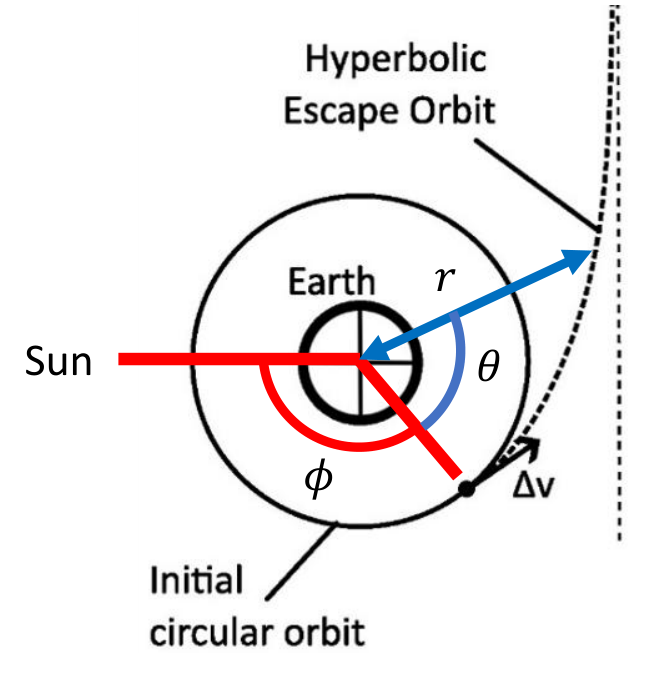
(v) Using Figure 1 from the paper for reference:
We have been given a polar form for the hyperbola, and we want to find the angle [accept any choice of notation]
Considering the asymptote, as , so from the polar equation this is achieved as
[1]
[This mark can alternatively be scored for calculating ]
[1]
By considering the diagram
[1] [3]
[Allow ecf using their values of and . For reference, using the values of and that come from and .]
[Although not needed to solve this question, the constant is known as the semi-latus rectum, and corresponds to the distance from the focus (at the centre of the Earth) to the hyperbola along a line perpendicular to the one between the focus and the perigee, known as the major axis. As you might have guessed, the constant is the eccentricity of the hyperbola; for hyperbolae ]
c.
(i) Recasting our expression for from b.(ii) in terms of and , as suggested
[1]
The minimum will correspond to a turning point, so we look where and make use of the chain rule
[correct differentiation] [1]
[1] [3]
Hence the value of r that minimises is
[1] [1]
[If this answer was achieved without following the suggested hint of recasting the expression in terms of and , the student can still receive 4 marks]
(ii) Substituting our value of r into the equation for
[1] [1]
[Valid alternative method: since then if , so ]
d.
(i) By conserving momentum (should be explicitly stated)
[1] [1]
[Since it is a ‘show that’ question, the mark is for clear reasoning rather than the final algebraic answer]
(ii) Setting up the integral with the bounds the right way round
[1]
[1] [2]
[Since it is a ‘show that’ question, the second mark is for correct evaluation of the integral, clearly showing how they have integrated 1/m]
(iii) Expanding the equation of the previous part to include the described quantities with correct dry and wet mass expressions [accept any choice of notation]
[1]
Rearranging for
[1]
Using our earlier values of from b.(ii) and from c.(ii)
[1] [3]
[Allow ecf from their values of and . For reference, if using , and . If they use the given value of ]
[In reality, the Orion spacecraft in the NASA Artemis programme (planned to send humans to Mars) has a dry mass 10 times heavier than this so the fuel requirements are enormous!]
Questions proposed by
Questions proposed by:
Francesca Di Cecio (University of Cambridge)
Ben Woodrow (University of Oxford)
Dr Alex Calverley (Surbiton High School)
Оригинал в Архива: BAAO_R2_2024.pdf · официални решения: BAAO_R2_2024_solutions.pdf