BPO 2019, Теория — Задача 1. Gravitational Billiard
1st Balkan Physics Olympiad – 2019 BPO · 14 юли 2019 г. · 25 т.
Условие
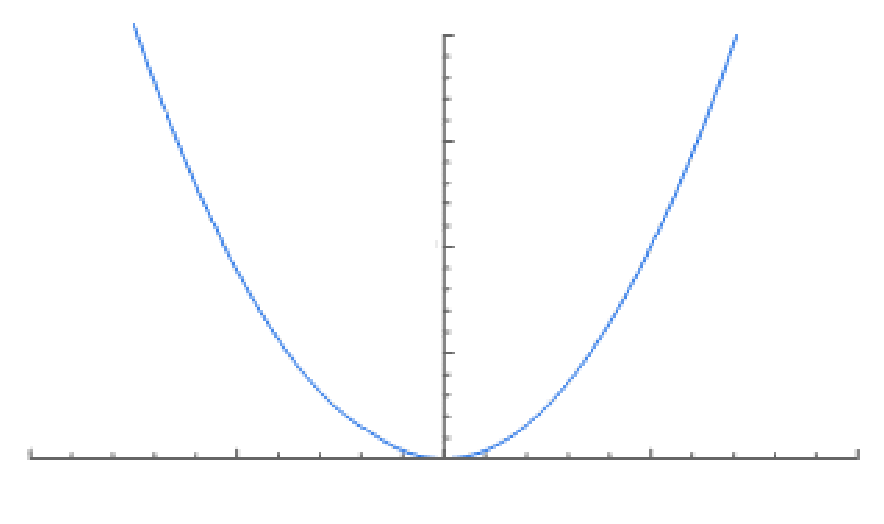
A point particle is moving in a homogeneous gravitational field close to the Earth surface in a vertical plane limited from below by a parabola (as shown in the figure). Consider periodic motion in a gravitational billiard. A periodic motion repeats itself indefinitely when friction forces are absent. After reflection from the boundary the energy of the particle remains unchanged.
a) Draw the periodic trajectories that touch the boundary in one, two and three distinct points. [3x3 points] [9 т.]
b) Calculate the period for the first two cases. [One touching point - 6 points] [Two touching points - 10 points] [16 т.]
The angle between the tangent of the parabola at an arbitrary point and the -axis is given by .
Отговори
- One touching point (vertical motion): T = 2v0/g. Two touching points, symmetric trajectory: T = 4√(x0/g) for the 45° case, in general T = 2√(2/ag), independent of x0.
Решение
1. In the simplest case the motion is along the vertical axis starting from the origin at the bottom of the parabola with an arbitrary initial velocity . The motion is described by , , . The highest point of the trajectory is reached at time . The period of the motion is .
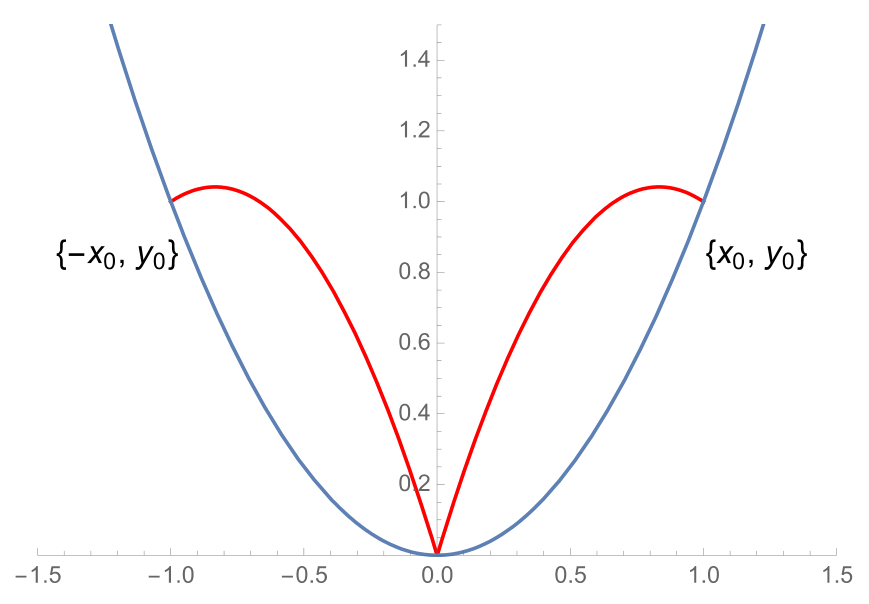
2. Another simpler case is a trajectory that is symmetric to the parabola that bounds the motion from below. This is illustrated with the following figure. In order to have periodic motion the trajectory of the particle must reach the boundary at an angle of . The point is not arbitrary. It is specific for the given bounding parabola. If is the speed at the instant of collision with the boundary given by , , , the trajectory of the particle is described by
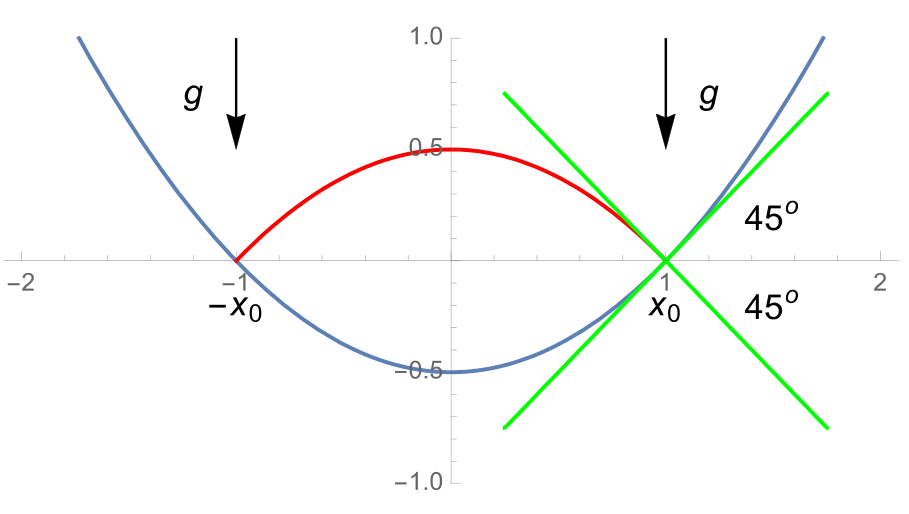
Elimination of from the above equations, with the additional requirement that the trajectory has the symmetric form , and taking into account that , one finds that the initial speed of the particle at the boundary should be . Therefore the period is .
3. The boundary may be represented as . Let us take and as the end points of the periodic trajectory. The tangents of the boundary at these end points, at the right and left side, are . The orthogonal direction to the tangent on the left is given by . Motion of the point particle is described by
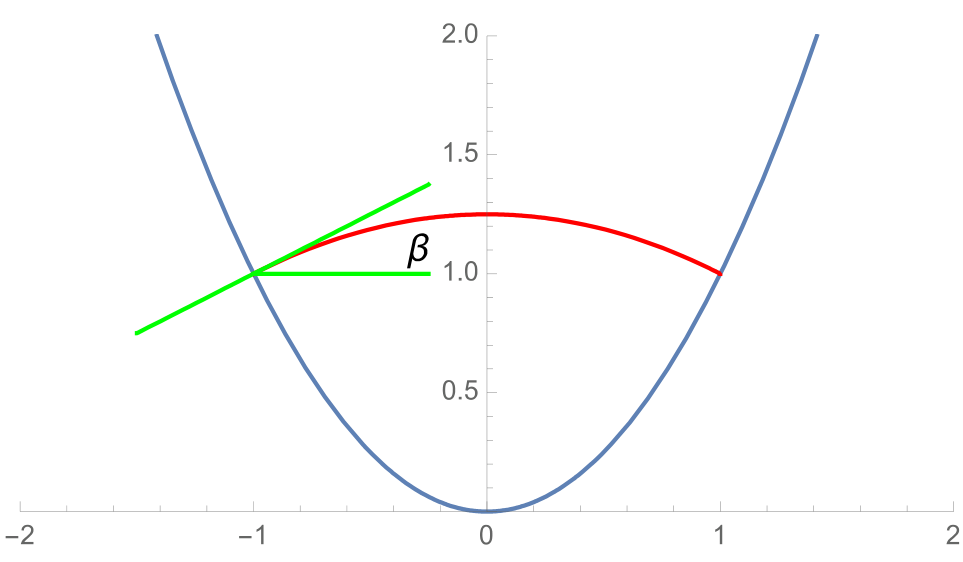
After elimination of , the symmetry requirement implies the condition and the trajectory is given by . The condition of orthogonality at the boundary leads to . The speed at the boundary reflection point is
and the period is independent of . This is in agreement with the result of section 2, where , and , that is .
4. The trajectory in the following figure has a parabolic section in the middle and two vertical sections at both ends. Indicated angles have to satisfy the relationship .
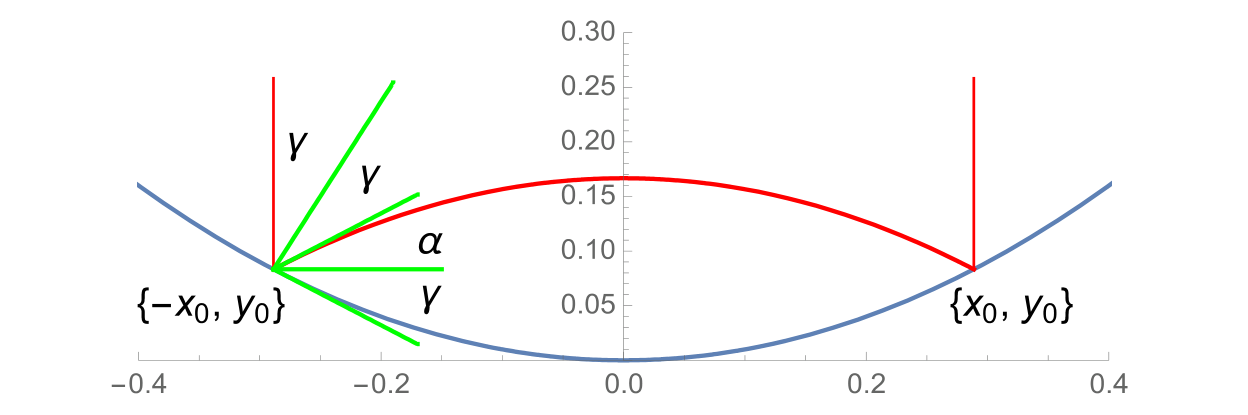
Such trajectory appears when the orthogonal line at the point of collision with the boundary divides in two halves the angle between the vertical line and the tangent at the end of the parabolic section of the trajectory. The period of this motion is given by and or
5. In this case the orbit, as shown in the figure, touches the boundary at three points. The boundary and the right and left branches of the trajectory are given by , , with the abscissa of the collision points with the boundary (, , ). From the orthogonality condition at the boundary , it follows . The period is found from where and is expressed from .
In analogy to the situation in section 4, the trajectory of section 5 can have vertical tails under similar conditions. There are probably two additional periodic trajectories that are not discussed.
Оригинал в Архива: problems.pdf · официални решения: solutions.pdf