BPO 2020, Теория — Задача 2. Block on a spring
Balkan Physics Olympiad – BPO 2, online contest, 24 October 2020, Craiova, ROMANIA · 24 октомври 2020 г.
Условие
Consider a block weighting is maintained at rest at a height above an ideal spring. The spring has a spring constant and is initially in its equilibrium state. The block is released and falls towards the spring while subjected to a friction constant force due to air resistance.
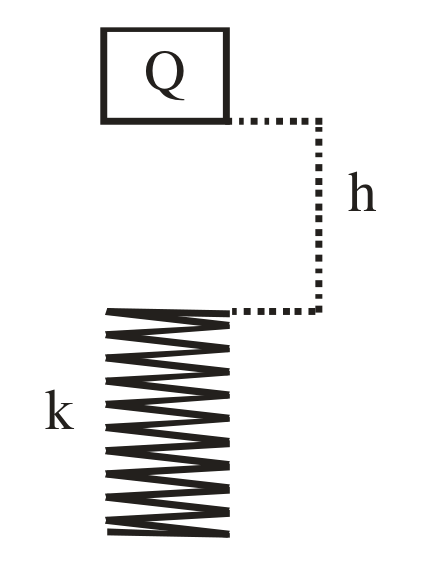
a) Determine the expression for compressing distance of the spring after the block falls on it, neglecting the friction force, and calculate its numerical value. [3 т.]
b) Taking into account the friction force, determine the expression for the compressing distance of the spring after the block falls on it and calculate its numerical value. [4 т.]
c) Taking into account the friction force, determine the expression for the maximum height of the block after its first contact with the spring (i.e. after the first „jump“) and calculate its numerical value. [4 т.]
d) Taking into account the friction force, determine the expression for the maximum height of the block after its second contact with the spring (i.e. after the second „jump“) and calculate its numerical value. [6 т.]
e) Taking into account the friction force, will the block jump after the third contact between the block and the spring? Explain your answer. [5 т.]
f) Taking into account the friction force, calculate the final compressing distance of the spring after the block comes to rest. [3 т.]
Отговори
a) 2.79 m
b) 2.34 m
c) 2.04 m
d) 0.57 m
e) No: the block will not jump off the spring after the third contact ( m would be negative).
f) 0.625 m
The official solution adds that, if no friction acts on the block at rest, the block finally reaches xf' = Q/k = 0.5 m.
Решение
a) (3 points) Determine the expression for compressing distance of the spring after the block falls on it, neglecting the friction force, and calculate its numerical value.
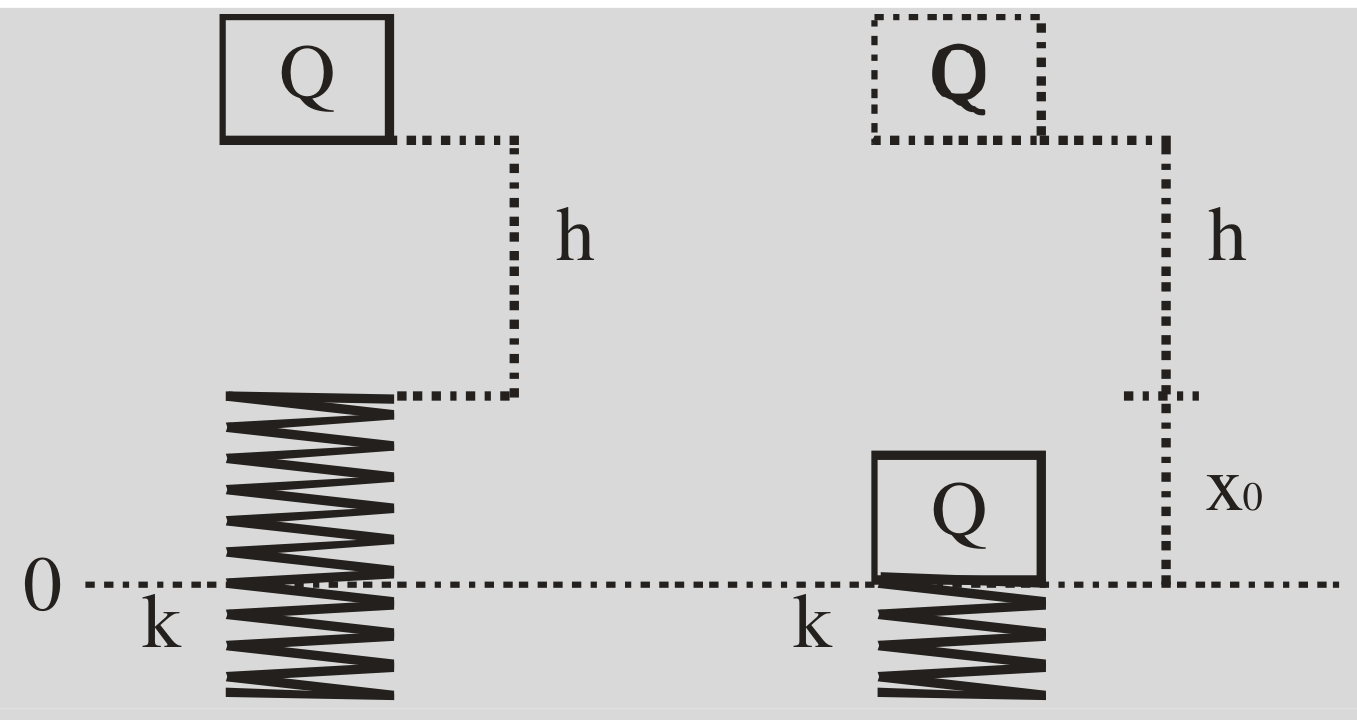
For , using the mechanical energy conservation low, we have
(1 point)
(1 point)
Taking the + sign the compressed distance is
(1 point)
b) (4 points) Taking into account the friction force, determine the expression for the compressing distance of the spring after the block falls on it and calculate its numerical value.
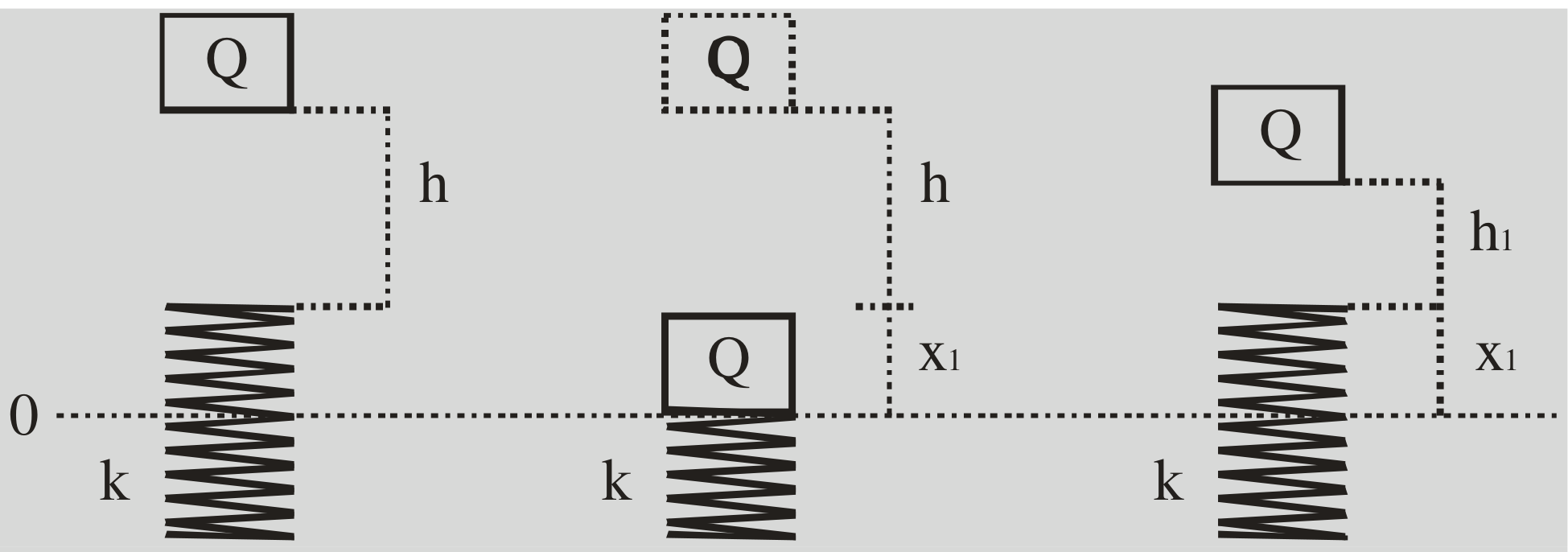
Taking into account the friction force, using the total energy conservation low, we have
(1 point)
(2 points)
Taking the + sign the compressed distance is
(1 point)
c) (4 points) Taking into account the friction force, determine the expression for the maximum height of the block after its first contact with the spring (i.e. after the first „jump“) and calculate its numerical value.
After the first contact between the block and the spring, the block starts to move up. We have
(1 point)
(2+1 points)
d) (6 points) Taking into account the friction force, determine the expression for the maximum height of the block after its second contact with the spring (i.e. after the second „jump“) and calculate its numerical value.
This time the block free falls from the height above top of the spring. We have
(1 point)
Taking the + sign the compressed distance is
(2 points)
After the second contact between the block and the spring, the block starts to move up again and we have
(1 point)
(2 point)
e) (5 points) Taking into account the friction force, will the block jump after the third contact between the block and the spring? Explain your answer.
If we try to calculate the maximal height after the third contact we would get negative numerical value
(2 points)
where is obtained as
(1 point)
We conclude that the block will not jump off the spring after their third contact. The block stays on top of the spring. (2 points)
f) (3 points) Taking into account the friction force, calculate the final compressing distance of the spring after the block comes to rest.
The block will come to rest at compressing distance while trying to move downwards or at while trying to move upwards. We will prove that it happened while trying to move upwards.
The block moves from upwards until it reaches . Using the theorem of kinetic energy variation, it follows
(0.5 points)
(0.5 points)
From the block moves downwards until it reaches . Using the same theorem, it follows
(0.5 points)
At the end, the block moves upwards from trying to reach :
(0.5 points)
We see that , which means that the block will come to rest while trying to move upwards (between and ), i.e.
(1 point)
*
Note: If the friction force had acted on the block at rest, then the above position would have been the final equilibrium position of the block on the spring (the resultant force acting on it would have been zero). However, this assumption was not given explicitly in the problem’s text.
On the other hand, considering that there is no friction force acting upon the block at rest, but only when it moves, for the above position the net force acting on the block is directed upwards, so the block will go up, in many small steps, until it reaches the final position given by:
Оригинал в Архива: problems.pdf · официални решения: solutions.pdf