BPO 2020, Теория — Задача 4. Electric resistances measurement
Balkan Physics Olympiad – BPO 2, online contest, 24 October 2020, Craiova, ROMANIA · 24 октомври 2020 г.
Условие
A. For measuring resistances, a student makes the electric circuit illustrated in Fig. 1. The switch k can be commuted in positions labeled with 1, respectively 2 in the diagram. is the unknown value of the resistance, V is the voltmeter and A is the amperemeter. The internal resistance of the voltmeter is and of the amperemeter is .
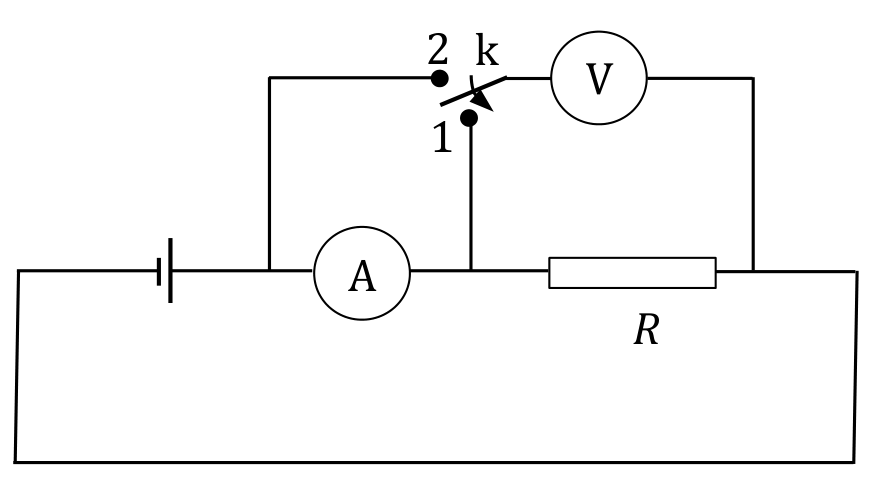
a) Derive, for each position of the switch (1, respectively 2), the measured value of the resistance (), as a function of , , and . [4 т.]
Because the amperemeter and the voltmeter are not ideal, the measured values of the resistance are different from the true value of the resistance.
b) Derive the expression of the relative variation (as a measure of accuracy) for each position of the switch. [1 т.]
Depending on the value of the resistance , a certain position of the switch is preferred over the other.
c) Based on the results obtained above, derive the range of values for the resistance for which each position of the switch is preferred. Express the results in terms of and . Using the well-known relationship between and , prove that the (practical) approximate mathematical expression for the limit between the two resistance ranges is and derive the numerical value for the coefficient . [6 т.]
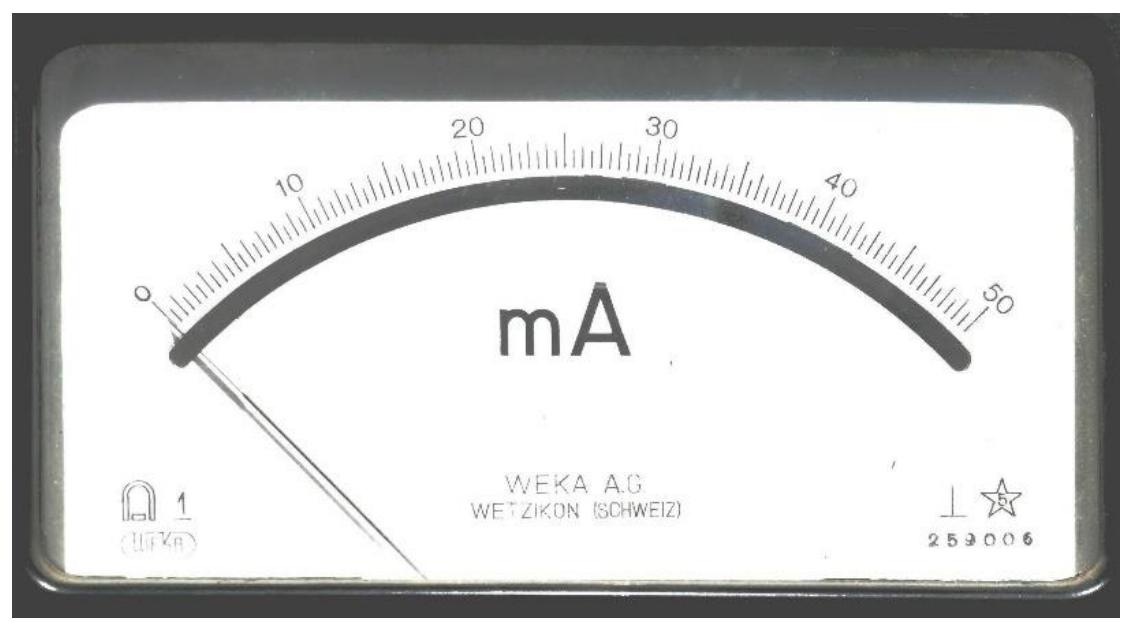
B. Using some of the circuit elements illustrated in Fig. 1, the student is assembling their own ohmmeter. The purpose is to measure an unknown resistance of a resistor. The result is shown in Fig. 2. The e.m.f. of the generator is (its internal resistance is neglected) and the internal resistance of the amperemeter is . The amperemeter is an analog one, with the scale range of and with divisions (Fig. 3). The current is indicated by a needle.
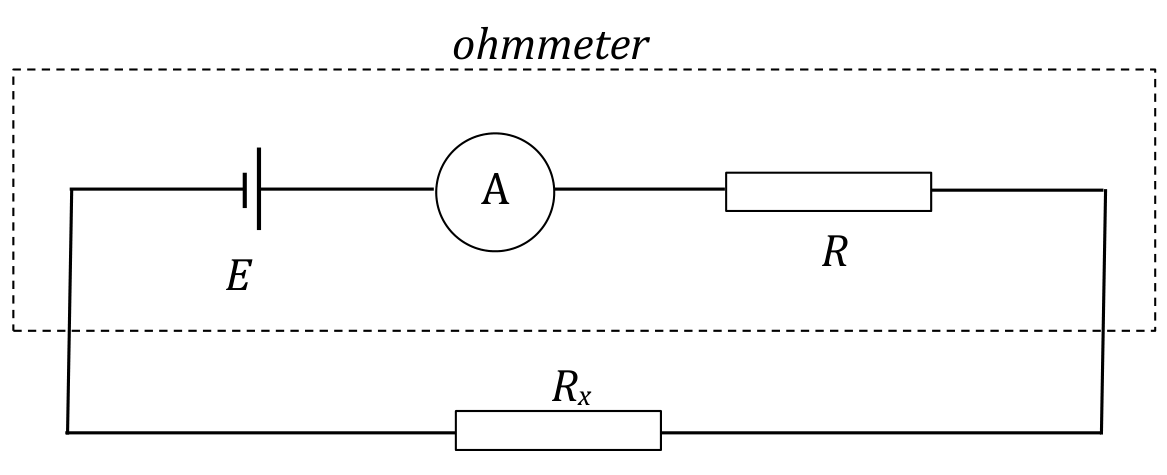
The student chooses the resistor with the resistance such that, when their ohmmeter is short-circuited, the needle indicates the maximum value on the scale.
d) Derive the mathematical formula for and calculate its numerical value. [2 т.]
When the resistor with the unknown resistance is connected to the ohmmeter, the needle deviation is divisions.
e) Express as a function of , and . [1,5 т.]
The student measures the resistances of several resistors and wonders for which of them the precision is the best possible.
f) Derive the mathematical formula for the relative error of determining . Based on this result, derive the value of for which this relative error is minimum.
Note: consider that , where is precision with which the student reads the number of divisions on the amperemeter scale. [4 т.]
g) Obtain the expressions for and for the absolute error , using derived at question f) and calculate their numerical values. [3,5 т.]
During the experiments, the student did not place the amperemeter in front of them, but to their right, such that the angle between the reading direction and the perpendicular to the scale is . The length of the amperemeter scale is and the distance between the needle and the scale’s plane is .
h) Obtain the expression for the systematic error caused by the incorrect reading of the current. [1,5 т.]
i) Calculate the maximum value of the angle such that reading error to be less than one division on the amperemeter scale. The length of the amperemeter scale is and the distance between the needle and the scale’s plane is . [1,5 т.]
Отговори
- a) Position 1: Rm = R RV/(R + RV); position 2: Rm = R + RA.
- b) Position 1: αR1 = −R/(R + RV); position 2: αR2 = RA/R.
- c) 1
- d) 170 Ω
- e)
- f) 50
- g) Rx = 180 ± 7 (Ω)
- h)
- i) 27 °
Решение
A.
a) Derive, for each position of the switch (1, respectively 2), the measured value of the resistance (), as a function of , , and . 4 p.
The measured value of the resistance is given by
1 p
where and are the indications of the voltmeter and of the amperemeter, respectively.
Switch in position 1:
1 p
such that
0.5 p
Switch in position 2:
1p
so
0.5 p
b) Derive the expression of the relative variation (as a measure of accuracy) for each position of the switch. 1 p.
Switch in position 1:
0.5 p
For this position of the switch the measured value of the resistance is smaller than the real value.
Switch in position 2:
0.5 p
For this position of the switch the measured value of the resistance is greater than the real value.
c) Based on the results obtained above, derive the range of values for the resistance for which each position of the switch is preferred. Express the results in terms of and . Using the well-known relationship between and , prove that the (practical) approximate mathematical expression for the limit between the two resistance ranges is and derive the numerical value for the coefficient . 6 p.
Position 1 of the switch is preferred when
1 p
Then
0.5 p
or
0.5 p
The solution of this inequality is
0.5 p
Since
0.5 p
if follows that , so
0.5 p
Conclusion:
When the position 1 of the switch is preferred 0.5 p
and
when the position 2 is preferred.
Since
0.5 p
the limit value of the resistance is
It follows that 1 p
0.5 p
B.
The student chooses the resistor with the resistance such that, when their ohmmeter is short-circuited, the needle indicates the maximum value on the scale.
d) Derive the mathematical formula for and calculate its numerical value. 2 p.
1 p
so
0.5 p
Its numerical value is:
0.5 p
When the resistor with the unknown resistance is connected to the ohmmeter, the needle deviation is divisions.
e) Express as a function of , and . 1.5 p.
The current is
0.5 p
so
1 p
The student measures the resistances of several resistors and wonders for which of them the precision is the best possible.
f) Derive the mathematical formula for the relative error of determining . Based on this result, derive the value of for which this relative error is minimum. Note: consider that , where is precision with which the student reads the number of divisions on the amperemeter scale. 4 p.
1 p
where
1 p
Consequently
or
1 p
This error is minimal when the function
reaches its maximal value, which happens for
0.5 p
The numerical value of is
0.5 p
which means that the most precise measurement is obtained when the needle is pointing exactly at the middle of the scale.
g) Obtain the expressions for and for the absolute error , using derived at question f) and calculate their numerical values. 3.5 p.
For , the requested value is
1 p
The absolute error is
0.5 p
Since the precision of the instrument is
0.5 p
then
0.5 p
In conclusion,
1 p
During the experiments, the student did not place the amperemeter in front of them, but to their right, such that the angle between the reading direction and the perpendicular to the scale is . The length of the amperemeter scale is and the distance between the needle and the scale’s plane is .
h) Obtain the expression for the systematic error caused by the incorrect reading of the current. 1.5 p.
Compared to the real indication, the student sees the tip of the needle deviated to the right with the amount
0.5 p
so, the error is
1 p
i) Calculate the maximum value of the angle such that reading error to be less than one division on the amperemeter scale. The length of the amperemeter scale is and the distance between the needle and the scale’s plane is . 1.5 p.
If
0.5 p
then
0.5 p
Numerically,
which gives
0.5 p
Оригинал в Архива: problems.pdf · официални решения: solutions.pdf