BPO 2023, Теория — Задача 2. Plank
5th Balkan Physics Olympiad, BPO 5 - Albania, 24 June 2023, Durrës, ALBANIA — Problems · 24 юни 2023 г.
Условие
A plank of mass M and length l lies on a smooth horizontal surface, and it can move across a rough area (i.e. along the x axis), characterized by its length l and the sliding friction coefficient , the same as the static one. The initial position of the plank is that depicted in the figure below.
A. The plank is launched with the unknown initial, horizontal speed , towards the rough area. Derive the minimum initial speed of the plank for which: [6,3 т.]

A1. it fully enters the rough area. [5 т.]
A2. it completely surpasses the rough area. [1,3 т.]
B. The plank starts from rest as illustrated in the figure above but is pulled to the right by a constant horizontal force , permanently acting on it. The purpose is to pull the plank on the rough area. [3,7 т.]
B1. Determine the minimum value of the force for the plank to completely enter the rough area. [2,5 т.]
B2. Derive the maximum value of the plank’s speed during its motion analyzed at B1, for the minimum value found for . [1,2 т.]
C. The plank starts from rest as illustrated in the figure above but is pulled to the right by a constant horizontal force , permanently acting on it. The purpose is to make the plank surpass the rough area for a minimum value of . [15 т.]
C1. Make a graph representation of the net force acting on the plank versus the coordinate x of its front end for . [3,7 т.]
C2. Determine the minimum value of the force for the plank to completely exit the rough area. It is known that the minimum value of the plank kinetic energy is very small, i.e. a very small fraction of the maximum value of the kinetic energy the plank had until it reached the minimal value. From the mathematical point of view, the fact that means that its algebraic powers higher than one can be neglected. The value of is known. [5 т.]
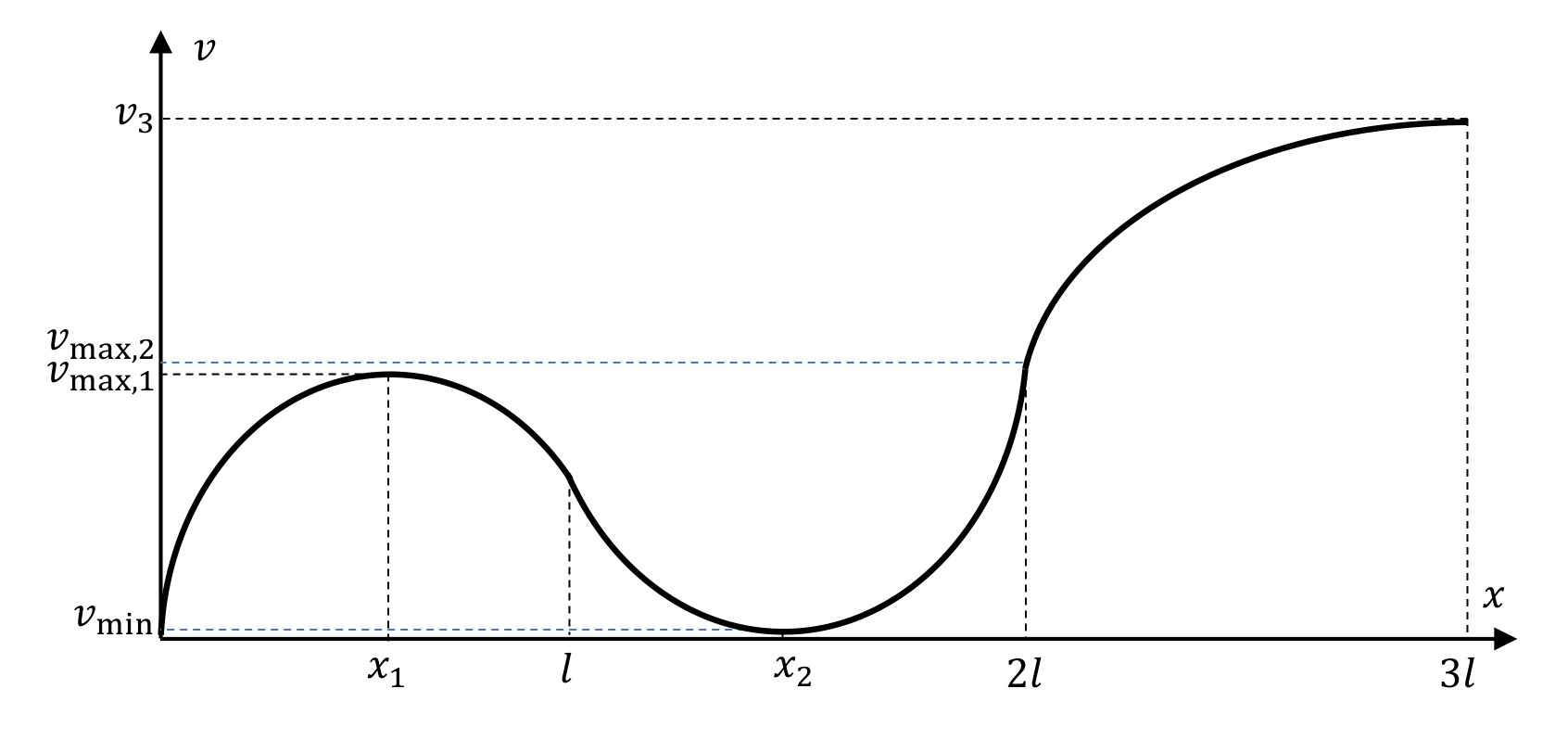
C3. Derive the maximum value of the plank’s speed during its motion on the interval . Plot the graph of the plank’ speed as a function of , for . [6,3 т.]
Note: If useful, you can use the Bernoulli’s approximation , if .
Отговори
- A1.
- A2.
- B1.
- B2.
- C1. Graph: F(x) = F0 − μMg x/l on [0, l], F(x) = F0 + μMg(x − 2l)/l on [l, 2l], F = F0 on [2l, 3l]; F0 < μMg.
- C2.
- C3.
Решение
A1. Solution: (5 p)
When the plank has a portion of length on the rough area, the friction force acting on it is:
(1 p)
Graphing this force (1 p), we get the adjacent representation, the area below which is the work of the friction force.
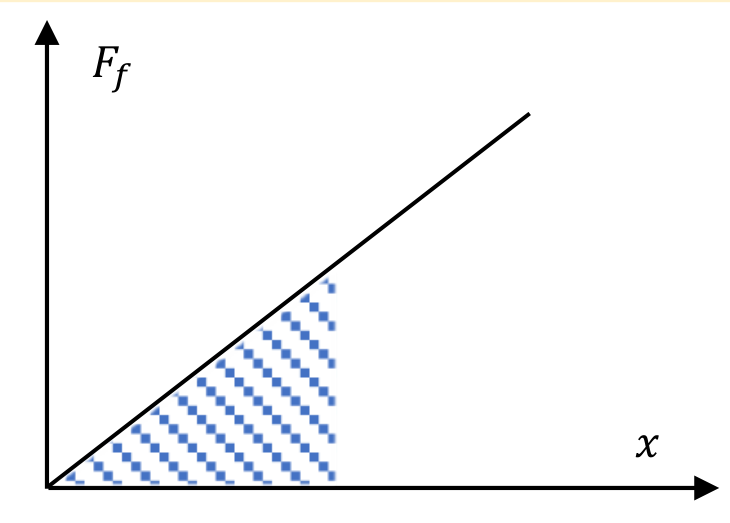
So, writing the kinetic energy theorem for the plank, it reads:
(1 p)
from which it follows that
(0.6 p)
This speed is minimal when
(0.7 p)
so
(0.7 p)
A2. Solution: (1.3 p)
For the plank to completely exit the rough area, the energy lost by friction doubles (1 p), so
(0.3 p)
B1. Solution (2.5 p):
In this case, the kinetic energy theorem is
(1.5 p)
Again, the force has the minimum value when
(0.5 p)
so
(0.5 p)
B2. Solution (1.2 p):
The plank’s speed is a quadratic function of , having the maximum value when
(0.5 p)
For this value, the maximum speed is
(0.7 p)
C1. Solution (3.7 p):
For the plank’s entrance on the rough area, i.e. , the net force acting on it is
(0.8 p)
For the plank’s exit from the rough area, i.e. , the friction force acting on it is
(0.8 p)
so, the net force acting on it is
(0.4 p)
The graph is depicted below (1.2 p): (for each value on the graph, the quantities represented on the axis and each line segment, there will be given 0.1 p).
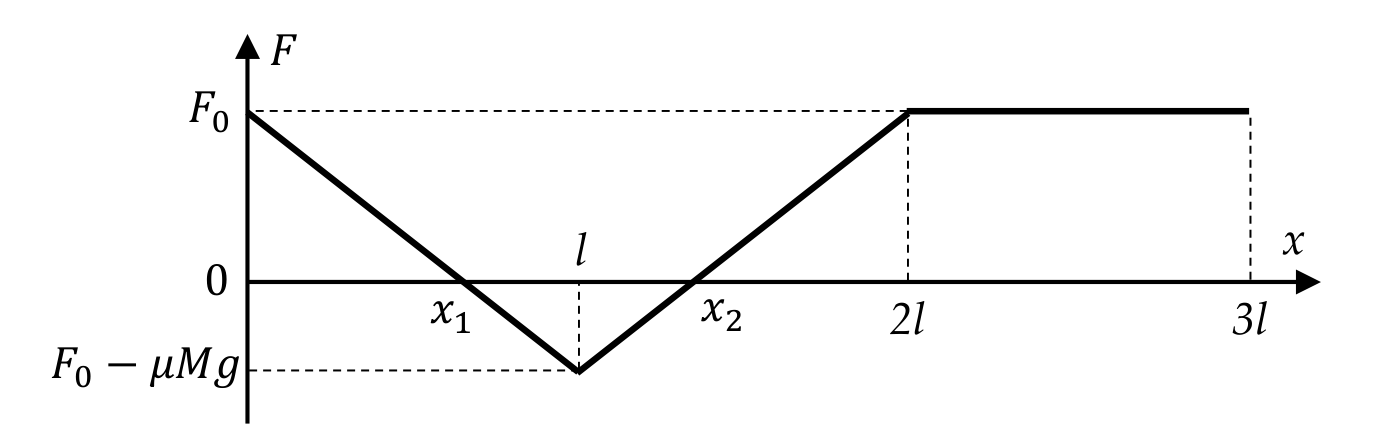
If is to be minimized, the lowest point on the graph should be below zero, which means that
(0.5 p)
C2. Solution (5 p):
The maximum value of the kinetic energy is reached when
(0.5 p)
and the minimum value when
(0.5 p)
The kinetic energy theorem gives:
(0.8 p)
and
(0.7 p)
(0.6 p)
Since
(0.6 p)
from the above two equations it follows that
(0.7 p)
(0.6 p)
Note: If , then the speed and acceleration are concomitantly zero, so the plank will finish its motion in , which is not what the problem asks.
C3. Solution (6.3 p):
For , the maximum speed of the plank is
(0.7 p)
so
(0.5 p)
For , the maximum speed of the plank is , which is given by the kinetic energy theorem:
(0.8 p)
but
(0.6 p)
so
(0.6 p)
From here we get
(0.7 p)
which is the maximum speed reached by the plank on the considered interval.
For plotting the requested graph, the value of the plank’ speed for is needed, which can be obtained again, using the kinetic energy theorem:
(0.7 p)
(0.7 p)
The graph is represented below (1 p):

Оригинал в Архива: problems.pdf · официални решения: solutions.pdf