BPO 2025, Теория — Задача 2. Star wars
BPO7 Problems 26-30 June 2025, Ohrid · 26 юни 2025 г. · 25 т.
Условие
An artificial satellite with mass , where is the mass of the Earth, orbits the Earth on an elliptical trajectory, having the semi-major axis , where is the mean Earth radius, , and eccentricity . Also known is the numerical value of the first cosmic speed, .
a) Determine the speed of the satellite at apogee (point A) () and at the perigee (point B) (). [8 т.]
A projectile with the mass , where , launched from the Earth, moves radially and undergoes a plastic collision with the satellite, when the satellite is at its apogee. After the collision, the eccentricity of the new orbit of the satellite becomes .
b) Determine the tangential speed of the satellite immediately after the collision. [2 т.]
c) Determine the ratio of the satellite energy immediately after the collision with the projectile to the satellite energy immediately before the collision. [7 т.]
d) Determine the radial speed of the satellite immediately after the collision. [3 т.]
e) Determine the launching speed of the projectile. [5 т.]
Notes:
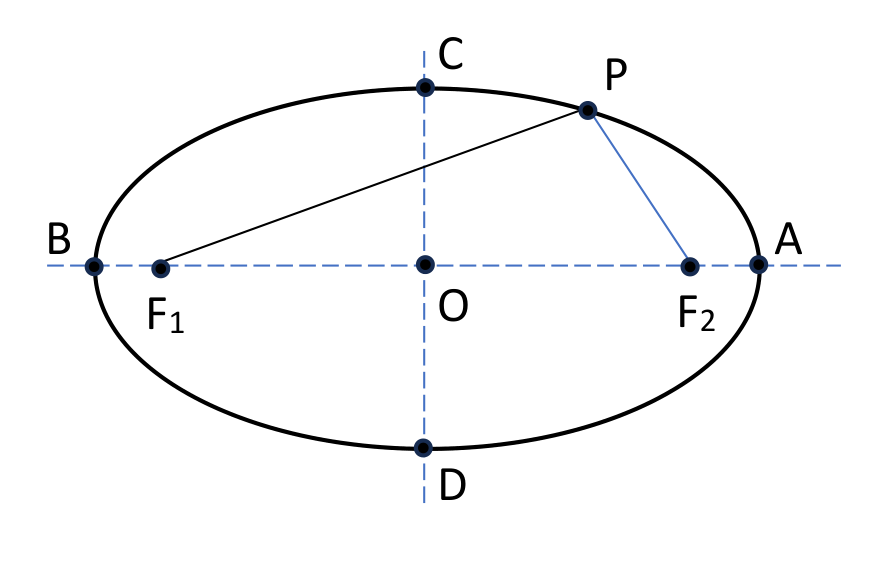
An ellipse is the plane curve represented in the figure, for which , for any point P . The point O is the center of the ellipse and the fixed points F are the ellipse’s focal points. If the Earth is in F, for example, then A is called the apogee and B – the perigee. Other important quantities for an ellipse are: – semi-major axis, – semi-minor axis, – the linear eccentricity, while the nondimensional parameter characterizing the ellipse is , called the ellipse eccentricity.
For a satellite – Earth system, there is a physical quantity called angular momentum with respect to the center of the Earth, which is conserved. Its conservation proves the second law of Kepler. Mathematically, the angular momentum has the magnitude (see the drawing below):
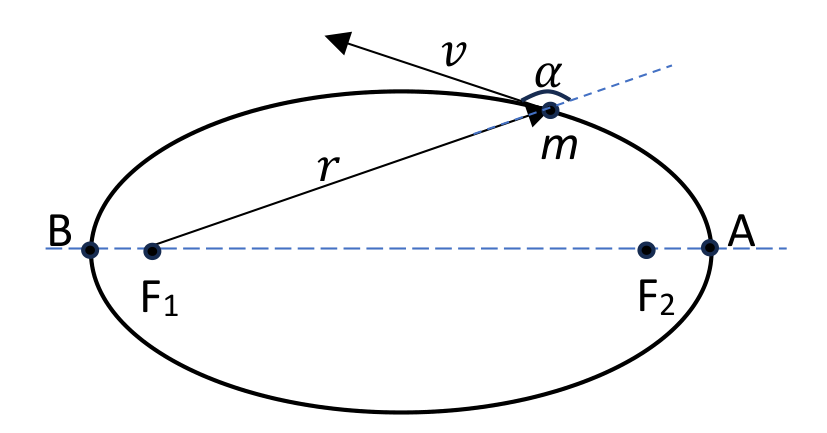
where is the satellite mass, – its speed, and – the distance from the center of the Earth (F) to the satellite.
Отговори
a) va = vI/3 ≅ 2.64 km/s, vp = vI = 7.91 km/s
b) 1.98 km/s
c) 1.38
E'/E = 112/81 = 1,38 (printed with a decimal comma).
d) 5.06 km/s
e) 22.5 km/s
Решение
a) (8 points) Determine the speed of the satellite at apogee () and at the perigee ().
Solution:
The first cosmic speed is the launching speed of a body from the Earth surface to make it orbit the Earth, at its surface:
(0.6 x 2)
where is the gravitational constant, so
(0.4)
The energy of the satellite on its orbit is
(0.8)
At the apogee
(0.7 x 2)
where
(0.4 x 2)
so
(0.5)
or, using the first cosmic speed,
(0.4)
Numerically,
(0.3)
At perigee, from angular momentum conservation (or from energy equation )
(1.0)
where
(0.4)
Finally,
(0.5)
Numerically,
(0.3)
b) (2 points) Determine the tangential speed of the satellite immediately after the collision.
Solution:
From momentum conservation on the tangential direction
(1.4)
Numerically,
(0.3 x 2)
c) (7 points) Determine the ratio of the satellite energy immediately after the collision with the projectile to the satellite energy immediately before the collision.
Solution:
The satellite energy before the collision is
From energy and angular momentum conservation, it follows that
(5.0)
where
(0.5)
[derivation:
(1.0)
and
(0.5)
at the apses. Eliminating between these equations, one gets
or
(0.5)
The solutions of this quadratic equation are
(0.5)
Since
(0.5 x 2)
and
(0.5 x 2)
then
(0.5)
end of derivation]
So
(0.7)
Under these conditions
(0.5)
Numerically,
(0.3)
d) (3 points) Determine the radial speed of the satellite immediately after the collision.
Solution:
Since
(0.5)
then
(1.0)
Under these conditions,
(0.7)
or
which gives
(0.5)
Numerically,
(0.3)
e) (5 points) Determine the launching speed of the projectile.
Solution:
From momentum conservation for the collision, on the radial direction, it follows that
(1.0 + 0.5)
or
(0.5)
The energy conservation for the projectile before the collision is written
(1.5)
so
(0.7)
Finally,
(0.5)
Numerically,
(0.3)
Оригинал в Архива: problems.pdf · официални решения: solutions.pdf