Балкански 2004, Теория — Задача 1. The Millikan experiment
Concours Général de Physiques “Minko Balkanski” — May 15th 2004 · 15 май 2004 г.
Указания
The two problems are unrelated to each other.
All the answers must be given in English or in French. The clarity and precision will be taken into account for the final note.
The exam is 4 hours long.
Условие
The electrical charge of the electron is a fundamental physical constant. It was the American physicist Robert Andrews Millikan who measured it for the first time in 1909 and showed that all charge appears only in multiples of . For his experiments Millikan was awarded the Nobel Price in 1923.
In this problem we study a simplified version of the original Millikan experiment, shown in the figure below :
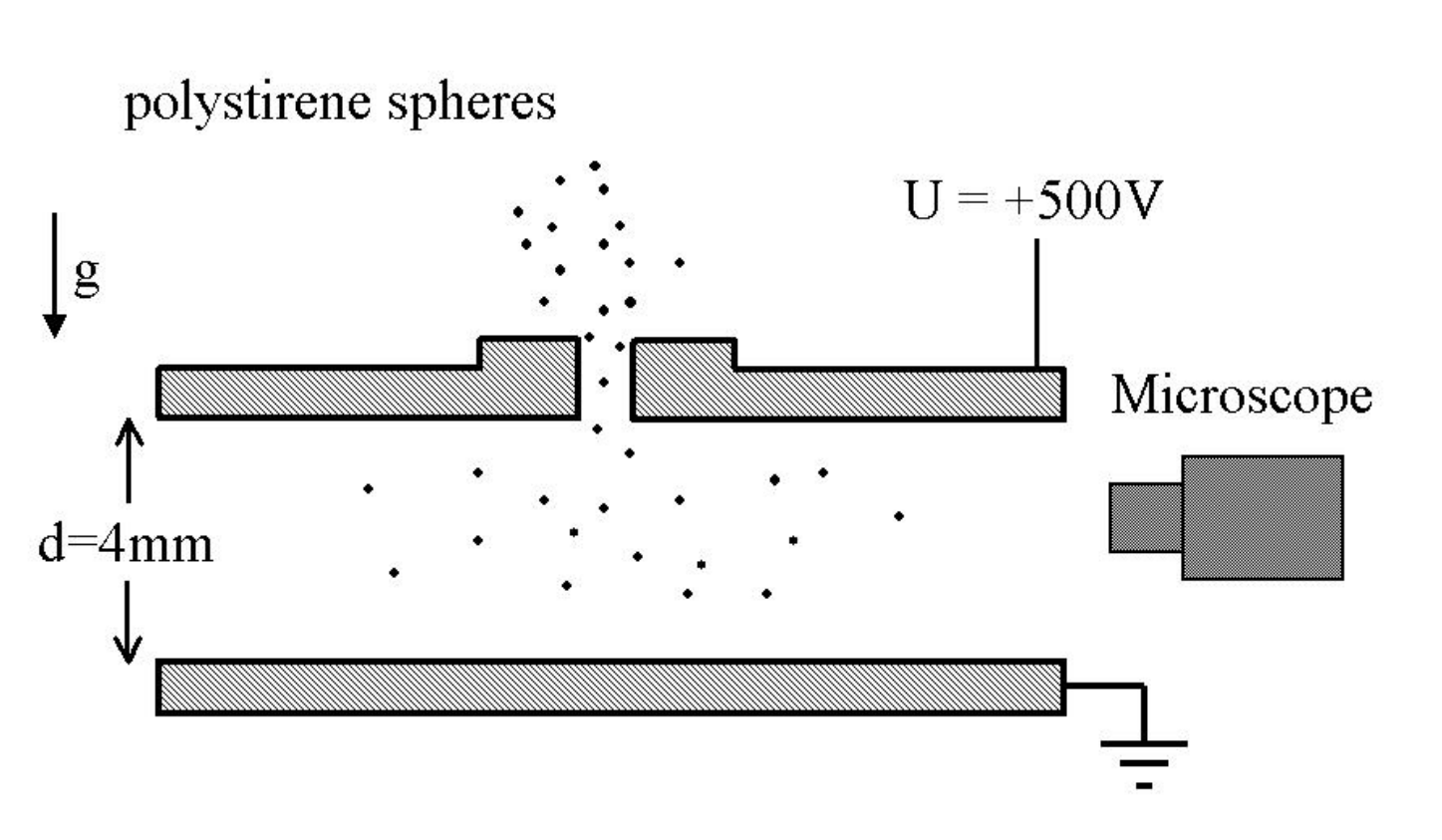
Very small polystyrene spheres (of radii up to several microns) are injected between the plates of a planar capacitor. The spheres are observed with a microscope. The distance between the capacitor plates is and the applied voltage is noted by . The spheres could became charged owing to the friction in the air.
1. The applied tension is zero. Consider a sphere of radius . We recall the Stokes’s law :
describing the friction force applied to a spherical body moving in a medium of viscosity .
1.a Compute the final velocity of the sphere as a function of - the density of the polystyrene, , and - the intensity of the gravitational field.
What is the direction of the motion of the sphere ?
1.b Cast the relation between the radius and the velocity under the form :
with a constant that you will compute numerically. Data : , SI units, .
2. A voltage is now applied. The sphere of the previous question is now moving upwards, with a new final velocity .
2.a What is the sign of the electrical charge of the sphere ? Why ?.
2.b Analyse the new movement of the sphere with the Newton’s law. Compute the velocity as function of the data and - the charge of the sphere. We recall that the distance between the capacitor plates is .
2.c By eliminating the force of gravity in the expressions obtained in 2.b show the following relation :
The constant should be expressed as a function of , and .
2.d What is the numerical value of in SI units ?
3 The measures of and are repeated with different spheres. The radii of the spheres are unknown. The following chart is obtained :
| Experiment n | radius (microns) | charge C | ||
|---|---|---|---|---|
| 1 | 4,3 | 10,9 | ||
| 2 | 2,6 | 10,2 | ||
| 3 | 7,9 | 10,7 | ||
| 4 | 7,5 | 11,5 | ||
| 5 | 5,6 | 3,3 | ||
| 6 | 5,6 | 7,7 | ||
| 7 | 8,7 | 5,4 | ||
| 8 | 12,5 | 5,1 | ||
| 9 | 3,9 | 11,9 | ||
| 10 | 2,2 | 12,0 | ||
| 11 | 7,9 | 7,0 | ||
| 12 | 11,5 | 3,8 |
3.a. Complete the columns ”” et ”” with the help of previous results. (Beware the units !)
3.b. Represent each measure as a point in a co-ordinate system with the ”” axis being the radius, and ”” axis being the charge.
3.c. What do you observe ? What is the value of the ”elementary charge” ? What is the minimal charge in these measures ?
3.d. Instead of going upwards, some of the spheres continue their downward motion. What could be said about the charge of those spheres ? Is it possible that spheres charged like in 2.a move downwards ?
3.e. The air density is . Estimate the force of buoyancy. Why is this force not taken into account ?
Решение
Внимание: Непълно решение
В архива няма официално решение на тази задача.
Оригинал в Архива: CGP_2004_en.pdf