Балкански 2005, Теория — Задача 1. LEDs for general lighting
Concours Général de Physiques “Minko Balkanski” — 7 may 2005 · 7 май 2005 г.
Указания
All three parts of the problem are independent.
The final note takes into account the clarity and the precision of the work. You should compose in English.
The test lasts 4 hours.
Условие
A LED is a semiconductor device that transforms electric current into light. Today, it is believed that LEDs are the future to energy saving lighting. In this problem, it is aimed to estimate, by simple models, the efficiency of a LED and to compare it to that of a simple incandescent lamp.
The LED is modeled by the following drawing:
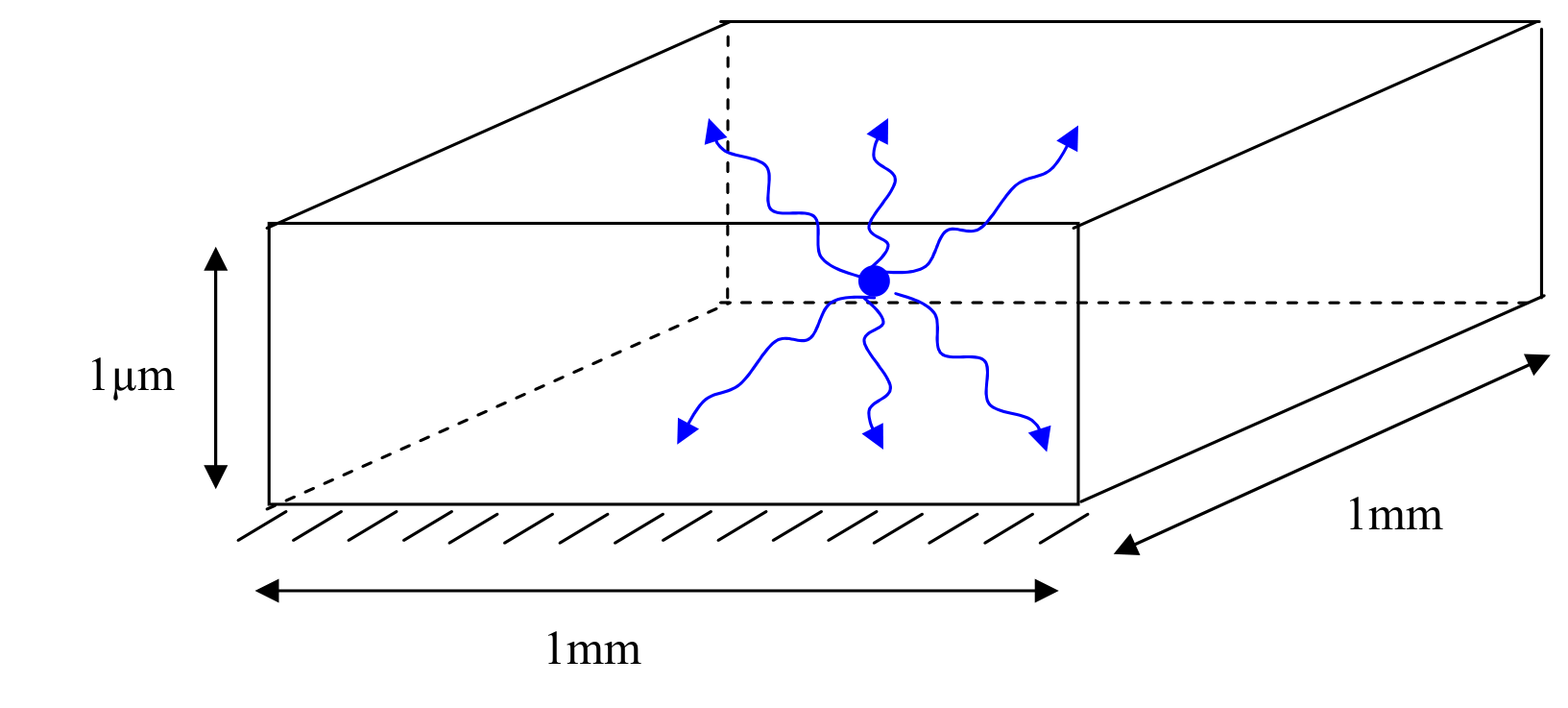
The dimensions of the LED are 1mm × 1mm × 1µm. The light ( in this simple model ) is generated homogeneously in a point source in the middle of the LED. The LED is formed by a single crystal of GaN with the following physical properties:
| Physical properties of GaN | Value (in SI units) |
|---|---|
| Refractive index at 410nm (n) | 2.5 |
| Mass density (D) | |
| Specific heat (C) | |
| Solidification temperature | 2500°C |
Remind that the energy of a photon at frequency is given by the formula , where . The speed of light is .
It is considered that any photon touching the lateral sides of the LED is immediately absorbed, that the bottom of the LED is perfectly reflecting and that the light can escape only from the top of the LED.
Part 1: Description of a simple LED
1. Explain what happens when a light beam goes from a medium with refractive index to a medium with refractive index .
2. If , give the condition for the beam to pass from the first to the second medium.
3. Evaluate what part of the light generated in the LED goes out of it.
4. Light is created by injecting current into the LED. Considering that each injected electron gives rise to 1 photon, write the relation between the power of the outgoing light and the injected current.
5. Calculate the absorbed power.
Let’s consider that the LED has a resistance of 12Ω and that it functions as a simple resistor.
6. Calculate the total power transformed into heat for an operation voltage of 12V.
7. Calculate the speed of temperature increase in the absence of any heat dissipation. How long will the LED last before melting down?
Normally any hot body radiates power following the Stefen-Boltzmann law : where T is the temperature of the body, S the surface of the body and is the constant of Stefen-Boltzmann.
8. Calculate the equilibrium temperature of the LED.
9. Compare the thermally radiated power to the power emitted by the operation of the LED.
10. For which surface the temperature of the LED will be equal to 27°C? What can you suggest to cool the LED?
Part 2: The classic incandescent lamp
The classic incandescent lamp consists of a tungsten wire with a resistance of 500Ω, length of 1m and circular section of 20µm diameter. The wire is polarized at 230V
1. What is the electrical power consumed by the lamp?
2. What is the temperature of the wire?
3. Calculate the emitted power of visible light, knowing that at this temperature 90% of the light is invisible. What is the efficiency of the lamp? Compare with the efficiency of the LED.
Part 3: Improved LED and white LED
The LED can be improved by treating the top surface in such a way, that any photon reaching it goes out from the LED.
1. Recalculate under this condition the questions 3 to 10 of the Part 1.
2. How does this treatment improve the LED?
3. In order to create white light a colour converting layer is deposited on top of the improved LED. The efficiency of the colour converting layer is 80%. Evaluate what power has to be injected into a white LED, in order to emit the same optical (visible) power like the lamp from Part 2.
4. How many white LEDs operating at 12V are necessary to emit at least as much visible light as the lamp from part 2.
5. The price of a white LED is 7€, compared to the price of a lamp which is 50cts. A lamp has a lifetime of 1000h compared to the LED which has a lifetime of 20000h. Is it economically interesting to use LEDs for lighting? What should be the price of the LED in order to have the same cost for LED lighting and incandescent lamp lighting?
Решение
Внимание: Непълно решение
В архива няма официално решение на тази задача.
Теми и трудност
Трудност: неоценена.
Оптика · Топлинни явления · Електричество · Пречупване · Топлинно излъчване · Електрична мощност и нагряване
Предпоставки: Гимназиална подготовка
Оригинал в Архива: CGP_2005_en.pdf